



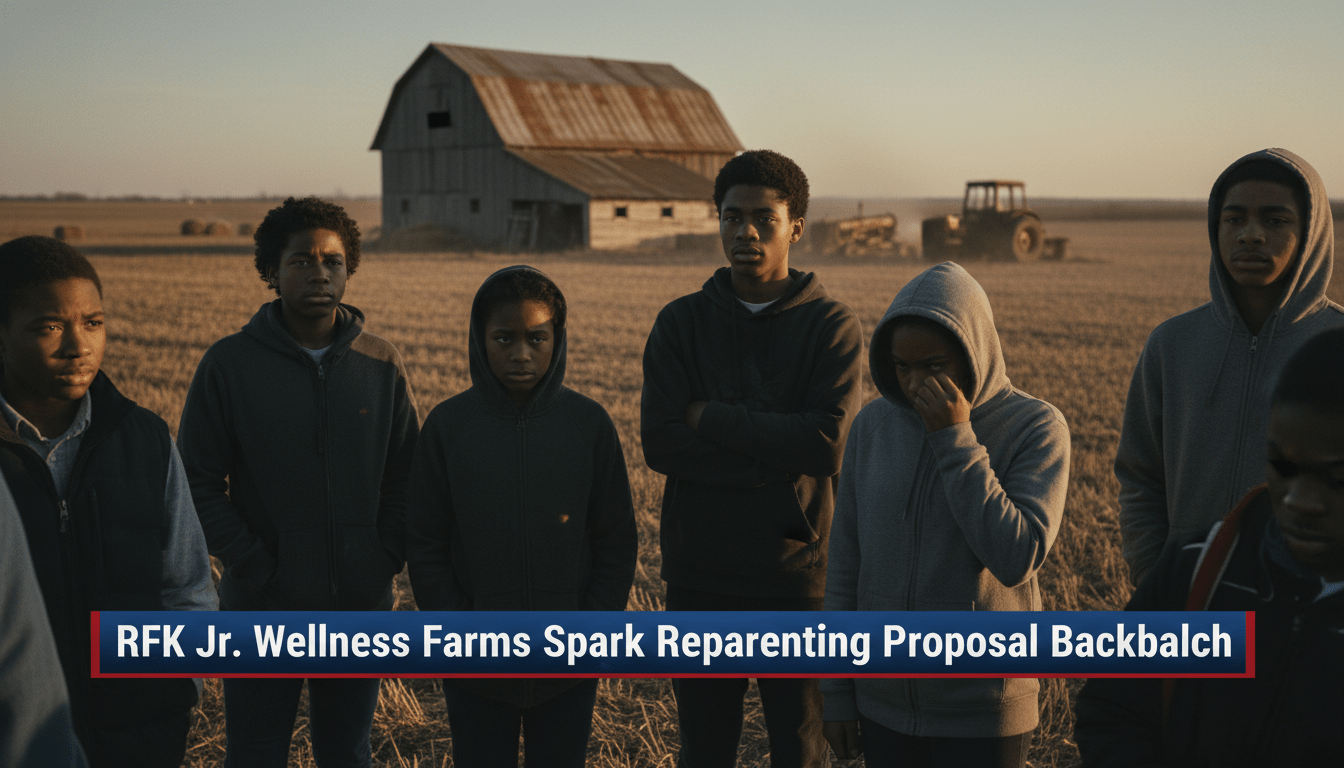
RFK Jr. Wellness Farms Spark Reparenting Proposal Backlash
By Darius Spearman (africanelements)
Support African Elements at patreon.com/africanelements and hear recent news in a single playlist. Additionally, you can gain early access to ad-free video content.
The year 2026 brought a fiery clash to the United States Senate floor. Under the administration of current President Donald Trump, Health Secretary Robert F. Kennedy Jr. introduced a sweeping new policy. He proposed a network of federal “wellness farms” aimed at alienated youth. This proposal sparked immediate and fierce backlash from civil rights advocates. The plan focuses heavily on Black youth facing addiction and mental health challenges. It promises a return to nature and manual labor.
However, many lawmakers and activists see a much darker picture. They view the plan as a dangerous step backward. Senator Angela Alsobrooks led the charge against the proposal during an April 2026 hearing. She questioned the motives behind placing marginalized youth in isolated rural settings. The debate centers on a single, controversial concept. The administration refers to this concept as “reparenting.”
Critics argue this rhetoric echoes centuries of harmful policies. The United States has a long history of removing marginalized children from their families. The state often claims these removals are for the greater good. This deep dive explores the history behind these headlines. It examines the deep roots of paternalistic care. It also highlights the modern fight for dignified medical treatment.
A Contentious Senate Showdown
During a high-profile Senate hearing, Senator Angela Alsobrooks challenged Secretary Kennedy directly. Alsobrooks represents Maryland as a Democrat. She brings a background as a former prosecutor and county executive. She previously invested twenty million dollars into dignified behavioral health facilities. She argued that isolated rural farms do not represent modern medical care. Her constituents demand community-integrated support instead of isolation.
Kennedy defended his signature health agenda. He claimed that the current medical system has failed young people. He specifically highlighted alienated youth struggling with despair. His proposal would redirect federal funds to create rural healing camps. He suggested funding these facilities through a massive federal tax on legalized cannabis. This tax could generate billions of dollars in revenue. However, civil rights groups immediately raised alarms. They questioned the federal government dictating how families should raise their children (salon.com, wrvo.org).
The proposal is currently a major focus within the Department of Health and Human Services. However, the plan faces significant roadblocks. Medical groups strongly oppose the model. Civil rights organizations warn of severe constitutional violations. The debate highlights a fundamental disagreement over public health. The clash reveals a divide between community-based care and state-directed isolation. This conflict is rooted in America’s difficult past regarding racial equity in healthcare.
Foster Care Placement Disparity
Likelihood of state removal by racial demographic
What Are Wellness Farms?
The Wellness Farm proposal outlines a multi-year residential experience. It targets youth dealing with mental health challenges and addiction. The model requires residents to live without digital distractions. They must surrender their cellphones and access to screens. Participants live in large, peer-led therapeutic communities. The primary focus is behavioral modification and manual labor. Clinical therapy takes a back seat to agricultural work (substack.com).
Kennedy frequently criticized modern psychiatric treatments during his 2024 campaign. He made a controversial claim regarding Black youth. He alleged that every Black kid is standardly prescribed Adderall, SSRIs, and benzodiazepines. Selective Serotonin Reuptake Inhibitors are common antidepressants. Benzodiazepines are anti-anxiety medications. Kennedy claimed these medications induce violence in young people. He suggested that wellness farms could help patients detox. They would learn to grow organic food instead of taking medication.
Medical experts strongly disagree with this approach. They argue that psychiatric medications provide essential medical care. Forcing patients to stop taking prescribed drugs can be highly dangerous. Mental health professionals call the proposal impractical. They stress that complex neurological conditions require clinical oversight. Growing vegetables does not cure severe depression or chemical imbalances. The substitution of farm labor for medicine concerns many health advocates.
The San Patrignano Influence
The proposed federal wellness farms draw heavy inspiration from Europe. Kennedy has repeatedly praised the San Patrignano community in Italy. This facility operates as a long-term, labor-based recovery program. It functions as a sprawling, village-like therapeutic community. Residents typically stay for three to four years. They live in dormitory-style suites. They perform unpaid labor in various agricultural sectors. These sectors include winemaking, cheesemaking, and leatherwork (thecut.com).
The San Patrignano model strictly rejects all addiction medications. It relies entirely on a drug-free, abstinence-only philosophy. The community does not employ traditional medical professionals. Instead, recovery relies on intense peer pressure and strict behavioral rules. While some supporters praise its high success rates, the facility faces serious scrutiny. Vincenzo Muccioli founded the community in the late twentieth century. He faced severe legal charges in the past. These charges involved chaining and imprisoning residents who attempted to flee (wikipedia.org, salon.com).
International observers have documented extreme “tough love” measures at the facility. Human rights groups express deep concern over these disciplinary tactics. Critics warn against replicating this model in the United States. They fear that punitive measures will be rebranded as wellness. Operating without strict medical oversight opens the door to abuse. Unpaid labor combined with physical restraint creates a dangerous environment for vulnerable youth.
The Reparenting Rhetoric Explained
The term “reparenting” stands at the center of the controversy. Reparenting originated as a specific psychotherapy concept. It involves a therapist helping a client heal childhood wounds. Kennedy adapted this clinical term for federal policy. He suggested that alienated youth require state intervention to reconnect with authority. He proposed that they spend several years on rural farms. They would learn basic social skills away from modern society.
The Department of Health and Human Services attempted to clarify the policy. An official statement claimed the term aimed to address rising despair. However, civil rights advocates see a massive red flag. The rhetoric suggests that Black families are inherently deficient. It implies that parents cannot properly raise their own children. State-appointed mentors would step in to provide discipline. This concept deeply offends many community leaders (ebsco.com).
Representative Terri Sewell publicly questioned the legality of the plan. She challenged the federal government taking Black children away from their families. She highlighted the dangerous precedent of state-sponsored family separation. Historically, paternalistic logic justified tearing families apart. The state often claimed it knew what was best for marginalized groups. The rhetoric of reparenting revives these painful historical memories.
Historical Echoes of Forced Labor
The concept of using rural, labor-intensive environments for reform is not new. This model has roots deep in the Reconstruction era. Authorities frequently used agricultural labor to control marginalized populations. Following the Civil War, the state needed a cheap labor force. Leaders enacted Vagrancy laws to criminalize unemployment and loitering. These laws specifically targeted newly freed Black people. This system fueled the continued to face involuntary servitude across the South.
Convict leasing utilized a loophole in the Thirteenth Amendment. This loophole allows forced labor as punishment for a crime. Southern states leased predominantly Black prisoners to private companies. They worked in mines, on railroads, and on plantations. The conditions were brutally harsh and often deadly. In places like Alabama, convict leasing generated up to seventy-three percent of state revenue by 1898. Lessees had no financial interest in the survival of the workers. Mortality rates in these camps sometimes exceeded those under slavery (eji.org).
The rhetoric of reparenting also mirrors the logic behind Indian Boarding Schools. From 1819 to 1969, the government funded schools designed to assimilate Indigenous children. The state removed children from their families by force. Authorities claimed they needed to civilize the children for their own good. The schools stripped youth of their cultural identities and languages. This legacy left deep generational trauma across communities. Modern critics see terrifying parallels in the current wellness farm proposal (wikipedia.org).
The Medical Care Gap
The alarm raised by civil rights advocates connects directly to modern data. Black communities face a persistent gap in quality healthcare. Studies show that Black patients are eight percent less likely to access medical treatment. Furthermore, fourteen percent of Black patients report experiencing racial discrimination from doctors. This gruesome history of medical experimentation and bias fuels intense distrust of state-run health facilities (medium.com).
Mental health disparities remain particularly striking. Black adults have high rates of mental health-related visits to the Emergency Department. However, hospitals are less likely to admit or transfer them for long-term psychiatric care. White patients receive greater access to therapeutic interventions. Medical professionals often prescribe chemical sedation for Black patients instead of holistic treatment. The system frequently denies Black individuals the sustained clinical care they desperately need.
Child welfare data reveals similar racial inequities. The state disproportionately removes Black children from their homes. Black children are roughly twice as likely to enter the foster care system as white children. Caseworkers frequently cite poverty-based neglect rather than actual abuse. Lack of housing or food is treated as a parenting failure. The state punishes families for systemic poverty instead of providing resources. A wellness farm model threatens to expand this pipeline of family separation.
Institutionalization Versus Healing
A massive divide exists between institutionalization and genuine medical care. Evidence-Based Treatment relies on clinical interventions proven through scientific research. Medication-Assisted Treatment stands as the gold standard for opioid addiction. This method combines approved medications with professional counseling. Studies prove that this treatment reduces overdose deaths. It also improves patient retention in recovery programs. Medical experts stress that modern science saves lives (nih.gov, stanford.edu).
The wellness farm model completely rejects this scientific consensus. It isolates young people from their communities and schools. Advocates argue this creates a separate but equal healthcare track. It forces marginalized youth into labor camps instead of clinics. Community-based behavioral health centers focus on integrating patients back into society. They teach patients how to cope within their natural environments. Isolation makes reentry into society incredibly difficult.
History provides examples of failed isolation models. The United States operated federal narcotic farms between 1935 and 1975. Facilities in places like Lexington, Kentucky combined detox with labor therapy. Patients worked on massive farming operations. History shows these models largely failed. They prioritized manual labor over sustainable medical care. Patients experienced incredibly high relapse rates once they left the farms. Isolation simply delays the necessary work of community integration (uchicago.edu).
The Illusion of Voluntary Care
Proponents of the wellness farms insist the program remains entirely voluntary. However, the details of the policy reveal a dual-track system. The proposal includes replacing rural prisons with these recovery farms. Individuals convicted of nonviolent drug offenses face a difficult choice. They can serve a standard prison sentence or volunteer for the farm. Critics strongly argue that this creates a system of coerced care. The threat of incarceration makes the choice an illusion (weku.org).
Low-income defendants frequently lack the resources to fight drug charges. The criminal justice system uses plea deals to process cases quickly. Many defendants will choose the farm out of pure fear. This funnels vulnerable populations directly into the labor programs. It marks a return to the political shifts of the era of mass incarceration. The state uses the justice system to mandate behavior.
During an interview, Kennedy outlined how individuals could choose to enroll. However, he followed up with concerning statements. He claimed every Black kid prescribed certain medications would have a chance to get reparented. This language suggests a systematic targeting of specific communities. Advocates warn that such programs inevitably shift from voluntary to mandatory. They point to the historical misuse of state power. Marginalized communities usually bear the brunt of experimental policies.
The True Cost of Paternalism
Paternalism involves authority figures interfering with a person’s liberty. The state claims it limits freedom for the person’s own good. Social science distinguishes between soft and hard paternalism. Soft paternalism influences behavior through positive incentives. Hard paternalism uses state coercion and strict mandates. Critics view the wellness farm proposal as an extreme form of hard paternalism. The state assumes that certain citizens cannot make rational choices (njsbf.org).
History proves that paternalistic institutions frequently breed severe abuse. The Florida School for Boys operated as a reformatory labor camp. It was also known as the Dozier School. It remained open for over a century. The state claimed it was reforming troubled youth. However, forensic investigations revealed a horrifying reality. Investigators identified at least fifty-five sets of remains buried on the grounds. Black youth suffered a disproportionate number of severe beatings and forced labor assignments (eji.org).
The wellness farm proposal fails to address the root causes of addiction. It ignores poverty, systemic racism, and failing public schools. State-run farms do not fix crumbling infrastructure in urban neighborhoods. Forcing youth into rural labor does not provide better educational opportunities. The focus remains entirely on punishing the individual. It shifts the blame away from societal failures. Advocates argue that healing must happen within the community, not outside of it.
A Push for Evidence-Based Healing
The backlash against Secretary Kennedy is a reaction to a repeating historical pattern. For Black communities, reparenting on state-run farms is not medical innovation. It represents the revival of a deeply flawed system. The United States has continuously prioritized control over genuine family integrity. Policies that mandate physical labor as a cure for medical illness belong in the past. Modern public health demands dignity, science, and compassion.
Civil rights leaders continue to push back against the proposal. They demand investments in urban health centers. They call for greater access to Evidence-Based Treatment. Communities need mental health professionals who understand cultural nuances. True healing requires keeping families together. Providing resources directly to struggling neighborhoods builds lasting resilience. The fight for equitable healthcare remains a defining civil rights battle of the decade.
Senator Alsobrooks summarized the frustration of millions during the hearing. She demanded that the government treat marginalized youth as patients, not laborers. The pushback serves as a powerful reminder. The Black community remembers the history behind the headlines. Activists refuse to let paternalism disguise itself as progress. The focus must remain on elevating community health standards. Isolation and forced labor have no place in modern medicine.
About the Author
Darius Spearman is a professor of Black Studies at San Diego City College, where he has been teaching for over 20 years. He is the founder of African Elements, a media platform dedicated to providing educational resources on the history and culture of the African diaspora. Through his work, Spearman aims to empower and educate by bringing historical context to contemporary issues affecting the Black community.
