


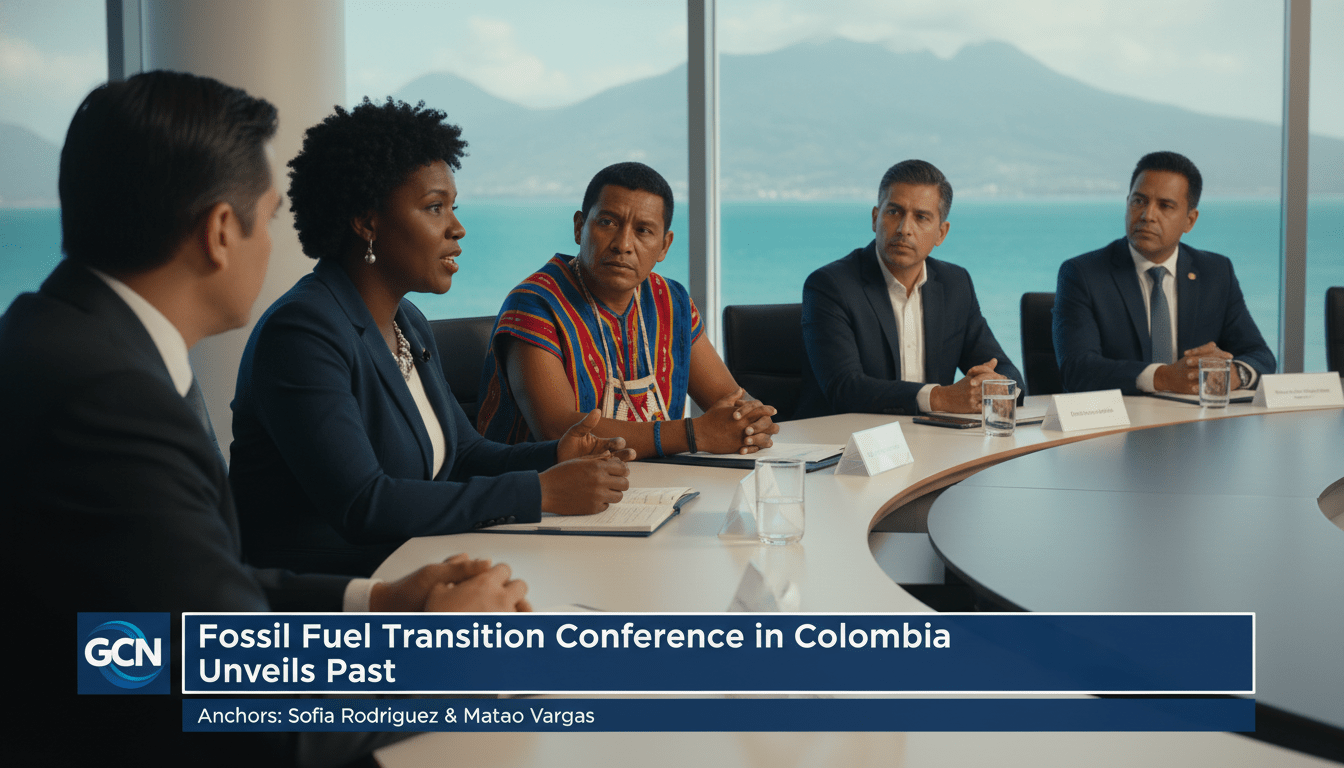
Fossil Fuel Transition Conference in Colombia Unveils Past
By Darius Spearman (africanelements)
Support African Elements at patreon.com/africanelements and hear recent news in a single playlist. Additionally, you can gain early access to ad-free video content.
A Historic Summit in Santa Marta
Leaders from around the globe are currently gathering in South America. They are attending the Fossil Fuel Transition Conference in Colombia. The event runs from April 24 to April 29, 2026. This summit takes place in the coastal city of Santa Marta. Representatives from over 60 nations are participating. These leaders come from Nigeria, Brazil, and Pacific island states. Indigenous Wayuu leaders and African diaspora advocates are also present. They demand an end to harmful resource extraction. The event focuses on completely phasing out coal, oil, and gas. Previous global meetings only tried to manage carbon emissions. This new approach seeks to eliminate fossil fuels entirely (nacla.org, fossilfueltreaty.org).
The governments of Colombia and the Netherlands co-host this conference. They aim to center the voices of heavily impacted communities. Before the official meeting, activists held a “People’s Summit.” The people created a detailed roadmap for environmental action. This plan prioritizes reparations for frontline communities. A major focus is establishing a new Fossil Fuel Non-Proliferation Treaty. Activists also demand relief from mounting international debt. Communities of color have endured environmental damage for decades. Therefore, this summit represents a significant turning point in global environmental policy (fossilfueltreaty.org).
The Roots of Harmful Extraction
The choice of Santa Marta as the host city holds deep symbolic meaning. This region sits near the departments of La Guajira and Cesar. These areas have suffered from nearly 50 years of conflict. The trouble began in 1976. The Colombian government signed a contract to develop the Cerrejón mine. Officials partnered with Exxon and the state company Carbocol. This massive project quickly disrupted local life. The government treated Indigenous and Afro-descendant lands as empty spaces. They believed the land existed only for corporate profit (mongabay.com, brookings.edu).
In 1986, the village of Manantial suffered complete destruction. This event marked the first community destroyed for mine expansion. State authorities forcibly removed families from their ancestral homes. Consequently, Santa Marta transformed into a busy export hub. The city became the primary gateway for Colombian coal. Ships carried this coal to European and North American markets. Multinational corporations gained immense wealth from this international trade. Meanwhile, local ethnic communities faced extreme poverty and displacement (mongabay.com).
The Tabaco Massacre of Memory
By the early 2000s, Colombia privatized its coal industry completely. Three major mining giants took over the Cerrejón mine. These companies were Anglo American, BHP Billiton, and Glencore. Expansion efforts became increasingly aggressive under their control. The pursuit of coal resulted in severe human rights violations. On August 9, 2001, tragedy struck the Afro-Colombian village of Tabaco. Security forces arrived to clear the land for the mine. They violently bulldozed the entire community (justiceinfo.net).
Local residents describe this event as the “Tabaco Massacre of Memory.” The destruction erased their homes, schools, and cultural roots. Families were thrown onto the streets without support. A 2002 Supreme Court ruling ordered the collective relocation of Tabaco. However, the displaced residents have waited over 20 years for justice. Leaders like Samuel Arregoces continue to fight for their rights. They demand that the mining companies rebuild their community. This long history of labor struggles influences the current demands at the summit. Restorative justice remains a primary goal for these displaced citizens (justiceinfo.net).
Severe Water Injustice and Public Health
The environmental toll of the Cerrejón mine is staggering. The operation covers over 69,000 hectares of land. It is currently the largest open-pit coal mine in Latin America. The mining process requires massive amounts of natural resources. The facility diverted the Bruno Stream to access more coal. Consequently, the mine consumes approximately 30 million liters of water daily. This occurs in a region known for its semi-arid climate. The local Indigenous Wayuu people constantly struggle to find drinking water (mongabay.com, brookings.edu).
Statistics reveal a devastating human cost. Many Wayuu families survive on less than one liter of water daily. In contrast, the mine uses millions of liters for industrial operations. During the 2010s, an estimated 4,770 Wayuu children died. They perished from severe malnutrition and thirst. The United Nations heavily linked this crisis to water deprivation from mining. Furthermore, only one percent of mine jobs go to Wayuu people. This disparity highlights a profound lack of economic benefit for locals. Extractive industries continue to harm vulnerable populations (un.org, mongabay.com).
The Threat of Extractive Colonialism
African and Indigenous leaders emphasize the dangers of “extractive colonialism.” This system removes valuable raw materials from marginalized lands. Wealthy nations use these resources to benefit foreign markets. However, they do not reinvest in the local communities. This process leaves behind damaged landscapes known as “sacrifice zones.” These zones suffer from ecological destruction and health crises. The system continues patterns established during the era of European colonization. It clearly prioritizes the needs of the Global North over local human rights (iwgia.org, iwgia.org).
Currently, a new threat is emerging for these communities. The world is transitioning to green energy technologies. This shift requires massive amounts of “critical minerals.” Essential materials include lithium, cobalt, copper, and nickel. These elements are vital for electric vehicle batteries and solar panels. However, the rush to mine these minerals threatens local ecosystems. For example, 70 percent of global cobalt comes from the Democratic Republic of Congo. The extraction often involves dangerous and exploitative conditions. Leaders worry that green initiatives will repeat past historical mistakes (climatechangenews.com, context.news).
Projected Lithium Demand (2020 – 2050)
Driven by Green Technologies in the Global North
10X Growth Expected
The Fossil Fuel Treaty Framework
Activists at the summit are pushing for a new legal framework. They strongly support the Fossil Fuel Non-Proliferation Treaty. This agreement is modeled after the 1968 treaty regarding nuclear weapons. It aims to halt the expansion of new coal and oil projects. The treaty also plans a fair global phase-out of existing production. Unlike the Paris Agreement, it directly addresses the supply side of climate change. It focuses on stopping the actual extraction of harmful fuels (fossilfueltreaty.org).
For Afro-descendant lands, this treaty offers crucial protection. It serves as a barrier against massive extraction projects. These massive projects are often referred to as “carbon bombs.” The treaty rests on three main pillars of action. These pillars are non-proliferation, fair phase-out, and a just transition. Over 100 Nobel Laureates support this important initiative. They advocate for protecting lands held by ethnic communities. The treaty would prevent further destruction of biodiversity-rich territories (fossilfueltreaty.org, unu.edu).
The Burden of Corporate Lawsuits
Another major obstacle to progress is a complicated legal system. Multinationals use the Investor-State Dispute Settlement (ISDS) system. This mechanism exists within many international trade agreements. It allows powerful corporations to sue sovereign governments in private tribunals. Companies demand billions of dollars if new laws impact their profits. This includes new environmental protections or basic human rights regulations. The threat of expensive lawsuits creates a massive “regulatory chill.” It changes the distribution of political power worldwide (context.news, brookings.edu).
Black and Indigenous nations are discouraged from enforcing protective laws. They simply cannot afford the massive legal fees required to fight. Furthermore, these cases are held in private settings. They bypass local court systems and national sovereignty entirely. Mining firms like Glencore have historically used these systems. They challenge social regulations designed to protect vulnerable communities. Over 70 percent of lawsuits against African nations come from Western corporations. African and Latin American nations lose billions in taxpayer money. These funds should support essential social and climate-resilience services (context.news).
Forging a Pan-African Strategy
The presence of African leaders highlights a shared history of exploitation. Colombian Vice President Francia Márquez is driving a new international approach. She launched the African Strategy covering the years 2022 to 2026. This policy aims to reconnect Colombia with the African continent. Colombia holds the third-largest Afro-descendant population in the Americas. The strategy focuses on diplomatic and economic cooperation between Southern nations. It seeks to establish formal ties with countries like Kenya, Ethiopia, and Senegal (un.org, brookings.edu).
This diplomatic effort includes opening new embassies in Sub-Saharan Africa. The goal is to build a powerful Global African voting bloc. This alliance will demand historical reparations in international forums. Cultural diplomacy is also a major component of this strategy. It promotes academic exchanges and recognizes shared cultural heritage. This growing alliance among marginalized groups strengthens the global push for justice. Vice President Márquez has transformed the concept of a just transition. It is now a powerful tool for global decolonization (un.org).
Reimagining Restorative Justice
In the context of climate action, restorative justice is essential. It involves measures intended to repair historical and environmental harm. Advocates focus on much more than mere financial compensation. They demand the complete restoration of the social fabric. A crucial element is returning ancestral lands to displaced communities. In Colombia, practical applications include specific land restitution policies. Decree 4635 grants collective land titles directly to Afro-descendant communities. This represents a significant step toward healing the wounds of the past (justiceinfo.net, brookings.edu).
Restorative justice also includes meaningful symbolic reparations. Creating memorials helps acknowledge the historical dispossession of these groups. Programs like Horizontes Seguros show what is possible when people unite. Former combatants work alongside the communities they once harmed. Together, they participate in demining and environmental restoration projects. Communities must have the right to Free, Prior, and Informed Consent. They must hold power over any future projects on their lands. True justice requires deep respect for local authority and cultural preservation (justiceinfo.net).
Demanding Accountability from the Global North
The Netherlands plays a unique role at this global conference. As a co-host, the country acknowledges its past actions. The Netherlands is a major destination for exported Colombian coal. Much of this coal enters Europe through the Port of Rotterdam. The nation is currently working to transition away from fossil fuels. However, it must also address the legacy debt owed to poorer nations. This debt represents the massive ecological damage caused by resource extraction. European prosperity was often built upon the suffering of marginalized communities (nacla.org, climatechangenews.com).
Global South leaders propose innovative financial solutions. One key idea involves debt-for-nature or debt-for-climate swaps. In this system, wealthy creditors forgive portions of international debt. In exchange, developing nations commit to verified environmental conservation efforts. The Netherlands has begun informal dialogues regarding debt-for-water swaps. These mechanisms could fund crucial green transitions in the Global South. The Fossil Fuel Transition Conference in Colombia marks a critical moment. It demands accountability for the environmental destruction of the past (nacla.org, climatechangenews.com).
About the Author
Darius Spearman is a professor of Black Studies at San Diego City College, where he has been teaching for over 20 years. He is the founder of African Elements, a media platform dedicated to providing educational resources on the history and culture of the African diaspora. Through his work, Spearman aims to empower and educate by bringing historical context to contemporary issues affecting the Black community.
