


Why New Texas Redistricting Maps Dilute Minority Voting Power
By Darius Spearman (africanelements)
Support African Elements at patreon.com/africanelements and hear recent news in a single playlist. Additionally, you can gain early access to ad-free video content.
The intense legal battles unfolding in Texas today over redrawn electoral maps represent the latest chapter in a long struggle over political power. Activists argue that new boundaries intentionally weaken the voting power of Black and Brown residents ahead of the 2026 midterms. This conflict rests on a foundation of shifting legal precedents and dramatic demographic changes across the state.
A Century of Exclusion in the Lone Star State
Texas utilized several mechanisms to limit the influence of minority voters throughout the twentieth century. The state passed a law in 1923 that explicitly barred Black citizens from voting in Democratic primaries. Because Texas operated as a one-party state at that time, the primary election served as the only contest that truly mattered. The Democratic Party was often treated legally as a private club to justify the exclusion of non-white members. The Supreme Court finally struck down these primaries as unconstitutional in the 1944 case Smith v. Allwright, ruling that the primary functioned as an integral part of the election process.
The Voting Rights Act of 1965 later aimed to dismantle remaining barriers like poll taxes and literacy tests. A decade later, the law expanded to include language minorities. This expansion brought Texas under a preclearance requirement. The state had to obtain federal approval from the Department of Justice before changing any voting laws or maps to ensure they were not discriminatory (wikipedia.org). The historical context reveals a troubling history of black voter disenfranchisement that continues to shape current events. Since 1970, federal courts have found that Texas violated the Voting Rights Act by discriminating against minority voters in every single decade of redistricting (texastribune.org).
The Collapse of Voting Rights Protections
Two major legal shifts in recent years set the stage for the current redistricting crisis. The United States Supreme Court struck down the formula used for preclearance in the 2013 Shelby County v. Holder decision. This ruling allowed Texas to redraw its maps without advance federal oversight for the first time since 1975. The Republican-led legislature immediately launched aggressive redistricting efforts (harvardlawreview.org).
Furthermore, the Fifth Circuit Court of Appeals issued a seismic ruling in 2024. The court decided in Petteway v. Galveston County that the Voting Rights Act does not protect coalition districts (democracydocket.com). Coalition districts exist where Black and Latino voters combine to form a majority to elect their preferred candidate. The court used a strict textualist interpretation, arguing that the law refers to a singular class of citizens and therefore does not authorize multiracial groups to join together to challenge vote dilution. This decision overturned nearly forty years of precedent established in 1987. The loss of coalition protections makes it significantly harder for multiracial communities to challenge maps that divide their neighborhoods. These shifts highlight how the notion of “freedom” impacts the political experience of marginalized groups in complex ways.
The Unprecedented Mid-Decade Redraw
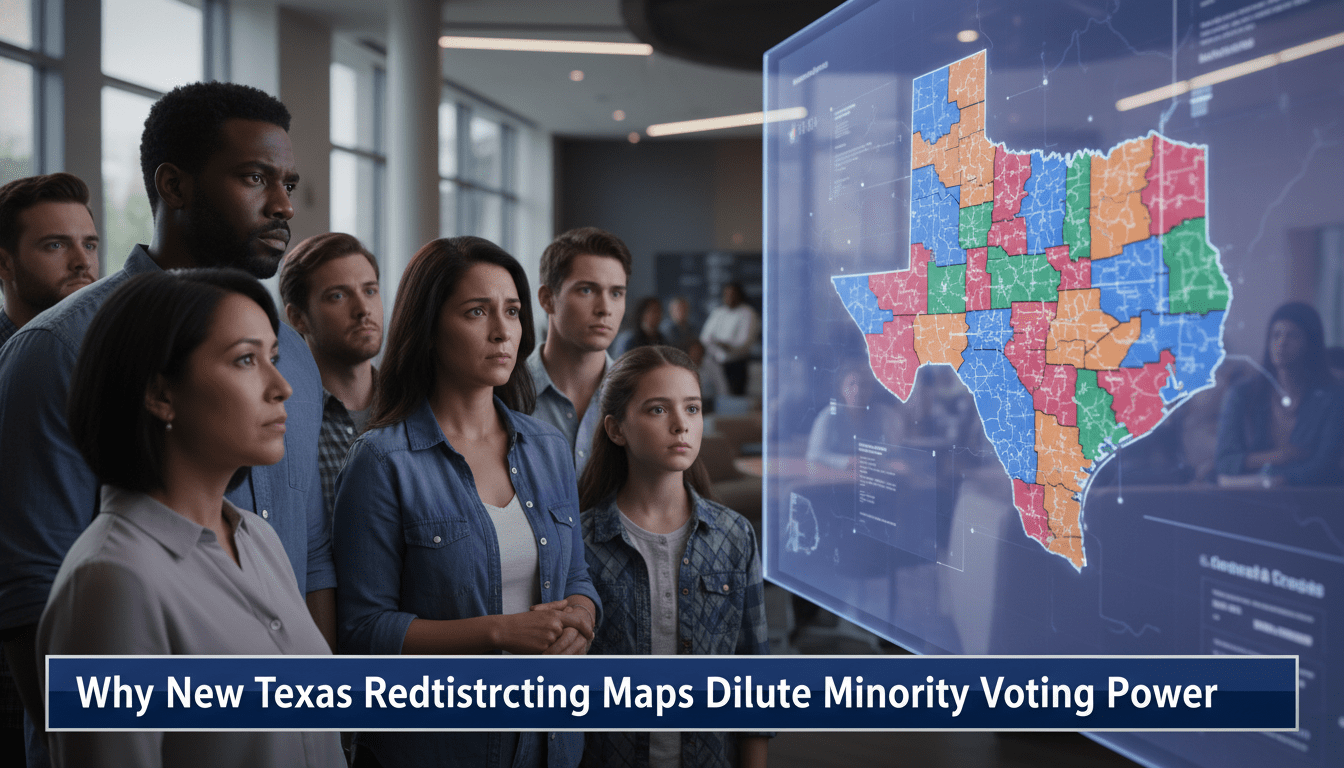
Redistricting typically happens once every ten years following the federal census. However, Texas took the rare and controversial step of conducting a mid-decade redistricting in 2025. While technically legal because the state constitution does not explicitly prohibit it, this practice remains highly controversial. Opponents argue it sets a dangerous precedent by allowing politicians to change the rules of the game whenever polling suggests they might lose. The state legislature passed new maps in August 2025, citing a directive to modernize electoral boundaries. Emboldened by recent federal court rulings, lawmakers specifically dismantled coalition districts in major urban centers like Houston, Dallas, and Austin (texastribune.org).
Critics argue this move directly targets Democratic incumbents who rely on multiracial coalitions. For example, Representatives Al Green and Marc Veasey serve as veteran leaders representing Black and Latino voters. The new maps dramatically shift their districts. In Houston, residents previously represented by the late Sheila Jackson Lee found themselves moved into new districts. This sudden shift caused widespread voter confusion. Voters often show up to their traditional polling places only to discover they now reside in a different precinct. The logistical hurdles created by frequent map changes can lead to lower voter turnout among marginalized communities (commoncause.org).
Population Growth Versus Political Representation
The core of the activist argument centers on a stark disconnect between state population growth and political representation. The total population in Texas grew from 25.1 million in 2010 to 29.1 million in 2020. People of color drove 95 percent of this massive four million resident growth. Consequently, the white population share decreased below 40 percent, while the Hispanic population grew to nearly equal the white population (texas.gov).
Despite these demographic realities, white voters effectively control approximately 73 percent of congressional seats in the state. Advocates argue that nearly all new political seats should reflect the diverse population growth. Instead, the 2025 maps aim to secure five additional seats for the Republican party in the 2026 elections (texastribune.org). This glaring disparity demonstrates how mapmakers can engineer outcomes that ignore demographic realities. Let us examine the data below to understand the gap between population changes and political power.
Tactics of Dilution: Cracking and Packing
Lawmakers use specific tactical methods to dilute the voting power of minority groups. The two primary strategies are known as cracking and packing. Cracking involves spreading a specific group of voters across many different districts. This strategy ensures the targeted voters never form a majority in any single area. As a result, they remain a permanent minority and cannot elect their preferred candidates. Cracking makes it nearly impossible for these groups to gain meaningful representation.
Packing represents the opposite approach. Mapmakers concentrate as many voters from a specific group as possible into a single district. This tactic creates a safe seat for the minority group but wastes their surplus votes. By packing voters tightly into one area, their political influence decreases in all surrounding districts (fiveable.me). Both strategies aim to minimize the overall political power of marginalized communities. Modern technology and advanced data analytics allow mapmakers to execute cracking and packing with incredible precision. Organizations like the League of United Latin American Citizens (LULAC), founded in 1929 in Corpus Christi, frequently serve as lead plaintiffs in lawsuits challenging these discriminatory maps (lulac.org).
Packing
Concentrating minority voters into one district to limit influence elsewhere.
Cracking
Scattering voters across many districts to prevent them from forming a majority.
The Legal Loophole of Partisan Gerrymandering
Proving racial discrimination in redistricting remains a complex legal challenge. Plaintiffs must demonstrate that race served as the predominant factor in drawing district lines. This requirement means showing that lawmakers ignored traditional districting principles to achieve a specific racial outcome. The challenge stems from the fact that race and political affiliation closely overlap in many southern states. Mapmakers frequently use this overlap to their advantage through a tactic known as the camo strategy.
The state defends its maps by claiming they represent partisan gerrymanders designed to disadvantage Democrats rather than racial minorities. The Supreme Court ruled in the 2019 Rucho v. Common Cause case that federal courts cannot police partisan gerrymandering (bipartisanpolicy.org). Therefore, if lawmakers can convince a judge that they targeted political opponents rather than racial groups, the maps remain legal. This overlap creates a massive loophole. Lawmakers can achieve racially discriminatory outcomes by hiding behind the shield of partisan strategy. This dynamic directly relates to how the system of federalism – or the sharing of power between national and state governments impacts civil rights enforcement on a local level.
The High Stakes for the Upcoming Elections
The legal battle over the 2025 mid-decade redraw recently escalated to the highest levels of the judicial system. A three-judge federal panel in El Paso initially blocked the new maps in November 2025. The judges labeled the boundaries a textbook case of racial gerrymandering. An injunction serves as a court order that stops a party from performing a specific act, such as using an illegal map. However, the United States Supreme Court issued a stay on that injunction in December 2025. This stay pauses the lower court order, allowing the state to use the disputed maps for the 2026 elections while the legal process continues (democracydocket.com).
The Supreme Court often relies on the Purcell Principle in these situations. This legal doctrine suggests that federal courts should avoid changing election rules too close to an upcoming vote to prevent voter confusion. Critics argue that courts weaponize this principle to protect discriminatory maps from judicial review. Because the stay pauses the remedy, millions of citizens must vote in districts that judges have already declared potentially illegal (harvardlawreview.org). This legal maneuvering holds significant implications in terms of political strategy for both political parties.
National Implications of the Texas Conflict
The outcome of the Texas legal battle carries immense consequences for the rest of the country. Political analysts view the state as a bellwether for the 2026 midterms. If the Supreme Court ultimately upholds the 2025 mid-decade redraw, other state legislatures might follow suit. This approval could trigger a redistricting arms race across the nation. Lawmakers in other states could pursue mid-decade redraws to secure political dominance whenever they gain legislative power, ignoring the traditional ten-year cycle entirely.
The maps used in Texas will heavily influence the balance of power in the United States House of Representatives during the administration of current President Donald Trump. The conflict demonstrates a dangerous collision between explosive minority population growth and a legal landscape systematically stripping away federal protections. As civil rights organizations continue to fight for fair representation, the struggle underscores a much larger battle over the future of American democracy. The voices and political futures of Black and Brown residents remain central to this ongoing pursuit of equality in the voting booth.
About the Author
Darius Spearman is a professor of Black Studies at San Diego City College, where he has been teaching for over 20 years. He is the founder of African Elements, a media platform dedicated to providing educational resources on the history and culture of the African diaspora. Through his work, Spearman aims to empower and educate by bringing historical context to contemporary issues affecting the Black community.
