


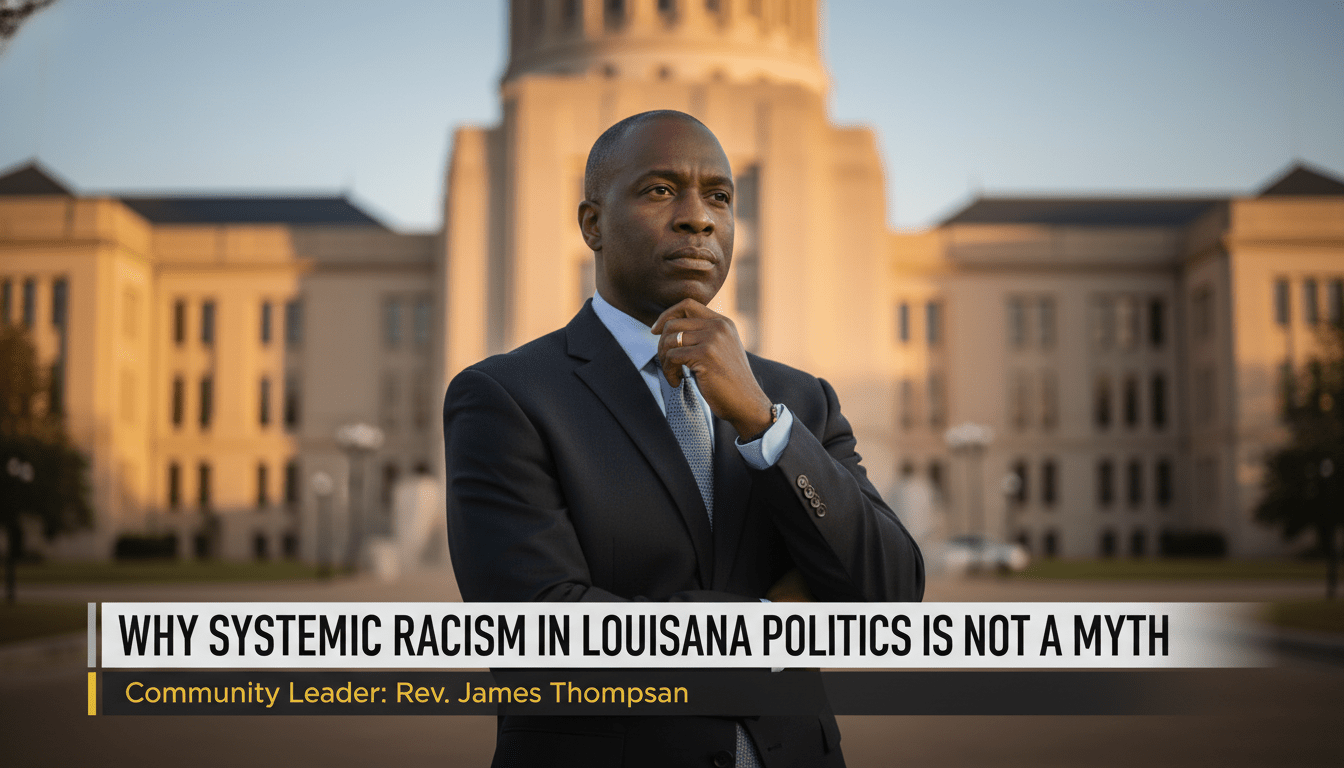
Why Systemic Racism in Louisiana Politics Is Not a Myth
By Darius Spearman (africanelements)
Support African Elements at patreon.com/africanelements and hear recent news in a single playlist. Additionally, you can gain early access to ad-free video content.
The Spark of the 2026 Controversy
In May 2026, Louisiana Governor Jeff Landry ignited a national firestorm during a high-profile television interview. The governor confidently dismissed the idea that systemic racism plays a structural role in state politics. He referred to the concept as a completely failed narrative. To support his claim, he pointed to the electoral success of Black Republicans and the historic presidency of Barack Obama. He argued that voters across the state are eager to support minority candidates, thereby proving that racial prejudice no longer dictates political outcomes.
The controversy erupted shortly after a monumental decision by the United States Supreme Court. On April 29, 2026, the Court delivered a sweeping 6–3 ruling in the case of Louisiana v. Callais. The decision struck down a court-ordered congressional map that had established a second majority-Black district. Following this federal ruling, Governor Landry issued an executive order suspending the state congressional primaries. He also oversaw the discarding of approximately 45,000 mail and absentee ballots. State officials justified this drastic action by claiming the ballots were cast under an illegal and unconstitutional map, but civil rights organizations immediately condemned the entire sequence of events (supremecourt.gov, wwltv.com).
The Danger of Historical Gaslighting
Voting rights advocates and civil rights leaders quickly mobilized against the governor and his dismissive comments. Organizations such as the NAACP and the League of Women Voters explicitly labeled the remarks as historical gaslighting. This term describes the intentional manipulation of facts to make marginalized communities question their own well-documented realities. Advocates argue that pointing to a few successful Black politicians completely ignores the deep, institutional barriers that affect millions of everyday citizens.
To fully understand this backlash, one must separate the concept of structural racism from individual prejudice. Personal bias involves conscious or unconscious thoughts held by one person against another. In stark contrast, structural racism refers to a complex web of laws, policies, and institutional practices that routinely produce racially inequitable outcomes. These systems operate continuously regardless of individual intent or malice. By dismissing this reality as a failed narrative, politicians create a convenient justification to remove essential legal protections. When society denies that a structural problem exists, lawmakers feel empowered to dismantle civil rights safeguards (researchgate.net, commondreams.org).
From Reconstruction to Overt Violence
Louisiana possesses a profound history of racial political engineering. Following the conclusion of the Civil War, the state temporarily adopted a remarkably progressive constitution in 1868. This document enfranchised Black men and briefly transformed the regional political landscape. During this era, Louisiana sent Black lawmakers to the federal Congress. The state even witnessed P.B.S. Pinchback serve as the first Black governor in the nation from 1872 to 1873. However, this promising era of diverse representation was tragically short-lived.
A violent and coordinated backlash soon followed, driven by those desperate to reestablish absolute control over the political system. The pushback against minority political power manifested in horrific acts of domestic terror. The most notable event was the Colfax Massacre of 1873. During this atrocity, white paramilitaries murdered over sixty Black men specifically to seize control of the local government. This overwhelming violence signaled the end of early civil rights gains and demonstrated how brutally Reconstruction failed African Americans in the long term (wikipedia.org, wikipedia.org).
The Strategy of Constitutional Disenfranchisement
As overt domestic terrorism became less socially acceptable, the strategies for exclusion evolved into sophisticated legal mechanisms. The most devastating blow to minority representation came with the Louisiana Constitution of 1898. The framers of this document openly and explicitly stated their goal was to perpetuate the supremacy of the white race. They implemented severe literacy tests, poll taxes, and a notorious provision known as the Grandfather Clause.
This specific clause exempted poor, illiterate white men from strict voting restrictions if their ancestors could vote before 1867. Naturally, this was a time when enslaved Black men could not vote at all. The document also eliminated the requirement for unanimous jury verdicts, allowing convictions by a 9-3 margin. This was a calculated move designed to minimize the influence of Black jurors in the justice system. The impact of these policies was immediate and catastrophic. In West Baton Rouge Parish, Black voter registration plummeted from an impressive 95.6 percent in 1896 to merely 1.1 percent by 1901 (wbrcouncil.org, americanprogress.org).
Modern Tactics of Voter Suppression
Today, explicit constitutional bans based on race are illegal, but the strategies for exclusion simply shifted to modern mapping techniques. Mapmakers use specific tactics known as packing and cracking to dilute the voting strength of minority communities. Packing involves concentrating minority voters into a single district to limit their influence in surrounding areas. Cracking spreads minority voters thinly across multiple districts so they never form a majority anywhere. These tactics represent modern anti-Black politics by ensuring marginalized communities cannot elect their preferred candidates.
The federal government introduced the Voting Rights Act of 1965 to combat these precise methods. Section 2 of the Act prohibits any voting practice that results in a denial or abridgment of the right to vote on account of race. It mandates the creation of majority-minority districts when a minority population is large and geographically compact enough. Despite these protections, the Supreme Court decision in 2026 severely weakened the ability to enforce these standards. Under the administration of current President Donald Trump, federal oversight of state elections remains a intensely debated and highly polarized topic (justia.com, democracydocket.com).
The Ongoing Representation Gap
The current statistics surrounding representation in Louisiana highlight a severe and enduring imbalance. Currently, Black residents make up approximately 33 percent of the overall state population. However, the state has consistently maintained only one out of six majority-Black congressional districts for several decades. This means that a third of the population is effectively represented in only 16 percent of the state congressional seats. The mathematics alone contradict the claim that structural barriers are merely a fictional narrative.
Furthermore, the exclusion extends far beyond federal congressional maps. In the post-Reconstruction era, no Black candidate has been elected to a statewide constitutional office in Louisiana. This includes powerful executive positions such as Governor, Attorney General, and Secretary of State. It took nearly one hundred years after Reconstruction for another Black legislator to serve in the state house. Ernest Morial was finally elected in 1968, and the Louisiana Legislative Black Caucus was formed in 1977 to combat this deeply rooted systemic exclusion (lablackcaucus.org, ballotpedia.org).
Louisiana Representation Gap (2026)
Black Codes and the Criminal Justice Crisis
The roots of structural racism in Louisiana also deeply penetrate the criminal justice system. Immediately following the Civil War, the state enacted severe laws known as Black Codes. These codes were specifically designed to restrict the freedom and labor of newly emancipated African Americans. They established vagrancy rules that allowed for the arrest and forced labor of any Black person who was unemployed. These policies effectively forced individuals into convict leasing, sharecropping, and other forms of involuntary servitude.
Today, this terrible legacy has evolved into a staggering crisis. Louisiana is widely recognized as the incarceration capital of the world. The state imprisons 1,067 out of every 100,000 residents, a rate higher than any independent democratic nation on earth. While Black residents comprise 33 percent of the state population, they constitute an alarming 67 percent of the state prison population. Since 1978, the Black incarceration rate in Louisiana has increased by an astonishing 201 percent. Scholars consistently argue that the modern era of mass incarceration serves as a primary tool for political and economic control (epi.org, wikipedia.org).
Prison Population Disparity
State Population
33%
Prison Population
67%
The Harsh Reality of Economic Inequality
Beyond voting rights and incarceration, systemic racism reveals itself through severe and persistent economic disparities. The financial landscape for Black residents in Louisiana remains bleak. Black households in the state earn roughly 44.3 percent less than the state average. Conversely, white households earn 70.4 percent more than the average. Poverty remains a pervasive and generational issue, with the state maintaining an overall poverty rate of 18.9 percent. The situation is particularly dire for marginalized youth, as Black children are nearly three times as likely to live in poverty compared to white children.
This economic inequality is heavily exacerbated by the state tax structure. Louisiana possesses the fourteenth most regressive tax code in the entire nation. A regressive tax system takes a larger percentage of income from low-income earners than from high-income earners. This happens primarily through a heavy reliance on sales taxes. Because low-income households must spend a higher portion of their earnings on basic necessities, they face a disproportionate financial burden. In Louisiana, low-income households pay a nearly 12 percent effective tax rate, while the top 20 percent of earners pay less than 8 percent. Furthermore, the federal income tax deduction overwhelmingly benefits the wealthiest taxpayers, reinforcing the generational wealth gap (investlouisiana.org, itep.org).
Effective Tax Rates by Income
Louisiana’s regressive tax structure disproportionately burdens low-income families.
Why the Narrative Remains Deeply Relevant
Civil rights leaders insist that the structures of exclusion have simply modernized over time. They transitioned from the overt violence of historical massacres to the quiet, sophisticated racial political engineering seen in modern redistricting battles. Dismissing this history as a failed narrative requires ignoring a massive collection of verifiable statistical data. The evidence consistently points to a system that operates exactly as it was historically designed to function. By declaring systemic racism nonexistent, political leaders effectively justify the removal of essential legal remedies.
This phenomenon explains precisely why organizations use the term historical gaslighting. When politicians deny the reality of structural disparities, they invalidate the lived experiences of millions of citizens. Governor Landry pointing to the existence of Black Republicans does not erase the systemic barriers that suppress marginalized communities daily. True progress requires an honest acknowledgment of history and a commitment to dismantling discriminatory structures. Until lawmakers address the institutional rules that produce inequitable outcomes, the debate over race, representation, and politics in Louisiana will undoubtedly continue to burn brightly across the nation.
About the Author
Darius Spearman is a professor of Black Studies at San Diego City College, where he has been teaching for over 20 years. He is the founder of African Elements, a media platform dedicated to providing educational resources on the history and culture of the African diaspora. Through his work, Spearman aims to empower and educate by bringing historical context to contemporary issues affecting the Black community.
