

How Protecting Democratic Processes in Africa Protects the Vote
By Darius Spearman (africanelements)
Support African Elements at patreon.com/africanelements and hear recent news in a single playlist. Additionally, you can gain early access to ad-free video content.
The Modern Battle for the African Vote
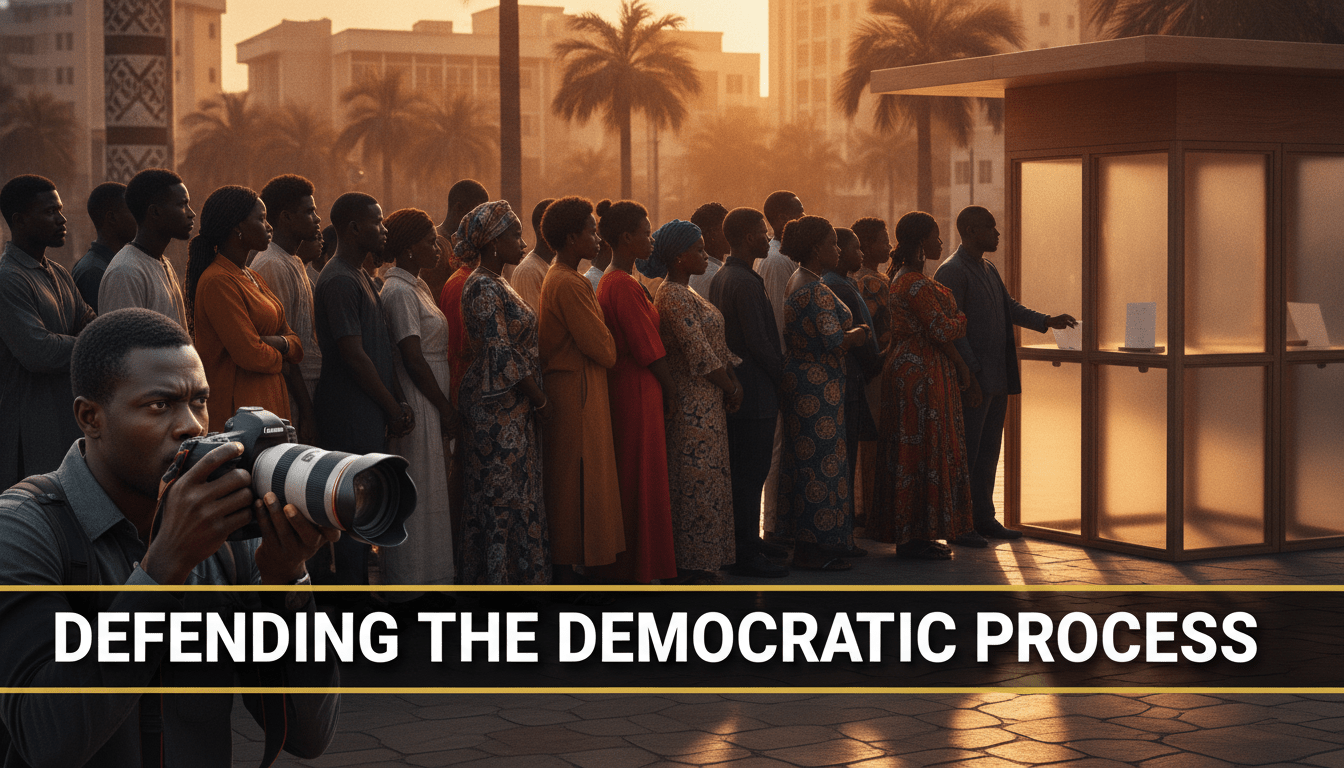
On June 12, 2026, the African Union Commission gathered media leaders for a vital online session (au.int). This event fell under the third cohort of the African Union Media Fellowship, which focuses on accountable governance (gazettengr.com). The session highlighted the critical role of media in protecting democratic processes in Africa. Throughout the diaspora, the struggle for civil rights has shown that a free press is vital for a fair vote. Without media watchdogs, the democratic process can easily break down.
The African Union Commission urged member states to protect civil liberties and defend media freedom (au.int). Modern journalism serves as a crucial line of defense against election manipulation. Because elections across the continent face new digital threats, the role of reporters is changing. Journalists are no longer simple observers of political changes. They have become key defenders of truth in a highly contested information environment (gazettengr.com).
From Non-Interference to Good Governance
To understand this struggle, one must examine the history of continental governance. The predecessor to the African Union was the Organization of African Unity, which was created in 1963 (wikipedia.org). For decades, this older body prioritized state sovereignty above all else. Under its charter, the principle of non-interference stopped the organization from acting against domestic oppression (wikipedia.org). Authoritarian regimes remained unchallenged because internal politics were treated as private matters.
This hands-off approach began to change as the century drew to a close. The Organization of African Unity conducted its first official election monitoring mission in Namibia in 1989 (idea.int). By 2002, the formal launch of the African Union in Durban ushered in a major policy shift (wikipedia.org). The Constitutive Act of the African Union, signed in Lomé in 2000, committed the continent to promoting democratic principles, human rights, and the rule of law (peaceau.org, au.int).
The Binding Power of the African Charter
To turn these principles into action, the African Union adopted a groundbreaking treaty. The African Charter on Democracy, Elections and Governance was adopted in 2007 and took effect in 2012 (rflgd.org, emory.edu). This agreement represents the first legally binding multilateral treaty focused on human rights and regular, transparent elections (emory.edu). It establishes a clear legal standard for democratic behaviour across the continent.
Enforcement of this treaty rests with the Peace and Security Council of the African Union (emory.edu). When a government experiences an unconstitutional change, the Council has the power to suspend that nation from all activities (icnl.org). Typical penalties include travel bans and asset freezes targeting those who seize power by force (emory.edu). However, enforcement often suffers from a lack of consensus among member states. While the Union quickly punishes military coups, it regularly struggles to address legal manipulations by sitting presidents (brill.com).
The Reality of Constitutional Coups
This failure to penalize legal manipulation has opened the door to “constitutional coups.” A constitutional coup occurs when an incumbent leader alters the laws to stay in power (africacenter.org). Often, these leaders use subservient legislatures or judiciaries to remove presidential term limits (georgetown.edu). Countries like Togo, Uganda, Chad, Cameroon, and Rwanda have seen such manipulations in recent decades (africacenter.org). By rewriting the rules, leaders can reset constitutional clocks and remain in office indefinitely.
These gradual alterations slowly erode democratic competition. When aging elites monopolize key state organs, peaceful political transitions become nearly impossible. This concentration of executive power reduces accountability and disenfranchises the electorate (ecdpm.org). Over time, public frustration with these legal schemes often boils over. In many cases, constitutional coups serve as the direct precursor and justification for military coups and social instability (africacenter.org).
Understanding the Democracy Paradox
This friction between nominal democracy and actual practice has created what experts call the “democracy paradox.” Despite massive investments in election observation, the quality of democratic outcomes remains fragile (amaniafrica-et.org). To address this crisis, the first Electoral Integrity Summit took place in Kampala in 2024 (amaniafrica-et.org). This was followed by a second major summit in Lusaka in November 2025 (issafrica.org).
The discussions at these summits led directly to Resolution 648 of the African Commission on Human and Peoples’ Rights (issafrica.org). This resolution calls on states to protect civic spaces and ensure the physical safety of journalists. It also proposes the creation of an African Democracy and Electoral Integrity Fund. Many experts argue that the democracy paradox persists because governments routinely ignore observation reports once the election cycle ends (amaniafrica-et.org).
Measuring Public Trust with Hard Data
Public opinion data confirms that a trust gap exists. According to Afrobarometer surveys conducted across thirty-nine countries, sixty percent of citizens prefer democracy (afrobarometer.org). Yet, only thirty-eight percent believe their most recent national elections were truly free and fair (afrobarometer.org). Furthermore, only thirty-nine percent of citizens trust their national independent electoral management commissions (afrobarometer.org).
These statistics come from a rigorous, face-to-face scientific methodology (afrobarometer.org). Afrobarometer uses randomly selected, nationally representative samples to protect data integrity (umich.edu). Independent global partners, such as the United States Agency for International Development and the Mastercard Foundation, fund this research (afrobarometer.org). The declining trust in electoral commissions, which dropped from fifty-one percent to forty-one percent over the last decade, highlights the urgent need to rebuild credible, transparent institutions (afrobarometer.org).
The Digital Frontier and Information Wars
Modern elections are fought on digital battlefields. Targeted election-time disinformation has become highly industrialized (bournemouth.ac.uk). Disinformation campaigns are concentrated heavily around the voting period and the active campaign phase (up.ac.za). These operations aim to suppress voter turnout and divide the public. Major external state actors, such as Russia and China, drive large-scale propaganda efforts to prop up authoritarian regimes (africacenter.org, africacenter.org).
These foreign campaigns are highly sophisticated. For example, Russian-sponsored networks have deployed campaigns in over twenty African nations (africacenter.org). They utilize generative artificial intelligence to craft highly realistic fake news content (cisa.gov). Furthermore, private political consulting firms like Cambridge Analytica have historically run covert digital influence operations to manipulate voters (uplopen.com). These actors create fake local news sites and pay social media influencers to amplify polarizing narratives (bournemouth.ac.uk, europa.eu).
The Power and Limits of Digital Activism
In response to these digital threats, civil society has embraced technological innovation. A pan-African organization called AfricTivistes leads this charge (africtivistes.com). Composed of over two hundred and fifty members across forty countries, AfricTivistes champions human rights and digital democracy (africtivistes.com). In June 2025, they launched Farafina, which serves as a centralized database to track voter metrics and election laws (africtivistes.com).
Yet, digital activism has its limits. To create lasting change, online campaigns must connect with offline, face-to-face social networks (researchgate.net). Authoritarian regimes routinely weaponize surveillance technology to track dissidents and censor online opposition (jfjustice.net, aww.cloud). In addition, disconnected rural communities are often shut out of these digital spaces (unimelb.edu.au). Governments frequently use targeted internet shutdowns during voting cycles to silence critical voices and hide irregularities (africtivistes.com, unimelb.edu.au).
Digital Activism
Platforms like AfricTivistes’ Farafina empower citizens, track voting laws in real-time, and mobilize youth across borders.
State Suppression
Authoritarian regimes retaliate with internet shutdowns, targeted surveillance, and laws restricting digital media access.
Agenda 2063 and the Path Forward
Securing the future of African democracy requires a long-term vision. The African Union established this vision through Agenda 2063, a fifty-year master plan adopted in 2013 (au.int, nepad.org). This framework seeks to build an integrated, prosperous, and peaceful continent (nepad.org). Aspiration Three of the plan explicitly focuses on good governance, human rights, and the rule of law (au.int).
Achieving these goals is impossible without a free and independent media. To realize the vision of Agenda 2063, member states must move beyond rhetoric (au.int, au.int). They must actively protect journalists from targeted arrests and dismantle restrictive laws (au.int). As the African continent moves deeper into the digital age, decolonizing institutions and protecting public expression are the only ways to guarantee true self-determination.
About the Author
Darius Spearman is a professor of Black Studies at San Diego City College, where he has been teaching for over 20 years. He is the founder of African Elements, a media platform dedicated to providing educational resources on the history and culture of the African diaspora. Through his work, Spearman aims to empower and educate by bringing historical context to contemporary issues affecting the Black community.
