


The Colonial Roots of the Climate Reparations Fight
By Darius Spearman (africanelements)
Support African Elements at patreon.com/africanelements and hear recent news in a single playlist. Additionally, you can gain early access to ad-free video content.
In June 2026, the World Meteorological Organization and the National Oceanic and Atmospheric Administration formally declared the arrival of a historic El Niño cycle (wmo.int, noaa.gov). Global sea-surface temperatures are rising at an unprecedented speed (wmo.int). Forecasters warn that this cycle carries an eighty to ninety percent likelihood of fueling extreme weather anomalies through the end of the year (wmo.int). While the science of this weather pattern is clear, the global response represents a major political shift.
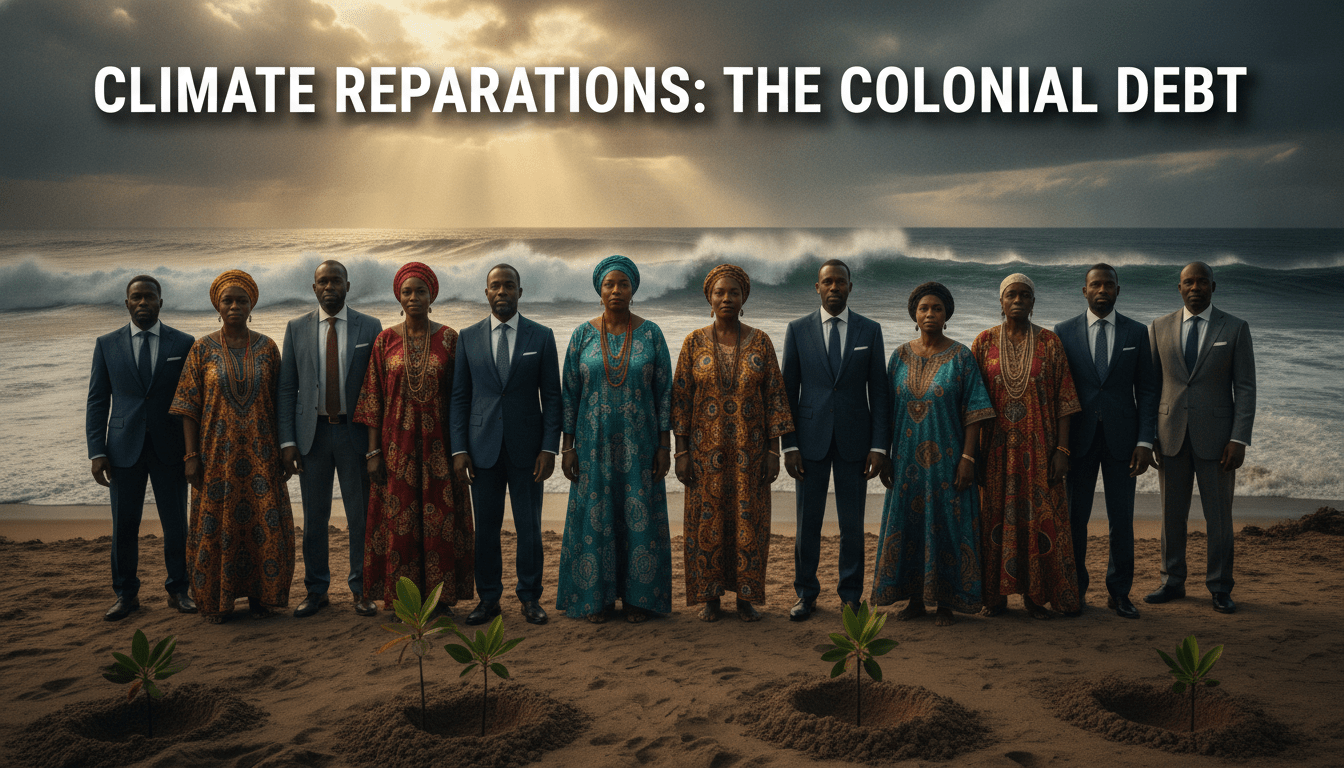
Across the African diaspora, community coalition groups are refusing to accept the standard cycle of disaster and charity. Instead, a unified front of Caribbean and African nations is demanding structural financial repair (caricom.org). This coalition argues that the extreme vulnerability of their coastlines is a direct result of centuries of colonial exploitation (climateandcommunity.org, brattle.com). Rather than asking for traditional humanitarian aid, these nations are demanding a systemic restructuring of the global financial system (bridgetown-initiative.org, globalpolicy.org). As the landmark Accra Conference on Reparatory Justice begins in Ghana, the conversation has moved from charitable assistance to a binding legal duty (gbcghanaonline.com, reparationscomm.org).
The Responsibility Gap: Emissions vs. Vulnerability
Comparing historical greenhouse gas contributions against systemic climate risk.
The Scientific Threat of the El Niño Cycle
The El Niño-Southern Oscillation is a naturally occurring climate pattern that warms the central and eastern Pacific Ocean (noaa.gov). Historically, South American fishers coined the term “El Niño” in the seventeenth century (noaa.gov). They noticed unusually warm ocean currents appearing near the end of the calendar year (noaa.gov). Today, this natural cycle is colliding with oceans that are heavily supercharged by human-induced greenhouse gas emissions (wmo.int).
The World Meteorological Organization warns that the current cycle will trigger severe systemic shocks across multiple continents (wmo.int, wmo.int). In Africa, this climate pattern threatens to suppress vital rainfall, which triggers severe agricultural droughts across the Sahel, the Horn of Africa, and Southern Africa (iom.int, wfp.org). In the Caribbean, warm sea-surface temperatures allow any storm that forms to intensify rapidly, causing massive coastal erosion and rising sea levels (crfm.int).
Historical precedents show the immense economic damage caused by these cycles. The El Niño cycle of 1997 and 1998 caused over one billion dollars in damage to Latin American and Caribbean infrastructure (climatecentre.org). A later cycle in Colombia damaged more than thirty thousand kilometers of roads and affected millions of citizens (idbinvest.org). Recently, another cycle forced over one million people in rural Caribbean and Latin American communities into severe food insecurity (wfp.org, mercycorps.org). These statistics show that natural weather cycles are now major threats to human survival (undrr.org).
Colonial Roots of Modern Ecological Risk
The extreme vulnerability of Small Island Developing States is not an accident of geography (undp.org). European empires systematically underfunded local infrastructure while siphoning resources to wealthy nations (climateandcommunity.org, brattle.com). Beginning in the sixteenth century, the transatlantic slave trade and colonial rule restructured global land use (balanta.org, reparationscomm.org). Colonizers cleared defensive mangrove forests to make way for massive, export-driven sugarcane plantations (stimson.org). This ecological destruction left coastlines exposed to severe erosion and storm surges (stimson.org).
When these nations achieved independence in the twentieth century, they inherited highly fragile economies (unu.edu). They lacked the diversified financial bases needed to build modern public infrastructure (bridgetown-initiative.org). Today, these communities continue their historic economic justice struggles to survive. On March 25, 2026, the United Nations General Assembly adopted a historic resolution declaring the transatlantic slave trade a grave crime against humanity (un.org). This resolution provides a powerful legal foundation for modern climate reparations (amnesty.org.uk).
The Financial Trap of International Debt
Modern international financial institutions often continue the patterns of colonial history (rooseveltinstitute.org). The Bridgetown Initiative, led by Barbados Prime Prime Minister Mia Mottley, has exposed major flaws in the global financial system (bridgetown-initiative.org). These institutions were created in 1944 at the Bretton Woods Conference (beyondbrettonwoods.org). At that time, most of the Global South was still colonized and had no voice in the negotiations (beyondbrettonwoods.org). Consequently, post-disaster loans trap developing nations in a cycle of endless debt (madhyam.org.in).
The financial strain on these countries is immense. Sub-Saharan African nations face crippling debt burdens that consume a massive portion of their national budgets (au.int). Forcing these nations to borrow money to rebuild from storms they did not cause is unjust (americanprogress.org). This dynamic shows why the global financial architecture must undergo a complete restructuring (globalpolicy.org).
Sub-Saharan Africa: Debt vs. Climate Adaptation
How debt servicing starves ecological resilience efforts.
National Revenue Spent on Debt Servicing
Revenue Invested in Climate Adaptation
Understanding the Concept of Loss and Damage
In international climate negotiations, the term “Loss and Damage” refers to the irreversible impacts of climate change (wri.org, lossanddamagecollaboration.org). This concept is distinct from traditional adaptation, which focuses on preparing for future climate shocks (undrr.org). Instead, Loss and Damage addresses harms that have already occurred and cannot be repaired (un.org). It includes economic losses, such as destroyed roads, alongside non-economic losses, such as lost cultural heritage (un.org).
This framework has evolved through decades of diplomatic struggle. In 1991, the Alliance of Small Island States first proposed an insurance pool to compensate low-lying islands for rising sea levels (ciel.org, lossanddamagecollaboration.org). Later, in 2009, Bolivia introduced the idea of climate debt (ciel.org). CARICOM advanced this discussion in 2013 by creating a reparations commission (caricom.org, reparationscomm.org). Unlike basic humanitarian aid, Loss and Damage is a matter of genuine justice, not voluntary charity (un.org).
A Powerful Pan-African and Diaspora Coalition
The year 2025 marked a historic moment of unity between African and Caribbean leaders (au.int). The African Union declared a year of reparations to seek justice for people of African descent (au.int, au.int). This declaration led to a unified framework at the Africa-CARICOM Summit (caricom.org). Together, these regions represent a massive diplomatic bloc fighting for global financial reform (caricom.org, caricom.org).
This coalition is active on multiple diplomatic fronts (caricom.org). Activists are demanding the cancellation of public debts to free up local adaptation funds (pacja.org). Reciprocal diplomatic offices are planned to coordinate these strategies (cbc.bb). In the United States, the African American diaspora displays incredible strength and resilience by supporting these international campaigns (thechisholmlegacyproject.org).
Historical Slavery Liabilities: The Brattle Group Metrics
Estimated heads of claims for United Kingdom reparations liability (Trillions of USD).
The Power of United Nations Resolutions
The passage of United Nations General Assembly Resolution A/RES/80/250 was a massive diplomatic victory (un.org). This resolution officially declared chattel slavery a crime against humanity (un.org). Although General Assembly resolutions are not legally binding, they hold immense moral and political power (un.org, journalisslp.com). This soft law establishes a clear normative standard for the global community (amnesty.org.uk).
Former colonial powers are facing growing pressure (colonialismreparation.org). Historical promises of development have failed to deliver true freedom to post-colonial nations. International coalitions are using this moral consensus to push for binding regional policies (afalab.org, pacja.org). The June 2026 conference in Ghana will help translate this moral statement into concrete financial agreements (gbcghanaonline.com).
Designing a Practical Framework for Reparations
Critics often ask how climate reparations would be managed in the real world (historyreclaimed.co.uk). Proponents argue that funding must bypass traditional charitable aid channels (climateandcommunity.org). Instead, funds should be managed by independent international trusts (thechisholmlegacyproject.org). One key proposal involves reforming the Special Drawing Rights of the International Monetary Fund (bridgetown-initiative.org, e3g.org).
This reform would reallocate global financial reserves directly to the Global South (bridgetown-initiative.org, beyondbrettonwoods.org). This method transfers wealth without creating new national debt (rooseveltinstitute.org). Furthermore, local communities would manage these resources through participatory budgeting (jtalliance.org). This system ensures that climate funding directly serves those living on the frontlines of ecological risk (thechisholmlegacyproject.org, thechisholmlegacyproject.org).
About the Author
Darius Spearman is a professor of Black Studies at San Diego City College, where he has been teaching for over 20 years. He is the founder of African Elements, a media platform dedicated to providing educational resources on the history and culture of the African diaspora. Through his work, Spearman aims to empower and educate by bringing historical context to contemporary issues affecting the Black community.
