

How the Ebola Poverty Crisis in Congo Threatens Millions
By Darius Spearman (africanelements)
Support African Elements at patreon.com/africanelements and hear recent news in a single playlist. Additionally, you can gain early access to ad-free video content.
In late June 2026, the United Nations Development Programme delivered a sobering message regarding the Democratic Republic of Congo (undp.org). The rapidly spreading Ebola outbreak in the region is much more than a public health threat (reliefweb.int). It is a full-blown economic crisis. Left unchecked, the outbreak could drain $3.6 billion from the African economy (undp.org). This massive loss threatens to push nearly one million vulnerable people into poverty (undp.org).
The World Health Organization is working alongside regional partners to contain the virus (who.int). However, understanding this crisis requires examining the history behind the headlines. The current epidemic represents a collision of a deadly pathogen, historical neglect, and economic instability. To solve the problem today, observers must look at how the past has shaped the present.
The Path of the Pathogen: From Yambuku to Bundibugyo
The history of Ebola began in late August 1976 in Zaire, which is now the Democratic Republic of Congo (cdc.gov). The virus first appeared in a rural village named Yambuku (cdc.gov). This first outbreak was caused by the Zaire strain, which killed eighty-eight percent of those infected (wikipedia.org). To prevent stigmatizing the village, scientists named the virus after the nearby Ebola River (cdc.gov). Since then, the nation has survived sixteen subsequent flare-ups, making the 2026 outbreak the seventeenth in its history (undp.org).
The current crisis is not caused by the classic Zaire strain (who.int). Instead, the culprit is the Bundibugyo ebolavirus, which was first identified in western Uganda in 2007 (cdc.gov). Historically, this strain has had lower fatality rates, ranging from thirty to fifty percent (cdc.gov). However, the Bundibugyo strain is highly transmissible and has historically lacked approved vaccines or treatments (globalbiodefense.com). This lack of medical tools makes the current spread highly dangerous.
The Unprecedented Speed of the 2026 Outbreak
According to the World Health Organization, the 2026 epidemic is moving with alarming speed (who.int). The virus required only thirty-seven days to claim two hundred and fifty lives (who.int). In comparison, the devastating 2014 West African outbreak took seventy-eight days to reach that same threshold (cdc.gov). The 2018 outbreak in the eastern Congo took one hundred and thirty days to cause two hundred and fifty deaths (cdc.gov).
By early July 2026, health authorities confirmed over one thousand five hundred cases and five hundred deaths (who.int). This rapid transmission rate prompted the World Health Organization to declare a Public Health Emergency of International Concern (who.int). This declaration signifies an extraordinary event that threatens other nations and requires a coordinated global response (who.int).
Days Taken to Reach 250 Deaths (Comparison)
Note: Shorter bars indicate faster transmission speeds (fewer days to reach 250 deaths).
A Dangerous Vacuum in Medicine and Treatment
A major challenge in containing this epidemic is the current state of medical technology (globalbiodefense.com). The approved Ebola vaccines and treatments, such as monoclonal antibody therapies, were designed specifically for the Zaire strain (impactglobalhealth.org). These existing tools do not protect patients against the Bundibugyo strain (globalbiodefense.com). This treatment gap leaves healthcare workers with few direct options to fight the infection.
The lack of prepared treatments highlights a historical pattern in global pharmaceutical research (impactglobalhealth.org). Out of ninety-four tracked filovirus vaccine candidates, over fifty target the Zaire strain, while the Bundibugyo strain was neglected for nearly twenty years (impactglobalhealth.org). This imbalance reflects a broader history of medical research where diseases in lower-income nations receive less funding. To address this, clinical trials are now starting in Africa to test experimental antibody drugs and antivirals (globalbiodefense.com).
Deep Roots of Economic Fragility in the Congo
The economic vulnerability of the Democratic Republic of Congo is not an accident (ushmm.org). It is the result of centuries of foreign exploitation and domestic turmoil (wikipedia.org). During the late nineteenth century, King Leopold II of Belgium established a brutal colonial regime (ushmm.org). This system relied on violent, extractive labor systems to plunder the rubber and mineral wealth of the nation (ushmm.org).
After independence, the country faced decades of political instability and dictatorship (wikipedia.org). Mobutu Sese Seko ruled for thirty years, creating a highly corrupt system that drained national resources (wikipedia.org). Today, despite having vast mineral wealth like cobalt, the country suffers from the resource curse (wikipedia.org). Decades of violent conflict involving regional actors and armed groups have destroyed infrastructure and weakened public services (wikipedia.org, ushmm.org). Consequently, the national economy has very little resilience against sudden shocks (undp.org).
Mapping the Economic Fallout: Three UNDP Scenarios
The United Nations Development Programme analyzed how this outbreak could damage the regional economy (undp.org). They created three distinct economic scenarios based on how well the virus is contained (undp.org). In the first scenario, the virus remains restricted to the Congo and Uganda (undp.org). Even in this best-case medical outcome, the Congolese economy faces a one billion dollar loss in real gross domestic product (undp.org). This contraction would eliminate approximately fifty-five thousand jobs (undp.org).
The second scenario assumes that neighboring nations implement strict border controls (undp.org). Even if the virus does not cross these borders, trade friction would cause a regional economic loss of over two billion dollars (undp.org). Finally, the third scenario combines the epidemic with a global energy shock (undp.org). This polycrisis would occur if global oil prices spike due to conflicts elsewhere (cascadeinstitute.org). Under this worst-case scenario, the African economy would lose three point six billion dollars and eliminate over three hundred thousand jobs (undp.org).
UNDP Projected Economic Impact Scenarios
Scenario 1: Localized
Lost GDP in DRC. Approximately 55,000 formal jobs eliminated.
Scenario 2: Friction
Lost GDP across Sub-Saharan Africa due to border closures.
Scenario 3: Polycrisis
Worst-case impact combined with global energy and trade shocks.
The Regressive Poverty Shock on Families
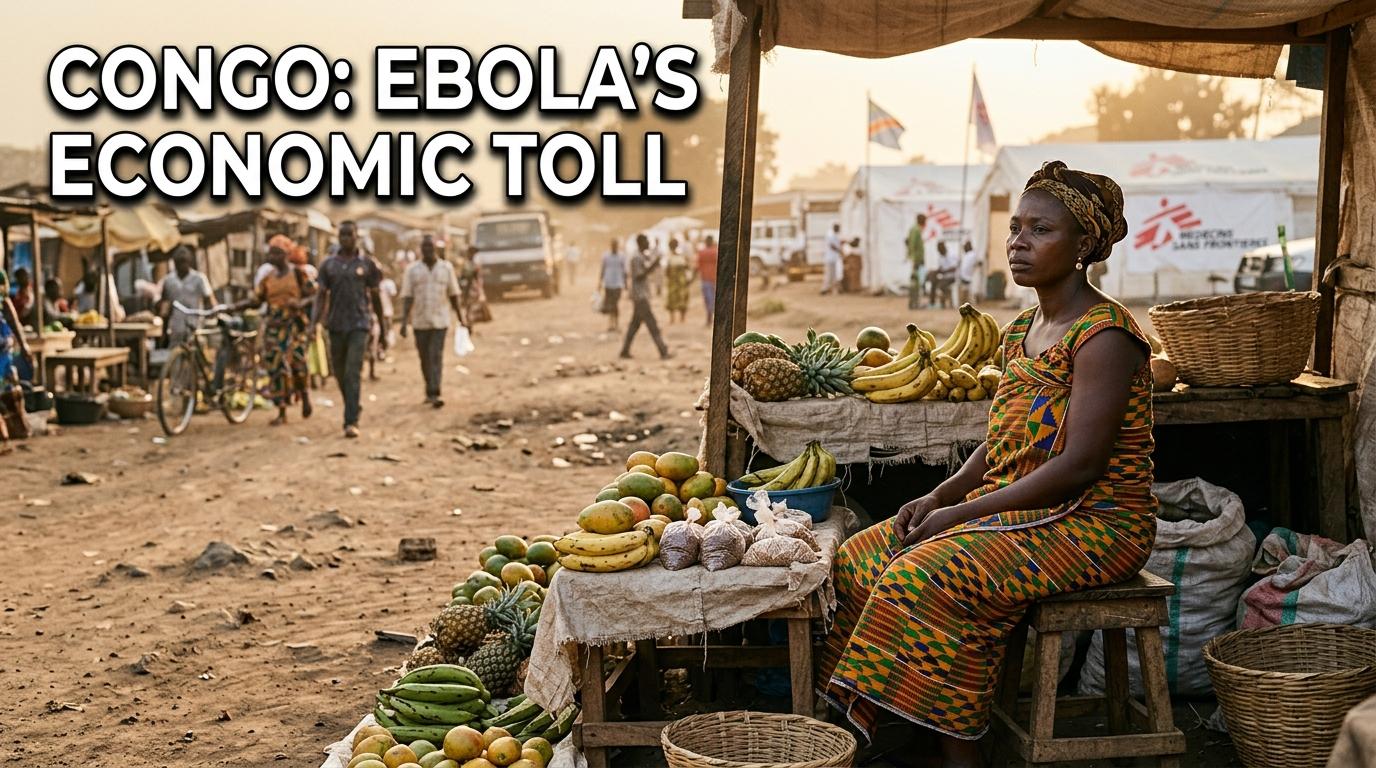
At the household level, this economic damage acts as a regressive poverty shock (undp.org). A regressive shock is an event that harms low-income families far more than wealthy ones (imf.org). In the Congo, where sixty percent of the population lives in extreme poverty, families have no financial cushion (undp.org). The United Nations estimates that the outbreak will push an additional nine hundred and eighty-five thousand people into poverty (reliefweb.int).
For the poorest twenty percent of households, daily consumption is projected to fall by nearly two percent (undp.org). This decline forces parents to make desperate choices between buying food or paying for basic medicine (reliefweb.int). Unlike wealthier citizens, these families cannot use savings or borrow money to survive the crisis (imf.org). They must absorb the full force of the economic blow directly.
The Human and Household Toll
Women and Children Bear the Heaviest Burden
The social effects of the Ebola outbreak are not distributed equally (undp.org). Women face a disproportionate share of both the health and economic risks (undp.org). In East and Central Africa, women run the majority of informal cross-border trade (undp.org). When governments close borders or restrict travel to stop the virus, these women lose their daily income immediately (undp.org).
Additionally, women perform the majority of caregiving work (undp.org). They work as frontline nurses and care for sick relatives at home, which increases their risk of contracting the virus (cdc.gov, undp.org). The crisis also harms children by disrupting routine healthcare services (undp.org). Because clinics are overwhelmed by Ebola, vaccinations and treatments for malaria are ignored (undp.org). This disruption is projected to cause over two thousand five hundred additional infant deaths (undp.org).
The Global Inequality of Medical Response
The international response to the outbreak highlights deep global inequalities (cnbcafrica.com). In June 2026, a single imported case of the Bundibugyo strain was confirmed in France (globalbiodefense.com). This single infection in Europe immediately triggered massive media coverage and rapid funding requests (cnbcafrica.com). For example, the United States and the European Union quickly proposed large financial aid packages (cnbcafrica.com).
In contrast, African health organizations had spent months pleading for funds with little success (cnbcafrica.com). Before the European case, the Africa Centres for Disease Control had received only thirteen percent of its requested budget (cnbcafrica.com). This double standard shows how global health funding is often driven by racial and political hierarchies. Wealthy nations often ignore crises until they threaten Western borders.
A Call for Systemic Solutions Beyond Medicine
Treating the Ebola outbreak purely as a medical emergency will not solve the underlying crisis (undp.org). As United Nations officials point out, the virus does not stop at the hospital gate (undp.org). It destroys livelihoods, disrupts education, and weakens public finances (undp.org). Therefore, the global response must include economic support alongside medical aid (undp.org).
To prevent millions from falling deeper into poverty, international donors must fund social safety nets (undp.org). Governments need resources to support cross-border traders, protect small businesses, and keep local health clinics open (undp.org). Only by addressing the economic dimensions of this epidemic can the region truly recover and build resilience for the future (undp.org).
About the Author
Darius Spearman is a professor of Black Studies at San Diego City College, where he has been teaching for over 20 years. He is the founder of African Elements, a media platform dedicated to providing educational resources on the history and culture of the African diaspora. Through his work, Spearman aims to empower and educate by bringing historical context to contemporary issues affecting the Black community.
