



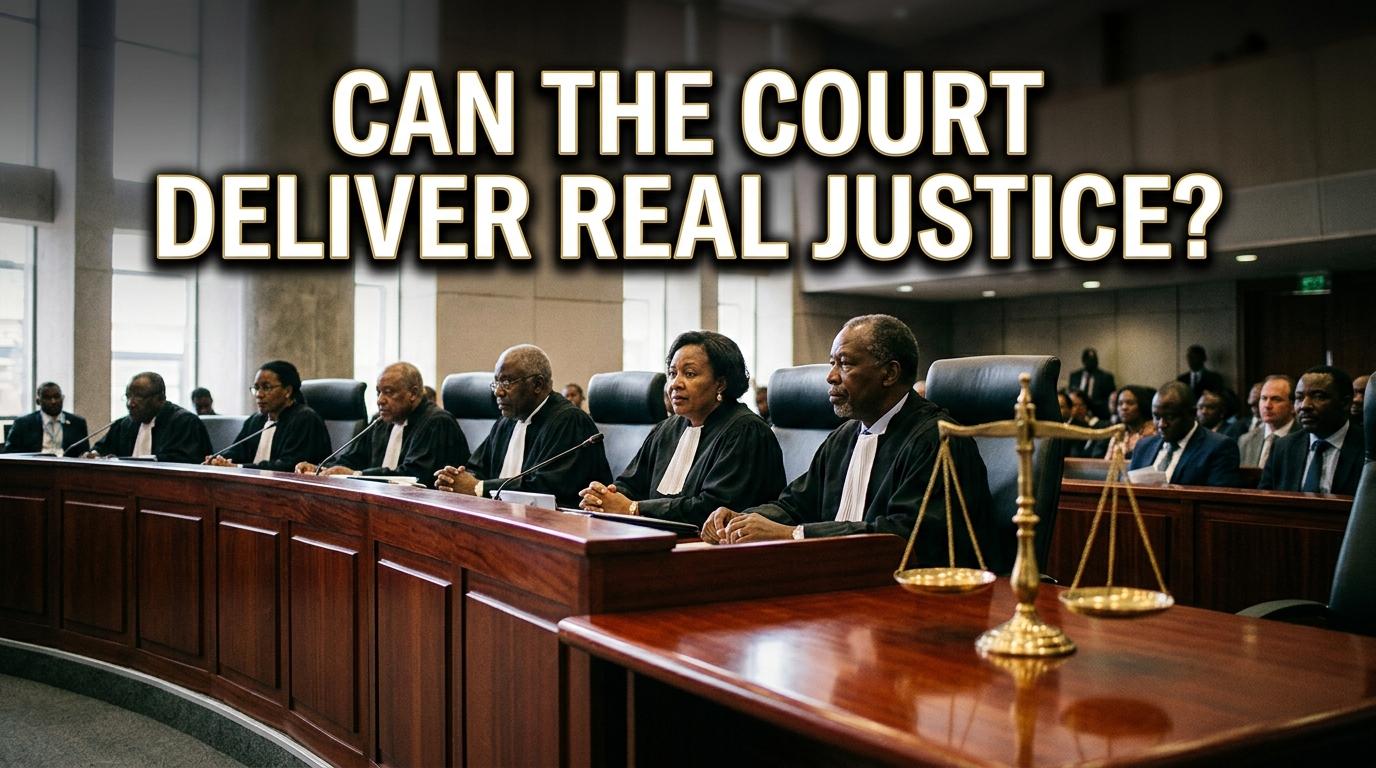
Can the African Court on Human Rights Deliver Real Justice?
By Darius Spearman (africanelements)
Support African Elements at patreon.com/africanelements and hear recent news in a single playlist. Additionally, you can gain early access to ad-free video content.
Two decades after its first bench of judges took the oath of office in Arusha, Tanzania, the African Court on Human and Peoples’ Rights stands at a historic crossroads (african-court.org). The judicial institution was created to turn continental human rights declarations into enforceable legal judgments (african-court.org). However, as human rights organizations across Africa commemorate twenty years of judicial operations, celebratory declarations are mixed with urgent warnings from civil society leaders (amnestyusa.org). The struggle to defend civil liberties across the continent mirrors historic civil rights struggles across the Black diaspora, where legal frameworks often promise protection that executive authorities hesitate to deliver.
Amnesty International published a detailed evaluation titled 20 Years of the African Court – Protect the Court, Protect the People to mark International Justice Day (amnestyusa.org, amnesty.org). The report highlights a glaring paradox in continental governance (amnestyusa.org). While the tribunal has produced groundbreaking decisions protecting journalists, indigenous populations, and political opposition figures, direct access to the institution for everyday citizens is rapidly shrinking (amnestyusa.org, justiceinfo.net). Understanding why this judicial mechanism faces such fierce political pushback requires examining the deep legal history behind the headlines.
Evolution of Continental Human Rights Adjudication
African Charter Adopted
The Organization of African Unity adopts the foundational human rights treaty for the continent.
African Commission Established
The Banjul Commission begins operations as a quasi-judicial monitoring organ.
Ouagadougou Protocol Adopted
Member states agree to create a binding court to reinforce the Commission.
First Bench Sworn In
Eleven inaugural judges take office in Arusha, launching judicial operations.
From Banjul to Arusha: The Quest for Continental Justice
The institutional foundations of continental human rights protection were established during the post-colonial restructuring of African governance (up.ac.za). In 1981, the Organization of African Unity adopted the African Charter on Human and Peoples’ Rights (up.ac.za). Six years later, in 1987, the African Commission on Human and Peoples’ Rights opened its headquarters in Banjul, The Gambia (up.ac.za). The creation of this supervisory organ marked a significant step forward for regional accountability (up.ac.za).
However, the Banjul Commission was established as a quasi-judicial body (up.ac.za). In public law, a quasi-judicial body is an administrative organ empowered to investigate complaints and issue findings, yet it lacks the legal authority to hand down binding court orders or enforce remedies (up.ac.za). When state authorities ignored the recommendations of the Commission, victims of human rights abuses had no legal venue to compel compliance (up.ac.za). Regional advocates recognized that moral suasion alone could not restrain state power (up.ac.za).
To overcome these enforcement structural limits, African leaders gathered in Ouagadougou, Burkina Faso, on June 9, 1998 (african-court.org, african-court.org). They adopted the Protocol to the African Charter on Human and Peoples’ Rights on the Establishment of an African Court on Human and Peoples’ Rights (african-court.org, african-court.org). This agreement established a permanent tribunal capable of rendering final, legally binding judgments against member states (african-court.org, up.ac.za). The Protocol officially entered into force on January 25, 2004, after obtaining the required fifteen state ratifications (african-court.org, african-court.org). On July 2, 2006, the first eleven judges took their oaths of office in Arusha, establishing the judicial seat of the tribunal (african-court.org, african-court.org).
The Transition from OAU to AU and the Legal Architecture
The institutional evolution of the judicial organ unfolded alongside radical shifts in continental integration (up.ac.za). In 2002, the Organization of African Unity officially disbanded and transformed into the African Union under its new Constitutive Act (up.ac.za). The OAU had been established in 1963 primarily to accelerate decolonization and eliminate apartheid (up.ac.za). In contrast, the African Union focused on economic integration, democratic governance, and institutional accountability (up.ac.za).
The newly formed African Union inherited all legal instruments from its predecessor, including the 1998 Ouagadougou Protocol (up.ac.za). Under this updated regional structure, responsibility for maintaining and overseeing the Arusha tribunal was transferred to two primary bodies (african-court.org, africacenter.org). The Assembly of Heads of State and Government retained authority to elect the eleven judges who serve staggered six-year terms (african-court.org). Meanwhile, the AU Executive Council was tasked with overseeing compliance and monitoring state execution of judicial orders (africacenter.org).
This structural arrangement embedded the court within the regional political system (african-court.org, africacenter.org). While the judges operate with strict judicial independence, their decisions rely on political institutions for actual enforcement (africacenter.org). This institutional separation between judicial decision-making and political execution has created long-standing enforcement challenges (africacenter.org). The dynamic remains central to ongoing legal debates across the continent (amnestyusa.org, africacenter.org).
Landmark Rulings and the Power of Progressive Jurisprudence
Despite significant political obstacles, the judicial tribunal has built an extensive body of progressive jurisprudence over two decades (amnestyusa.org). In legal terminology, jurisprudence refers to the collected precedents, case interpretations, and legal standards established by judicial rulings over time (scielo.org.mx). Through dozens of detailed opinions, the court has expanded interpretations of civil liberties, political participation, and economic rights across member states (amnestyusa.org).
One early decision was the landmark case of Norbert Zongo v. Burkina Faso (justiceinfo.net). Norbert Zongo was a prominent investigative reporter who was assassinated in 1998 while examining government corruption (justiceinfo.net). The court ruled that Burkina Faso had violated the African Charter by failing to thoroughly investigate the murder (justiceinfo.net). The judgment established a clear precedent that sovereign states bear an affirmative legal duty under international law to protect journalists and actively prosecute attacks against media figures (justiceinfo.net). That victory reflected efforts aimed at protecting human rights defenders who risk their lives to expose state abuses.
In another groundbreaking ruling, Ogiek Community v. Kenya, the tribunal delivered a major victory for indigenous rights (icj.org). The court found that the eviction of the indigenous Ogiek people from their ancestral lands in the Mau Forest violated their rights to property, culture, and natural resources (icj.org). This judgment established crucial legal protections across Africa by affirming that environmental protection efforts cannot be used to justify the arbitrary displacement of indigenous communities (icj.org). Additionally, the tribunal has invalidated laws permitting child marriage in Mali, abolished mandatory death penalty statutes, and challenged restrictive electoral rules across several nations (amnestyusa.org, justiceinfo.net).
AU Member State Participation Breakdown
The Article 34(6) Declaration and the Direct Access Crisis
Despite its significant rulings, the court faces a structural crisis that limits its ability to protect victims of human rights abuses (amnestyusa.org, justiceinfo.net). Out of fifty-five African Union member states, thirty-four have ratified the Protocol establishing the court (african-court.org, africancourtcoalition.org). However, ratifying the Protocol does not automatically allow citizens to bring cases before the judges in Arusha (justiceinfo.net, africancourtcoalition.org). Direct citizen access requires a distinct legal step governed by Article 34(6) of the Protocol (justiceinfo.net, africancourtcoalition.org).
Under treaty law, sovereign nations must give explicit consent before international judicial bodies accept claims directly from individual citizens or civil society organizations (columbialawreview.org, ouplaw.com). Optional clauses like Article 34(6) respect national sovereignty by allowing states to join regional agreements without immediately exposing themselves to direct litigation from private citizens (columbialawreview.org, ouplaw.com). Consequently, an individual can only file a case against a government if that state has deposited an optional declaration accepting direct jurisdiction (justiceinfo.net, africancourtcoalition.org).
Currently, only seven member states allow direct individual and non-governmental access (justiceinfo.net, africancourtcoalition.org). These nations are Burkina Faso, The Gambia, Ghana, Guinea-Bissau, Malawi, Mali, and Niger (africancourtcoalition.org). Historically, twelve states had deposited this declaration (justiceinfo.net, africancourtcoalition.org). However, five countries withdrew their acceptance after the court issued adverse political rulings against them (justiceinfo.net).
Rwanda initiated the withdrawals in 2016 following a political rights dispute involving opposition politician Ingabire Victoire Umuhoza (justiceinfo.net). Tanzania withdrew in 2019 amid a high volume of prison rights complaints (justiceinfo.net). Benin and Côte d’Ivoire both withdrew in 2020 after the court issued orders challenging local election regulations and political candidate disqualifications (justiceinfo.net). Most recently, Tunisia revoked its Article 34(6) declaration in March 2025 amid growing political consolidation (justiceinfo.net). This wave of withdrawals has drastically reduced direct legal options for millions of citizens across the continent (amnestyusa.org, justiceinfo.net).
State Withdrawal Timeline from Direct Jurisdiction
Bypassing the Wall: Alternate Routes to Continental Justice
When a state party revokes or refuses to sign an Article 34(6) declaration, direct access for its citizens is blocked (justiceinfo.net, africancourtcoalition.org). However, this restriction does not leave individuals completely without judicial recourse under continental law (up.ac.za, umn.edu). The governing framework contains alternate procedural pathways that allow human rights disputes to reach Arusha indirectly (up.ac.za, umn.edu).
Under Article 5(1)(a) of the Protocol, the African Commission on Human and Peoples’ Rights possesses explicit standing to submit cases directly to the court (up.ac.za, umn.edu). Citizens residing in non-declaration states can file complaints, known as communications, with the Banjul Commission (up.ac.za, umn.edu). The Commission evaluates the allegations, conducts investigations, and makes initial determinations regarding Charter violations (up.ac.za, umn.edu). If the state government refuses to comply with the recommendations of the Commission, the Commission can refer the dispute to the court for a final, binding judgment (up.ac.za, umn.edu).
Alternative pathways include state-to-state referrals or submissions by African Intergovernmental Organizations (up.ac.za). While these mechanisms provide legal options, they are often slow and subject to political delays (amnestyusa.org, up.ac.za). The intermediate screening step through Banjul can add years to an already lengthy legal process (amnestyusa.org, up.ac.za). Consequently, civil society coalitions continue to campaign for universal direct access, arguing that justice delayed is justice denied (amnestyusa.org).
Non-Compliance, Sovereign Resistance, and Enforcement Void
In addition to jurisdictional barriers, the tribunal faces low compliance rates with its rulings (amnestyusa.org, africacenter.org). Even when citizens win victories in Arusha, state authorities frequently delay or ignore order implementation (amnestyusa.org, africacenter.org). This unwillingness to fulfill constitutional promises and treaty obligations undermines the rule of law across the region.
The enforcement framework ultimately relies on political organs (africacenter.org). Under Article 23(2) of the African Union Constitutive Act, the Assembly of Heads of State and Government can impose sanctions against member states that fail to comply with continental decisions (africacenter.org). These potential sanctions include political isolation, suspension of voting rights, and the denial of transport and communications links (africacenter.org). However, the AU Assembly has historically hesitated to impose sanctions on member governments for failing to enforce judicial judgments (amnestyusa.org, africacenter.org). Sovereignty arguments frequently override enforcement efforts during regional summit discussions (amnestyusa.org, africacenter.org).
Furthermore, major geopolitical powers across the continent have failed to ratify the court protocol altogether (africanlegalstudies.blog). Nations such as Egypt, Ethiopia, Morocco, Angola, and Sudan remain completely outside the jurisdiction of the court (africanlegalstudies.blog). Ethiopia hosts the headquarters of the African Union in Addis Ababa, yet it has not ratified the protocol establishing the judicial organ of the union (africanlegalstudies.blog). The absence of these influential nations limits the geographic authority of the court and weakens continental accountability mechanisms (amnestyusa.org, africanlegalstudies.blog).
Former Leaders Speak Out and the Path Toward AU Agenda 2063
As the court completed its twentieth operational year, prominent figures gathered in Arusha to address the future of continental governance (witness.co.za, youtube.com). Serving as Guest of Honour, former Ghanaian President John Dramani Mahama delivered a speech urging current heads of state to support the tribunal (witness.co.za, youtube.com). He argued that national governments should view the court as a tool for stability rather than a threat to national sovereignty (witness.co.za, youtube.com). He emphasized that genuine economic progress requires respect for the rule of law and human dignity (witness.co.za, youtube.com).
Strengthening the judicial tribunal aligns directly with the long-term vision of the continent (up.ac.za). Under AU Agenda 2063, Aspiration 3 envisions an Africa governed by democratic values, social justice, and respect for human rights (up.ac.za). Judicial enforcement remains essential to realizing those objectives (up.ac.za). Expanding access to educational institutions, much like ongoing initiatives aimed at decolonizing educational systems, empowers citizens to defend their rights under continental legal frameworks.
The ongoing struggle to protect the court reflects broader efforts within historic Pan-African liberation movements. True independence requires robust domestic and regional institutions capable of protecting citizens from arbitrary power. As civil society coalitions enter a new decade of advocacy, their demand remains clear: member states must ratify the protocol, restore direct citizen access, and honor judicial decisions (amnestyusa.org). The future of human rights enforcement across Africa depends on whether continental leaders match their legal promises with political commitment (amnestyusa.org).
About the Author
Darius Spearman is a professor of Black Studies at San Diego City College, where he has been teaching for over 20 years. He is the founder of African Elements, a media platform dedicated to providing educational resources on the history and culture of the African diaspora. Through his work, Spearman aims to empower and educate by bringing historical context to contemporary issues affecting the Black community.
