


Can African Health Sovereignty Break Decades of Global Aid?
By Darius Spearman (africanelements)
Support African Elements at patreon.com/africanelements and hear recent news in a single playlist. Additionally, you can gain early access to ad-free video content.
The Gathering in Addis Ababa
Health ministers and public health leaders from forty-seven African nations met in Addis Ababa, Ethiopia, for the 76th Session of the World Health Organization Regional Committee for Africa (who.int, allafrica.com). The historic summit focused on achieving true continental self-reliance in medicine and public infrastructure (who.int, who.int). Leaders gathered to confront a long history of external dependency and systemic vulnerability (who.int, africa-newsroom.com).
Ethiopian Health Minister Dr. Mekdes Daba and WHO Regional Director for Africa Professor Mohamed Yakub Janabi opened the proceedings by urging decisive action (who.int, allafrica.com). Before the formal meetings, hundreds of delegates participated in a symbolic health march (allafrica.com, who.int). The march started at the Adwa Victory Memorial in the heart of Addis Ababa (allafrica.com). This starting point was chosen with deep intention (allafrica.com, wikipedia.org).
The Living Spirit of Adwa
The Battle of Adwa in 1896 remains a defining moment in modern African history (wikipedia.org). Emperor Menelik II and Empress Taytu Betul led Ethiopian forces to a decisive victory against an invading Italian army (wikipedia.org, britannica.com). That historic triumph shattered colonial myths of European military invincibility (wikipedia.org). It forced global powers to recognize Ethiopian sovereignty during the colonial partition of the continent (britannica.com).
Health leaders in Addis Ababa drew a clear connection between that military defense and the modern struggle for medical autonomy (allafrica.com). True political independence cannot exist without the ability to protect the health of a population (africacdc.org, weforum.org). In the modern era, relying entirely on foreign powers for life-saving medicine creates a dangerous form of subjugation (africacdc.org, thinkglobalhealth.org). The conference signaled that the defense of African lives must be self-determined (who.int, allafrica.com).
The African Medical Supply Deficit
Sub-Saharan Africa bears approximately 25% of the global disease burden yet remains critically dependent on foreign imports for essential treatments.
The Roots of Medical Dependency
Following the era of independence, many African health systems remained tied to external donor funding and vertical health programs (nih.gov, futureofghis.org). These vertical programs funneled money into single diseases like malaria or polio instead of building broad clinical systems (futureofghis.org, nih.gov). As a result, national primary healthcare systems remained underfunded and fragile (futureofghis.org).
This structural imbalance became devastating during the peak of the HIV/AIDS epidemic in the 1990s (nih.gov, thinkglobalhealth.org). Antiretroviral therapy transformed HIV from a fatal diagnosis into a manageable condition across the Western world (nih.gov). However, corporate monopolies and intellectual property rules kept medication prices prohibitively high in Africa (nih.gov, thinkglobalhealth.org). Millions of people died while waiting for affordable generic drugs to arrive through humanitarian programs (nih.gov, thinkglobalhealth.org). The crisis exposed the lethal consequences of relying on foreign supply chains (africacdc.org, thinkglobalhealth.org).
Structural Debt and the Abuja Pledge
Economic policies imposed by international financial institutions further weakened healthcare spending across the continent (nih.gov, nih.gov). Structural Adjustment Programs throughout the 1980s and 1990s forced governments to slash social spending, freeze civil service hiring, and reduce clinic budgets (nih.gov, sajems.org). These policies gutted public clinics and sparked a severe brain drain of medical professionals (nih.gov, sajems.org).
In April 2001, African heads of state met in Nigeria to address this systemic underinvestment (mamaye.org, nih.gov). Leaders signed the Abuja Declaration, pledging to allocate at least fifteen percent of national budgets to healthcare (mamaye.org, nih.gov). However, many nations have struggled to meet this benchmark due to crushing debt burdens (nih.gov, sajems.org). Heavy debt obligations continue to crowd out social services, leaving healthcare systems vulnerable to external shocks (sajems.org, nih.gov).
The 2001 Abuja Declaration Spending Reality
Pledged commitment versus the practical budgetary allocations across African Union Member States.
Institutional Awakening After Ebola
The catastrophic Ebola epidemic in West Africa between 2014 and 2016 served as another major turning point (africacdc.org, cdc.gov). The virus claimed over eleven thousand lives across Guinea, Liberia, and Sierra Leone (africacdc.org, cdc.gov). International assistance arrived slowly, highlighting the urgent need for a coordinated regional defense body (africacdc.org, africa-newsroom.com).
In response, the African Union established the Africa Centres for Disease Control and Prevention in 2017 (africacdc.org, cdc.gov). Headquartered in Addis Ababa, the Africa CDC was built to lead continental epidemic response and disease surveillance (africacdc.org, africa-newsroom.com). Two years later, the African Union adopted the treaty for the African Medicines Agency to standardize pharmaceutical regulation across national borders (africacdc.org, unctad.org). African leaders recognized that regulatory fragmentation hindered the approval and distribution of essential treatments (africacdc.org, unctad.org).
Vaccine Apartheid and the Pandemic Awakening
The COVID-19 pandemic revealed profound global inequities in real time (healthpolicy-watch.news, africacdc.org). When effective vaccines became available, wealthy countries hoarded supplies through advance purchase agreements (healthpolicy-watch.news, thinkglobalhealth.org). Wealthy nations secured enough doses to cover their populations multiple times over (healthpolicy-watch.news, thinkglobalhealth.org). Meanwhile, African countries were left waiting at the back of the queue (healthpolicy-watch.news, africacdc.org).
This dynamic was widely described as vaccine apartheid (healthpolicy-watch.news, thinkglobalhealth.org). Donor-led mechanisms like COVAX faced severe delivery delays when exporting nations restricted trade (healthpolicy-watch.news, african.business). In response, the African Union launched the African Vaccine Acquisition Task Team, known as AVAT (africacdc.org, african.business). Backed by a two-billion-dollar guarantee facility from Afreximbank, AVAT directly purchased over two hundred million vaccine doses (africacdc.org, african.business). The initiative proved that pooled continental procurement could secure supplies when global charity fell short (africacdc.org, african.business).
Vaccine Manufacturing Vision (PAVM 2040)
African Union strategic roadmap to scale continental vaccine production capacity.
Facing the Looming Aid Cliff
Today, the urgency for self-reliance is amplified by a sharp contraction in international development aid (cgdev.org, thinkglobalhealth.org). Western nations face domestic economic challenges and shifting political priorities, resulting in reduced global health budgets (cgdev.org). This abrupt reduction, often called the aid cliff, threatens clinical operations across low-income countries (cgdev.org, thinkglobalhealth.org). Critical programs for HIV, tuberculosis, and malaria face potential disruptions (cgdev.org, thinkglobalhealth.org).
To navigate this transition, African leaders endorsed the Lusaka Agenda in late 2023 (futureofghis.org). The roadmap demands fundamental changes in global health financing (futureofghis.org). It calls for integrating vertical donor programs into national health strategies and ending parallel administrative systems (futureofghis.org, thinkglobalhealth.org). Health ministers at RC76 stressed that domestic tax mobilization and regional funding must replace dwindling foreign grants (who.int, futureofghis.org). True sustainability requires domestic ownership of public health budgets (who.int, futureofghis.org).
Building Local Manufacturing Capacity
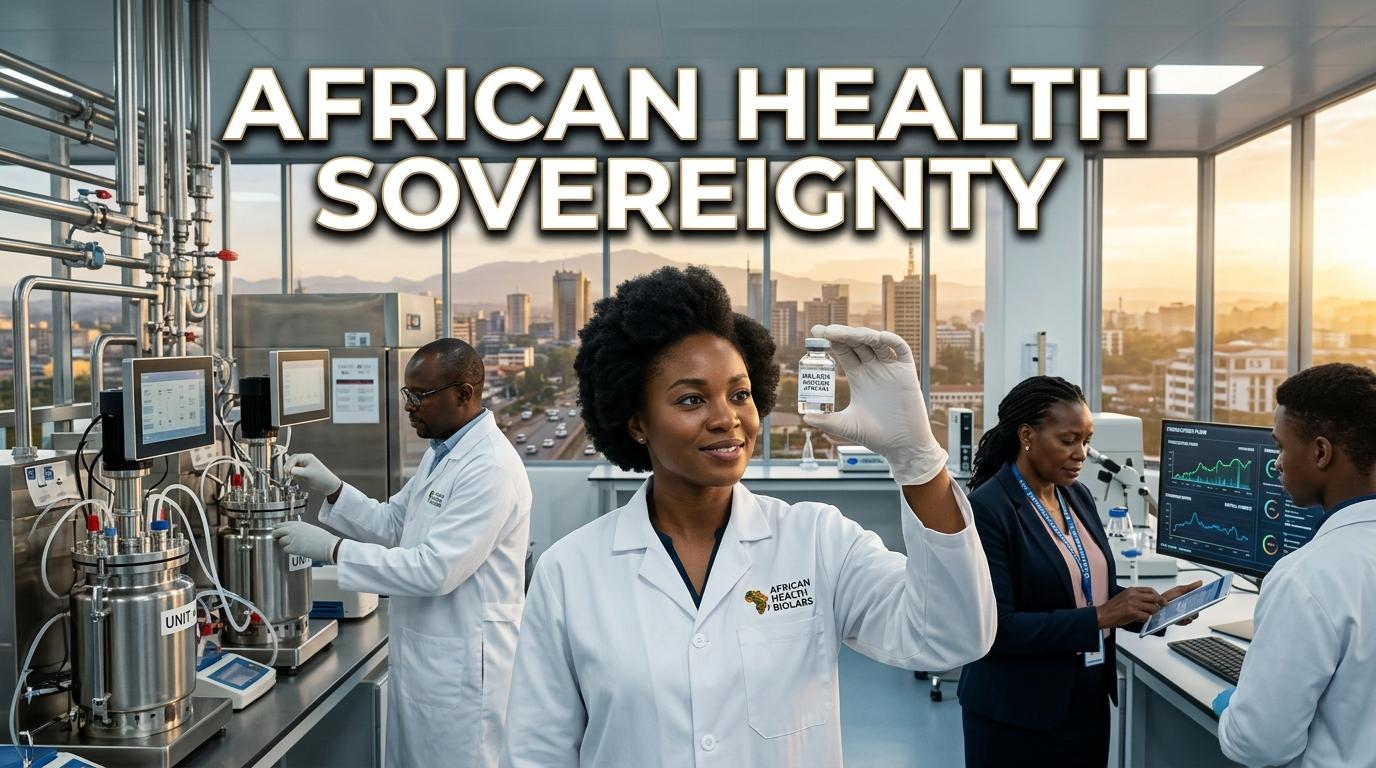
A central pillar of the African health sovereignty agenda is the expansion of domestic pharmaceutical manufacturing (africacdc.org, unctad.org). African nations currently produce less than three percent of the medicines consumed on the continent (unctad.org, weforum.org). Furthermore, over ninety-five percent of Active Pharmaceutical Ingredients are imported from Asia (unctad.org). Local factories frequently operate as packaging plants rather than end-to-end chemical synthesis facilities (unctad.org).
The African Union established the Partnerships for African Vaccine Manufacturing to address this vulnerability (africacdc.org, african.business). The initiative aims to produce sixty percent of the continent’s routine vaccines locally by the year 2040 (africacdc.org). Achieving this objective requires building bio-manufacturing hubs, training specialized scientists, and establishing reliable power grids (african.business, unctad.org). African facilities also require active technology transfer and equitable patent licensing rather than closed corporate monopolies (african.business, thinkglobalhealth.org). Efforts toward decolonizing institutions will support the scientific research required to develop local biotechnology pipelines (uct.ac.za, unctad.org).
Integrated Defense and the One Health Model
Continental health security also demands modern disease surveillance systems (who.int, igad.int). A large majority of emerging infectious diseases are zoonotic, originating in animal populations before crossing over into humans (cdc.gov). Habitat encroachment, environmental changes, and rapid urbanization increase the frequency of these spillover events across the globe (cdc.gov).
Health leaders at RC76 emphasized the necessity of the One Health framework (who.int, igad.int). This strategy integrates human medicine, veterinary science, and environmental monitoring into a single early-warning network (who.int, cdc.gov). Regional surveillance centers under the Africa CDC now track biological threats in real time (africacdc.org, cdc.gov). Detecting outbreaks before they escalate into global emergencies protects both continental and worldwide health security (igad.int, africacdc.org).
Shared Struggles Across the Diaspora
The drive for African health sovereignty connects directly to the historical struggles of the wider African diaspora (nih.gov, nih.gov). For centuries, Black populations on the continent and across the Americas have navigated systems of medical neglect and exploitation (nih.gov, nih.gov). From colonial-era medical trials to the Tuskegee Syphilis Study, medical systems have often treated Black bodies with indifference (nih.gov, nih.gov). These historical injustices have created lasting health disparities across communities worldwide (nih.gov, nih.gov).
The resilience of Black communities has consistently driven the creation of autonomous institutions to secure survival (nih.gov). Black communities have repeatedly built mutual aid societies, community clinics, and independent medical schools to overcome institutional exclusion (nih.gov). These historical struggles mirror the current continental effort to dismantle foreign medical dependency (africacdc.org, nih.gov). Decolonizing global health governance ensures that Black populations everywhere gain control over their healthcare resources and bodily autonomy (africacdc.org, nih.gov).
From Policy Declarations to Continental Action
Achieving health sovereignty requires turning high-level policy declarations into measurable investments on the ground (who.int, allafrica.com). African governments must enforce regional procurement preferences to guarantee local pharmaceutical plants have steady consumer demand (africacdc.org, unctad.org). The African Continental Free Trade Area provides an opportunity to create a unified market of 1.4 billion people (african.business, unctad.org). A consolidated regional market allows local factories to achieve economies of scale and compete effectively against imported generic drugs (african.business, unctad.org).
The 76th Session of the WHO Regional Committee for Africa in Addis Ababa represents a decisive step toward self-reliance (who.int, allafrica.com). African leaders are moving away from traditional models of charitable dependency (who.int, futureofghis.org). By investing in domestic manufacturing, pooled procurement, and scientific research, the continent is laying the foundation for permanent health independence (africacdc.org, african.business). Health is no longer treated merely as a social cost, but as a vital foundation for continental sovereignty and economic freedom (who.int, weforum.org).
About the Author
Darius Spearman is a professor of Black Studies at San Diego City College, where he has been teaching for over 20 years. He is the founder of African Elements, a media platform dedicated to providing educational resources on the history and culture of the African diaspora. Through his work, Spearman aims to empower and educate by bringing historical context to contemporary issues affecting the Black community.
