


Why Ghana and Jamaica Are Leading the Global Reparations Push
By Darius Spearman (africanelements)
Support African Elements at patreon.com/africanelements and hear recent news in a single playlist. Additionally, you can gain early access to ad-free video content.
Transatlantic History Written in Law: A Historic Accord
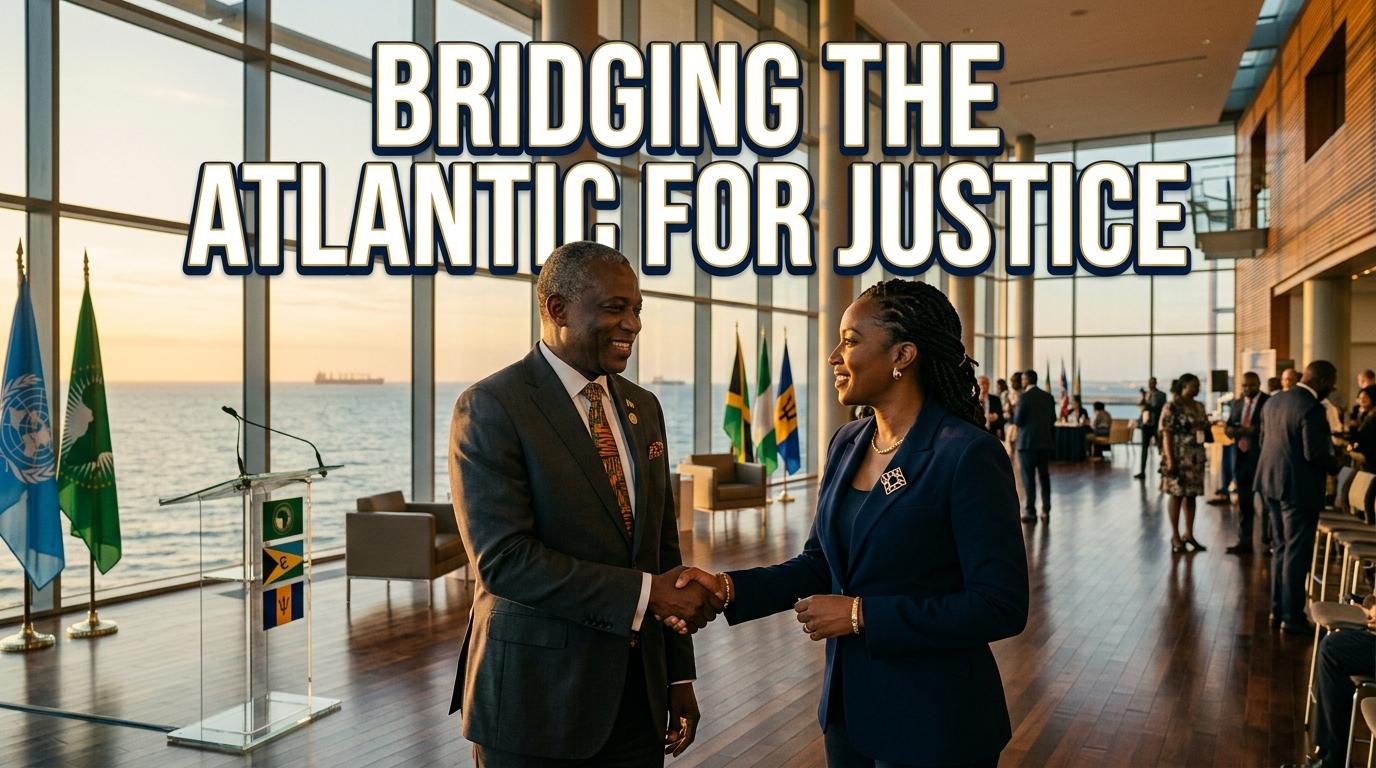
A major shift in international diplomacy occurred during the state visit of Ghanaian President John Dramani Mahama to Jamaica (jis.gov.jm). Alongside Jamaican Prime Minister Andrew Holness, President Mahama formalized bilateral commitments designed to transform the movement for global reparatory justice (jis.gov.jm, jis.gov.jm). The two nations established a United Nations-backed High-Level Global Advisory Council on Reparatory Justice (jis.gov.jm, jis.gov.jm). This body links Africa and the Caribbean in a structured diplomatic alliance (mfa.gov.gh, mfa.gov.gh).
The formalization of this council represents the culmination of five centuries of shared history (jnht.com, wikipedia.org). What began centuries ago as grassroots resistance among enslaved Africans has evolved into state policy and international law (caricomreparations.org, reparationscomm.org). By anchoring their demands in multilateral institutions, Ghana and Jamaica are building a permanent diplomatic bridge across the Atlantic Ocean (jis.gov.jm, mfa.gov.gh). This bridge directly addresses the long-term economic, social, and political damage caused by chattel slavery and colonial rule (cadtm.org, brattle.com).
During the summit in Kingston, Prime Minister Holness accepted an appointment to serve on the Global Advisory Council alongside other prominent regional leaders (jis.gov.jm, jis.gov.jm). These members include Barbadian Prime Minister Mia Amor Mottley, former Saint Vincent Prime Minister Ralph Gonsalves, and Vice-Chancellor of the University of the West Indies Sir Hilary Beckles (jis.gov.jm, jis.gov.jm). Together, this council provides high-level political direction to coordinate advocacy across the United Nations, the African Union, and the Caribbean Community (jis.gov.jm, caricom.org).
UN Resolution A/RES/80/250 Vote Breakdown
Historic UN General Assembly Vote on Slavery as a Crime Against Humanity
The Deep Roots: From West African Shores to Jamaican Resistance
The relationship between Ghana and Jamaica was created through the violence of the transatlantic slave trade (jnht.com, wikipedia.org). Between the sixteenth and nineteenth centuries, the Gold Coast served as a primary point of departure for captive West Africans shipped across the Atlantic Ocean (jnht.com, study.com). Over one million enslaved Africans were brought to Jamaica under British colonial rule (jnht.com). A large percentage of these captives originated from Gold Coast peoples, including the Akan and Coromantee groups (jnht.com, wikipedia.org).
These captive West Africans arrived in Jamaica with rich traditions of political organization, agricultural knowledge, and military tactics (wikipedia.org). Enslaved Gold Coast captives frequently organized plantation uprisings across the island (wikipedia.org). Many escaped into the dense interior to form independent Maroon communities in regions like the Cockpit Country and the Blue Mountains (wikipedia.org). These Maroon societies maintained distinct West African cultural practices and successfully waged guerrilla warfare against British forces (wikipedia.org). Their efforts eventually forced the British Crown to sign peace treaties granting them legal autonomy in the eighteenth century (wikipedia.org).
Physical landmarks across both nations continue to bear witness to this ancestral connection (jnht.com). In Jamaica, sites like Seville Heritage Park in St. Ann preserve the physical history of this transatlantic migration (jnht.com). Seville was an early Spanish settlement that later became a major British sugar plantation (jnht.com). Archaeological excavations at the site revealed preserved Ghanaian-style housing structures and ancestral burial sites constructed by enslaved West Africans (jnht.com). These physical artifacts reflect the complex societies that existed in Africa before European colonization, which captives worked to replicate in the Americas (jnht.com).
The cultural influence of the Gold Coast remains evident in contemporary Jamaican language, spiritual traditions, and folklore (wikipedia.org). Concepts of spiritual resilience and community solidarity passed down from West African ancestors helped sustain the population through generations of severe hardship (jnht.com, wikipedia.org). Today, leaders in both Kingston and Accra view their current political alliance not as a modern political creation, but as the fulfillment of a long historical bond forged through shared survival and resistance (jis.gov.jm, jnht.com).
Pan-African Legacies and the Path to UN Resolution A/RES/80/250
The diplomatic foundation for modern reparatory justice draws heavily upon twentieth-century Pan-African thought (harvard.edu, wikipedia.org). Jamaican national hero Marcus Garvey played a central role by founding the Universal Negro Improvement Association in 1914 (wikipedia.org). Garvey advocated for economic independence, political sovereignty, and global Black solidarity (wikipedia.org). His vision inspired subsequent anti-colonial leaders across the African continent and the Caribbean diaspora (wikipedia.org, wikipedia.org).
When Ghana achieved independence in 1957 as the first sub-Saharan nation to break from colonial rule, Prime Minister Kwame Nkrumah declared that Ghanaian freedom was incomplete without the total liberation of Africa (wikipedia.org). Nkrumah welcomed African American and Caribbean intellectuals, including W.E.B. Du Bois, positioning Accra as an intellectual hub for global Pan-Africanism (harvard.edu, wikipedia.org). This legacy laid the groundwork for institutional efforts to seek legal redress for historical colonial exploitation (cadtm.org, reparationscomm.org).
Over the past three decades, this political ideology gradually transformed into concrete international policy commitments (cadtm.org, caricomreparations.org, reparationscomm.org):
- 1993 Abuja Proclamation: Organized by the Organization of African Unity, this conference formally declared that a moral and financial debt was owed to African nations for centuries of enslavement and colonization (cadtm.org).
- 2001 Durban Declaration: Adopted at the UN World Conference Against Racism in South Africa, this document recognized chattel slavery and the transatlantic slave trade as crimes against humanity (reparationscomm.org).
- 2013 CARICOM 10-Point Plan: Drafted by Caribbean heads of government, this document established a clear framework demanding formal apologies, debt cancellation, and structural development assistance from European nations (caricomreparations.org).
- 2023 Accra Proclamation: Convened by the African Union and Ghana, this summit established a global front uniting African and Caribbean states to demand financial and political repair (mfa.gov.gh).
These foundational efforts culminated in the adoption of Resolution A/RES/80/250 by the United Nations General Assembly on March 25, 2026 (un.org, un.org). Spearheaded by Ghana and supported by African Union and CARICOM member states, the landmark resolution passed with 123 votes in favor, 3 against, and 52 abstentions (un.org, un.org). The resolution formally designated the transatlantic trade in enslaved Africans and racialized chattel slavery as the gravest crimes against humanity in world history (un.org, un.org).
Quantified Slavery Liabilities by Nation (Brattle Report)
Estimated Present Value Debt Based on Historical Stolen Labor and Harms (Trillions USD)
Quantifying Five Centuries of Debt: The Economics of Slavery
A central pillar of the joint Ghana-Jamaica strategy involves applying economic modeling to quantify historical financial liabilities (brattle.com, brattle.com). For decades, opponents argued that calculating financial compensation for historic enslavement was impossible (quillette.com). However, rigorous scientific studies have challenged that assumption by providing precise financial calculations (brattle.com, brattle.com).
In 2023, a landmark economic report published by The Brattle Group and presented at the University of the West Indies Mona calculated global reparations liabilities (brattle.com, brattle.com). The study evaluated the economic impact of centuries of uncompensated economic labor, loss of life, physical injury, and post-abolition wealth extraction across thirty-one enslaving nations (brattle.com, brattle.com). The report estimated total global reparations liabilities to range between $107.8 trillion and $131 trillion (brattle.com, brattle.com).
The report assigned significant financial liabilities to former colonial powers (brattle.com, brattle.com). The United Kingdom carries an estimated liability of $24 trillion across fourteen Caribbean nations, with $9.5 trillion owed directly to Jamaica (brattle.com). Meanwhile, the United States carries an estimated liability of $26 trillion (brattle.com). These quantitative metrics offer empirical support for domestic movements, such as the work carried out by a state-level reparations task force seeking economic repair within North America.
The economic necessity for repair is further highlighted by historical policies implemented at the time of emancipation (bankofsaintlucia.com, theguardian.com). Under the British Slavery Abolition Act of 1833, the British government provided £20 million in financial compensation—equivalent to approximately £17 billion today—not to formerly enslaved people, but to 46,000 plantation owners for the loss of their “property” (bankofsaintlucia.com, theguardian.com). Formerly enslaved Africans in Jamaica received zero financial assistance and no land redistribution (bankofsaintlucia.com, theguardian.com). This massive transfer of public capital enriched British financial institutions while leaving newly freed populations trapped in severe generational poverty (cadtm.org, bankofsaintlucia.com).
Beyond Cash Handouts: Reframing Reparations as Systemic Repair
In their joint declarations, President Mahama and Prime Minister Holness emphasized a modern understanding of reparatory justice (jis.gov.jm, jis.gov.jm). Both leaders stressed that reparations must extend beyond individual cash payments (jis.gov.jm, jis.gov.jm). Instead, the diplomatic push focuses on structural economic investment, institutional capacity building, and systemic international reforms (jis.gov.jm, jis.gov.jm, caricomreparations.org).
Developing nations across Africa and the Caribbean continue to struggle with disproportionate debt burdens (cadtm.org, caricomreparations.org). These high debt levels stem directly from colonial resource extraction and unfair global trade structures (cadtm.org). Consequently, the High-Level Global Advisory Council frames sovereign debt cancellation as a necessary component of reparatory justice (jis.gov.jm, caricomreparations.org). Canceling unsustainable commercial debt allows developing nations to redirect vital national funds toward public education, modern healthcare, and climate change resilience (jis.gov.jm, caricomreparations.org).
The bilateral agreements signed between Ghana and Jamaica provide a practical demonstration of this vision (radiojamaicanewsonline.com, jis.gov.jm). During the summit in Kingston, both governments operationalized agreements to recruit Ghanaian health professionals to serve in Jamaican public hospitals (radiojamaicanewsonline.com, jis.gov.jm). This initiative directly addresses severe staffing shortages in the Caribbean healthcare sector (radiojamaicanewsonline.com). It also provides a practical countermeasure to address historical medical trauma and long-standing underinvestment in public health infrastructure caused by colonial legacies (radiojamaicanewsonline.com, caricomreparations.org).
Four Pillars of the Global Reparations Framework
Institutional Structure Established by Ghana and Jamaica
1. Global Advisory Council
High-level political body aligning strategy across UN, AU, and CARICOM leadership.
2. Global Legal Panel
Legal experts building evidentiary dockets and litigating monarchical/state liability.
3. Cultural Restitution Panel
Facilitating unconditional return of stolen African artifacts, regalia, and human remains.
4. Economic Reform Body
Integrating reparations into sovereign debt cancellation and climate fund transfers.
Legal Strategies and Global Diplomacy in Action
The diplomatic partnership between Ghana and Jamaica introduces new legal mechanisms to challenge former colonial powers (jamaica-gleaner.com). Jamaica is advancing a formal legal petition addressed to King Charles III and the British Monarchy (jamaica-gleaner.com). The petition seeks to refer specific legal questions regarding monarchical liability for chattel slavery to the Judicial Committee of the Privy Council (jamaica-gleaner.com). Because the Privy Council remains Jamaica’s highest appellate authority under its 1962 independence constitution, this petition utilizes an existing constitutional court framework to evaluate Crown liability (jamaica-gleaner.com, conyers.com).
Ghana’s formal co-sponsorship provides essential cross-continental support for this legal strategy (jis.gov.jm, jamaica-gleaner.com). By uniting an independent West African sovereign state with a Commonwealth Caribbean nation, the petition expands beyond a regional claim into a broader Pan-African legal mandate (jis.gov.jm, mfa.gov.gh). This strategy forces Western legal systems to address the ongoing legal consequences of colonial enslavement under international human rights law (asil.org, icj.org).
However, this global movement faces strong resistance from several Western governments (un.org, un.org). During the vote on UN Resolution A/RES/80/250, three nations—the United States, Israel, and Argentina—voted against the measure (un.org, un.org). Additionally, fifty-two nations, primarily Western European governments, chose to abstain (un.org, un.org). Representatives from opposing states expressed concern that declaring chattel slavery a crime against humanity with financial consequences could create binding legal liabilities for state institutions and commercial enterprises in domestic courts (un.org, un.org).
Despite these diplomatic hurdles, the High-Level Global Advisory Council continues to expand its diplomatic coordination (jis.gov.jm, jis.gov.jm). Lacking direct enforcement powers, the council relies on multilateral diplomatic pressure, economic negotiations, and international coalition building (jis.gov.jm, mfa.gov.gh). By coordinating voting blocs across the African Union, CARICOM, and the Community of Latin American and Caribbean States, the council ensures that reparatory justice remains a permanent item on the United Nations agenda (jis.gov.jm, un.org).
A Unified South-South Corridor for the Future
The state visit to Kingston demonstrated that the push for historical justice is directly tied to present-day economic development (jis.gov.jm, radiojamaicanewsonline.com). Beyond legal claims, President Mahama and Prime Minister Holness operationalized agreements through the third Jamaica-Ghana Permanent Joint Commission on Cooperation (jis.gov.jm, radiojamaicanewsonline.com). These agreements span defense cooperation, direct air travel logistics, cultural exchanges, and trade expansion (jis.gov.jm, radiojamaicanewsonline.com).
Establishing direct air routes and commercial travel corridors between West Africa and the Caribbean represents a critical practical priority (jis.gov.jm, radiojamaicanewsonline.com). Historically, travel and trade between Africa and the Caribbean required transit through European or North American hubs (radiojamaicanewsonline.com). Direct transport links reduce transaction costs, facilitate bilateral trade, and promote tourism across the diaspora (jis.gov.jm, radiojamaicanewsonline.com). These commercial corridors enable developing nations to build self-reliant trade networks independent of traditional colonial routes (jis.gov.jm, radiojamaicanewsonline.com).
The joint initiative between Ghana and Jamaica offers a working model for modern South-South diplomatic cooperation (jis.gov.jm, mfa.gov.gh). By combining historical memory with concrete policy frameworks, both nations demonstrate how shared historical trauma can be transformed into effective geopolitical leadership (jis.gov.jm, jis.gov.jm). As the African Union embarks on its designated Decade of Reparations, the alliance between Accra and Kingston provides a clear roadmap for achieving international justice, economic equity, and human dignity (jis.gov.jm, peaceau.org).
About the Author
Darius Spearman is a professor of Black Studies at San Diego City College, where he has been teaching for over 20 years. He is the founder of African Elements, a media platform dedicated to providing educational resources on the history and culture of the African diaspora. Through his work, Spearman aims to empower and educate by bringing historical context to contemporary issues affecting the Black community.
