


Why African Farmers Are Fighting Corporate Seed Laws
By Darius Spearman (africanelements)
Support African Elements at patreon.com/africanelements and hear recent news in a single playlist. Additionally, you can gain early access to ad-free video content.
The Push for Corporate Monopolies and Seed Harmonization
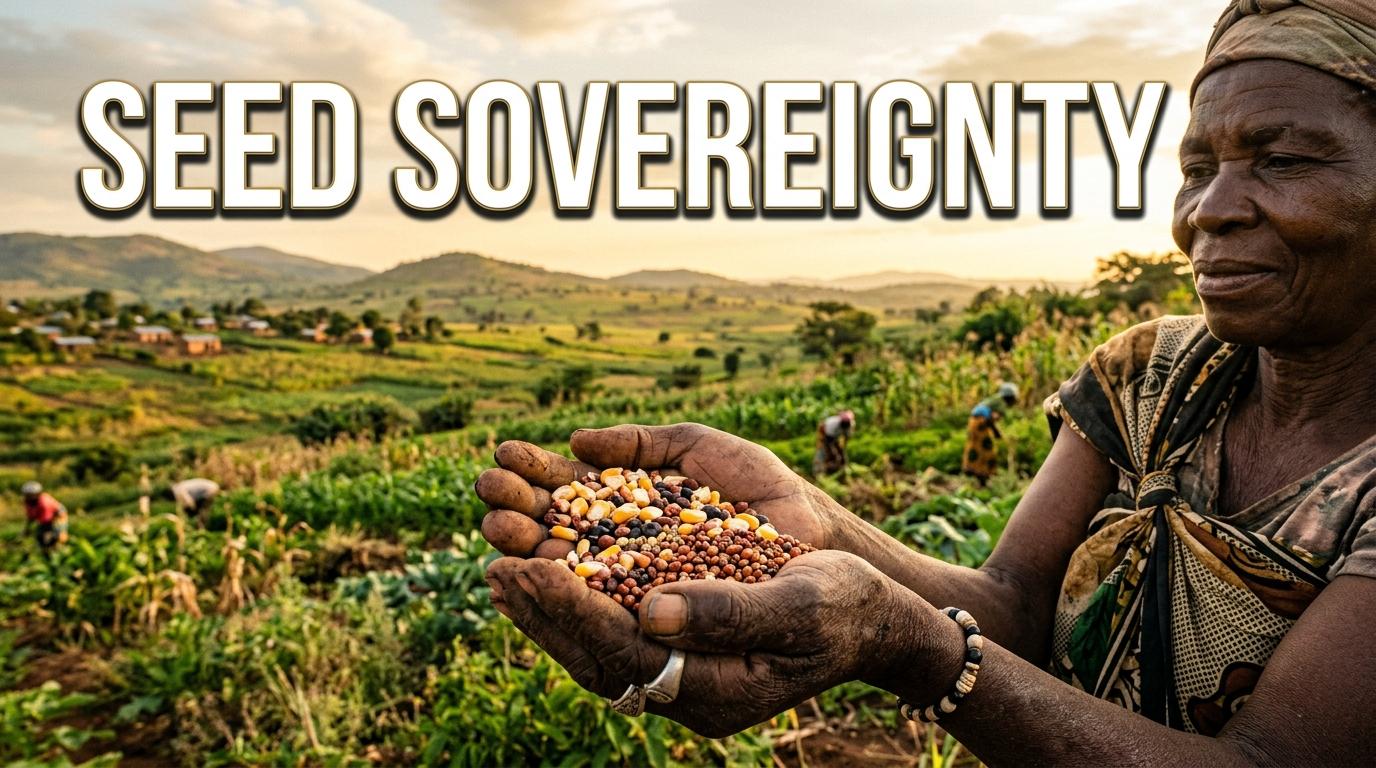
For generations, African smallholders depended on Farmer-Managed Seed Systems (FMSS). Farmers saved, selected, exchanged, and cross-bred indigenous seeds freely across local networks (grain.org). These traditional community systems preserved natural agricultural biodiversity. Furthermore, they protected rural villages against microclimate shifts and environmental shocks across West, East, and Southern Africa (afsafrica.org).
In 2006, foreign philanthropic foundations launched the Alliance for a Green Revolution in Africa (AGRA) (cagj.org). Promoters pledged to modernize African farming by introducing commercial hybrid seeds, synthetic fertilizers, and chemical pesticides (grain.org). AGRA leadership claimed crop productivity and farmer incomes would double across thirteen target countries by 2020 (cagj.org). However, independent empirical evaluations revealed that staple crop yields increased by only 18 percent over twelve years (cidse.org). Meanwhile, undernourishment rose by 30 percent across those same focus nations (cidse.org).
To support commercial seed expansion, regional economic bodies pushed national legislation harmonizing seed laws under UPOV 1991 standards (grain.org). The UPOV 1991 framework grants strict intellectual property rights to commercial plant breeders (cbd-alliance.org). Consequently, Plant Variety Protection (PVP) acts outlaw the traditional practice of saving, swapping, or selling farm-saved proprietary seeds (grain.org). Civil society organizations warn that these laws transform living seeds into private corporate property, forcing smallholders into perpetual reliance on multinational corporations (afsafrica.org).
AGRA Promises vs. Empirical Reality
12-Year Performance Evaluation Metrics Across Priority Focus Nations
Seeds of Debt: The Economic Impact on Smallholder Farmers
Commercial seed mandates create a heavy financial burden for smallholder farming families. Proprietary hybrid and genetically modified seeds require annual purchases because saved seeds lose vigor or violate patent restrictions (grain.org). Furthermore, these commercial seeds depend on specific chemical fertilizers and synthetic pesticides to produce expected yields (inadesformation.net).
Direct seasonal seed expenses absorb 15 to 30 percent of an average smallholder’s operating budget in West Africa (tridge.com). When extreme weather strikes, commercial crops frequently fail under local environmental stress. Consequently, smallholders accumulate debt while attempting to repay input loans (inadesformation.net). These economic shocks trigger land sales, asset loss, and forced migration to urban centers (inadesformation.net). These harsh realities mirror historical patterns where failed agricultural promises stripped agrarian communities of financial independence.
In response, farmer coalitions across the continent are asserting rights over traditional seed systems (afsafrica.org). Organizations like the Alliance for Food Sovereignty in Africa advocate for national seed policy reforms (afsafrica.org). They demonstrate that farmer-managed seeds eliminate seasonal input debt while maintaining stable crop yields during changing weather patterns (afsafrica.org, grain.org).
Legal Battlegrounds: Reversing GMO Approvals in South Africa and East Africa
Courtrooms have become primary sites of resistance against corporate agricultural expansion. In South Africa, the African Centre for Biodiversity launched legal challenges against state approvals for Bayer/Monsanto’s MON87460 drought-tolerant maize (afsafrica.org). In October 2024, the Supreme Court of Appeal issued a judgment setting aside the commercial approval permit (afsafrica.org). The court found that government decision-makers failed to require rigorous environmental assessments prior to commercial release (afsafrica.org).
Furthermore, in late 2025, the Constitutional Court of South Africa dismissed a final appeal brought by government ministers and biotech entities (afsafrica.org). The highest court affirmed that state regulators must strictly enforce the Precautionary Principle (afsafrica.org). The Precautionary Principle mandates that when scientific uncertainty exists regarding environmental or health hazards, authorities must adopt a cautious approach and withhold commercial deployment (afsafrica.org).
Similarly, legal challenges stalled commercial biotech expansion in East Africa. The Kenyan government abruptly lifted a ten-year ban on genetically modified crop imports in October 2022 (nationofchange.org). However, public interest organizations, including the Kenya Peasants League, filed actions to protect local seeds (kenaff.org). In March 2025, the Kenya Court of Appeal reinstated the import ban (nationofchange.org). The court ruled that public health and biosafety protections override commercial distribution interests (nationofchange.org).
Key Agricultural Litigation & Policy Rulings
Ghana High Court Ruling on Bt Cowpea
Accra Human Rights Court mandates immediate, strict commercial labeling and public disclosures for all GMO products.
South Africa Supreme Court of Appeal
SCA sets aside state approval for Bayer/Monsanto GM maize due to lack of statutory environmental assessments.
African Union Post-Malabo Framework
AU Summit in Kampala officially adopts the 2026–2035 CAADP action plan prioritizing resilient agrifood systems.
Kenya Court of Appeal GMO Decision
Court reinstates prohibition on GMO crop imports, citing health, environmental, and biosafety concerns.
South Africa Constitutional Court Affirmation
Highest court upholds judgment against GM maize approval, setting legal precedent for the Precautionary Principle.
West African Resistance: The Lessons of Ghana and Burkina Faso
West Africa provides clear examples regarding commercial seed adoption and public resistance. In 2008, Burkina Faso introduced genetically modified Bt cotton engineered with *Bacillus thuringiensis* bacterial genes (grain.org, gmwatch.org). The modified technology aimed to suppress destructive bollworm caterpillars without external chemical sprays (gmwatch.org). However, over consecutive harvests, the GM cotton compromised lint quality and reduced fiber length (gmwatch.org).
By 2016, Burkinabè cotton companies completely phased out Bt cotton and returned to conventional seeds (gmwatch.org). Local ginners demanded 280 million dollars in compensation from Monsanto for lost export market value (gmwatch.org). This experience demonstrated the risks of replacing indigenous crop varieties with single-trait commercial seeds (grain.org). Smallholders who spent generations working in cotton fields suffered economic losses during the commercial transition.
In Ghana, civil society groups challenged state approvals for genetically modified crops. Food Sovereignty Ghana filed legal action against the National Biosafety Authority over Bt cowpea (environewsnigeria.com). Bt cowpea is modified to resist the *Maruca pod borer* caterpillar pest (africasciencenews.org). Plaintiffs presented concerns regarding digestive health risks, potential allergenicity, and the creation of insecticide-resistant superbugs (africasciencenews.org). In May 2024, the Accra Human Rights Court dismissed the injunction against commercial release (myjoyonline.com). However, the court issued mandatory directives requiring immediate commercial labeling and continuous public education regarding all GMO sales (myjoyonline.com).
Food Security Versus Food Sovereignty
The agricultural battle across Africa highlights a clash between two fundamentally different policy visions. Commercial developers focus on food security (fian.org). Food security defines progress through the physical and market availability of calories, regardless of production origin or corporate ownership (fian.org). Under a food security framework, food demands are satisfied through imported grain, corporate monocultures, or proprietary seeds (fian.org).
Conversely, smallholder networks organize around food sovereignty (afsafrica.org). Food sovereignty asserts the right of local populations to control their own food systems, land, water, and seeds (fian.org). It prioritizes sustainable, ecologically sound production methods over commercial market monopolies (afsafrica.org).
This ideological divide is shaping continental policy decisions. In January 2025, African Union leaders convened at the Extraordinary CAADP Summit in Kampala, Uganda (akademiya2063.org). The summit formally adopted the Post-Malabo Framework, establishing continental strategy for 2026 through 2035 (akademiya2063.org). This framework succeeds the 2014 Malabo Declaration (akademiya2063.org). Non-state actor coalitions actively participate in Post-Malabo policy discussions (akademiya2063.org). They urge African governments to increase direct investments in smallholders and protect indigenous seed systems (afsafrica.org).
Policy Framework Comparison
Food Security Model
- Focuses on calorie volume and market availability.
- Relies on proprietary seeds, patents, and chemical inputs.
- Enforces top-down corporate supply chains.
- Views farmers primarily as consumers of imported technology.
Food Sovereignty Model
- Focuses on human rights, land justice, and local control.
- Protects Farmer-Managed Seed Systems (FMSS).
- Promotes agroecological farming and agrobiodiversity.
- Centers smallholder decision-making and seed autonomy.
The Agroecological Alternative: Reclaiming Local Systems
Across Africa, resistance has expanded from courtroom battles into sustainable agricultural development. Smallholder farming coalitions promote agroecology as a viable alternative to industrial agricultural models (agroecology-coalition.org). Agroecology integrates ecological science with traditional agricultural knowledge (agroecology-coalition.org). It relies on natural soil enrichment, crop diversification, and biological pest management instead of costly synthetic inputs (agroecology-coalition.org).
The Sovereign Agroecological Model centers indigenous knowledge and community resource control (agroecology-coalition.org). Research shows that agroecological practices enhance long-term soil fertility and protect smallholders from seasonal input debt (agroecology-coalition.org). Consequently, several African nations are incorporating agroecology into national legislation.
Tanzania adopted its National Ecological Organic Agriculture Strategy through 2030 (esaff.org). Similarly, Kenya launched a comprehensive National Agroecology Strategy in late 2024 to support sustainable food systems (agroecology-coalition.org). These national policies explicitly protect farmer-managed seed systems and promote local agrobiodiversity (agroecology-coalition.org, esaff.org). Such institutional shifts represent an important phase of transformation and decolonization across African agricultural sectors.
Diaspora Connections and the Global Fight for Food Justice
The battle over seed sovereignty in Africa connects to food justice struggles across the African Diaspora. In the United States, Black agrarian communities face historical land loss, predatory lending, and urban food apartheid. Corporate agricultural consolidation in both regions extracts wealth while reducing community control over food production.
Historically, Black farmers in the American South formed cooperatives to protect land ownership and food self-reliance. Today, urban agricultural movements align with African smallholder coalitions in resisting corporate seed patents and chemical dependencies. Both movements recognize that seed autonomy and land rights are essential components of racial and economic justice.
As multinational corporations push to expand plant patents, organized resistance continues to grow across Africa. Legal precedents in South Africa and Kenya show that public interest litigation can protect farmer rights. By defending traditional seed systems, African smallholders are securing food sovereignty and environmental protection for future generations. This continental movement demonstrates how economic resistance and solidarity can successfully counter corporate extraction.
About the Author
Darius Spearman is a professor of Black Studies at San Diego City College, where he has been teaching for over 20 years. He is the founder of African Elements, a media platform dedicated to providing educational resources on the history and culture of the African diaspora. Through his work, Spearman aims to empower and educate by bringing historical context to contemporary issues affecting the Black community.
