


Why Is the Horn of Africa Malnutrition Crisis Exploding Now?
By Darius Spearman (africanelements)
Support African Elements at patreon.com/africanelements and hear recent news in a single playlist. Additionally, you can gain early access to ad-free video content.
The Anatomy of a Sudden Humanitarian Collapse
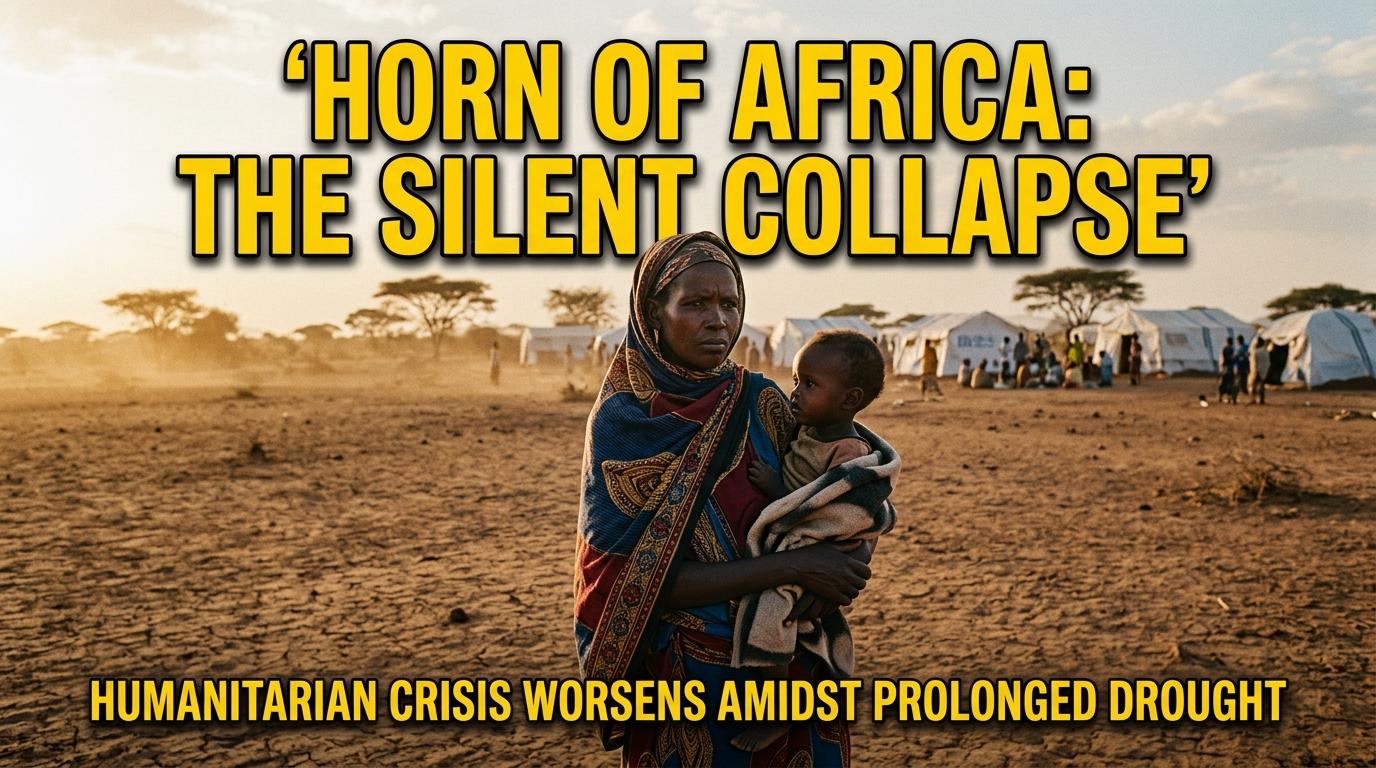
A silent disaster is sweeping through the Horn of Africa today. In southwestern Somalia, emergency feeding centers face massive operational overload. Admissions of severely malnourished children have jumped over 80 percent year over year (care.org, doctorswithoutborders.org). Families arrive after walking dozens of miles through arid lands. However, they often find shuttered medical doors instead of relief.
This alarming emergency stems directly from a sudden withdrawal of foreign assistance. Total international funding for Somalia plunged from $2.2 billion in 2022 down to roughly $300 million in 2026 (humanitarianaction.info, wfp.org). Consequently, over 500 primary health centers and mobile nutrition clinics ceased operations across the region (who.int, who.int). While drought remains a recurring threat, political decisions in distant donor capitals triggered this immediate collapse.
Understanding the Horn of Africa and Its Environment
Geographically, the core Horn of Africa comprises four main nations. These nations are Somalia, Ethiopia, Eritrea, and Djibouti (britannica.com). Broader geopolitical definitions also include neighboring East African countries such as Kenya, Sudan, South Sudan, and Uganda (wikipedia.org). The region sits along vital global trade corridors bordering the Red Sea and Gulf of Aden (britannica.com). Furthermore, it is home to over 115 million people with rich shared histories. Exploring the deep historical roots of the continent reveals how past social structures sustained communities through extreme climates.
Pastoralists and agro-pastoralists make up more than half of Somalia’s total population (preparecenter.org, socialscienceinaction.org). Pastoralists rely directly on nomadic livestock herds, including camels, cattle, and goats. Meanwhile, agro-pastoralists combine animal herding with rain-fed farming of staple crops like sorghum and maize (socialscienceinaction.org). Because both groups depend entirely on predictable rainfall, severe dry spells eliminate both food supplies and family income (preparecenter.org). Left without livestock or crops, rural families face immediate starvation and forced displacement.
The 2026 Aid Shock and International Decisions
The current crisis represents a structural breakdown rather than a simple weather anomaly. International assistance targeted specifically at acute malnutrition dropped by over 80 percent in a single year (care.org, humanitarianaction.info). For instance, the United States previously supplied $1.18 billion in total humanitarian aid to Somalia in 2023 (usaid.gov). In addition, it provided $70 million specifically for nutrition initiatives in 2025 (state.gov). However, major donor funding for nutrition dropped to zero in 2026 (state.gov).
This drastic reduction followed official investigations into aid diversion and food stockpile seizures (state.gov, usaid.gov). U.S. officials enforced zero-tolerance policies after reports surfaced that local authorities seized tons of emergency grain (state.gov, usaid.gov). Meanwhile, global donor fatigue and competing international conflicts further diverted foreign attention (humanitarianaction.info, wfp.org). As Western donor nations reallocated resources, vulnerable civilians in rural displacement camps paid the ultimate price.
Decades of Crisis: Civil Conflict and Historical Famines
Mass hunger in the Horn of Africa is rarely a purely natural phenomenon. Historically, severe famines occur when environmental shocks intersect with civil war and governance failures. Following the collapse of the Barre regime in 1991, Somalia fell into prolonged conflict (wikipedia.org). Clan warlords seized prime agricultural river valleys in the south (wikipedia.org). Consequently, opposing factions used food blockades as a direct weapon of war (wikipedia.org, wikipedia.org). Between 1991 and 1992, an estimated 300,000 to 350,000 Somalis perished from starvation (wikipedia.org).
Two decades later, the region experienced its worst drought in 60 years (washingtonpost.com). In 2011, the United Nations declared a formal famine across southern Somalia (wikipedia.org). The extremist group Al-Shabaab controlled vast rural territories and banned international aid agencies from delivering relief (washingtonpost.com, counterextremism.com). Furthermore, the global response lagged months behind early warning indicators (tufts.edu). That crisis claimed approximately 258,000 lives, over half of whom were young children (wikipedia.org). Historically, these repeated disruptions mirror broken structural promises that leave marginalized populations vulnerable during times of crisis.
Proof That Aid Works: Lessons From 2017 and 2022
In contrast to earlier disasters, the crisis of 2016 and 2017 proved that proactive intervention saves human lives. When severe drought struck the region again, international donors reacted swiftly (tufts.edu). Aid organizations mobilized over $1.3 billion in rapid emergency relief (tufts.edu). Consequently, humanitarian workers successfully averted widespread famine despite climate conditions matching those of 2011 (tufts.edu).
Similarly, between 2020 and 2023, the Horn of Africa endured five consecutive failed rainy seasons (fews.net). This historical mega-drought severely threatened millions of lives across East Africa (wfp.org). However, international donors scaled up total aid to Somalia to a record $2.2 billion in 2022 (wfp.org). Massive humanitarian intervention once again prevented catastrophic mortality rates (wfp.org, fews.net). These successful outcomes clearly prove that donor funding acts as a direct line between life and death.
Measuring Severe Malnutrition in Displacement Centers
Humanitarian agencies measure acute hunger using rigorous international diagnostic standards. The Famine Early Warning Systems Network, known as FEWS NET, monitors food security indicators worldwide (fews.net, fews.net). It tracks climate data, market prices, and crop yields to forecast emergencies months in advance (fews.net, fews.net). Furthermore, organizations utilize the Integrated Food Security Phase Classification scale to categorize food crises (ipcinfo.org, ipcinfo.org). IPC Phase 5 represents the highest severity level, signaling extreme catastrophe and famine (ipcinfo.org).
Clinically, Severe Acute Malnutrition occurs when a child experiences extreme wasting or fluid swelling (who.int, nih.gov). Medical staff diagnose the condition using a Mid-Upper Arm Circumference measurement under 115 millimeters (who.int, nih.gov). Without quick medical care, affected children face permanent developmental damage or death (who.int). In displacement hotspots like Baidoa, rapid screenings show that 50 percent of children suffer from acute hunger (care.org, doctorswithoutborders.org). Furthermore, 25 percent meet the clinical criteria for Severe Acute Malnutrition (care.org, doctorswithoutborders.org). Uncomplicated cases require Ready-to-Use Therapeutic Food, while severe complications demand emergency hospital care (who.int, nih.gov).
Governance Fragmentation and Systemic Aid Diversion
Navigating Somalia’s complex political landscape remains a primary challenge for aid delivery. Modern Somalia contains distinct regional governance structures with varying degrees of autonomy (transparency.org, hornreview.org, garoweonline.com). Somaliland unilaterally declared independence in 1991 and operates its own government (wikipedia.org). Meanwhile, Puntland functions as a semi-autonomous state within the federal framework (garoweonline.com). In central Somalia, Galmudug operates with constrained administrative capacity (transparency.org, hornreview.org). This political fragmentation fragments healthcare management and worsens regional resource disparities (transparency.org, hornreview.org, garoweonline.com).
Systemic aid diversion further complicates relief operations in active conflict zones (u4.no, counterextremism.com). In Somalia, diversion occurs through multiple illegal channels (u4.no, counterextremism.com). Militant groups like Al-Shabaab extort illegal protection taxes from relief agencies (counterextremism.com). Additionally, local informal authority figures, known as gatekeepers, force displaced families to surrender aid supplies (u4.no). Furthermore, corrupt government officials have occasionally intercepted humanitarian shipments for private resale (state.gov, usaid.gov). International donors face continuous pressure to balance anti-corruption requirements against humanitarian obligations. Today, many nations struggle under rising economic burdens that limit their foreign aid flexibility.
Innovations in Aid Integrity and Regional Leadership
To overcome aid diversion, modern agencies deploy sophisticated technological protections. Biometric identity systems capture fingerprints and iris scans at distribution sites (privacyinternational.org). This technology ensures relief reaches verified beneficiaries without intermediary interference (privacyinternational.org). In addition, direct digital cash transfers via mobile phones bypass physical warehouses entirely (u4.no). Independent third-party organizations also perform unannounced inventory audits in high-risk zones (u4.no). Meanwhile, predictive analytics software maps security risks to safeguard transport routes (undp.org).
Simultaneously, regional leadership bodies are stepping forward to address long-term security and resilience. The African Union coordinates peacekeeping missions to stabilize vulnerable zones and combat insurgent groups (byjus.com, europa.eu). Furthermore, regional groups like the Intergovernmental Authority on Development operate specialized early warning networks (byjus.com, europa.eu). In addition, non-Western donors from the Gulf region provide direct infrastructure investments and targeted emergency relief (europa.eu). Long-term stability ultimately requires sustainable investments in local health infrastructure, climate adaptation, and institutional integrity. Empowering local communities through African-centered solutions will remain essential for breaking perpetual cycles of crisis.
The Imperative of Restoring Global Solidarity
The ongoing tragedy across the Horn of Africa underscores an inescapable historical truth. Environmental droughts set the stage for acute hunger, but political choices dictate whether people survive. When international aid collapses, vulnerable rural families pay the ultimate price with their lives. Restoring funding streams and building local resilience are necessary steps to prevent catastrophic loss. Without sustained global solidarity and anti-diversion protections, history will continue to repeat its deadliest chapters.
About the Author
Darius Spearman is a professor of Black Studies at San Diego City College, where he has been teaching for over 20 years. He is the founder of African Elements, a media platform dedicated to providing educational resources on the history and culture of the African diaspora. Through his work, Spearman aims to empower and educate by bringing historical context to contemporary issues affecting the Black community.
