



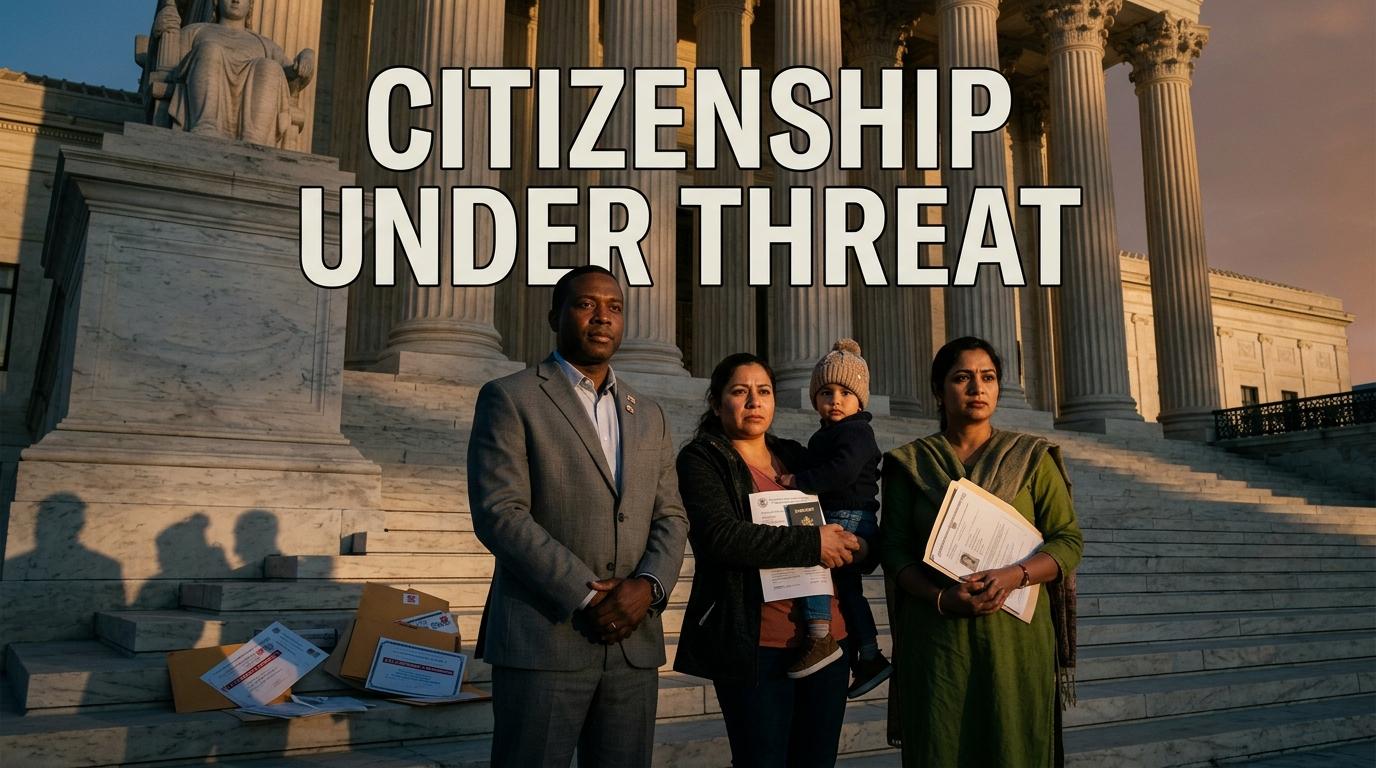
DOJ Denaturalization Surge Threatens Naturalized U.S. Citizens
By Darius Spearman (africanelements)
Support African Elements at patreon.com/africanelements and hear recent news in a single playlist. Additionally, you can gain early access to ad-free video content.
The Department of Justice has launched an unprecedented campaign targeting naturalized American citizens. Federal prosecutors are using a once-rare legal tool to strip individuals of their citizenship (democracyforward.org, americanoversight.org). Between January 2025 and August 2026, the government filed 123 civil denaturalization complaints in federal district courts (justice.gov, justice.gov, justice.gov). This rapid surge marks the highest volume of citizenship revocations in modern history (tracreports.org, americanoversight.org).
Federal officials frame these lawsuits as necessary actions against fraud and serious violent crime (justice.gov, justice.gov, justice.gov). However, civil rights organizations warning of a dangerous constitutional shift express deep alarm (forumtogether.org, democracyforward.org). New policy mandates require administrative quotas from federal field offices (americanoversight.org, uscis.gov). Consequently, field agents must send between 100 and 200 denaturalization referrals to prosecutors every month (americanoversight.org, uscis.gov). To understand this current crackdown, one must explore the history behind the headlines.
The Historical Roots of Revoking U.S. Citizenship
For the first century of American history, local courts managed naturalization without standard federal oversight (historians.org, case.edu). Congress passed the Naturalization Act of 1906 to centralize federal control over citizenship (historians.org). This law established the first statutory grounds for revoking naturalization status (historians.org, case.edu). Government officials could cancel citizenship if applicants obtained status illegally or concealed material facts (historians.org, cwsl.edu).
Later, lawmakers passed the Immigration and Nationality Act of 1952 (cwsl.edu, uclawsf.edu). Codified under 8 U.S.C. § 1451, this law remains the primary legal foundation for civil denaturalization (cwsl.edu, ilrc.org). Historically, federal authorities turned to denaturalization during times of national war or political unrest (migrationpolicy.org, aaihs.org). Government prosecutors targeted anarchists, union organizers, and political dissidents during early twentieth-century Red Scares (migrationpolicy.org, aaihs.org, aaihs.org).
During the First and Second World Wars, federal agents targeted individuals suspected of foreign sympathies (migrationpolicy.org, aaihs.org). Between 1906 and 1967, the federal government stripped citizenship from over 22,000 Americans (migrationpolicy.org, aaihs.org). These historical crackdowns set a lasting precedent for using immigration statutes to police political behavior (aaihs.org, aaihs.org).
Targeting Black Activists and Foreign Radicals
Federal authorities also used immigration enforcement to disrupt Black liberation movements and suppress racial justice organizers (aaihs.org, wikipedia.org). During the early twentieth century, federal agencies used residency revocation and deportation against Black immigrant leaders (wikipedia.org, drdeniselynn.com). Marcus Garvey, the Jamaican-born founder of the Universal Negro Improvement Association, became a prime target (wikipedia.org). Federal law enforcement monitored Garvey constantly before securing a conviction and deporting him in 1927 (wikipedia.org).
Decades later, federal authorities targeted Claudia Jones, a Trinidadian Black radical feminist and civil rights journalist (drdeniselynn.com). Jones led powerful anti-racist campaigns and organized labor movements in Harlem (drdeniselynn.com). Under Red Scare legislation, prosecutors stripped Jones of her legal residence rights (drdeniselynn.com). Federal agents imprisoned and eventually deported her in 1955 (drdeniselynn.com, uga.edu).
These actions showed how federal immigration laws could suppress civil rights movements (aaihs.org, drdeniselynn.com). Today, scholars view these historical purges as part of broader post-war political struggles against marginalized groups (aaihs.org). Federal surveillance routinely weaponized immigration status to break up community organizing (wikipedia.org, drdeniselynn.com). This long history reveals how status revocation expanded alongside the expansion of law enforcement across the nation.
Legal Guardrails and the Shift to Digital Dragnets
Due to severe constitutional concerns, the Supreme Court eventually established strict legal protections for naturalized citizens (ijlsss.com, wikipedia.org). In Schneiderman v. United States (1943), the Court declared that citizenship is a fundamental right (ijlsss.com, wikipedia.org). Judges ruled that the government must provide clear, convincing, and unequivocal evidence to justify revocation (ijlsss.com, wikipedia.org). Later, in Afroyim v. Rusk (1967), the Supreme Court ruled that the Fourteenth Amendment protects naturalized citizens from arbitrary loss of nationality (wikipedia.org).
The Afroyim ruling caused civil denaturalization actions to drop by ninety-nine percent over the following decades (migrationpolicy.org, wikipedia.org). For decades, federal prosecutors reserved denaturalization almost exclusively for former Nazi war criminals and human rights violators (justiceinitiative.org, wikipedia.org). Furthermore, in Maslenjak v. United States (2017), the Supreme Court ruled that minor misstatements on forms cannot justify revoking citizenship (wikipedia.org). The Court affirmed that false statements must be material to the granting of status (wikipedia.org, ilrc.org).
Despite these clear judicial limits, the modern infrastructure for mass denaturalization expanded rapidly through digital technology (migrationpolicy.org, tracreports.org). In 2010, the Obama administration launched Operation Janus after discovering old paper fingerprint records were un-digitized (migrationpolicy.org, tracreports.org). Operation Janus identified 315,000 old fingerprint files and flagged hundreds of naturalized citizens for investigation (migrationpolicy.org, tracreports.org). Later, the Trump administration expanded this effort into Operation Second Look, reviewing over 700,000 files (tracreports.org, ilrc.org). In February 2020, the Department of Justice established a dedicated Denaturalization Section to litigate these cases nationwide (justice.gov, americanoversight.org).
Civil Versus Criminal Denaturalization Requirements
Understanding the difference between civil and criminal denaturalization is essential to navigating current government actions (yewlegal.com, federal-lawyer.com). The Department of Justice can revoke citizenship through either civil lawsuits or criminal prosecutions (ilrc.org, federal-lawyer.com). Each path operates under vastly different legal rules, burdens of proof, and constitutional guarantees (democracyforward.org, federal-lawyer.com).
Civil denaturalization lawsuits are filed under 8 U.S.C. § 1451(a) in federal district court (cwsl.edu, federal-lawyer.com). In civil cases, the government must prove its claims using clear, convincing, and unequivocal evidence (ijlsss.com, federal-lawyer.com). Notably, civil denaturalization actions have no statute of limitations (ilrc.org, federal-lawyer.com). Prosecutors can file lawsuits targeting paperwork misstatements made twenty or thirty years in the past (ilrc.org, lawofficeimmigration.com).
Crucially, defendants in civil denaturalization cases receive no constitutional right to court-appointed legal counsel (democracyforward.org, nipnlg.org). Naturalized citizens who cannot afford expensive federal attorneys must represent themselves (democracyforward.org, ilrc.org). Defendants receive exactly sixty days to file a formal answer to a civil complaint (yewlegal.com, kktplaw.com). If an unrepresented individual misses this sixty-day window, the court enters a default judgment (kktplaw.com, lawofficeimmigration.com). A default judgment immediately revokes citizenship without the government presenting trial witnesses (kktplaw.com, lawofficeimmigration.com).
In contrast, criminal denaturalization occurs under 18 U.S.C. § 1425 (federal-lawyer.com, findlaw.com). Criminal prosecutions require the highest legal standard of proof beyond a reasonable doubt (federal-lawyer.com, findlaw.com). Criminal charges are subject to a strict ten-year statute of limitations (federal-lawyer.com). Furthermore, criminal defendants receive full Sixth Amendment protections, including public defenders and jury trials (federal-lawyer.com, findlaw.com). A criminal conviction automatically revokes U.S. citizenship under 8 U.S.C. § 1451(e) (federal-lawyer.com).
The Role of Federal Agencies and Derivative Citizenship
Executing a denaturalization action involves four key federal agencies operating across executive departments (americanoversight.org, uscis.gov). U.S. Citizenship and Immigration Services (USCIS) conducts administrative file reviews to spot potential misrepresentations (uscis.gov, uscis.gov). USCIS works under the Department of Homeland Security (DHS) to manage referral pipelines (americanoversight.org, uscis.gov). Once USCIS flags a file, agents refer the case to the Department of Justice (DOJ) (uscis.gov, uscis.gov).
The Department of Justice holds sole legal authority to file denaturalization lawsuits in federal district court (justice.gov, federal-lawyer.com). Federal prosecutors prosecute the case until a judge issues a final order revoking citizenship (justice.gov, kktplaw.com). Once citizenship is voided, Immigration and Customs Enforcement (ICE) steps in (hoppocklawfirm.com, nipnlg.org). ICE detains the individual and initiates deportation proceedings in immigration court (hoppocklawfirm.com, nipnlg.org).
This enforcement process carries devastating collateral consequences for vulnerable working families (nipnlg.org, cnvisalaw.com). Under Section 340 of the Immigration and Nationality Act (8 U.S.C. § 1451), revocation impacts derivative citizenship (yewlegal.com, cnvisalaw.com). Derivative citizenship allows spouses and minor children to obtain green cards or citizenship through a primary relative (yewlegal.com, cnvisalaw.com).
If the government revokes citizenship due to actual fraud or willful misrepresentation, derivative family members lose their status (yewlegal.com, cnvisalaw.com). Minor children and spouses revert to their prior immigration status or become completely undocumented (nipnlg.org, cnvisalaw.com). Consequently, entire families face immediate detention and removal by ICE agents (hoppocklawfirm.com, nipnlg.org). This rule creates severe risks of forced family separation (nipnlg.org, cnvisalaw.com).
Demographics, Financial Hardships, and Appeal Rights
Department of Justice records show that the 123 civil complaints span naturalized citizens from at least eighteen different nations (justice.gov, justice.gov, justice.gov, justice.gov). Targeted individuals originate from Pakistan, Nigeria, Jamaica, India, Mexico, Colombia, Moldova, Taiwan, Honduras, and Sweden (justice.gov, justice.gov, justice.gov, justice.gov, easternherald.com). While official complaints highlight underlying fraud or past criminal allegations, government releases lack disaggregated demographic breakdowns by race or ethnicity (tracreports.org, easternherald.com).
Immigrant rights groups stress that lack of court-appointed legal counsel creates systemic inequality (democracyforward.org, ilrc.org). Defending against federal civil litigation costs tens of thousands of dollars in legal fees (democracyforward.org, nipnlg.org). Low-income working immigrants frequently cannot afford private defense attorneys (democracyforward.org, ilrc.org). As a result, many unrepresented defendants suffer default judgments solely due to financial hardship (kktplaw.com, lawofficeimmigration.com). These disparities highlight ongoing struggles against systemic inequality within the federal judicial system.
When a federal district court judge revokes citizenship, specific legal remedies remain available (kktplaw.com, findlaw.com). A defendant has the right to file an appeal with the U.S. Court of Appeals (kktplaw.com, findlaw.com). Under Rule 4 of the Federal Rules of Appellate Procedure, the notice of appeal must be filed within sixty days (kktplaw.com, findlaw.com). If the Circuit Court affirms the order, the individual can petition the Supreme Court for a writ of certiorari (wikipedia.org, findlaw.com).
Additionally, defendants can file a motion for relief from judgment under Rule 60(b) of the Federal Rules of Civil Procedure (kktplaw.com). This motion allows district courts to reopen default rulings based on improper service or excusable neglect (kktplaw.com). However, filing an appeal does not automatically stop immigration court removal proceedings (hoppocklawfirm.com, nipnlg.org). Defendants must explicitly request a formal stay of deportation while appellate judges review their case (hoppocklawfirm.com, nipnlg.org).
Conclusion: A Constitutional Reckoning
The Department of Justice’s expanded campaign represents a fundamental transformation in U.S. immigration enforcement (democracyforward.org, americanoversight.org). What began in 1906 as a federal fix for local court fraud has evolved into a high-volume administrative strategy (historians.org, americanoversight.org). Modern digital databases and monthly referral quotas have reshaped how the federal government reviews citizenship records (tracreports.org, uscis.gov).
As federal courts weigh record numbers of denaturalization lawsuits, the nation faces a vital constitutional question (democracyforward.org, ijlsss.com). Is citizenship an irrevocable right protected by the Constitution, or can administrative checks jeopardize naturalized status decades later? The resolution of these cases will define equal protection and the meaning of American citizenship for generations to come (democracyforward.org, wikipedia.org).
About the Author
Darius Spearman is a professor of Black Studies at San Diego City College, where he has been teaching for over 20 years. He is the founder of African Elements, a media platform dedicated to providing educational resources on the history and culture of the African diaspora. Through his work, Spearman aims to empower and educate by bringing historical context to contemporary issues affecting the Black community.
