


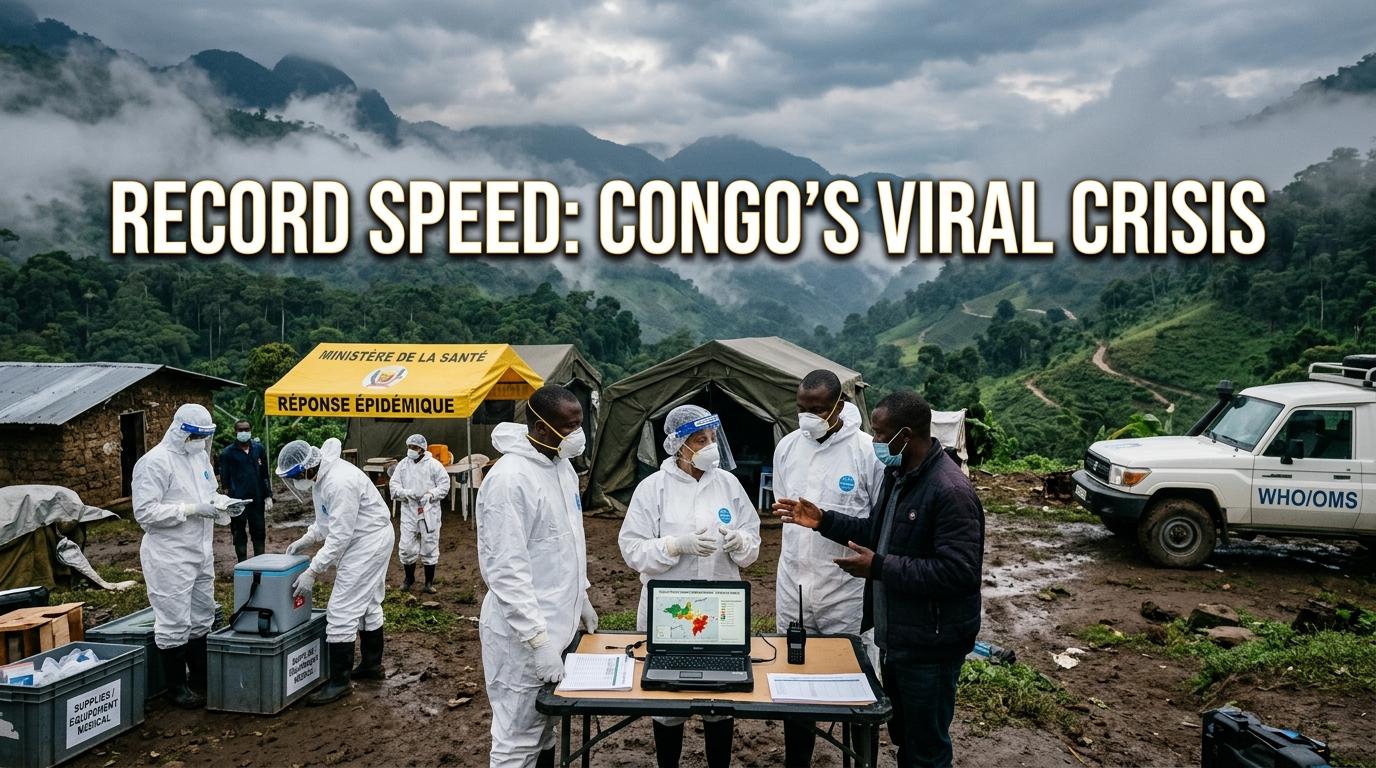
Why DRC Ebola Outbreak Spreads at Record Speed
By Darius Spearman (africanelements)
Support African Elements at patreon.com/africanelements and hear recent news in a single playlist. Additionally, you can gain early access to ad-free video content.
The Emergency in Eastern Congo
The Democratic Republic of the Congo faces an unprecedented public health disaster. International relief agencies have raised alarms as the newest outbreak expands across the northeastern provinces. A person now loses their life to this contagion every thirty minutes. United Nations humanitarian officials immediately released $30.5 million from the Central Emergency Response Fund to contain the crisis (unocha.org, reliefweb.int).
This epidemic moves faster than any filovirus outbreak in recorded history. The virus infected more than one thousand people within the first forty days of emergency mobilization. In contrast, previous major epidemics required hundreds of days to reach that same threshold. Cumulative cases have climbed past 4,600 confirmed infections, resulting in over 2,100 deaths across fifty-four health zones (who.int, unocha.org).
Health authorities identify the Bunia-Rwampara-Mongbwalu corridor in Ituri province as the main epicenter. More than eighty percent of recorded deaths have occurred in this mineral-rich territory. The infection has crossed provincial borders into North Kivu, Haut-Uélé, Tshopo, South Kivu, and Bas-Uélé. Health monitors also detected and contained isolated transmission chains across the border in Uganda (unocha.org, sosmediasburundi.org, who.int).
2026 DRC Outbreak Vital Statistics
Source: UN OCHA & WHO Epidemiological Bulletins
Roots of the Pathogen from Yambuku to Today
To understand the current emergency, observers must look back half a century into medical history. Ebola virus disease was first documented in 1976 in the northern village of Yambuku, Zaire. A headmaster at a local Catholic mission school fell ill with high fever after buying game meat. The pathogen spread through reusable needles in the mission clinic, killing 280 people and establishing an eighty-eight percent mortality rate (asm.org, cdc.gov).
Congolese microbiologist Dr. Jean-Jacques Muyembe-Tamfum investigated that mysterious 1976 outbreak alongside international researchers. Dr. Muyembe pioneered early infection control protocols in the dense rainforest. He later demonstrated that transfusions of blood containing protective antibodies from survivors helped reduce death rates. His early field work created the scientific framework for modern targeted antibody treatments (asm.org, wikipedia.org).
Filovirology explores how these filamentous, thread-like viruses attack the human body. Researchers have identified several distinct virus species over five decades. The Zaire strain drove historical epidemics in Kikwit and West Africa. Meanwhile, scientists identified the Bundibugyo strain during a 2007 outbreak in western Uganda. These distinct viral families require specialized medical strategies to save lives (wikipedia.org, cdc.gov, nih.gov).
The Danger of the Bundibugyo Strain
The current disaster stems directly from the Bundibugyo virus species rather than the common Zaire strain. The National Institute of Biomedical Research confirmed this strain through genomic sequencing in Kinshasa. Retrospective tests showed the pathogen had been quietly spreading in rural villages months before public alerts sounded. This head start allowed the infection to embed itself deeply inside vulnerable communities (who.int, who.int).
The Bundibugyo strain presents an acute therapeutic challenge for medical responders. During the 2018 outbreak, clinical teams deployed the licensed Ervebo vaccine across eastern Congo. That vaccine provided strong immunity against the Zaire virus. However, Ervebo provides zero cross-protection against the Bundibugyo species because the surface proteins differ significantly (who.int, nih.gov).
Similarly, approved monoclonal antibody therapies like Ebanga cannot neutralize the Bundibugyo pathogen. Frontline physicians must rely on basic supportive care and intravenous fluids while clinical trials test candidate treatments. African medical teams draw upon deep collective survival methods to manage sick patients under resource constraints. Without approved pharmaceutical countermeasures, containment depends entirely on community surveillance and rapid physical isolation (who.int, mercycorps.org).
Days Required to Reach 1,000 Confirmed Cases
Comparing Outbreak Transmission Velocity Across Decades
The Crucible of Conflict and Displacement
Epidemics do not happen in a vacuum. Eastern Congo has suffered from persistent armed violence for decades. Multiple armed groups, including the March 23 Movement and CODECO factions, clash over mineral deposits and farmland. The violence has forced more than one million residents from their ancestral homes across Ituri and North Kivu into overcrowded camps (aljazeera.com, mercycorps.org, africacenter.org).
These displacement camps lack clean water, sanitation infrastructure, and proper partition walls. Several families often share single canvas tents, making physical distance impossible when family members fall ill. When armed clashes flare up, panicked residents flee again, carrying hidden infections into new villages. This instability mirrors historical patterns where displacement complicates struggles for justice and freedom among marginalized communities (mercycorps.org, mercycorps.org).
Insecurity also blocks public health workers from reaching remote forest clinics. Militia ambushes along rural dirt roads turn entire health zones into inaccessible red zones. Epidemiologists cannot complete contact tracing when field teams face abduction risks or armed skirmishes. Consequently, transmission chains remain hidden until patients arrive at regional hospitals in critical condition (aljazeera.com, africacenter.org).
Broken Health Systems and Collateral Harm
The expanding outbreak has severely strained provincial healthcare facilities. Widespread fear of infection keeps thousands of vulnerable patients away from local health centers. Routine clinical visits have dropped by forty percent across the most affected territories. Expectant mothers and malnourished children suffer the heaviest consequences from this health system collapse (unocha.org, actionaidusa.org).
Expectant mothers often avoid medical facilities due to rumors about quarantine wards. Maternal mortality in Ituri province has doubled, with an average of six women dying weekly from unassisted childbirth complications. The historical vulnerability of marginalized mothers connects to broader diasporic struggles regarding the protection of Black women during structural crises. Furthermore, children represent twenty-five percent of confirmed Ebola cases and nearly a third of all deaths (unocha.org, un.org, actionaidusa.org).
Frontline health personnel carry an enormous burden under severe resource shortages. Over one hundred fifty doctors and nurses have contracted the virus while caring for patients, resulting in forty-four deaths. Clinical staff have staged protests over unpaid hazard wages and missing safety gear. International aid allocations seek to resolve these salary arrears and deliver protective equipment to rural medical clinics (unocha.org, reliefweb.int).
UN Emergency Scale-Up Pillars
Priority Operations Funded by $30.5M CERF Release
Traditional Rites and Safe Burials
Halting filovirus transmission requires deep cultural understanding and community partnerships. When a patient succumbs to the virus, their body carries peak concentrations of the pathogen. Traditional funeral customs often involve washing, embracing, and dressing deceased relatives. These loving rituals unintentionally expose grieving family members to infectious bodily fluids, causing explosive secondary outbreaks (cdc.gov, nih.gov).
Early international interventions during past outbreaks created friction by forcibly removing bodies in anonymous plastic bags. That approach caused intense pain, mistrust, and secret midnight burials. Public health agencies now utilize Safe and Dignified Burial protocols. These revised methods combine strict pathogen containment with respectful community participation (cdc.gov, nih.gov).
Specially trained Congolese burial teams wear full personal protective equipment while decontaminating the environment. Families observe the burial from a safe distance and conduct religious prayers according to their traditions. When public health initiatives respect community dignity, families cooperate willingly with medical guidelines. This community trust remains the most effective tool to stop viral transmission chains (cdc.gov, nih.gov).
Mobilizing the Pan-African Health Front
African public health leadership has mobilized aggressively to confront this expanding epidemic. The Africa Centres for Disease Control and Prevention works directly with national authorities under unified response plans. Continental institutions deploy epidemiologists, laboratory reagents, and mobile sequencing machines directly to field laboratories in Bunia and Goma (africacdc.org, africacdc.org, africacdc.org).
African researchers are also leading clinical trials for candidate Bundibugyo therapeutics. Professor Placide Mbala oversees early investigational antiviral drug protocols at regional treatment centers. This scientific self-determination challenges historic dependencies where global powers dictated medical priorities. These actions represent a vital institutional political strategy aimed at protecting African public health autonomy (who.int, africacdc.org).
Continental health bodies actively push for regional pharmaceutical manufacturing capabilities. African nations seek to produce their own diagnostic kits, protective equipment, and vaccines. Creating domestic medical infrastructure protects local populations when international supply chains falter during emergency shortages. This pan-African coordination establishes long-term resilience against future biological threats across the continent (africacdc.org, africacdc.org).
Global Solidarity in the Fight for Congo
The tragedy unfolding in the Democratic Republic of the Congo requires sustained global solidarity. As United Nations Emergency Relief Coordinator Tom Fletcher stated, humanitarian agencies cannot allow the virus to outrun global assistance. Containing this pathogen protects global health security while defending the fundamental human rights of vulnerable Congolese families (unocha.org, reliefweb.int).
Defeating this outbreak requires more than emergency financial pledges. International partners must support comprehensive peace initiatives to end militia violence in eastern Congo. Global institutions must also fund research into neglected tropical diseases that receive minimal commercial investment. When the international community invests in local health workers and community leadership, long-term containment becomes possible (unocha.org, mercycorps.org, africacenter.org).
The people of eastern Congo have demonstrated extraordinary resilience through decades of conflict and health crises. Their local health volunteers, nurses, and community leaders remain on the front lines every day. By combining modern science, cultural respect, and international resources, the global community can help bring an end to the deadliest viral surge in recorded history (unocha.org, asm.org, reliefweb.int).
About the Author
Darius Spearman is a professor of Black Studies at San Diego City College, where he has been teaching for over 20 years. He is the founder of African Elements, a media platform dedicated to providing educational resources on the history and culture of the African diaspora. Through his work, Spearman aims to empower and educate by bringing historical context to contemporary issues affecting the Black community.
