


Why 650,000 South Sudan Refugees Face Starvation
By Darius Spearman (africanelements)
Support African Elements at patreon.com/africanelements and hear recent news in a single playlist. Additionally, you can gain early access to ad-free video content.
The Looming Famine Cliff in South Sudan
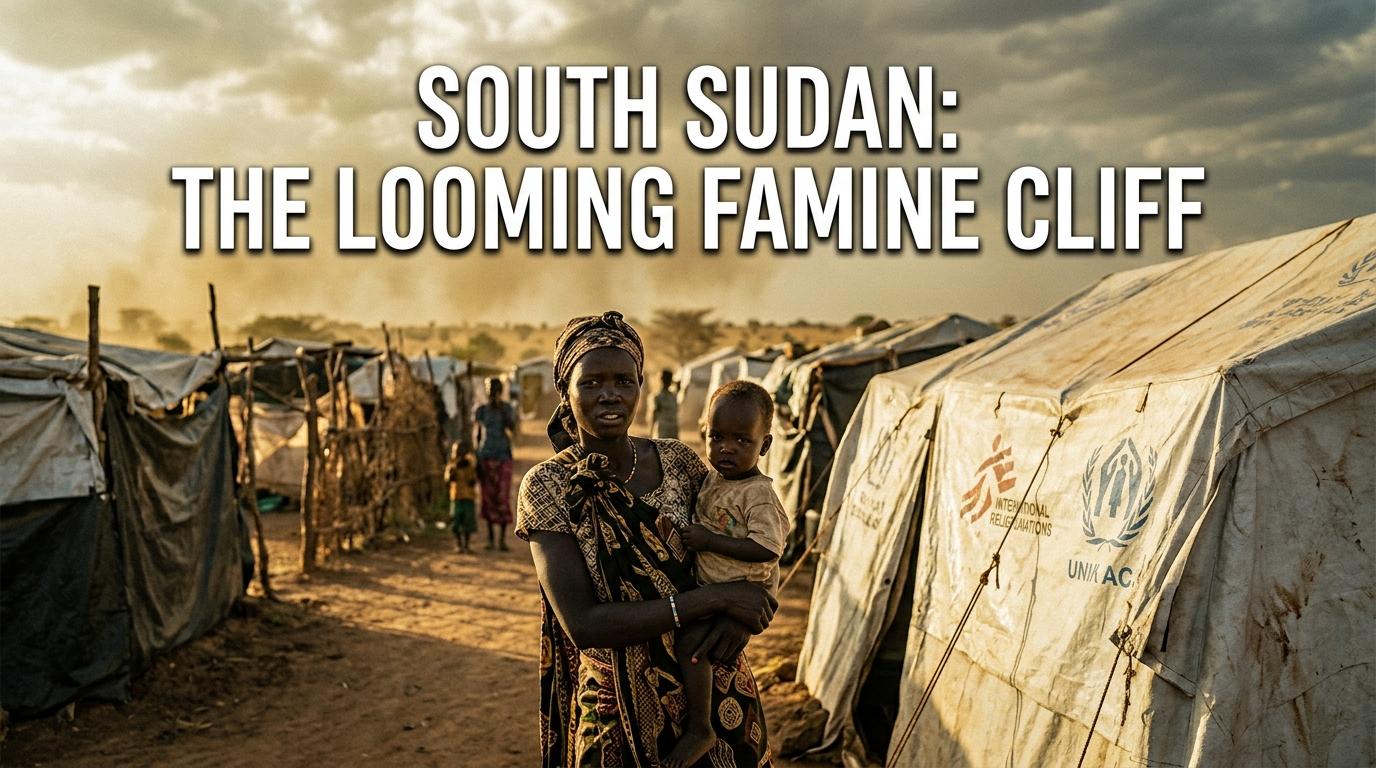
A humanitarian catastrophe is unfolding in South Sudan. International aid organizations have issued urgent warnings that severe budget deficits will soon force the total shutdown of critical food assistance. More than 650,000 refugees and asylum seekers will lose their primary source of survival within weeks (healthpolicy-watch.news, tbsnews.net). The United Nations World Food Programme and the UN Refugee Agency have reached a breaking point due to empty supply pipelines (healthpolicy-watch.news, aa.com.tr).
By September, the final food rations will be delivered to roughly 240,000 highly vulnerable refugees who are already surviving on half-portions (healthpolicy-watch.news). Furthermore, food support for another 180,000 internally displaced persons will cease completely by October (healthpolicy-watch.news). These abrupt aid suspensions leave families stranded without basic nourishment in an unstable region. To understand how hundreds of thousands of people arrived at this perilous cliff, one must examine the deep historical roots of regional instability, climate shocks, and global inequities.
Humanitarian Appeal Funding Deficits (2026)
Severe budget shortfalls paralyze life-saving food pipelines in South Sudan.
The Legacy of Colonial Exploitation and Partition
South Sudan entered the global stage as an independent nation in July 2011 after enduring decades of devastating liberation warfare against the central government in Khartoum (wikipedia.org, issafrica.org). However, the British-Egyptian colonial regime had spent the previous century deliberately isolating the southern provinces from the north. Colonial administrators concentrated investments, education, and modern infrastructure along the riverine north while treating the southern region solely as an extractive labor reserve (riftvalley.net).
Consequently, the young nation inherited almost no paved roads, agricultural storage networks, or diversified public institutions at birth (wikipedia.org). The domestic economy relied on crude oil for more than 95 percent of national revenues (brookings.edu). When global commodity prices plummeted or export pipelines through the north shut down, public institutions buckled. This historical underinvestment left rural farmers vulnerable, making food production difficult to sustain without stable markets.
Civil War and the Loss of Food Sovereignty
The promise of independence dissolved into catastrophic warfare in December 2013 when a bitter political rivalry fractured the national leadership along ethnic lines (wikipedia.org, carnegieendowment.org). The ensuing five-year conflict claimed approximately 400,000 lives and forced more than four million people from their ancestral lands (wikipedia.org). Armed forces devastated fertile agricultural belts across Greater Equatoria, driving smallholder farmers away during vital planting cycles (riftvalley.net, prio.org).
This widespread destruction dismantled traditional food sovereignty throughout the countryside. Food security merely measures whether food is physically present, but food sovereignty represents the right of communities to control their own agricultural systems, seeds, and land (viacampesina.org, viacampesina.org). By destroying farming tools and displacing rural populations, the war forced millions into permanent reliance on international emergency aid rations (riftvalley.net, alnap.org). Even though rival leaders signed the 2018 Revitalized Agreement on the Resolution of the Conflict in South Sudan, localized violence continues to block agricultural recovery (peaceagreements.org, prio.org).
Historic Floods and Ecological Displacement
Compounding the legacy of conflict, the Nile River basin has experienced historic, back-to-back climate disasters since 2019 (cgiar.org, nih.gov). Extreme seasonal downpours inundated the Sudd wetlands, submerging entire villages and washing away hundreds of thousands of hectares of arable cropland (cgiar.org). Pasturelands vanished beneath stagnant floodwaters, drowning millions of cattle that represent the economic backbone of pastoralist communities (humdata.org, nih.gov).
These chronic climate shocks permanently uprooted rural households, forcing them into crowded elevated camps. Floodwaters contaminated shallow wells and destroyed traditional historical survival strategies that rural families relied on during seasonal lean periods (nih.gov). The country remains trapped in an environmental crisis where local populations cannot cultivate food, intensifying reliance on external humanitarian pipelines (ipcinfo.org, fews.net).
Humanitarian Crisis Numbers at a Glance
The combined scale of regional displacement, malnutrition, and border arrivals.
Refugees Losing All Food Aid
Weekly Border Arrivals from Sudan
Severely Food Insecure (IPC 3+)
Acutely Malnourished Children
The Sudan War and Cross-Border Spillover
In April 2023, full-scale war erupted in neighboring Sudan between the Sudanese Armed Forces, commanded by General Abdel Fattah al-Burhan, and the Rapid Support Forces paramilitary group, led by Mohamed Hamdan Dagalo (apnews.com, carnegieendowment.org). The violence turned major urban centers into battlegrounds and triggered the displacement of over ten million people (apnews.com, reliefweb.int). Consequently, an overwhelming influx of desperate civilians surged southward across the border into South Sudan (healthpolicy-watch.news, sana.sy).
Approximately 3,000 people cross the border each week, arriving through transit towns such as Renk in Upper Nile State (healthpolicy-watch.news, sana.sy). Many families arrive with severe physical trauma, acute illnesses, and empty hands after fleeing active artillery fire (healthpolicy-watch.news). South Sudan, a nation already struggling to feed its domestic population, suddenly transformed into an overburdened sanctuary for hundreds of thousands fleeing violence in the north (healthpolicy-watch.news, apnews.com).
The Returnee Paradox and Legal Status Disparities
Displacement crises create complex legal boundaries that determine who receives institutional protection. Under international law, registered refugees cross international borders fleeing violence and receive legal safeguards under the 1951 Refugee Convention along with dedicated UNHCR support (umn.edu, fmreview.org). In contrast, internally displaced persons remain inside their sovereign homeland, protected only by national frameworks (umn.edu, oas.org).
This division creates a painful paradox for returnees—South Sudanese citizens who lived in Sudan for decades before the recent fighting drove them south (healthpolicy-watch.news, fmreview.org). Because returnees are technical citizens of South Sudan, they lose formal refugee benefits upon re-entering the country (fmreview.org). Yet, they return to find their family homes destroyed, their lands occupied, and their social ties erased (healthpolicy-watch.news). They stand in the same dusty transit camps as foreign refugees, equally destitute, but frequently fall through bureaucratic cracks in the humanitarian response (healthpolicy-watch.news, fmreview.org).
Global Inequity and Aid Disparities
The primary driver of the current aid suspension is a steep reduction in contributions from wealthy donor nations (healthpolicy-watch.news, humanitarianaction.info). International emergency funding is heavily reliant on a tiny group of Western contributors, primarily the United States, the European Union, the United Kingdom, and Germany (humanitarianaction.info). When these governments reduce foreign assistance allocations or redirect budgets toward conflicts in Ukraine and the Middle East, African humanitarian operations suffer immediate cutbacks (careinternational.org.uk, nrc.no, humanitarianaction.info).
Humanitarian monitors repeatedly show that crises across the African continent are among the most underfunded operations in the world (nrc.no). While high-visibility conflicts receive massive international financing, the protracted suffering of displaced African families rarely commands sustained global attention (careinternational.org.uk, nrc.no). This dynamic aligns with broader historical patterns of institutional neglect, prompting modern activists to organize demands for structural justice across international development systems (nrc.no).
Integrated Food Security Phase Scale (South Sudan)
Over half the nation is classified under emergency food insecurity thresholds.
Devastating Household Coping Mechanisms
As food distributions dwindle, displaced families are forced to adopt devastating survival measures simply to stay alive (healthpolicy-watch.news). Field assessments reveal that thousands of households have reduced their meals to once a day or survive solely on wild leaves and boiled roots (healthpolicy-watch.news, careinternational.org.uk). Parents sell their last possessions, including cooking pots and sleeping mats, to purchase handfuls of grain in local markets (healthpolicy-watch.news).
The protection risks for vulnerable populations escalate rapidly under these conditions (healthpolicy-watch.news). Young girls face heightened dangers of child marriage, and women risk physical violence while walking long distances into insecure scrubland to gather firewood (healthpolicy-watch.news, careinternational.org.uk). In the most extreme instances, families are contemplating returning across active front lines into Sudan, concluding that the immediate danger of artillery fire is preferable to slow starvation in isolated refugee settlements (healthpolicy-watch.news).
Grassroots Mutual Aid and Community Resilience
In the absence of adequate international funding and domestic social safety nets, ordinary communities have mobilized their own survival networks (rightlivelihood.org, mutualaidsudan.org). In neighboring Sudan, youth organizers and neighborhood committees formed Emergency Response Rooms to run communal kitchens and medical posts during intense fighting (rightlivelihood.org, mutualaidsudan.org). These decentralized initiatives mirror historical grassroots African solidarity models that emerge during times of severe state collapse (mutualaidsudan.org).
Within South Sudanese transit zones, community members draw upon traditional practices of shared solidarity, known locally as Nafeer (mutualaidsudan.org). Host families share their scarce grain supplies, build temporary shelters for arriving strangers, and care for unaccompanied children (mutualaidsudan.org). These grassroots efforts save countless lives daily at a fraction of the cost of international operations, proving that local mutual aid remains the most reliable lifeline when institutional systems fail (rightlivelihood.org, mutualaidsudan.org).
The Path Toward Long-Term Sovereignty
Halting the immediate catastrophe requires international donors to fill the $37 million emergency shortfall needed for basic refugee food rations through the end of the year (healthpolicy-watch.news). However, emergency food aid is only a temporary bandage on a deep structural wound. Continuous emergency shipments will not break the cycle of crisis unless regional powers address the root political and environmental causes of displacement (riftvalley.net, issafrica.org).
True resilience requires investing in climate-resilient agriculture, rebuilding regional transport infrastructure, and supporting genuine food sovereignty for smallholder farmers (viacampesina.org, cgiar.org). The people of South Sudan and the displaced refugees within its borders do not simply need emergency grain; they require the peace, security, and agrarian resources to cultivate their own lands and build an independent future free from chronic dependency (viacampesina.org, peaceagreements.org).
About the Author
Darius Spearman is a professor of Black Studies at San Diego City College, where he has been teaching for over 20 years. He is the founder of African Elements, a media platform dedicated to providing educational resources on the history and culture of the African diaspora. Through his work, Spearman aims to empower and educate by bringing historical context to contemporary issues affecting the Black community.
