


Inside the Deadliest DRC Ebola Outbreak in History
By Darius Spearman (africanelements)
Support African Elements at patreon.com/africanelements and hear recent news in a single playlist. Additionally, you can gain early access to ad-free video content.
A Historic Tragedy in Eastern Congo
The Democratic Republic of the Congo has reached a heartbreaking public health milestone. Cumulative fatalities from Ebola virus disease in the eastern provinces have officially crossed 2,325 deaths (wikipedia.org, who.int). This makes the protracted crisis the deadliest Ebola event in the country’s history (wikipedia.org). International agencies are urgently scaling up emergency response teams to prevent further loss of life (un.org, rescue.org).
Behind the grim headlines lies a complex story of survival, science, and systemic neglect. The eastern provinces of North Kivu and Ituri have borne the brunt of this suffering (wikipedia.org, who.int). Understanding this milestone requires looking beyond the casualty numbers. Long before modern headlines appeared, the history of Africa was reshaped by outside interventions and political fractures. The current public health emergency represents a clash between a lethal pathogen and decades of regional instability (rescue.org, africacenter.org).
The 1976 Discovery in Yambuku
The roots of this viral threat stretch back nearly fifty years. In August 1976, an unknown hemorrhagic fever appeared in the northern village of Yambuku (wikipedia.org, cdcmuseum.org). The mysterious illness struck quickly, killing 280 of 318 infected patients (wikipedia.org, cdc.gov). Scientists named the pathogen after the nearby Ebola River to protect the village from enduring stigma (wikipedia.org, cdcmuseum.org).
A young Congolese microbiologist named Dr. Jean-Jacques Muyembe-Tamfum was among the first investigators on the ground (wikipedia.org, cdcmuseum.org). Working without protective suits, he collected initial clinical specimens (cdcmuseum.org). He noted that the disease spread primarily through bodily fluids (cdcmuseum.org). Foreign laboratories received those samples to isolate the pathogen (wikipedia.org, cdcmuseum.org). This early research set a long pattern of Western labs claiming scientific discovery while African researchers performed the perilous field labor (wikipedia.org, cdcmuseum.org).
Historical Ebola Fatality Rates
Comparison of Case Fatality Rates (CFR) across major African outbreaks
Armed Conflict and the Outbreak Zone
Earlier outbreaks in Central Africa struck isolated rainforest communities and ended within months (cdc.gov). However, the crisis in eastern Congo developed inside an active war zone (rescue.org, africacenter.org). North Kivu and Ituri have suffered decades of instability following regional warfare (africacenter.org). Over one hundred armed groups operate across the territory (africacenter.org).
The World Health Organization described this intersection of disease and civil war as a perfect storm (rescue.org). Medical personnel faced severe danger while responding to community infections (rescue.org, reliefweb.int). Rebel factions attacked treatment centers and transit checkpoints (rescue.org, reliefweb.int). Aid workers from groups like Doctors Without Borders and the International Rescue Committee faced physical violence (rescue.org, reliefweb.int). Consequently, routine contact tracing stopped for days at a time (rescue.org, reliefweb.int).
Viral Transmission and Biological Realities
Ebola is a filovirus, named for its distinct thread-like shape under an electron microscope (ukhsa.gov.uk, nih.gov). It belongs to the same viral family as Marburg virus (ukhsa.gov.uk, nih.gov). The pathogen enters human populations through zoonotic spillover from forest animals (nih.gov, cdc.gov). Fruit bats serve as the primary natural reservoir host (nih.gov, cdc.gov). Direct contact with wild animal blood or infected meat initiates human illness (nih.gov, cdc.gov).
The virus spreads between humans through direct contact with infectious bodily fluids (cdc.gov, cdc.gov). Blood, vomitus, and diarrhea carry high viral loads during late stages of infection (cdc.gov, cdc.gov). Ebola is not an airborne illness (cdc.gov, cdc.gov). Casual conversation or breathing the same air cannot transmit the pathogen (cdc.gov). Nevertheless, touching contaminated surfaces or handling deceased patients carries extreme infection risks (cdc.gov, cdc.gov).
Core Medical Innovations Deployed
Modern tools developed to counter the filovirus epidemic
mAb114 (Ebanga)
A single human monoclonal antibody developed from the cells of a 1995 Kikwit outbreak survivor.
REGN-EB3 (Inmazeb)
A potent three-antibody cocktail that binds to the viral surface glycoprotein to neutralize infection.
rVSV-ZEBOV Vaccine
An effective preventative shot deployed in ring vaccination campaigns to protect immediate contacts.
Biosecure CUBEs
Transparent individual isolation chambers that allow continuous care without heavy, alienating suits.
The PALM Trial and African Innovation
Medical innovation accelerated during the height of the crisis in eastern Congo (nih.gov). The landmark clinical study known as the PALM trial was launched in 2018 (nih.gov). The name stood for Pamoja Tulinde Maisha, a Kiswahili phrase meaning “Together Save Lives” (nih.gov). The trial tested four experimental treatments inside active conflict zones like Beni and Butembo (nih.gov, nih.gov).
Dr. Jean-Jacques Muyembe-Tamfum co-led the study alongside international research partners (nih.gov). The trial proved that two monoclonal antibody treatments significantly reduced patient mortality (regeneron.com, nih.gov). These therapies, mAb114 (Ebanga) and REGN-EB3 (Inmazeb), neutralize the virus by blocking cellular entry (regeneron.com, nih.gov). When clinicians administered these medications early, patient survival reached nearly ninety percent (regeneron.com, nih.gov). This historic research proved that African scientists could conduct rigorous clinical trials during severe humanitarian crises (nih.gov).
Community Mistrust and Cultural Grief
Public health interventions often falter when authorities disregard local customs and community dignity (rescue.org). In eastern Congo, traditional funerary practices require relatives to wash and embrace deceased loved ones (brown.edu). These rituals honor ancestral obligations and deep spiritual connections (brown.edu). Similar bonds define the strong history of the Black family across generations. Early emergency burial teams disrupted these sacred ceremonies by taking bodies away in sealed bags (rescue.org, brown.edu).
The militarization of health teams also created intense suspicion among local residents (rescue.org, reliefweb.int). Armed security escorts accompanied medical teams into rural neighborhoods (rescue.org, reliefweb.int). Many families viewed the rapid arrival of foreign vehicles and isolation tents with understandable alarm (rescue.org). Persistent historical exploitation made people question the sudden influx of international funds (rescue.org). When authorities canceled local elections due to health concerns, political mistrust deepened further (africacenter.org).
Crisis Impact and Vulnerability Metrics
Key operational realities documented across the response zones
Gender Inequity in Epidemic Zones
The burden of the Ebola outbreak fell heavily on Congolese women and young children (who.int, reliefweb.int). In eastern Congo, women serve as primary domestic caregivers for sick relatives (reliefweb.int). They prepare meals, manage home hygiene, and nurse bedridden family members (reliefweb.int). These caregiving roles place women in close physical contact with highly infectious bodily fluids (reliefweb.int). Consequently, infection rates rose significantly among female household members (who.int, reliefweb.int).
Pregnant women faced catastrophic risks from the filovirus (who.int). Ebola causes severe internal bleeding and high rates of pregnancy loss (who.int). Furthermore, women manage informal markets and cross-border trade routes throughout North Kivu and Ituri (reliefweb.int). Travel bans and commercial lockdowns damaged their financial independence (worldbank.org, reliefweb.int). Despite bearing these heavy burdens, women were frequently excluded from community response committees and strategic planning sessions (reliefweb.int).
Logistical Hurdles and the Cold Chain
Distributing life-saving vaccines across remote, tropical terrain created enormous logistical challenges (cdc.gov). The frontline rVSV-ZEBOV vaccine requires ultra-cold storage between minus sixty and minus eighty degrees Celsius (cdc.gov). Eastern Congo lacks a reliable electrical grid to power standard laboratory freezers (worldbank.org). Response agencies relied on specialized cooling boxes and diesel generators to protect vaccine potency (worldbank.org).
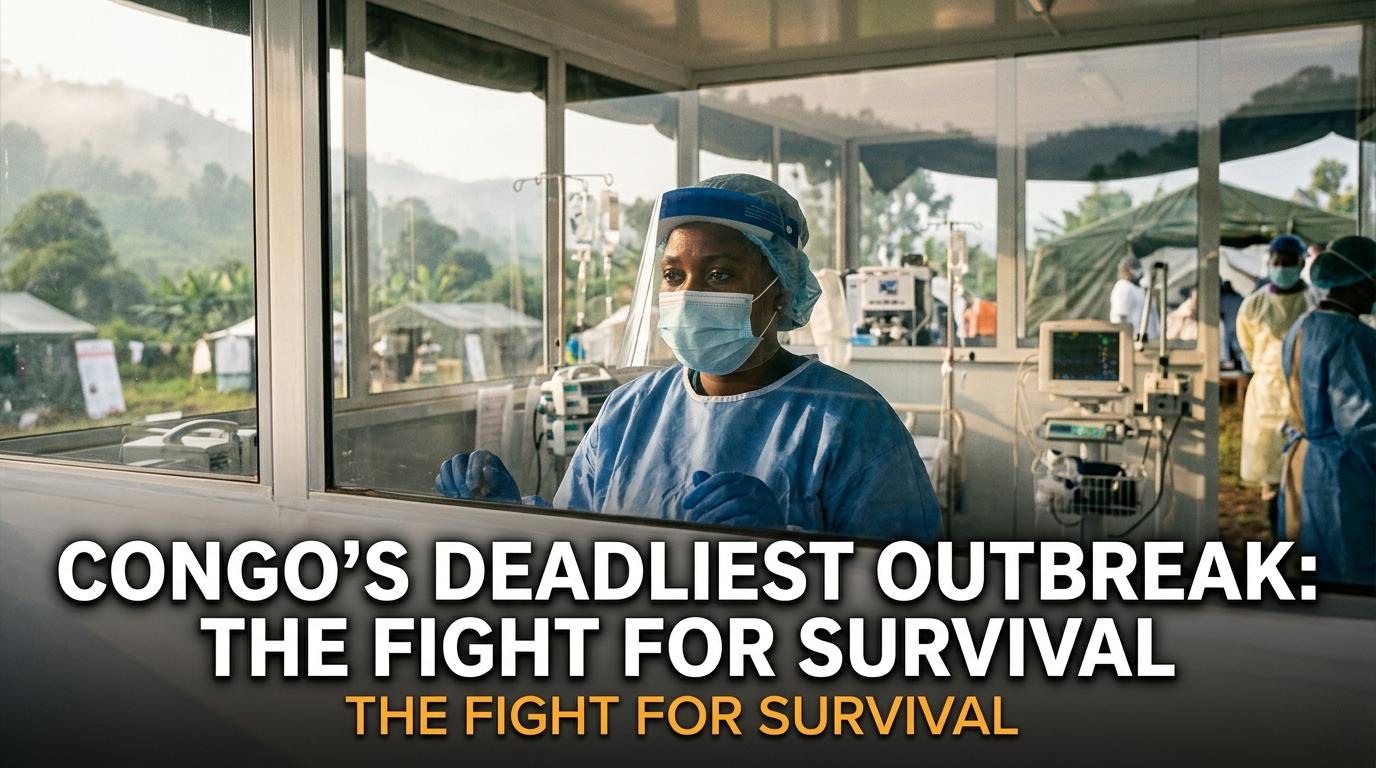
Humanitarian responders also introduced innovative treatment spaces to rebuild public trust (alima.ngo). The medical group ALIMA designed the CUBE, a biosecure emergency care room (alima.ngo). These transparent individual chambers allow medical staff to monitor patients without wearing intimidating protective gear (alima.ngo). Transparent walls permit conscious patients to see and speak with their visiting families (alima.ngo). This transparent design reduced terror and humanized clinical care in rural treatment centers (alima.ngo).
Bio-Equity and the Path Forward
The tragic record in eastern Congo highlights persistent inequalities in global medicine. For generations, foreign institutions extracted African biological samples without sharing commercial patents or manufacturing capacity. This dynamic mirrors the painful record of medical exploitation seen throughout history. Biological materials taken from Congolese survivors generated multi-million dollar therapies abroad (regeneron.com, cancer.gov). Yet local hospitals frequently struggled to maintain sufficient stockpiles of those exact treatments (worldbank.org, reliefweb.int).
True public health security requires local empowerment and lasting investment (worldbank.org). African institutions like the National Institute for Biomedical Research now lead genomic sequencing initiatives (nih.gov). Rebuilding rural clinics and training local community nurses saves more lives than temporary crisis units (worldbank.org, reliefweb.int). By centering African scientific expertise and honoring community dignity, global health agencies can ensure that future outbreaks never reach such devastating milestones again (nih.gov, reliefweb.int).
About the Author
Darius Spearman is a professor of Black Studies at San Diego City College, where he has been teaching for over 20 years. He is the founder of African Elements, a media platform dedicated to providing educational resources on the history and culture of the African diaspora. Through his work, Spearman aims to empower and educate by bringing historical context to contemporary issues affecting the Black community.
