


AU Peace Mission to Sudan: Can True Peace Prevail?
By Darius Spearman (africanelements)
Support African Elements at patreon.com/africanelements and hear recent news in a single playlist. Additionally, you can gain early access to ad-free video content.
The High-Stakes African Union Peace Mission
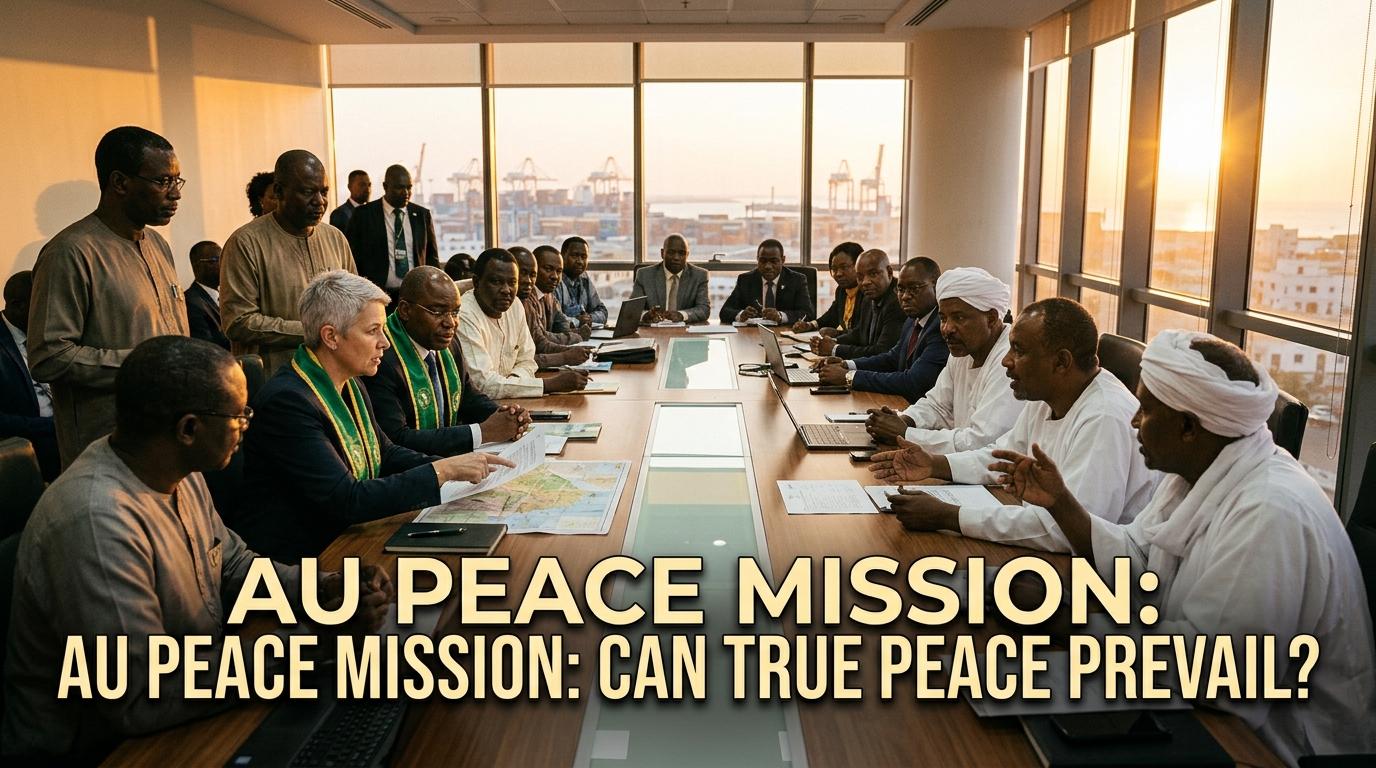
A high-level diplomatic delegation from the African Union Peace and Security Council arrived in Sudan on a critical two-day mission (amaniafrica-et.org, amaniafrica-et.org). The delegation traveled directly to Port Sudan to push the warring factions toward an immediate ceasefire (sudanhorizon.com, newarab.com). In addition, delegates worked to secure life-saving humanitarian corridors for millions of starving civilians (aljazeera.com, anews.com.tr). The mission represents a bold effort to restore direct continental diplomacy after months of remote engagement (issafrica.org, amaniafrica-et.org).
The visiting council members met with General Abdel Fattah al-Burhan, the head of the Sudanese Armed Forces and Transitional Sovereign Council (aljazeera.com, newarab.com). Throughout the meetings, delegates stressed the absolute urgency of stopping military operations (sudanhorizon.com, anews.com.tr). Continental leaders understand that Sudan stands on the brink of total collapse (csis.org). Observers across the global African diaspora recognize that lasting stability requires African-centered solutions to heal internal divisions and build sovereign peace (issafrica.org, democracyinafrica.org).
The Deep Roots of the Conflict in Darfur
Understanding the current war requires examining decades of centralized authoritarian rule and peripheral neglect (harvard.edu). In 2003, non-Arab rebel movements in western Darfur rose against the central government in Khartoum (harvard.edu, wikipedia.org). These communities had endured generations of economic marginalization, racial discrimination, and political disenfranchisement (harvard.edu). The central state answered their demands with overwhelming military violence rather than political reform (hrw.org, wikipedia.org).
Former dictator Omar al-Bashir implemented a brutal divide-and-rule counterinsurgency campaign (harvard.edu). The government armed nomadic Arab militias, known infamously as the Janjaweed (harvard.edu, hrw.org). These state-backed fighters carried out widespread ethnic cleansing, mass murder, and village burnings across Darfur (hrw.org, wikipedia.org). The violence systematically targeted indigenous African farming communities, including the Masalit, Fur, and Zaghawa (hrw.org). These historical atrocities left deep social scars that continue to haunt the nation today (harvard.edu, hrw.org).
Paramilitary Rise: From Janjaweed to the RSF
To protect his regime against military coups, Omar al-Bashir reorganized the Janjaweed militias in 2013 (harvard.edu). He formally institutionalized these forces into the Rapid Support Forces, placing them under the command of Mohamed Hamdan Dagalo, known as Hemedti (csis.org, harvard.edu). The paramilitary group operated as a personal security apparatus reporting directly to the presidency (harvard.edu, wikipedia.org). This structure granted Hemedti unprecedented autonomy from regular military oversight (csis.org, harvard.edu).
Over the following decade, the Rapid Support Forces grew into an independent economic empire (csis.org, harvard.edu). The group captured lucrative gold mines in Darfur and ran transnational mercenary operations across Libya and Yemen (csis.org, harvard.edu). These parallel revenue streams provided immense wealth and advanced weaponry (csis.org). The transformation created a heavily armed rival to the regular army, establishing the groundwork for future armed conflict (csis.org, harvard.edu).
The Ruptured Alliance and the 2023 Outbreak
Massive civilian demonstrations erupted in late 2018, demanding democracy and economic relief (harvard.edu, wikipedia.org). In April 2019, General al-Burhan and Hemedti allied to depose Omar al-Bashir (harvard.edu). Under continental mediation, the military agreed to a power-sharing arrangement with civilian leaders (wikipedia.org, democracyinafrica.org). However, this fragile partnership collapsed in October 2021 when the generals staged a joint coup (amaniafrica-et.org, amaniafrica-et.org). The coup suspended democratic progress and sparked fierce nationwide protests (democracyinafrica.org).
Tensions soon exploded over proposed security sector reforms (csis.org). General al-Burhan demanded the rapid integration of the Rapid Support Forces into the regular army within two years (csis.org). In contrast, Hemedti insisted on a ten-year integration window that preserved his independent command (csis.org). These intense struggles over central power reached a breaking point on April 15, 2023 (csis.org). Heavy fighting erupted across Khartoum, quickly spreading into a nationwide catastrophe (csis.org, acaps.org).
Evolution of Continental Peace Architecture in Sudan
Key milestones of African Union diplomatic and peacekeeping engagement.
The African Union deploys its first peacekeeping mission to monitor the humanitarian crisis in Darfur.
The historic joint AU-UN hybrid mission deploys up to 20,000 personnel to protect civilians across Darfur.
Armed peacekeepers withdraw, transitioning to an unarmed political mission and leaving a security vacuum.
The AU Peace and Security Council suspends Sudan following the military coup against civilian leadership.
The AU delegation arrives in Port Sudan to negotiate humanitarian corridors and an urgent ceasefire.
Two Decades of African Union Peace Architecture
The current intervention builds upon more than twenty years of continental engagement in Sudan (issafrica.org, amaniafrica-et.org). In 2004, the African Union deployed the African Union Mission in Sudan to monitor early ceasefires in Darfur (idsa.in). The mission marked a bold step forward for African-led conflict resolution (idsa.in). However, operational limitations soon demonstrated the need for expanded resources and personnel (idsa.in).
In 2007, the United Nations Security Council partnered with the regional bloc to create UNAMID (idsa.in). This historic hybrid mission deployed thousands of peacekeepers with an explicitly African character (idsa.in). Nevertheless, the mission terminated in December 2020, leaving a dangerous security vacuum (unmissions.org, idsa.in). The subsequent civilian mission, UNITAMS, lacked armed protection capabilities (unmissions.org, unmissions.org). Consequently, violence erupted unchecked when full-scale war returned in 2023 (csis.org, securitycouncilreport.org).
The Scale of Human Displacement and Famine
The humanitarian fallout from the war is staggering in its proportions (acaps.org, unocha.org). More than 12 million people have been forced from their homes (reliefweb.int, unhcr.org). This figure includes roughly 9.5 million internally displaced persons trapped inside Sudan (reliefweb.int). Another 3 million refugees have fled across international borders into neighboring states like Chad, Egypt, and South Sudan (unhcr.org, unocha.org). This represents the largest displacement catastrophe on the planet today (reliefweb.int, unhcr.org).
Famine now threatens an entire generation of Sudanese children (reliefweb.int, un.org). More than 25 million people suffer from acute food insecurity (reliefweb.int, unocha.org). Famine conditions have been officially confirmed in the Zamzam camp near El Fasher (un.org, un.org). Furthermore, over seventy percent of medical facilities in conflict zones remain non-functional (acaps.org, unocha.org). Disease outbreaks, including cholera, continue to ravage vulnerable communities (acaps.org, unocha.org).
Sudan Humanitarian Catastrophe by the Numbers
Estimated humanitarian impact according to verified international relief data.
Geopolitical Meddling and Proxy War Dynamics
The conflict inside Sudan does not exist in isolation (csis.org). External powers actively fuel the fighting by supplying weapons, finance, and logistical support to both sides (csis.org, acjps.org). United Nations investigations show that the Rapid Support Forces receive weapons and supply convoys originating from the United Arab Emirates through Chad (acjps.org). These advanced systems allow paramilitary forces to sustain brutal sieges across Darfur and Kordofan (hrw.org, acjps.org).
Conversely, General al-Burhan’s military secures strategic backing from regional allies, including Egypt and Iran (csis.org). Combat drones supplied by foreign partners have enabled the army to launch counter-offensives across central Khartoum (csis.org). In addition, foreign mercenary groups and gold trading networks exploit the chaos to loot national resources (csis.org). This outside interference severely undermines diplomatic initiatives and prolongs civilian suffering (csis.org, amaniafrica-et.org).
Strategic Obstacles Facing African Union Mediators
Primary diplomatic and operational hurdles confronting the Peace and Security Council.
Both the SAF and RSF believe they can win on the battlefield, making compromise difficult.
Regional powers continue sending weapons, drones, and funds, fueling active combat zones.
Competing forums in Jeddah, IGAD, and Cairo allow belligerents to forum-shop and delay compliance.
Armed factions sideline grassroots democracy activists and mutual aid networks during peace talks.
Grassroots Mutual Aid and Civilian Resistance
Amid the breakdown of state services, ordinary Sudanese citizens stepped forward to save lives (democracyinafrica.org). Neighborhood-based Resistance Committees established Emergency Response Rooms across the country (democracyinafrica.org). These volunteer networks run communal soup kitchens, organize emergency medical clinics, and facilitate civilian evacuations (democracyinafrica.org). These mutual aid efforts reflect historic traditions of mass mobilization in times of national crisis.
Volunteers carry out this vital work under extreme personal danger (democracyinafrica.org, humanrightspulse.com). Both warring factions target aid workers, arbitrarily arresting and assassinating community leaders (hrw.org, humanrightspulse.com). Despite this constant violence, civilian activists remain committed to their peaceful revolutionary principles (democracyinafrica.org). They continue to reject military governance and demand a democratic, civilian-led future for Sudan (democracyinafrica.org).
The Road Ahead for Sudan and the African Diaspora
The African Union peace mission faces an uphill battle to secure lasting stability (issafrica.org, amaniafrica-et.org). Diplomatic delegates must navigate competing regional initiatives, including the US-Saudi Jeddah Platform and IGAD discussions (csis.org, amaniafrica-et.org). True peace cannot emerge from an elite deal between rival warlords (democracyinafrica.org). Instead, international mediators must center civilian voices and demand full accountability for war crimes (humanrightspulse.com, asil.org).
Global communities must support efforts that address historical racial injustices and economic exploitation (harvard.edu, humanrightspulse.com). The African Union must leverage its continental authority to silence the guns and establish humanitarian safe zones (aljazeera.com, peaceau.org). Sudan’s journey toward democracy remains long and painful (democracyinafrica.org). Yet the courage of its grassroots activists proves that the struggle for freedom and justice continues unabated (democracyinafrica.org).
About the Author
Darius Spearman is a professor of Black Studies at San Diego City College, where he has been teaching for over 20 years. He is the founder of African Elements, a media platform dedicated to providing educational resources on the history and culture of the African diaspora. Through his work, Spearman aims to empower and educate by bringing historical context to contemporary issues affecting the Black community.
