

Why Deadly ICE Raids in New York Sparked Mass Outcry
By Darius Spearman (africanelements)
Support African Elements at patreon.com/africanelements and hear recent news in a single playlist. Additionally, you can gain early access to ad-free video content.
Blood in Marble Hill and the March to Varick Street
The gunfire erupted in the middle of a busy autumn afternoon. On October 8, 2026, plainclothes federal agents surrounded a car near West 225th Street in Marble Hill (columbiaspectator.com, riverdalepress.com). Officers wore dark civilian clothing and protective face masks (columbiaspectator.com). They drew semi-automatic weapons without announcing their federal agency (bronxdefenders.org). Seconds later, an agent fired seven rounds into the vehicle (riverdalepress.com). The driver was Oscar Belgal, a 28-year-old Dominican father (columbiaspectator.com). A bullet struck him directly in the neck (columbiaspectator.com, bronxdefenders.org).
His five-year-old son sat strapped in the backseat during the shooting (columbiaspectator.com, riverdalepress.com). The child escaped physical injury but watched his father bleed (columbiaspectator.com). Federal spokespersons claimed agents fired because the driver weaponized the vehicle (cbsnews.com, riverdalepress.com). Eyewitnesses disputed that claim, describing sudden confusion and panic on the residential block (columbiaspectator.com, bronxdefenders.org). Paramedics rushed Belgal to Allen Hospital under heavy armed guard (columbiaspectator.com). Demonstrators gathered outside the emergency room that evening (columbiaspectator.com).
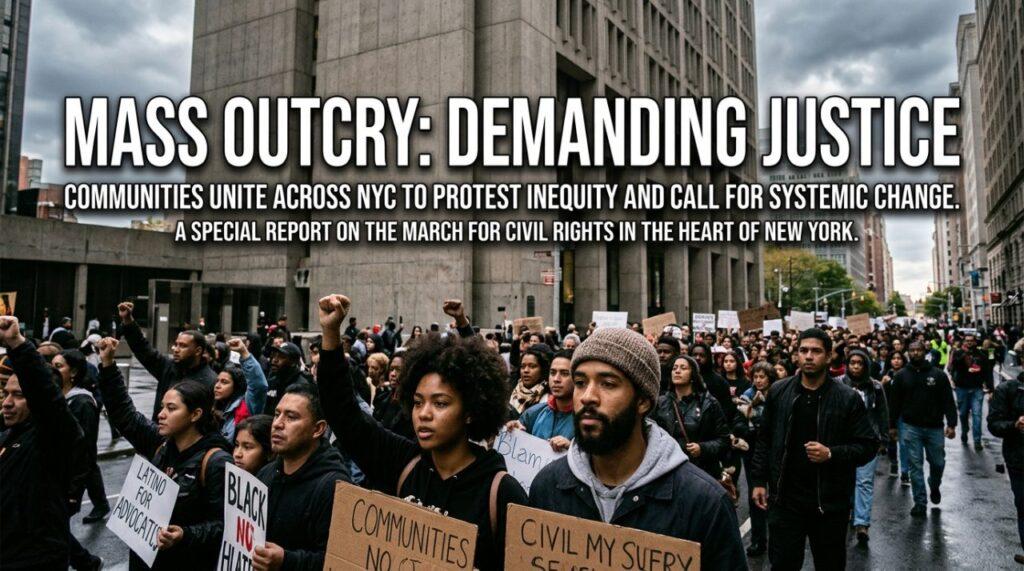
Twenty-four hours later, public outrage reached Lower Manhattan. On October 9, thousands of New Yorkers assembled at Foley Square (columbiaspectator.com, bds.org). Labor organizers, legal defenders, and neighborhood groups joined hands (columbiaspectator.com). The crowd marched across Canal Street to 201 Varick Street (columbiaspectator.com). They surrounded the federal immigration complex, chanting slogans and holding handmade signs (columbiaspectator.com, bds.org). Demonstrators demanded the immediate release of shooting footage, criminal accountability, and an end to militarized street enforcement (columbiaspectator.com, nyic.org).
The Strategic Importance of 201 Varick Street
The federal building at 201 Varick Street holds a central role in immigration enforcement. Located in Hudson Square, the twelve-story structure houses the Executive Office for Immigration Review (yu.edu, courthousenews.com). It also contains holding cells managed by federal removal operations (columbiaspectator.com, courthousenews.com). Regional agents bring individuals through the loading docks after neighborhood sweeps (columbiaspectator.com). Detainees sit in basement holding cells while awaiting processing or remote video hearings (columbiaspectator.com, yu.edu).
This federal address has witnessed fierce civil disobedience before. During the 2018 family separation crisis, community members blockaded the garage entryways under the Occupy ICE banner (columbiaspectator.com). Federal officials suspended in-person court dates in response (columbiaspectator.com). In May 2026, a federal judge issued an injunction restricting enforcement at the building (columbiaspectator.com, yu.edu). The ruling barred agents from arresting noncitizens attending immigration hearings inside or near the property (yu.edu). Denied courthouse arrests, agents turned to residential sidewalks and moving traffic (columbiaspectator.com).
NY-NJ Street Stops vs Population Share
The 1996 Law That Criminalized Civil Immigration
Modern immigration raids did not appear overnight. Their statutory roots trace directly to the Illegal Immigration Reform and Immigrant Responsibility Act of 1996 (brooklaw.edu). Signed by President Bill Clinton, the law fundamentally transformed immigration enforcement into a punitive system (brooklaw.edu). Legal scholars label this convergence of penal mechanisms and immigration administrative processing as crimmigration (brooklaw.edu). The statute mirrored the broader political rise of mass incarceration across Black and Latino communities during that decade.
The 1996 legislation expanded the legal category known as aggravated felonies (brooklaw.edu). Lawmakers added minor nonviolent crimes, low-level drug offenses, and misdemeanors with one-year prison sentences (brooklaw.edu). Furthermore, Congress applied these new standards retroactively to older convictions (brooklaw.edu). The law eliminated judicial discretion, barring immigration judges from granting relief based on family hardship (brooklaw.edu). Longtime legal residents faced mandatory deportation without consideration of community ties (brooklaw.edu).
The statute also created Section 287(g) of the Immigration and Nationality Act (dhs.gov). This provision allowed the federal government to deputize state and local police officers to enforce civil immigration rules (dhs.gov). It instituted mandatory detention without bond for vast categories of immigrants (brooklaw.edu). It also created expedited removal pathways, bypassing judicial oversight altogether (brooklaw.edu). These legal mechanisms laid the foundation for the plainclothes paramilitary units active in cities today.
The Post-9/11 Reorganization and Paramilitary Policing
The structural transformation deepened following the attacks of September 11, 2001 (ice.gov). For decades, civil immigration regulation fell under the Department of Justice within the Immigration and Naturalization Service (ice.gov). In 2002, Congress passed the Homeland Security Act (ice.gov). The legislation dissolved the old agency, reallocating its functions into three separate divisions (ice.gov). In March 2003, interior immigration policing moved to the Department of Homeland Security (ice.gov).
The creation of Immigration and Customs Enforcement, known as ICE, placed civil enforcement into a counterterrorism framework (ice.gov). Enforcement and Removal Operations adopted tactical gear, unmarked vehicles, and aggressive surveillance methods (columbiaspectator.com, ice.gov). Operations formerly reserved for high-risk felony apprehensions became standard procedure for routine civil detentions (nyclu.org, ice.gov). Over time, federal field squads operated with minimal external oversight, executing warrants inside residential neighborhoods and school zones (columbiaspectator.com, nyclu.org).
Federal Field Weapon Discharges (Recent Incidents)
Sanctuary Rules, Detainers, and the Fourth Amendment
New York City developed its sanctuary protections across four decades of legal conflict. The framework began in 1989 when Mayor Ed Koch issued Executive Order 40 (nyc.gov). That order prohibited municipal personnel from transmitting immigration information to federal authorities unless required by federal law (nyc.gov). Between 2011 and 2014, the City Council enacted Local Laws 62 and 63 (nyclu.org). These measures barred local corrections and police from holding individuals on federal detainers without an order signed by a judge (nyclu.org).
The constitutional rationale rests firmly on the Fourth Amendment. A federal immigration detainer, known as Form I-247A, is an administrative request written by an enforcement agent (courthousenews.com). It lacks the signature of an independent Article III judge (courthousenews.com). Federal courts have established that detaining an individual past their scheduled release time constitutes a new warrantless arrest (courthousenews.com). Holding noncitizens on administrative requests exposes municipalities to civil liability for unlawful imprisonment (courthousenews.com).
These municipal statutes reflect ongoing debates over federalism and state power. Unchecked local collaboration produces severe racial profiling against Black and Latino residents (nyclu.org). It discourages immigrant families from seeking medical care, reporting crimes, or enrolling children in public schools (nyclu.org). When federal agencies flooded New York with more than 6,000 detainer requests, local officials refused to comply without judicial warrants (nyclu.org). Consequently, federal squads escalated direct street operations across the five boroughs (columbiaspectator.com, nyclu.org).
The Danger of Plainclothes Vehicle Interdictions
The shooting of Oscar Belgal revealed a recurring tactical pattern. Civil rights investigators have documented repeated instances where plainclothes squads box in cars with unmarked vehicles (theguardian.com, theguardian.com). Armed agents approach without uniforms or verbal identification, producing severe panic among drivers (bronxdefenders.org). When motorists attempt to navigate away from unidentified gunmen, agents open fire into the vehicle (bronxdefenders.org, theguardian.com). Federal authorities routinely claim the car became a deadly weapon directed at their personnel (cbsnews.com, theguardian.com).
Municipal police protocols strictly condemn this specific practice. The New York City Police Department explicitly forbids officers from firing at moving vehicles (theguardian.com). Decades of urban policing research show that firing at moving automobiles increases collateral hazards (theguardian.com). Bullets incapacitate drivers, turning unguided cars into lethal hazards for nearby pedestrians (theguardian.com). In contrast, federal agents continue employing these aggressive methods, heightening the severe challenges facing Black families and immigrant households navigating public streets.
Varick Street Immigration Decisions (FY 2025)
MDC Brooklyn and the Crisis of Medical Neglect
The civil rights emergency escalated further after Belgal left the hospital. Within hours of receiving initial emergency triage, federal agents transferred him to the Metropolitan Detention Center in Brooklyn (bronxdefenders.org). Defense attorneys from public defender groups struggled for twenty-four hours to locate him (bronxdefenders.org). When legal counsel finally secured access, they discovered him held in an isolation cell (bronxdefenders.org). The bullet remained lodged in his neck, and staff provided minimal medical care (bronxdefenders.org).
MDC Brooklyn holds an extensive record of administrative dysfunction and physical neglect. Multiple federal judges have characterized conditions inside the facility as a ongoing humanitarian failure (cbsnews.com, davisvanguard.org). Official government reports document severe staffing shortages, raw sewage leaks, persistent vermin infestations, and unheated winter cells (justice.gov). Incarcerated individuals routinely endure months of delays before receiving necessary medical evaluations or prescription medicines (cbsnews.com, justice.gov).
Due to severe custodial vacancies, the facility routinely enforces prolonged lockdowns (davisvanguard.org, justice.gov). These institutional lockdowns subject the entire population to conditions identical to punitive solitary confinement (davisvanguard.org). Confining a wounded man with an untreated bullet wound inside such an environment poses acute risks of infection, permanent neurological injury, and sepsis (bronxdefenders.org). Public defenders filed emergency motions in federal court demanding his immediate transfer to an outside hospital (bronxdefenders.org).
Community Resistance and the Legislative Path Ahead
The mobilization outside 201 Varick Street marked an important turning point for immigrant defense coalitions (columbiaspectator.com). Organizers connected the shooting in Marble Hill directly to state and national policies (columbiaspectator.com, nyic.org). Coalitions like Hands Off NYC argue that municipal sanctuary rules remain vulnerable without comprehensive statewide legislation (nyic.org). They are pressing state lawmakers in Albany to pass the New York For All Act (nyic.org, bronxdefenders.org). That bill would prohibit local government agencies from sharing databases with federal deportation officers (nyic.org).
Advocates also demand the passage of the Dignity Not Detention Act (nyic.org, bronxdefenders.org). This proposed statute would prohibit county jails across New York from contracting detention space to federal agencies (nyic.org). These legal battles align with wider discussions regarding state racial justice policies and institutional accountability. Community networks continue organizing rapid response alert systems across working-class neighborhoods (columbiaspectator.com, nyic.org).
The demonstration at 201 Varick Street demonstrated the resilience of community defense networks (columbiaspectator.com). From the 1996 immigration overhaul to modern plainclothes operations, federal policies have systematically expanded interior policing powers (ice.gov, brooklaw.edu). The events in Marble Hill showed that when federal agencies conduct militarized operations in dense neighborhoods, severe violence follows (columbiaspectator.com, bronxdefenders.org). As long as armed agents patrol city streets without accountability, the pavement outside federal immigration courts will remain a center of community protest (columbiaspectator.com).
About the Author
Darius Spearman is a professor of Black Studies at San Diego City College, where he has been teaching for over 20 years. He is the founder of African Elements, a media platform dedicated to providing educational resources on the history and culture of the African diaspora. Through his work, Spearman aims to empower and educate by bringing historical context to contemporary issues affecting the Black community.
