


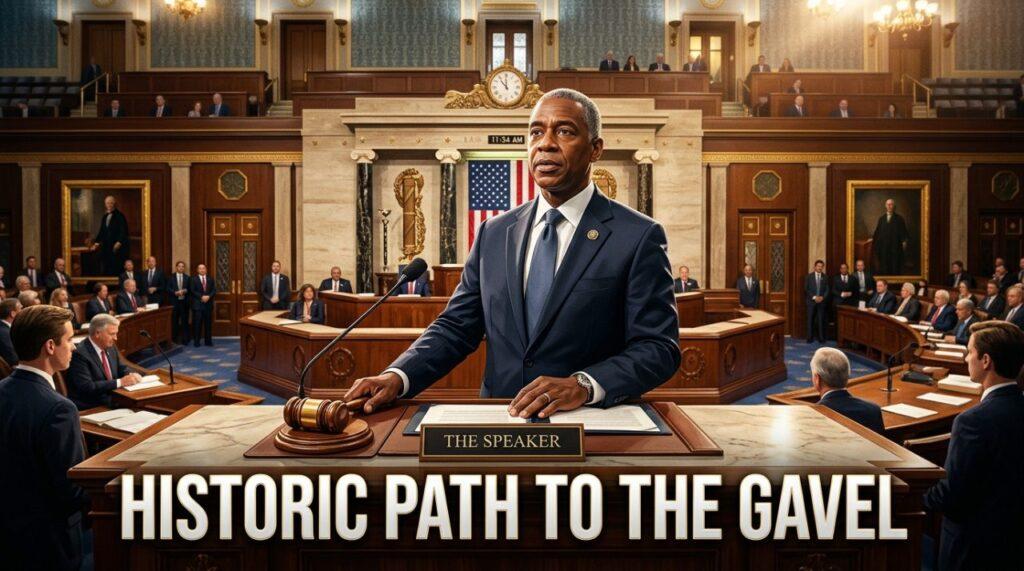
Hakeem Jeffries House Speaker: Historic Path to the Gavel
By Darius Spearman (africanelements)
Support African Elements at patreon.com/africanelements and hear recent news in a single playlist. Additionally, you can gain early access to ad-free video content.
The United States Capitol was constructed in part through the forced labor of enslaved Black Americans. For more than two centuries, the physical center of federal lawmaking reflected the racial hierarchies that defined the republic. Now, following congressional election results that secured a new legislative alignment, Representative Hakeem Jeffries of New York stands on the verge of claiming the highest office in the U.S. House of Representatives (youtube.com, archives.gov). The prospect of Hakeem Jeffries House Speaker represents more than an ordinary change of partisan control. It marks the culmination of a political journey spanning over one hundred and fifty years (britannica.com).
This leadership milestone bridges the distance between the brief, fragile political gains of post-Civil War Reconstruction and modern legislative governance. The story of this elevation is rooted in the long struggle of Black Americans to secure the ballot, build legislative institutions, and demand constitutional equality (archives.gov, house.gov). To understand this contemporary political development, one must examine the deep historical currents that brought the representative from Brooklyn to the doorstep of the speakership (hakeemjeffries.com).
Democratic House majority Clears the Path for a New Era
The return of a Democratic House majority following recent national elections set the stage for a historic transfer of legislative authority. In American politics, the party that holds a numerical advantage in the House of Representatives possesses the constitutional right to elect the chamber’s presiding officer (house.gov). After navigating consecutive sessions as the House Democratic Leader, Jeffries maintained party unity across diverse ideological factions (ballotpedia.org). His caucus remained disciplined during high-stakes floor votes and contentious legislative negotiations (youtube.com, gpb.org).
The party leadership transition began in late 2022 when veteran lawmakers stepped down to clear the way for younger leadership. Nancy Pelosi, Steny Hoyer, and James Clyburn transferred authority to a new executive slate led by Jeffries, Democratic Whip Katherine Clark, and Caucus Chair Pete Aguilar (youtube.com, ballotpedia.org). Jeffries had already made history on November 30, 2022, when his colleagues voted unanimously to elect him House Democratic Leader, making him the first African American to lead a major political party in either chamber of Congress (binghamton.edu, nul.org). With a newly won majority, that leadership post now translates into an official nomination for the speakership itself (kare11.com).
first Black House Speaker Poised to Break a 237-Year Precedent
When the new Congress convenes and completes the formal roll call vote, Jeffries is slated to become the first Black House Speaker in United States history (youtube.com, kare11.com). Since the First Congress gathered in New York City in 1789 and elected Frederick Muhlenberg to the post, fifty-six individuals have held the Speaker’s gavel (house.gov). Every single one of them has been white. Breaking this 237-year barrier represents an institutional milestone that transforms the public face of national governance (britannica.com).
The symbolic significance of this elevation is profound when viewed against the building where the vote takes place. The Statue of Freedom stands atop the Capitol dome, cast by enslaved foundry workers who possessed no legal standing or civil rights under the law (archives.gov). That an African American lawmaker will soon preside over the House chamber directly answers generations of legal exclusion. Yet the speakership is far more than a ceremonial position. It carries institutional responsibilities that govern the legislative output of the entire federal government (house.gov, house.gov).
Speakers of the House Since 1789
Reconstruction era Black lawmakers and the Broken Promise
The lineage of federal Black leadership began in the ashes of the American Civil War. During Reconstruction, the passage of the Thirteenth, Fourteenth, and Fifteenth Amendments created the legal opening for formerly enslaved men to participate in national elections (archives.gov, house.gov). In 1870, Hiram Rhodes Revels of Mississippi entered the Senate, filling the seat once occupied by Confederate president Jefferson Davis. That same year, South Carolina voters sent Joseph Hayne Rainey to the House of Representatives, making him the first African American seated in the lower body (smithsonianmag.com, britannica.com).
Rainey was born into chattel slavery in Georgetown, South Carolina, and purchased his freedom before the war (smithsonianmag.com). In May 1874, during floor debate over civil rights legislation, Speaker James G. Blaine invited Rainey to preside temporarily over the chamber as Speaker pro tempore (archives.gov, smithsonianmag.com). For a single afternoon, an African American man held the legislative gavel for the first time in federal history. Rainey used his tenure to advocate for public education, economic fairness, and legal protections against racial terror (smithsonianmag.com, britannica.com).
Sixteen Black men served in Congress during this period, but their presence provoked violent resistance from southern white supremacists (archives.gov). When the federal government withdrew occupying troops under the Compromise of 1877, southern state legislatures instituted unfree labor arrangements and began systematically stripping Black citizens of their constitutional franchise. Through literacy tests, poll taxes, and Ku Klux Klan violence, Black political power was suppressed across the South (archives.gov, house.gov).
In March 1901, Representative George Henry White of North Carolina, the final Black congressman of the Reconstruction era, delivered his valedictory address on the House floor (archives.gov). White declared that while Black lawmakers were being forced from the halls of power, the Black American would one day rise again like a phoenix (archives.gov). His departure began a twenty-eight-year period during which zero African Americans served in Congress. The complete exclusion ended only in 1928, when Oscar De Priest won election in Chicago following the Great Migration (house.gov, britannica.com).
The political allegiance of Reconstruction era Black lawmakers belonged squarely to the Republican Party, known then as the party of Abraham Lincoln (house.gov). However, Black federal representation underwent a profound partisan transition across the twentieth century. The first stage unfolded during the Great Depression of the 1930s. Franklin D. Roosevelt’s New Deal policies provided direct economic assistance to impoverished communities, prompting northern urban Black voters to reconsider their traditional loyalties. In 1934, Arthur Mitchell of Illinois won election as the first Black Democrat in congressional history (britannica.com).
The second stage occurred during the 1960s civil rights movement. National Democrats championed the Civil Rights Act of 1964 and the Voting Rights Act of 1965 under Lyndon B. Johnson, establishing federal oversight of state elections (house.gov, britannica.com). Simultaneously, the Republican Party embraced the Southern Strategy, appealing to disaffected white southern voters who opposed federal desegregation mandates. This structural political shift permanently aligned the vast majority of Black voters and federal candidates with the Democratic Party (house.gov).
Black Members in U.S. Congressional History
Congressional Black Caucus history and the Rise of Majority Districts
The modern era of Black legislative authority expanded dramatically in the late 1960s. In 1968, voters in Central Brooklyn elected Shirley Chisholm to represent New York’s 12th Congressional District, making her the first African American woman elected to Congress (wikipedia.org). Running under the campaign slogan “Unbought and Unbossed,” Chisholm challenged the institutional seniority system that silenced junior members and people of color. In 1972, she mounted the first major-party presidential run by an African American, laying an assertive blueprint for urban electoral power (wikipedia.org).
In February 1971, thirteen Black representatives founded an organization that would permanently change Capitol Hill: the Congressional Black Caucus (cbcfinc.org, cbcfinc.org). Led by figures such as Charles Rangel, John Conyers, Ron Dellums, and Shirley Chisholm, the organization formed to coordinate legislative policy for Black Americans nationwide (cbcfinc.org, cbcfinc.org). At a time when extra-parliamentary activism flourished through radical urban organizing, the CBC styled itself as the “Conscience of the Congress,” insisting that federal budgets reflect the material needs of marginalized communities (cbcfinc.org).
However, the expansion of Black representation required specific legal interventions to dismantle persistent voter suppression. For decades, white-dominated state legislatures engaged in black voter disenfranchisement by cracking Black communities into multiple districts to dilute their voting strength. The breakthrough arrived when Congress amended Section 2 of the Voting Rights Act in 1982 to prohibit discriminatory voting practices regardless of legislative intent (house.gov).
In the landmark 1986 ruling Thornburg v. Gingles, the Supreme Court established strict standards requiring the intentional creation of majority-minority districts. Where minority populations were sufficiently large and geographically compact, states had to draw boundaries allowing those communities to elect candidates of their choice. The subsequent redistricting cycle after the 1990 Census dramatically expanded Black congressional representation across the country, increasing the size of the Congressional Black Caucus and creating safe urban seats (cbcfinc.org, cbcfinc.org). This structural transformation allowed Black lawmakers to build the institutional seniority required to capture powerful committee gavels and leadership posts (house.gov).
Congressional Black Caucus Membership Growth
Hakeem Jeffries political career from Central Brooklyn to Capitol Hill
The institutional foundation built by Shirley Chisholm directly shaped the district that launched the Hakeem Jeffries political career. Raised in Crown Heights, Brooklyn, by working-class parents—a social worker and a state substance abuse counselor—Jeffries grew up surrounded by traditions of communal resilience and kinship (hakeemjeffries.com). He completed his undergraduate education at Binghamton University, earned a Master of Public Policy from Georgetown University, and graduated magna cum laude from the New York University School of Law (binghamton.edu, hakeemjeffries.com).
Following a career in corporate litigation and a six-year tenure in the New York State Assembly, Jeffries won election to the U.S. House of Representatives in 2012, representing New York’s 8th Congressional District (ballotpedia.org, hakeemjeffries.com). In Washington, he balanced traditional committee work with assertive public messaging. In 2018, Jeffries demonstrated legislative pragmatism by co-authoring the FIRST STEP Act, a federal criminal justice reform law that reduced mandatory minimum sentencing guidelines and expanded rehabilitative programming in federal prisons (hakeemjeffries.com, wikipedia.org).
His national visibility accelerated in early 2020 when Speaker Nancy Pelosi appointed him as an impeachment manager in the first Senate trial of Donald Trump (hakeemjeffries.com, wikipedia.org). Jeffries delivered precise legal arguments peppered with references to Brooklyn culture and hip-hop lyrics, earning praise from party colleagues for his composure under pressure (hakeemjeffries.com). Inside the caucus, he maintained bridges between progressive reformers and moderate suburban members, steadily positioning himself for House leadership succession (youtube.com, ballotpedia.org).
Jeffries demonstrated his endurance as a minority leader on the House floor in July 2025. Delivering a blistering floor speech against majority legislation titled the “One Big Beautiful Bill Act,” Jeffries spoke continuously for eight hours and forty-five minutes (wikipedia.org). The marathon address broke the previous modern House record, highlighting his determination to resist opposing policy priorities while commanding national media attention (wikipedia.org, sfgate.com).
House Speaker constitutional powers and the Line of Succession
Holding the Speaker’s gavel differs fundamentally from serving as an internal party whip or floor leader. Under the U.S. Constitution, the Speaker of the House is not simply a legislative party boss; the office is a constitutional institution established under Article I, Section 2 (house.gov). While party whips are responsible for counting votes and maintaining member discipline, the Speaker exercises near-absolute gatekeeping authority over the legislative docket (house.gov, house.gov).
The Speaker controls the House calendar and exerts broad influence over the House Rules Committee, deciding which bills reach the floor, which amendments are considered, and which proposals are permanently discarded (house.gov). A party whip cannot force a bill to the floor if the leadership objects. In contrast, the Speaker holds the unilateral authority to prioritize civil rights measures, economic equity legislation, or voting rights protections. Furthermore, the Speaker leads high-stakes negotiations with the Senate and the White House, giving social justice issues institutional leverage that minority leaders cannot provide alone (house.gov).
Beyond legislative scheduling, the office holds profound constitutional weight in the executive chain of command. Under the Presidential Succession Act of 1947, the Speaker of the House stands second in the line of presidential succession, directly behind the Vice President (house.gov). If the President and Vice President are incapacitated, the Speaker assumes the powers and duties of the presidency (house.gov). Elevating an African American lawmaker to this constitutional position represents an unprecedented shift in federal executive continuity (youtube.com, britannica.com).
As Hakeem Jeffries prepares to ascend the rostrum, the transition signifies more than personal achievement or partisan advantage. It represents the realization of an institutional trajectory set in motion during Reconstruction (archives.gov, smithsonianmag.com). From Joseph Rainey’s brief stewardship of the gavel in 1874 to George Henry White’s prophecy of a political resurgence, Black Americans have continually fought to shape federal governance (archives.gov, britannica.com). The coming speakership places an African American leader at the center of the constitutional order, concluding a long march toward full legislative power (youtube.com, house.gov).
About the Author
Darius Spearman is a professor of Black Studies at San Diego City College, where he has been teaching for over 20 years. He is the founder of African Elements, a media platform dedicated to providing educational resources on the history and culture of the African diaspora. Through his work, Spearman aims to empower and educate by bringing historical context to contemporary issues affecting the Black community.
