

Haiti Gang Violence: Inside the Deadly Raid on Martissant
By Darius Spearman (africanelements)
Support African Elements at patreon.com/africanelements and hear recent news in a single playlist. Additionally, you can gain early access to ad-free video content.
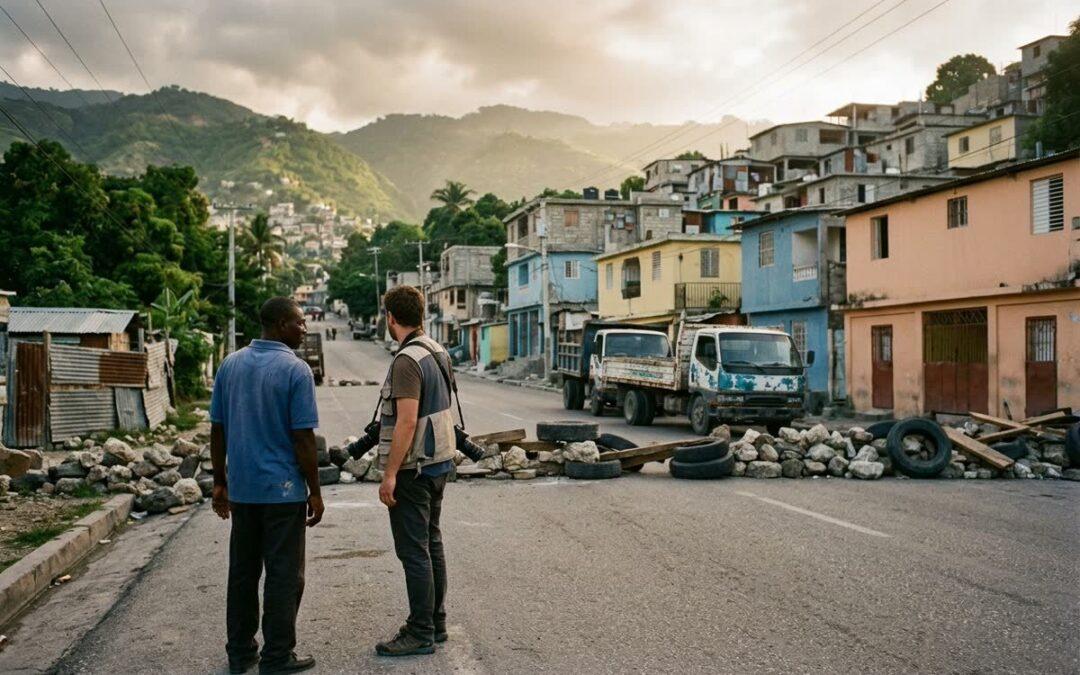
Gunfire echoed across the southern entrance of Port-au-Prince as state security forces launched an aggressive ground and air offensive. When the smoke cleared, the Haitian National Police reported that thirty-four suspected gang members lay dead in the district of Martissant (jamaicaobserver.com, jamaicaobserver.com). Armored vehicles breached barricaded alleys while commercial drones dropped explosives onto fortified redoubts (cbc.ca, aljazeera.com). The high-intensity clash marked one of the deadliest single security incursions in the capital in recent years.
For casual observers, the headlines depict sudden urban combat. Yet Martissant is not an ordinary neighborhood. It represents the historical gateway to southern Haiti and the exact location where state control dissolved years ago (lenouvelliste.com, cardh.org). The escalating conflict reveals how decades of institutional erosion, external political meddling, and state-sponsored paramilitary networks transformed street factions into heavily armed federations. The present crisis reflects deep historical currents that continue to shake the first free Black republic in the Americas.
The Martissant Gang Raid and the Battle for the Capital
The tactical offensive unfolded across the densely packed sectors of Martissant 2, 4, and 23 (jamaicaobserver.com). Units of the Haitian National Police coordinated with a specialized tactical team to breach barricades that had blocked law enforcement for years. Video records corroborated by independent observers showed heavily reinforced armored vehicles tearing down iron gates and concrete roadblocks (cbc.ca, youtube.com). Aerial units operated explosive-equipped surveillance drones to strike sniper nests situated on rooftops above the main roads (aljazeera.com).
The raid specifically targeted structural compounds used as operational headquarters by gang commanders (jamaicaobserver.com). Reports indicated that private defense contractors assisted security personnel with tactical intelligence and aerial reconnaissance (inquisitr.com, bsinews.id). While international partners have provided technical resources, the ground assault rested upon Haitian tactical units facing heavy machine-gun fire. Thirty-four gang fighters were killed during the operation, dealing a localized blow to criminal networks (jamaicaobserver.com, jamaicaobserver.com). However, tactical incursions without permanent military garrisons have rarely produced lasting security in the capital.
Sovereign leadership in Haiti remains divided as authorities navigate legal limits regarding foreign security assistance (aa.com.tr, ua.news). Following the resignation of Prime Minister Ariel Henry, executive power shifted to a transitional presidential council alongside an interim prime minister (newsday.com). Under domestic law and international treaties, hiring foreign mercenary armies remains illegal (humanrightsincontext.be). This restriction limits the state to bilateral technical support and police advisement. Meanwhile, the United Nations-backed Multinational Security Support mission, led by Kenyan police forces, has deployed only a fraction of its planned personnel due to chronic international funding shortages (aa.com.tr, newsday.com).
Port-au-Prince Territorial Control Estimates
Route Nationale 2 and the Rise of the Grand Ravine Gang
To understand the strategic importance of Martissant, one must look at a map of Haiti. Martissant straddles Route Nationale 2, the single terrestrial highway linking Port-au-Prince to four southern administrative departments (lenouvelliste.com, arcgis.com). Over three million residents rely directly on this transit route for food, commercial trade, and medical transport. When armed groups seized the corridor, they gained an economic choke point over the entire republic.
The turning point arrived on June 1, 2021. Armed factions aligned with the Grand Ravine gang, headed by Renel Destina, known as “Ti Lapli,” launched an assault alongside the 5 Segond gang against rivals in Ti-Bois (lenouvelliste.com, lenouvelliste.com). Gang fighters overran the local police substation and drove law enforcement away. More than nineteen thousand civilians fled their burning homes within days (lenouvelliste.com). The state never regained control, marking the official birth of what human rights monitors identify as lost territories (cardh.org).
“The capture of Martissant in June 2021 was the initial crack that caused the institutional dam of southern Port-au-Prince to burst entirely.”
Human Rights Field Assessment, Source: (cardh.org)
Once established, the Grand Ravine gang converted the highway into an extortion toll zone. Commercial vehicles and freight trucks faced demands of up to $380 per passage (cardh.org). Drivers who refused were shot or kidnapped for ransom. The closure of the highway cut the capital off from southern agricultural produce, causing urban food prices to soar. Medical centers were forced to shut down. Doctors Without Borders permanently closed its emergency trauma hospital in Martissant after facilities and ambulances sustained gunfire (lenouvelliste.com). The area became an unpoliced corridor funding gang expansion across the metropolitan area.
State Paramilitarism and the Roots of Tonton Macoutes History
The armed groups terrorizing Port-au-Prince did not emerge from a vacuum. Their structural lineage connects directly to a long tradition of state-sponsored paramilitarism. During the dictatorship of François “Papa Doc” Duvalier and his son Jean-Claude, the regime created the Volontaires de la Sécurité Nationale (wikipedia.org). Known popularly as the Tonton Macoutes, this militia answered directly to the presidential palace. It served as a violent counterweight to the traditional armed forces, silencing political opponents through torture, disappearances, and public executions (wikipedia.org, harvard.edu).
When the Duvalier regime collapsed in 1986, the militia disbanded in name only. Thousands of former Macoutes kept their weapons and integrated into private security networks run by wealthy elites. Following a series of military coups, President Jean-Bertrand Aristide completely abolished the Armed Forces of Haiti in 1995 with United States backing (harvard.edu). The government established the civilian Haitian National Police to maintain order. However, the new police force lacked resources, heavy equipment, and institutional training to resist corrupting influences (arcgis.com, harvard.edu).
Without an army, political factions in the late 1990s and early 2000s began arming neighborhood youths in marginalized slums like Cité Soleil, Bel Air, and Grand Ravine (arcgis.com). Known as chimères, these armed groups received weapons, state cash, and legal protection in exchange for breaking up opposition protests and guaranteeing votes (harvard.edu). This reliance on armed civilians established a dangerous model of political patronage. The struggle mirrors other historical chapters where marginalized communities faced violence amid failed structural reform and broken promises of state protection.
Haitian history illustrates how political elites repeatedly weaponized armed factions for factional survival. When international peacekeepers under the United Nations Stabilization Mission entered Haiti in 2004, they fought armed gangs in urban slums (harvard.edu). Yet international operations focused almost exclusively on military confrontation. They ignored the underlying economic starvation, lack of judicial institutions, and political corruption that created the gangs in the first place (globalinitiative.net, harvard.edu). Consequently, criminal networks survived every foreign intervention.
Evolution of Armed Groups in Haiti
The Illicit Pipeline: Florida Gun Trafficking to Haiti
Haiti does not manufacture firearms or ammunition. Every rifle, magazine, and bullet used by gang syndicates enters through foreign borders (unodc.org). Investigations by the United Nations Office on Drugs and Crime and federal agencies demonstrate that Florida serves as the primary originating hub for illegal armaments entering Haiti (unodc.org, globalinitiative.net). High-powered semi-automatic rifles, assault weapons, and .50-caliber anti-materiel sniper guns flow steadily from United States retail outlets into Haitian ports (unodc.org).
The trafficking network relies on coordinated straw-purchasing operations across southern states. Individuals with clean criminal records purchase weapons at licensed gun stores and private gun shows (unodc.org). Traffickers then dismantle the firearms, conceal them inside commercial freight, and mislabel the cargo as automotive components, packaged groceries, or humanitarian donations (unodc.org, globalinitiative.net). These shipping containers depart small, unmonitored wharves along the Miami River as well as major Florida sea terminals (globalinitiative.net).
| Trafficking Stage | Operational Vulnerability | Impact on Violence |
|---|---|---|
| U.S. Straw Purchases | Loopholes in gun-show sales and unregulated bulk purchases | Supplies military-grade assault rifles and high-capacity magazines |
| Maritime Shipping | Uninspected cargo containers departing southern Florida ports | Transports concealed weapons and millions of ammunition rounds |
| Haitian Customs Entry | Compromised port terminals and disabled cargo scanners | Allows unchecked arrival of weapons into gang-controlled districts |
Upon arrival in Haiti, foreign firearms slip through inspection points with minimal interference. Key maritime terminals, including private ports like Lafito and Terminal Varreux, face deep regulatory breakdowns (unodc.org). Port cargo scanners are frequently broken, disabled, or deliberately bypassed by compromised port personnel (globalinitiative.net). Bribes paid to customs officials allow containers packed with weapons to clear dockyards without physical searches. At the same time, the Haitian Coast Guard possesses few operational patrol boats to monitor eleven hundred miles of open coastline, leaving illegal drop points open for maritime deliveries (unodc.org).
Mob Violence and the Bwa Kale Vigilante Movement
Faced with systemic police failure, everyday citizens formed neighborhood defense groups to protect their families. In April 2023, this desperation erupted into the Bwa Kale vigilante campaign (amnesty.org, cbsnews.com). The spark occurred in the Canapé-Vert neighborhood when an unarmed crowd intercepted fourteen suspected gang members in police custody (cbsnews.com). The mob dragged the men from the police vehicle, lynched them, and burned their bodies in the street (cbsnews.com). Within days, community self-defense groups organized across the capital to hunt suspected gang affiliates.
The movement reflected total disillusionment with state authority. However, it quickly produced grave human rights abuses. According to United Nations observers and independent monitoring organizations, mob action degenerated into arbitrary killings without judicial process (amnesty.org). Displaced refugees, youths traveling through unfamiliar neighborhoods, and individuals accused through personal vendettas were beaten and executed by crowds (amnesty.org, aljazeera.com). The line between community protection and extrajudicial violence vanished in chaotic street encounters.
In response to vigilante killings, armed gang coalitions launched punitive counter-strikes against residential communities (aljazeera.com, amnesty.org). Factions allied under the Viv Ansanm banner conducted coordinated assaults against neighborhoods suspected of assisting vigilantes. Gangs burned homes, executed entire families, and carried out systematic sexual assaults to terrify residents into submission (aljazeera.com, cardh.org). Rather than restoring security, the cycle deepened urban displacement, driving the total number of displaced persons across Haiti past one million (cardh.org).
Humanitarian Impact of the Conflict
The tragedy confronting Haiti connects back to global systems that have isolated the nation since its founding. When enslaved Africans overthrew French colonial rule in 1804, European empires and the United States imposed economic embargoes to punish the Black republic. France later extorted a massive indemnity under naval gunboats, saddling the young nation with unpayable sovereign debt. The history of state collapse cannot be separated from the legacy of external resource extraction and foreign military occupations that dismantled domestic civil institutions.
The tactical raid that claimed thirty-four gang members in Martissant demonstrates that the national police retain combat capabilities under specialized leadership (jamaicaobserver.com). Yet historical patterns suggest that tactical operations alone cannot dismantle entrenched criminal networks. As long as illegal weapons flow freely from United States ports, politicians utilize armed groups for control, and youth lack basic economic alternatives, the roots of violence will remain. The struggle for Martissant is a reminder that genuine peace requires rebuilding democratic institutions, holding corrupt financiers accountable, and honoring the fundamental right of Haitian communities to self-determination, survival and resilience.
About the Author
Darius Spearman is a professor of Black Studies at San Diego City College, where he has been teaching for over 20 years. He is the founder of African Elements, a media platform dedicated to providing educational resources on the history and culture of the African diaspora. Through his work, Spearman aims to empower and educate by bringing historical context to contemporary issues affecting the Black community.
