

California Voter ID Measure Rejected: What You Need to Know
By Darius Spearman (africanelements)
Support African Elements at patreon.com/africanelements and hear recent news in a single playlist. Additionally, you can gain early access to ad-free video content.
California voters delivered a clear verdict on the state ballot by defeating Proposition 39, a proposed constitutional amendment that sought to enforce strict identification requirements on in-person and mail-in ballots. The measure would have forced voters to write identification numbers on vote-by-mail envelopes and mandated routine citizenship checks across state registration rolls. Defeated by a margin of roughly twenty points, the outcome marked a critical victory for voting rights coalitions that organized against the initiative (abc10.com, ballotpedia.org).
The campaign emerged as a central flashpoint in contemporary California politics and national discussions surrounding election integrity. While proponents framed the measure as a simple security safeguard, civil rights organizations, legal scholars, and community advocates recognized the proposal as part of a recurring national pattern. For generations, administrative ballot requirements have functioned as tools of voter suppression, creating structural hurdles that disproportionately burden Black, Latino, low-income, and young voters across the United States (democracydocket.com, aclu-sdic.org).
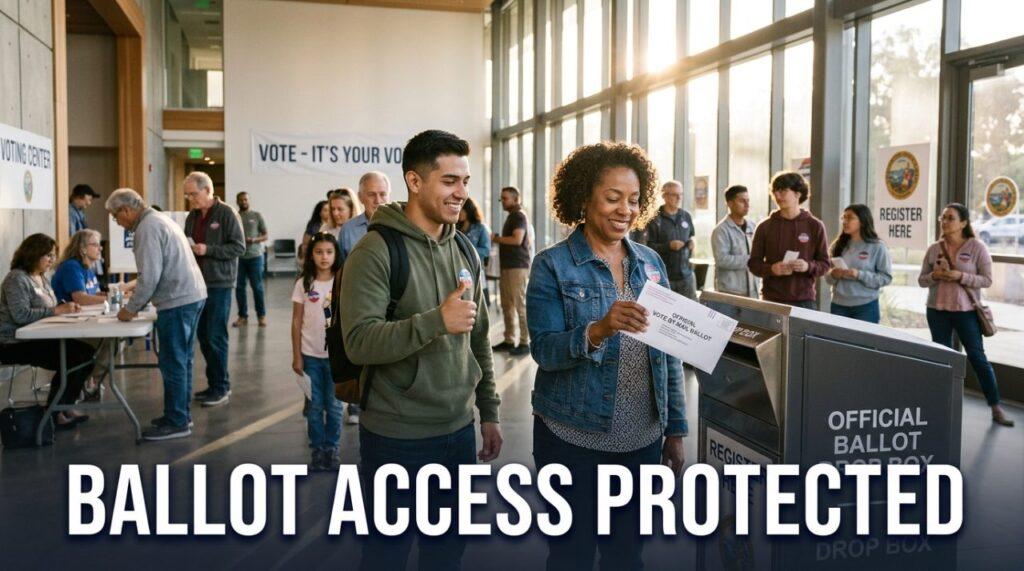
Decisive Proposition 39 Results Preserve California Ballot Access
The certified Proposition 39 results revealed a decisive rejection of mandatory identification rules, with approximately sixty percent of voters casting ballots against the measure and forty percent voting in favor (abc10.com, ballotpedia.org). Spearheaded by conservative organizations, the initiative attempted to amend the state constitution on three fronts: mandating government-issued photo identification at vote centers, requiring mail voters to disclose the last four digits of an identification number on external envelopes, and compelling election clerks to conduct annual citizenship database purges (ballotpedia.org, ballotpedia.org).
Campaign finance records demonstrated that the contest quickly transformed into a high-stakes national proxy war. Proponents collected approximately 37 million dollars, heavily funded by out-of-state donors such as packaging magnate Richard Uihlein, who contributed 17 million dollars, alongside technology investor Joe Gebbia, who provided 8 million dollars (ballotpedia.org, ballotpedia.org). Conversely, the opposition campaign gathered roughly 35 million dollars through a broad coalition of labor unions, civic groups, and statewide leaders who emphasized that the measure would dismantle the state’s accessible voting framework (ballotpedia.org, cadem.org).
Proposition 39 Final Ballot Results
Echoes of the Past: Voting Rights History and Systemic Barriers
To understand the debate over California voter ID legislation, one must locate the initiative within the deeper arc of American voting rights history. Following the Civil War and the collapse of Reconstruction, Southern states developed legal mechanisms designed to nullify the Fifteenth Amendment. Rather than explicitly banning Black citizens on paper, state legislatures enacted facially neutral procedural hurdles, including poll taxes, literacy exams, and complex voucher systems that stripped Black communities of the franchise (naacp.org, brennancenter.org).
These historical barriers operated alongside other post-emancipation labor and legal controls, showing how institutional rules have consistently shaped civic life. Understanding these dynamics connects directly to broader lessons on unfree labor systems established after emancipation. The civil rights movement secured the Voting Rights Act of 1965, which established federal oversight under Section 5 to stop discriminatory voting procedures before implementation (naacp.org, brennancenter.org).
However, federal protections eroded in recent decades. In the 2008 ruling Crawford v. Marion County Election Board, the Supreme Court permitted strict photo identification laws without requiring states to produce evidence of in-person impersonation (brennancenter.org, justia.com). Five years later, the Supreme Court effectively dismantled federal preclearance in Shelby County v. Holder, enabling states to pass sweeping voter restrictions (brennancenter.org, brennancenter.org). The 2021 decision in Brnovich v. DNC placed further limits on federal legal challenges, shifting the primary arena of voting rights defense back to state laws and citizen referendums (democracydocket.com, brennancenter.org).
From Free State Myth to Expansion: California Election Laws
California possesses its own complex relationship with civil franchise and racial equality. Although admitted to the Union as a free state, early state governance maintained racial exclusions and property qualifications that restricted non-white participation. The contradictions of that era mirror early legislative debates explored in the history of debates over statehood and early racial policies. For decades, minority residents navigated institutional neglect that limited access to public services and civic representation (wikipedia.org).
During the late twentieth century, California diverged from national trends by systematically expanding ballot access. In 1978, the state removed the requirement that voters supply an approved excuse to request an absentee ballot (ca.gov). Decades later, the Legislature passed the 2016 California Voter’s Choice Act, introducing flexible community vote centers, and enacted Assembly Bill 37 in 2021 to make universal vote by mail a permanent feature of general elections (smcacre.gov, asmdc.org). Today, county clerks mail an official ballot to all active registered voters across California (ca.gov).
The push for Proposition 39 followed local resistance to these universal voting structures. In early 2024, the municipal government of Huntington Beach approved Measure A to mandate photo identification for local elections (dailybruin.com, cbsnews.com). State officials, led by Attorney General Rob Bonta, challenged the municipal policy, prompting the Legislature to enact Senate Bill 1174, which explicitly prohibited local photo identification mandates (latimes.com, cbsnews.com). When state courts upheld state preemption, proponents drafted Proposition 39 to enforce those same mandates statewide through a constitutional amendment (dailybruin.com, ballotpedia.org).
Examining Mail-In Ballot Security and Verification Procedures
The core policy disagreement over Proposition 39 centered on mail-in ballot security. Proponents claimed that writing identification numbers on return envelopes would modernize verification and prevent fraudulent submissions. Yet state election administrators demonstrated that California already maintains rigorous identity safeguards. Under current statutes, election workers verify every returned ballot by cross-referencing the voter’s signature on the envelope against their official signature stored in the Department of Motor Vehicles or voter registration databases (ca.gov, ca.gov).
A crucial component of this existing system is the state-mandated notice-and-cure procedure (ca.gov). When election workers detect a missing or mismatched signature, state law requires them to notify the voter by mail, phone, or electronic alert, giving the citizen a set period to verify their identity before the ballot is disqualified (ca.gov, ca.gov). The omission of an explicit cure process in Proposition 39 raised alarm among constitutional attorneys. Without guaranteed notice, simple clerical mistakes or omitted numbers would have led to automatic, unchecked ballot rejections, violating Fourteenth Amendment guarantees of procedural due process (aclu-sdic.org, davisvanguard.org).
Furthermore, privacy specialists and civil liberties advocates noted that requiring millions of voters to handwrite personal identification digits on the exterior of mail envelopes posed genuine security risks (aclu-sdic.org, spur.org). Exposing sensitive numbers to postal workers and intermediaries during transit exposed residents to identity theft, turning a basic civic exercise into a severe personal privacy vulnerability (aclu-sdic.org, spur.org).
California Voting Patterns & Rejections
Documenting Disparities and Voter Disenfranchisement Risks
The campaign against Proposition 39 relied heavily on empirical research revealing severe voter disenfranchisement risks across California’s diverse population. Academic surveys by the Brennan Center for Justice and the University of Maryland show that nearly 21 million voting-age American citizens do not possess an unexpired government photo identification (brennancenter.org, fairelectionscenter.org). This gap follows stark racial and economic lines: up to 25 percent of voting-age African Americans lack an acceptable photo identification, compared to just 8 percent of white citizens (brennancenter.org, fairelectionscenter.org).
These disparities stem from concrete structural inequities rather than individual apathy. Generational health segregation during the Jim Crow era excluded many Black citizens from hospital births, leaving elderly residents without official county birth certificates (naacp.org, brennancenter.org). Obtaining replacement records costs between 15 and 60 dollars, creating a financial obstacle that operates as a modern poll tax for indigent citizens (brennancenter.org, fairelectionscenter.org). These ongoing inequities are examined closely in ongoing discussions concerning the struggle for representation and political access.
Administrative records in California show that strict clerical checks disproportionately harm non-white communities. Research by Dr. Michael Herndon at the UCLA Voting Rights Project found that election workers rejected over 200,000 California mail ballots between 2020 and 2024 due to signature disputes alone (ucla.edu, ucla.edu). Non-white voters experienced rejection rates up to four times higher than white voters, while young voters under 25 faced rejection rates ten to fifteen times higher than senior citizens (ucla.edu, ucla.edu). Adding mandatory identification numbers to envelopes would have intensified these disqualifications (aclu-sdic.org, ucla.edu).
Citizens Lacking Photo Identification
Federal Litigation, Database Flaws, and Civil Rights and Voting
The struggle over ballot security reached federal courts when the Department of Justice demanded that California election officials sequester over 20,000 mail-in ballots from individuals federal agencies claimed were noncitizens (democracydocket.com, ucla.edu). The demand generated immediate legal resistance from advocacy organizations, including the Coalition for Humane Immigrant Rights and the UCLA Voting Rights Project (ucla.edu). An audit led by Dr. Matt Barreto and Michael Rios revealed that 42.4 percent of the individuals on the federal list were not even registered in the state database, while the remaining voters were verified naturalized citizens (ucla.edu, ucla.edu).
Federal judges rejected the federal government’s claims, characterizing the database matching methodology as deeply flawed and prone to administrative error (democracydocket.com, ucla.edu). When the federal administration submitted an emergency application to block those ballots, the United States Supreme Court denied the request, refusing to disrupt California’s ongoing voting process (democracydocket.com). These court proceedings underscore the enduring connections between modern legal policies and broader historical struggles explored in analyses of systemic legal policies that govern civic participation.
In addition to legal conflicts, the nonpartisan Legislative Analyst’s Office determined that Proposition 39 would have cost taxpayers tens of millions to hundreds of millions of dollars each year (ballotpedia.org, calbudgetcenter.org). State and county agencies would have needed to divert election funds from cybersecurity and basic administration to process annual citizenship audits and handle ID envelopes (calbudgetcenter.org, calbudgetcenter.org). By rejecting Proposition 39, California voters maintained an electoral infrastructure designed to protect access rather than manufacture bureaucratic hurdles (abc10.com, calmatters.org).
About the Author
Darius Spearman is a professor of Black Studies at San Diego City College, where he has been teaching for over 20 years. He is the founder of African Elements, a media platform dedicated to providing educational resources on the history and culture of the African diaspora. Through his work, Spearman aims to empower and educate by bringing historical context to contemporary issues affecting the Black community.
