
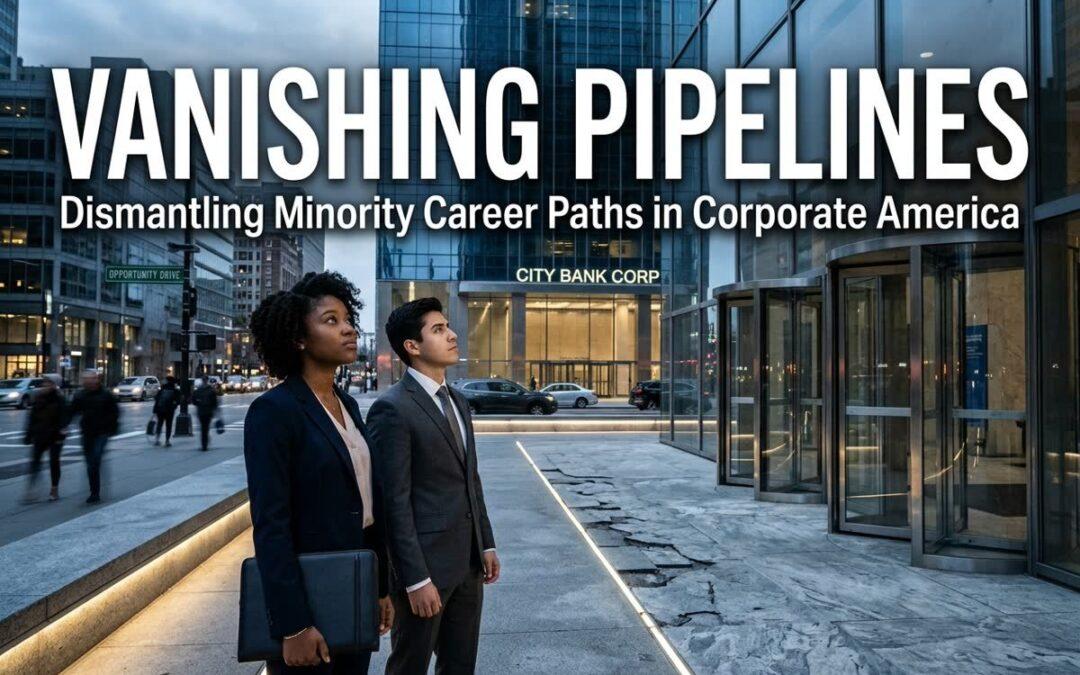


Corporate DEI Rollbacks: Why Minority Job Pipelines Vanish
By Darius Spearman (africanelements)
Support African Elements at patreon.com/africanelements and hear recent news in a single playlist. Additionally, you can gain early access to ad-free video content.
A joint investigative report published by The Hechinger Report and Soledad O’Brien Productions reveals that campus talent pipelines for Black and Latino students are unraveling rapidly (hechingerreport.org, fastcompany.com). Corporate recruiters have pulled back from regional universities. Affinity career sessions have quietly disappeared. Early-immersion internships designed for underrepresented sophomores and freshmen have been dismantled or stripped of demographic criteria (hechingerreport.org, hechingerreport.org).
This retrenchment reflects far more than a single hiring cycle downturn. The retreat represents the systematic dismantling of a sixty-year recruitment system. Civil rights organizers, corporate executives, and university officials constructed these pathways across six decades to open segregated white-collar professions. Today, corporate DEI rollbacks are severing those hard-won connections between higher education and economic advancement.
The Civil Rights Era and the Rise of minority internship programs
The earliest structural efforts to integrate white-collar American enterprise emerged directly from the urban uprisings and civil rights battles of the 1960s. For generations following Emancipation, systemic racial barriers restricted Black workers primarily to agricultural, service, and manual labor roles. An examination of post-Civil War labor conditions reveals how legal codes and economic disenfranchisement blocked Black entry into commercial finance and corporate management.
Federal intervention began to alter that dynamic during the Kennedy and Johnson administrations. President John F. Kennedy issued Executive Order 10925 in 1961, introducing the term affirmative action to federal contracting (hechingerreport.org). Congress followed with Title VII of the Civil Rights Act of 1964, prohibiting employment discrimination based on race, color, religion, sex, or national origin. President Lyndon B. Johnson then signed Executive Order 11246 in 1965, requiring federal contractors to take proactive measures to recruit underrepresented applicants (hechingerreport.org).
Government mandates alone did not integrate private boardrooms. Following urban unrest across dozens of cities, the Kerner Commission warned in 1968 that the United States was moving toward two separate and unequal societies. The report identified economic exclusion as a primary driver of racial inequality. Private leaders recognized that federal statutes did not provide underrepresented students with access to closed professional networks. Bridging institutions stepped forward to build targeted pathways (seo-usa.org).
Michael Osheowitz established Sponsors for Educational Opportunity in 1963, creating SEO Career to place Black and Latino undergraduates into Wall Street banks, real estate firms, and corporate law offices (seo-usa.org). Frank C. Carr founded INROADS in Chicago in 1970 (anyflip.com). INROADS partnered directly with major corporations to offer multi-year, paid corporate internships paired with mentorship. Over several decades, INROADS placed more than 140,000 underrepresented students into corporate career tracks, establishing minority internship programs as a pillar of white-collar workforce development (anyflip.com).
Employer Diversity Recruiting Priority
Percentage of major employers prioritizing campus diversity recruiting (Veris Insights Survey)
From Civil Rights Mandates to corporate diversity pledges
During the 1970s and 1980s, corporate integration efforts evolved from compliance into structured internal organizing. Black professionals established Employee Resource Groups, starting with Xerox’s Black Employee Network in 1970. These employee groups lobbied human resources departments to establish formal relationships with Historically Black Colleges and Universities and minority student associations on predominantly white campuses.
By the 1990s, management theorists framed diversity as a business imperative rather than a legal duty. They argued that diverse management teams produced superior financial returns and understood changing global demographics. When the Supreme Court reviewed university admissions in the 2003 case Grutter v. Bollinger, dozens of Fortune 500 corporations filed legal briefs in defense of race-conscious policies. Corporate executives argued that their talent pipelines depended directly on universities training diverse classes of future leaders (hechingerreport.org).
Major investment banks, management consultancies, and technology corporations established early-identification programs. These initiatives recruited underrepresented college freshmen and sophomores for paid workshops and corporate shadow days. Securing a sophomore fellowship became the standard path to a junior summer internship. Junior internships, in turn, served as the primary feeder for full-time job offers upon graduation (hechingerreport.org, hechingerreport.org).
This framework reached its crest in 2020. Following nationwide protests over the murder of George Floyd, major corporations announced an estimated fifty billion dollars in corporate diversity pledges (forbes.com). Companies expanded partnerships with minority-serving institutions, sponsored identity-based campus career fairs, and established public targets for hiring underrepresented professionals. Those commitments generated widespread visibility, yet their legal foundations remained fragile (hechingerreport.org, forbes.com).
The Contagion of affirmative action bans Beyond Higher Education
The contemporary unwinding began in June 2023. In Students for Fair Admissions v. Harvard and SFFA v. University of North Carolina, the Supreme Court struck down race-conscious admissions across American higher education (hechingerreport.org, hechingerreport.org). The ruling determined that race-conscious university admissions violated the Equal Protection Clause of the Fourteenth Amendment and Title VI of the Civil Rights Act of 1964. The ruling addressed college admissions rather than corporate workplaces.
Title VII of the Civil Rights Act of 1964 governs private employment and has prohibited racial quotas for decades. Nevertheless, conservative legal organizations immediately transferred the reasoning of the university ruling into the corporate sphere. Activist groups warned major corporations that targeted campus programs, identity-based fellowships, and affinity networking days constituted unlawful reverse discrimination (forbes.com, washingtonpost.com).
Widespread legal confusion accelerated the corporate retreat. A survey conducted by researchers at Columbia Business School examined 505 human resources executives across major American companies (columbia.edu). Half of the human resources professionals familiar with the ruling mistakenly believed that the Supreme Court decision legally applied to workplace hiring decisions. Furthermore, sixty-two percent reported that their organizations altered at least one recruitment practice or candidate screening method to minimize legal scrutiny (columbia.edu).
The broader debate surrounding affirmative action in education demonstrates how judicial decisions reshape institutional behavior far beyond their initial scope. Corporate legal departments adopted precautionary measures. Rather than defending targeted talent searches, general counsels advised executives to eliminate race-conscious criteria entirely (hechingerreport.org, columbia.edu).
HR Response to SFFA Admissions Ruling
Survey of 505 corporate HR leaders (Columbia Business School Study)
How Section 1981 lawsuits Targeted Early Career Pathways
To dismantle private pipelines, conservative legal organizations turned to a Reconstruction-era statute. Congress originally passed the Civil Rights Act of 1866 under the Thirteenth Amendment to protect newly emancipated Black citizens from Southern Black Codes. Section 1981 of that statute guarantees all persons equal rights to make and enforce contracts, free from racial discrimination.
In the 1976 decision McDonald v. Santa Fe Trail Transportation Co., the Supreme Court ruled that Section 1981 protects white individuals as well as racial minorities from contractual discrimination. Decades later, conservative litigants repurposed this interpretation to attack diversity fellowships and minority capital funds (forbes.com, washingtonpost.com). Section 1981 has become an effective legal vehicle because it lacks the administrative prerequisites of Title VII. Litigants do not need to file complaints with the Equal Employment Opportunity Commission, and damages under the statute remain uncapped.
Legal activist groups filed high-profile challenges against major law firms, including Morrison & Foerster and Perkins Coie. The lawsuits asserted that paid diversity fellowships open exclusively to underrepresented law students constituted racially discriminatory contracts. Both firms quickly settled by removing demographic requirements from their fellowship criteria. Pfizer faced similar litigation over its Breakthrough Fellowship Program and opened eligibility to applicants of all racial backgrounds (forbes.com).
The litigation expanded rapidly into entrepreneurial capital. The Eleventh Circuit Court of Appeals issued an injunction against the Fearless Fund in 2024. The fund operated a grant program open exclusively to Black women entrepreneurs (forbes.com). The appellate panel ruled that race-restricted grant competitions constitute commercial contracts under Section 1981 rather than protected First Amendment speech. This ruling demonstrated that any program conditioned explicitly on race faces serious legal vulnerability. Facing litigation risks, corporations dismantled their identity-restricted student programs across the country (hechingerreport.org, forbes.com).
How anti-DEI state laws Stifled Public University Campuses
While federal courts scrutinized corporate contracts, state legislatures targeted public university career operations directly. Lawmakers passed sweeping anti-DEI state laws designed to eliminate administrative equity initiatives. Texas enacted Senate Bill 17, and Florida enacted Senate Bill 266, prohibiting public universities from maintaining diversity offices or conducting race-restricted programming (hechingerreport.org, fastcompany.com).
The tension between state and federal authority has historically shaped the boundaries of civil rights enforcement. In response to state statutory bans, university career centers severed official ties with minority student organizations. Administrators prohibited staff from co-sponsoring events with groups such as the National Society of Black Engineers or the Hispanic Business Students Association (hechingerreport.org).
The impact manifested quickly in campus career offices. At San Jose State University, officials rebranded the campus “Diversity Job Fair” as the generic “October Fest Job and Internship Fair” to avoid administrative scrutiny (hechingerreport.org). At Occidental College, career center leaders reported that corporate finance and management recruiters who previously scheduled dedicated outreach sessions for first-generation and minority candidates ended those programs entirely (hechingerreport.org).
Rather than maintaining broad recruiting networks across public state institutions, corporations consolidated their outreach. Data from Veris Insights revealed that the proportion of major employers limiting recruitment to a narrow roster of core schools jumped from seventeen percent in 2022 to twenty-six percent in 2025 (hechingerreport.org). This retreat to elite private institutions harms regional state university systems that educate the vast majority of Black and Latino undergraduates.
Employers Limiting Campus Target Lists
Percentage of employers restricting visits to narrow core school lists (Veris Insights)
The Chilling Future of campus diversity recruiting and Intergenerational Wealth
The narrowing of institutional recruitment footprints carries profound consequences for upward mobility. According to analysis from the Burning Glass Institute, graduates from Ivy League universities receive sixty percent more interview callbacks than identically qualified candidates from state universities (hechingerreport.org). When major firms curtail regional campus visits and rely on elite institutional pedigree, they reproduce racial and economic disparities without explicitly mentioning race.
Some corporations have attempted to preserve diversity pipelines by concentrating their recruiting budgets exclusively on Historically Black Colleges and Universities. Title VII and Section 1981 permit institutional partnerships at minority-serving institutions, provided that applicant selection remains race-neutral. Because HBCUs enroll students of all backgrounds, visiting these campuses constitutes institutional outreach rather than an unlawful racial classification. Yet, analysts observe that HBCUs educate less than ten percent of all Black undergraduates nationwide (hechingerreport.org).
The drying up of early-career pipelines threatens broader economic mobility. Entry-level positions in finance, technology, engineering, and consulting represent critical channels for closing racial wealth disparities. Historically, building Black-owned business enterprises and accumulating family assets depended on access to commercial credit, technical training, and corporate networks.
Economists predict that the full impact of this rollback will emerge when the college class of 2028 enters the labor market. That cohort represents the first class admitted under the post-affirmative action admissions framework. By abandoning campus diversity recruiting and early internships today, corporate America is closing the door to professional advancement long before those graduates receive their degrees (hechingerreport.org, hechingerreport.org).
About the Author
Darius Spearman is a professor of Black Studies at San Diego City College, where he has been teaching for over 20 years. He is the founder of African Elements, a media platform dedicated to providing educational resources on the history and culture of the African diaspora. Through his work, Spearman aims to empower and educate by bringing historical context to contemporary issues affecting the Black community.
