
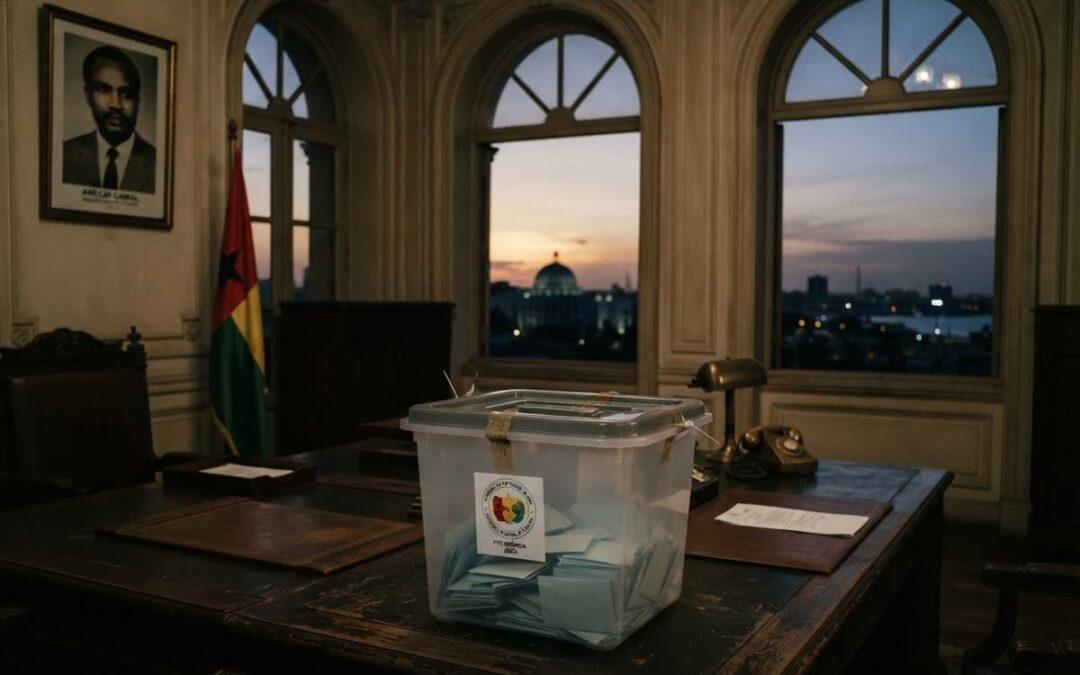


Guinea Bissau Military Junta Extends Rule to 2028
By Darius Spearman (africanelements)
Support African Elements at patreon.com/africanelements and hear recent news in a single playlist. Additionally, you can gain early access to ad-free video content.
On November 26, 2026, marking exactly one year since seizing power following a disputed national election, the military leadership of Guinea-Bissau announced a major change to its political timeline (news.cn, aljazeera.com). Transitional President Major-General Horta Inta-A Na Man issued a formal presidential decree that cancelled scheduled national voting (news.cn). The decree postponed the December 6, 2026 presidential and legislative elections by two full years, moving the target date to November 26, 2028 (news.cn, iol.co.za).
The transitional authorities justified this decision by citing severe deficits in logistical, technical, and financial resources required to execute a credible national ballot (news.cn). However, the unilateral postponement effectively tripled the tenure of the Guinea Bissau military junta from twelve months to thirty-six months (news.cn, africacenter.org). This decree directly challenged regional diplomatic bodies and demonstrated the structural entrenchment of the armed forces in the political life of the small West African republic (africacenter.org, africansecurityanalysis.com).
Guinea Bissau Election Delay Sparks Democratic Crisis
The sudden Guinea Bissau election delay disrupted what was supposed to be a rapid twelve-month restoration of democratic governance (news.cn, africacenter.org). When military officers initially established the High Military Command for the Restoration of National Security and Public Order in late 2025, they promised the domestic public and international diplomats that their intervention would be brief (aljazeera.com, africansecurityanalysis.com). The extension to late 2028 pushes balloting more than 700 days past the promised December 2026 timetable, leaving opposition coalitions and civic organizations in institutional limbo (news.cn, civicus.org).
Prime Minister Ilídio Vieira Té defended the extension by asserting that the state lacked the biometric census systems, updated voter registries, and administrative funding needed for fair elections (news.cn). Political analysts observe that prolonged election timetables are frequently deployed by unelected administrations to consolidate operational leverage and restructure governing frameworks (africacenter.org, adf-magazine.com). In Guinea-Bissau, this postponement follows a familiar pattern where public pledges of democratic restoration gradually give way to extended military rule (africansecurityanalysis.com, politicalviolenceataglance.org).
Transitional Rule Duration (Months)
General Horta Inta-A Transition and Executive Consolidation
The current transitional regime originated directly from the crisis of late November 2025 (aljazeera.com, africansecurityanalysis.com). On November 23, 2025, Guinea-Bissau organized general elections featuring incumbent President Umaro Sissoco Embaló and prominent opposition candidate Fernando Dias (africansecurityanalysis.com). Before the National Electoral Commission could release verified provisional tallies, both contenders declared victory, generating an acute political dispute (aljazeera.com, africansecurityanalysis.com). On November 26, 2025, military contingents mobilized across Bissau, stormed the presidential complex, detained Embaló, and dissolved civilian institutions (clickondetroit.com, aljazeera.com).
The resulting General Horta Inta-A transition systematically reordered the state apparatus (africansecurityanalysis.com). Rather than restricting operations to election security, the junta organized a constitutional referendum on August 30, 2026 (africansecurityanalysis.com, adf-magazine.com). The referendum dismantled the historic semi-presidential model, shifting administrative control away from the National People’s Assembly and establishing an executive presidency with centralized control over defense commands and judicial selections (africansecurityanalysis.com, wikipedia.org). Furthermore, authorities prohibited exiled former president Embaló from returning to the territory, demonstrating how the Guinea Bissau transitional government has reorganized executive rules before opening the ballot box (clickondetroit.com, africansecurityanalysis.com).

African History Series • Volume II • Anti-Colonial Resistance & Sovereignty
Africa Reclaimed: Overcoming the Legacies of the Colonial Machine
By Professor A. Darius Spearman • 353 Pages • ISBN: 979-8-9924836-4-2
Colonialism in Africa was never passively endured—and its extractive machinery did not simply vanish when independence flags were raised. Professor A. Darius Spearman traces the unbroken arc of African political power from 19th-century indigenous statecraft and mid-20th-century liberation wars to contemporary battles against neo-colonial debt and resource imperialism.
Guinea Bissau Coup History and the Praetorian Legacy
To understand the current impasse, one must examine the deep roots of military supremacy in Guinea-Bissau (africacenter.org, wikipedia.org). The armed forces were not built as a neutral civil defense corps by a sovereign civilian legislature (wikipedia.org). Instead, the armed wing—the Revolutionary Armed Forces of the People (FARP)—preceded the republic (wikipedia.org, britannica.com). Between 1963 and 1974, guerrilla fighters led by Amílcar Cabral and the African Party for the Independence of Guinea and Cape Verde (PAIGC) fought an eleven-year armed struggle to dislodge Portuguese colonial authority (wikipedia.org, britannica.com). This historic mobilization created the Amilcar Cabral PAIGC legacy, but it also fostered a military ethos that viewed the soldier caste as the original founders and rightful guardians of the state (africacenter.org, researchgate.net).
This organizational mindset led directly to a chronic African praetorian guard culture, where the military claimed permanent veto authority over civilian politics (africacenter.org, politicalviolenceataglance.org). In political science, praetorianism denotes a system where the military establishment acts as an autonomous kingmaker because civil institutions lack independent enforcement capacity (africacenter.org). Much like the broader historical struggle for self-determination across the African Diaspora, Guinea-Bissau encountered institutional fissures shortly after ending colonial governance (wikipedia.org, britannica.com).
The post-independence schism became acute under the nation’s first president, Luís Cabral (wikipedia.org). Political influence was disproportionately concentrated among Cape Verdean and mixed-race elites in administrative hubs, whereas the battlefield ranks of FARP were predominantly comprised of indigenous mainlanders, particularly from the Balanta ethnic community (wikipedia.org, wikipedia.org). Resentment over economic exclusion and perceived second-class status inside the state prompted Prime Minister General João Bernardo “Nino” Vieira to stage a foundational coup d’état on November 14, 1980 (wikipedia.org, wikipedia.org).
The 1980 putsch severed binational union with Cape Verde, suspended the civilian constitution, and established a military Revolutionary Council (wikipedia.org, wikipedia.org). That intervention established armed force as the default instrument of political succession (africacenter.org, wikipedia.org). Since independence, Guinea Bissau coup history features five successful overthrows (1980, 1999, 2003, 2012, and 2025) alongside more than a dozen abortive mutinies (africacenter.org, wikipedia.org). Remarkably, across five decades of sovereign statehood, only one civilian head of state—José Mário Vaz, who governed from 2014 to 2019—managed to complete a full constitutional term in office (africacenter.org, wikipedia.org).
Executive Term Completion (1974-2026)
Narco State Political Capture and Military Impunity
During the early 2000s, Guinea-Bissau’s institutional vulnerability collided with international organized crime (globalinitiative.net, unodc.org). Latin American narcotics syndicates identified the country’s unmonitored maritime borders, fragile judicial apparatus, and the eighty-eight islands of the Bijagós Archipelago as an ideal logistics hub for transatlantic cocaine distribution destined for Western Europe (globalinitiative.net, unodc.org). This development accelerated a system of narco state political capture, where illicit trafficking profits funded political factions and entrenched military autonomy (africacenter.org, globalinitiative.net).
High-ranking defense officials became directly linked to international trafficking operations (globalinitiative.net, unodc.org). Figures such as Navy Chief Rear Admiral José Américo Bubo Na Tchuto and Army Chief General António Indjai were designated as international narcotics kingpins by international bodies and foreign courts (globalinitiative.net, americanprogress.org). Because illicit trafficking revenues frequently matched or exceeded the state’s formal gross domestic product, military factions operated independently of public finances or legislative oversight (globalinitiative.net, unodc.org).
“The annual street value of illicit narcotics transiting through Bissau has frequently surpassed the total legitimate revenue of the formal national economy, shielding defense elites from civilian budgetary control.”
United Nations Office on Drugs and Crime, Source: (unodc.org)
The convergence of armed force and shadow finance produced violent internecine conflict (africacenter.org, wikipedia.org). On March 1, 2009, a bomb explosion inside armed forces headquarters killed Chief of Staff General Batista Tagme Na Waie (wikipedia.org, wikipedia.org). Hours later, factional soldiers executed President João Bernardo Vieira in apparent reprisal, highlighting the deadly stakes of defense command rivalry (wikipedia.org, wikipedia.org). Three years later, during the April 2012 “Cocaine Coup,” the military arrested Prime Minister Carlos Gomes Júnior between election rounds specifically to derail planned security sector reforms that would have downsized military commands (africacenter.org, politicalviolenceataglance.org).
Estimated Illicit Cargo Interceptions (Tons)
ECOWAS Guinea Bissau Response and Enforcement Limits
The postponement until November 2028 directly undermines regional diplomatic frameworks (news.cn, africacenter.org). The ECOWAS Guinea Bissau response has historically relied on mediation protocols, diplomatic isolation, and targeted individual sanctions to reverse unconstitutional changes of government (africacenter.org, eplo.org). Following the November 2025 coup, regional delegates insisted on a strict twelve-month return to civilian control (aljazeera.com, africacenter.org). The two-year extension decreed by General Inta-A exposes the operational limits of regional enforcement mechanisms (africacenter.org, africansecurityanalysis.com).
Regional leaders face institutional fatigue and declining leverage across West Africa (africacenter.org, parliament.uk). Sanctions frameworks frequently place economic burdens on general populations while doing little to alter the incentives of entrenched military juntas (africacenter.org, civicus.org). Internal political debates over centralized state authority mirror the friction between national sovereignty and regional oversight across the continent (africacenter.org, eplo.org). In Bissau, military commanders calculated that the regional bloc lacked the operational unity to impose binding penalties, allowing the junta to delay elections with limited immediate repercussions (africacenter.org, africansecurityanalysis.com).
West Africa Military Juntas and Regional Contagion
Guinea-Bissau’s prolonged transition forms part of a wider trend across the region (africacenter.org, parliament.uk). Over the past five years, West Africa military juntas have dismantled civilian administrations in Mali, Burkina Faso, Guinea, and Niger (africacenter.org, parliament.uk). In each instance, transitional military regimes initially agreed to rapid restoration roadmaps under international pressure, only to unilaterally push target dates back by several years (africacenter.org). Much like its Sahelian counterparts exploring foreign military partnerships, Bissau’s leadership has capitalized on shifting international dynamics to solidify its grip on state power (africacenter.org, parliament.uk).
Domestic civil society groups continue to protest this prolonged political closure (civicus.org, omct.org). Organizations like the Guinean Human Rights League (LGDH) and the civic coalition Frente Popular have repeatedly condemned executive overreach and the suppression of assembly rights (civicus.org, omct.org). Protesters and union organizers have faced state surveillance and repression, including arbitrary detentions and bans on peaceful street gatherings (mfwa.org, civicus.org). Concurrently, labor confederations like the National Union of Workers of Guinea (UNTG) organize periodic strikes over unpaid public sector wages and the neglect of basic social infrastructure (civicus.org).
With Guinea-Bissau ranking 177th out of 193 nations on the United Nations Human Development Index, recurring military interventions divert vital resources from healthcare, schools, and development initiatives (reliefweb.int). The postponement of elections until November 26, 2028, indicates that the praetorian guard remains the primary arbiter of state power (africacenter.org, africansecurityanalysis.com). Until deep institutional reforms establish genuine civilian oversight, transition timetables in Bissau will likely function as tactical measures to renegotiate political privilege rather than clear pathways toward lasting democracy (africacenter.org, eplo.org).
About the Author
Darius Spearman is a professor of Black Studies at San Diego City College, where he has been teaching for over 20 years. He is the founder of African Elements, a media platform dedicated to providing educational resources on the history and culture of the African diaspora. Through his work, Spearman aims to empower and educate by bringing historical context to contemporary issues affecting the Black community.
