

Kenya Ethiopia Border Crisis: Clashes Spark Refugee Exodus
By Darius Spearman (africanelements)
Support African Elements at patreon.com/africanelements and hear recent news in a single playlist. Additionally, you can gain early access to ad-free video content.
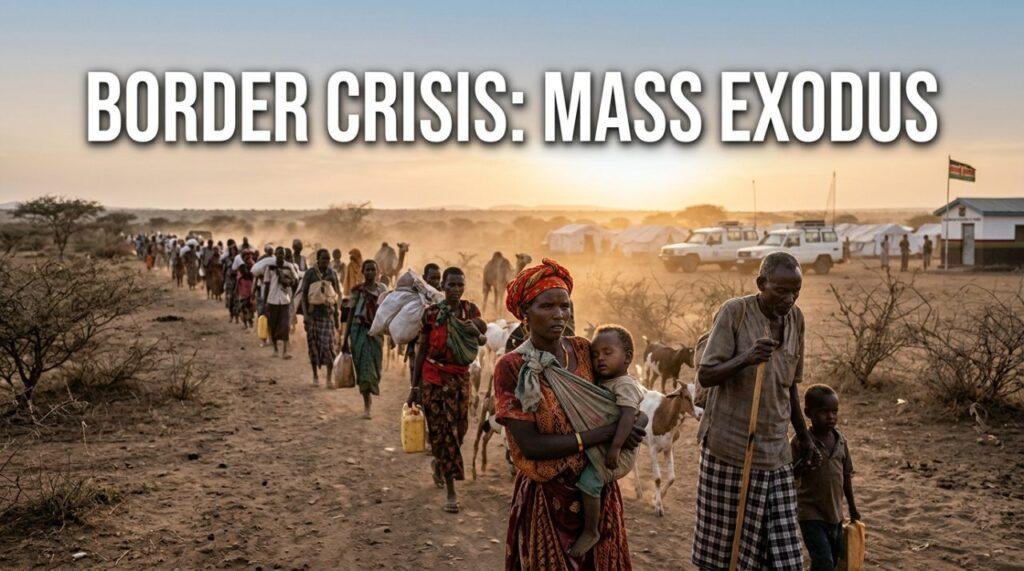
A severe humanitarian emergency has unfolded along the frontier separating southern Ethiopia and northern Kenya. In late October and early November 2026, an outbreak of communal warfare displaced tens of thousands of civilians from their homes (borkena.com, eastleighvoice.co.ke). Seeking refuge from artillery shelling and retaliatory raids, more than 50,000 people crossed into Marsabit County, Kenya, within a matter of days (malindikenya.net, eastleighvoice.co.ke). The rapid movement of people overwhelmed local outposts and triggered an immediate emergency mobilization by Kenyan authorities and international relief agencies (malindikenya.net, unhcr.org).
The Kenya Ethiopia Border Crisis represents more than an isolated boundary incident. Across the African diaspora, scholars and observers recognize how modern borderlines frequently dissect ancient communities. In this arid corridor, the sudden influx of Ethiopian refugees in Kenya reflects a direct continuation of unresolved imperial treaties, post-colonial restructuring, and zero-sum political rivalries (wikipedia.org, shalomconflictcenter.org). Understanding why a localized municipal dispute escalated into an international crisis requires examining the historical architecture of southern Ethiopia’s lowland frontier.
Moyale Border Clashes Ignited by Municipal Flashpoint
The town of Moyale sits directly on the international borderline, divided into an Ethiopian northern sector and a Kenyan southern sector (wikipedia.org). On October 18, 2026, administrative personnel from the Somali Regional State raised their regional flag and opened a municipal branch office in Kebele 02 (borkena.com). Kebele 02 is a contested neighborhood long claimed by the neighboring Oromia Regional State (borkena.com, addisstandard.com). Local Oromo residents organized immediate demonstrations to reject the unilateral administrative assertion, viewing the flag as a direct territorial annexation (borkena.com).
The confrontation turned lethal when security personnel discharged live ammunition into the crowd, killing a thirteen-year-old Oromo girl named Diqqoo Jaataan Aagaa (borkena.com). News of the killing circulated rapidly across local networks, provoking widespread outrage. Within forty-eight hours, civil unrest transformed into armed conflict between regional police battalions and affiliated ethnic militias (borkena.com, acleddata.com). The fighting did not remain confined to Moyale. It expanded rapidly across seven neighboring administrative districts, including Wachile, Gumi Eldallo, and the rangelands of Arero along the Dawa River basin (borkena.com).
The resulting Moyale Border Clashes quickly crossed the international boundary line. Mortar rounds and stray gunfire landed in Kenyan Moyale, shattering residential buildings and disrupting commercial traffic along the Trans-African Highway (eastleighvoice.co.ke). Fearing targeted neighborhood sweeps, families gathered whatever belongings they could carry and crossed the dry riverbeds into Kenya (eastleighvoice.co.ke). By late October, the rate of crossing reached several thousand individuals per day, creating an acute protection crisis in northern Kenya (malindikenya.net, unhcr.org).
Refugee Influx Surge into Marsabit County
Verified cumulative arrivals following late October 2026 clashes
Ethiopia Ethnic Federalism Roots and Colonial Boundary Divisions
The structural roots of this border crisis precede modern administrative decrees by more than a century. Prior to European colonial intervention, the arid rangelands connecting southern Ethiopia with northern Kenya were fluid territories navigated by pastoralist communities (wikipedia.org, shalomconflictcenter.org). The Borana, an Oromo subgroup, shared resources and contested pastures with the Garre, a Somali clan, and the Gabra (shalomconflictcenter.org). Communal boundaries were negotiated through customary councils rather than fixed international lines (wikipedia.org).
In 1907, the British East Africa Protectorate and the Ethiopian Empire under Emperor Menelik II signed a formal border agreement (wikipedia.org). This artificial boundary line divided ancestral pastoral rangelands into separate colonial and imperial domains. Families sharing identical dialects, lineages, and economic networks found themselves split between British Kenya and sovereign Ethiopia (wikipedia.org, shalomconflictcenter.org). Customary pastoral migration routes were interrupted, creating chronic competition over access to deep water wells, known as the ancestral tulaa wells (shalomconflictcenter.org).
Decades later, internal state restructuring altered these relationships again. Following the fall of the Derg military junta in 1991, the incoming Ethiopian People’s Revolutionary Democratic Front instituted a system based on ethno-linguistic regional autonomy (addisstandard.com, wikipedia.org). Formalized in the 1995 Constitution, this administrative system sought to redress past historical marginalization. Much like broader questions concerning federalism and state power, the division of authority created acute jurisdictional dilemmas (addisstandard.com).
The Ethiopia Ethnic Federalism Roots produced unintended consequences in multi-ethnic border zones. In pastoral drylands where shared seasonal migration had historically sustained peace, the system assigned exclusive territorial sovereignty to single ethnic groups (addisstandard.com, shalomconflictcenter.org). Towns like Moyale were divided down the center, placing the Borena Zone under Oromia and the Liban and Dawa zones under the Somali Region (addisstandard.com, addisstandard.com). Securing administrative dominance over a ward or municipal sector became a zero-sum calculation for parliamentary representation, land ownership, and local tax revenues (addisstandard.com).
Oromia Somali Border Conflict and the Disrupted Gadaa Sacred Routes
Tensions reached an institutional impasse in October 2004, when the Ethiopian federal government held a national referendum across hundreds of contested border kebeles (addisstandard.com). The referendum aimed to settle conflicting land claims between the Oromia and Somali regional states (addisstandard.com). While the process finalized jurisdiction in several interior zones, contested municipalities like Moyale and the Dawa basin border dispute remained unresolved (addisstandard.com, shalomconflictcenter.org). Consequently, localized political friction repeatedly produced mass displacement events over the following two decades (apnews.com, africanews.com).
Moyale Cross-Border Displacement History
Recorded refugee flight episodes into Marsabit County, Kenya
The enduring Oromia Somali Border Conflict carries deep spiritual and cultural consequences for local populations. Central to Borana Oromo society is the Gadaa system, an indigenous socio-political governance structure inscribed on the UNESCO Intangible Cultural Heritage list in 2016 (wikipedia.org). Operating on eight-year generational cycles, the system regulates democratic leadership transitions, natural resource allocation, and civic ethics under the guidance of the supreme cultural leader, the Abba Gada (wikipedia.org).
To finalize leadership transitions and ensure communal harmony, the Abba Gada and council elders undertake sacred pilgrimage journeys across ancestral rangelands and ceremonial shrines (borkena.com, wikipedia.org). When the October 2026 fighting spread across Arero district near the Dawa River, active military operations blocked these ceremonial migration corridors (borkena.com). Community leaders viewed the obstruction of their sacred pathways as an existential threat to pastoral sovereignty, accelerating armed mobilization among rural clans (borkena.com).
Liyu Police Paramilitary Mobilization Escalates Localized Disputes
The escalation of small-scale municipal disputes into high-caliber warfare stems directly from the militarization of sub-national governance. In Ethiopia’s administrative hierarchy, regions divide into zones, zones into districts (woredas), and districts into village associations (kebeles) (acleddata.com, addisstandard.com). Over the past two decades, regional states developed well-equipped special forces known as the Liyu Police (acleddata.com). These units report to regional executives rather than federal military command, operating with machine guns, armored transport, and light artillery (acleddata.com).
When municipal disputes occur over contested boundaries, regional authorities frequently deploy these paramilitaries to enforce jurisdictional control (borkena.com, acleddata.com). The Liyu Police Paramilitary Mobilization during the October 2026 standoff transformed street protests into mechanized warfare (borkena.com). Scholars of comparative history observe how state security apparatuses often expand their operational reach during times of political uncertainty, deepening communal cleavages rather than resolving them (acleddata.com).
Simultaneously, the Ethiopian National Defense Force experienced severe constraints in pacifying the border. Federal troops face extensive operational overstretch across northern and central Ethiopia, leaving southern lowland outposts undermanned (acleddata.com). Furthermore, federal authorities must navigate sensitive jurisdictional boundaries. Intervening hastily risks accusations of federal overreach or regional favoritism, which frequently results in static garrisoning while regional paramilitaries engage along the perimeter (acleddata.com).
Ethiopian Refugees in Kenya Face Severe Border Strain
The civilian cost of the fighting became visible along the dry expanses of Marsabit County. Displaced families crossed into Kenyan territory through unofficial paths to evade armed checkpoints, congregating at designated reception sites including Harhosa, OMC, St. Mary’s Catholic Mission, and Manyatta Burji (eastleighvoice.co.ke). Displaced households arrived carrying minimal belongings, having walked dozens of miles in extreme heat without food or potable water (eastleighvoice.co.ke, unhcr.org).
Relief assessments conducted by humanitarian teams revealed acute physical strain among the arriving population. Women, children, and elderly individuals constituted approximately seventy-eight percent of the verified displaced population (unhcr.org). Mid-Upper Arm Circumference screenings conducted by mobile health clinics identified elevated rates of acute malnutrition among children under the age of five (eastleighvoice.co.ke). The arrivals occurred in an arid environment already weakened by successive failed rainy seasons, placing immense pressure on local water boreholes and community food supplies (malindikenya.net, eastleighvoice.co.ke).
Historical research highlights how the contradictions of sovereign governance regularly leave borderland populations vulnerable to structural neglect. The Ethiopian Refugees in Kenya found immediate shelter among local Kenyan residents who shared their clan heritage (eastleighvoice.co.ke, shalomconflictcenter.org). While host community hospitality prevented immediate starvation, informal sheltering in crowded domestic compounds made comprehensive tracking difficult and depleted the food reserves of host households within days (eastleighvoice.co.ke).
Demographic Breakdown of Displaced Arrivals
Marsabit reception profiling by vulnerable demographic category
Marsabit Humanitarian Response and Regional Security Dilemmas
Faced with a rapidly compounding emergency, Kenyan institutions initiated structured intake operations on October 31, 2026 (eastleighvoice.co.ke). The Kenya Department of Refugee Services, operating alongside the Kenya Red Cross Society and the United Nations High Commissioner for Refugees, established emergency registration stations at Harhosa and OMC (eastleighvoice.co.ke). Relief workers distributed numbered, tamper-proof blue wristbands to new arrivals (eastleighvoice.co.ke). This system created orderly verification lines, separated unaccompanied minors for specialized care, and enabled subsequent biometric enrollment (eastleighvoice.co.ke).
To support the Marsabit Humanitarian Response, United Nations partner agencies issued an emergency flash appeal seeking 8.9 million dollars for immediate field interventions (unhcr.org). The appeal outlines critical three-month targets:
- Emergency provision of clean drinking water, sanitation facilities, and water purification chemicals to prevent cholera outbreaks (malindikenya.net, unhcr.org).
- Distribution of high-energy therapeutic biscuits and supplementary nutritional rations for nursing mothers and young children (eastleighvoice.co.ke, unhcr.org).
- Issuance of family relief kits containing plastic tarpaulins, cooking utensils, blankets, and hygiene supplies (eastleighvoice.co.ke).
- Biometric household registration to formalize documentation under the UNHCR Marsabit refugee influx framework (eastleighvoice.co.ke, unhcr.org).
Beyond humanitarian aid, Kenyan national security planners moved swiftly to protect domestic territory. The Ministry of Interior deployed additional General Service Unit platoons to patrol the border perimeter and prevent armed combatants from entering civilian encampments (eastleighvoice.co.ke). Security officials remained acutely aware of northern Kenya’s ethnic demographics. Marsabit County is home to the same Borana, Gabra, Garre, and Burji populations present in southern Ethiopia (shalomconflictcenter.org). Past cross-border escalations have ignited retaliatory clan violence inside Kenya, turning external political disputes into domestic security crises (shalomconflictcenter.org).
Kenyan diplomats have engaged their counterparts in Addis Ababa to demand the demilitarization of the Moyale urban corridor and secure safe passage for commercial freight (malindikenya.net, eastleighvoice.co.ke). Yet regional analysts caution that temporary truces will not dismantle the structural drivers of conflict. Until the rigid administrative borders of ethnic federalism are reconciled with the fluid mobility requirements of pastoral societies, the border rangelands will remain fragile, leaving vulnerable communities vulnerable to recurrent cycles of displacement (addisstandard.com, shalomconflictcenter.org).
About the Author
Darius Spearman is a professor of Black Studies at San Diego City College, where he has been teaching for over 20 years. He is the founder of African Elements, a media platform dedicated to providing educational resources on the history and culture of the African diaspora. Through his work, Spearman aims to empower and educate by bringing historical context to contemporary issues affecting the Black community.
