
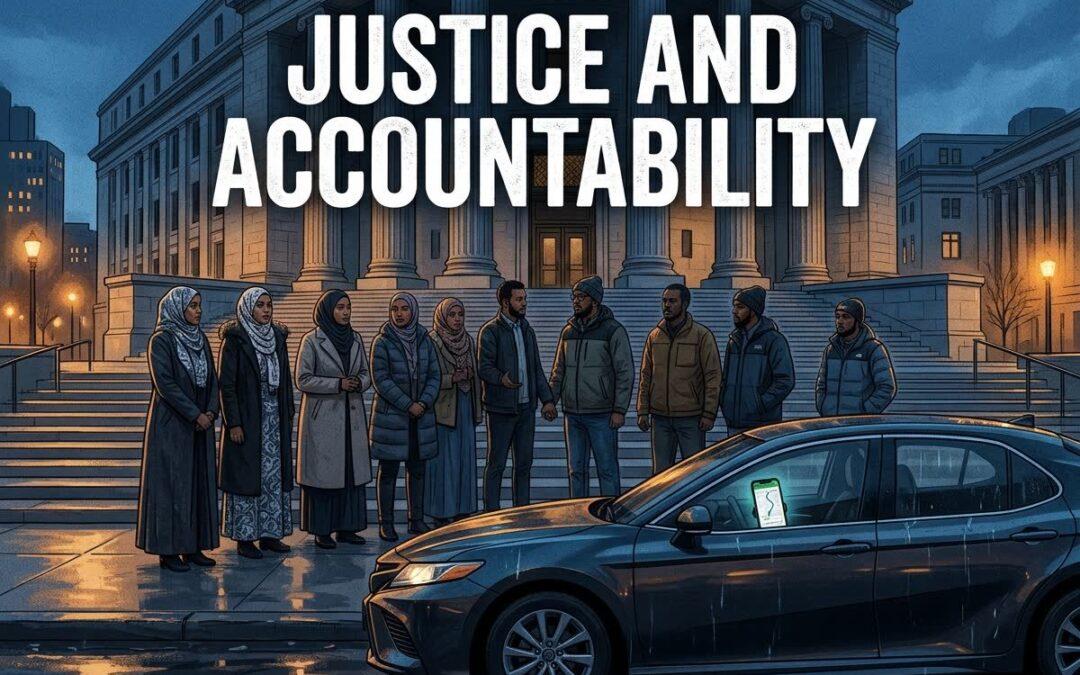


Mohamed Yusuf Uber Attack: Inside the Charges and Legal Debate
By Darius Spearman (africanelements)
Support African Elements at patreon.com/africanelements and hear recent news in a single playlist. Additionally, you can gain early access to ad-free video content.
In the early morning hours of November 14, 2026, Mohamed Yusuf accepted a late-night ride request in Northeast Minneapolis. Yusuf, a 51-year-old Somali American rideshare driver, was finishing his shift while speaking with his brother on a hands-free phone line. That routine call turned into an audio record of extreme transit violence. Minutes after stepping into the vehicle, a passenger made a hostile remark regarding the name Mohamed. The passenger then strangled Yusuf with a seatbelt, drove him to the suburb of Hopkins, and threw him out of the car. The attacker then repeatedly ran over Yusuf with his own vehicle and left him in a ditch (aljazeera.com, cnn.com).
Police officers located Yusuf lying fifteen feet off the road with life-threatening physical injuries. Yusuf suffered collapsed lungs, fractured ribs, a broken leg, and severe spinal trauma that required immediate emergency surgery (newsweek.com, cbsnews.com). As Yusuf remained in a medically induced coma at Hennepin County Medical Center, community members mobilized. A viral Mohamed Yusuf GoFundMe campaign raised hundreds of thousands of dollars within days to assist his family with catastrophic medical bills (mprnews.org, kare11.com). The Hopkins Uber attack shocked the Twin Cities, but it also exposed long-standing systemic vulnerabilities confronting Black immigrant workers who perform precarious labor across urban centers (newsweek.com).
The Hopkins Ambush and Samit Apurva Patel Charges
Investigators rapidly traced the vehicle to a residence in Hopkins after the suspect’s parents contacted authorities for a wellness check. Police officers arrested 25-year-old Samit Apurva Patel outside the home, where Yusuf’s damaged vehicle sat parked in the driveway with an open driver door and cut seatbelts (aljazeera.com, cbsnews.com). Hennepin County Attorney Mary Moriarty subsequently filed formal felony counts against the passenger. The Samit Apurva Patel charges consist of second-degree intentional attempted murder and first-degree carjacking, with each count carrying a statutory maximum penalty of twenty years in state prison (newsweek.com, cnn.com).
Despite the severity of the assault, the charging decision ignited widespread community frustration. Yusuf’s brother informed investigators that Patel explicitly stated, “Fuck, I don’t like that name,” immediately after Yusuf introduced himself (aljazeera.com, mprnews.org). Even so, county prosecutors announced they would not pursue a bias-motivated penalty enhancement. Mary Moriarty hate crime charging standards, according to county statements, require proof beyond a reasonable doubt that racial or religious bias served as the operative legal motive for the act (cbsnews.com, mprnews.org). Public anger deepened when Patel posted an $800,000 corporate bond on an initial $1 million bail setting, walking out of custody under electronic home monitoring while Yusuf fought for survival (newsweek.com, cbsnews.com).
Civil rights leaders and advocacy groups, including the Council on American-Islamic Relations Minnesota, demanded an expanded state or federal civil rights probe (aljazeera.com, fox9.com). The decision to bypass bias charges highlighted a persistent legal contradiction. Community members view the assault as an unambiguous act of violent intolerance. Meanwhile, local prosecutors point to statutory constraints that complicate hate crime prosecutions in state courtrooms (mprnews.org, cbsnews.com).
Migration and the Somali Community in Minnesota
The assault on Yusuf cannot be separated from the historical migration that established the largest Somali diaspora in the United States. Following the collapse of the Siad Barre government in 1991, civil war devastated Somalia. Hundreds of thousands of families fled their homes and entered international refugee camps across East Africa (wikipedia.org). Beginning in the mid-1990s, voluntary resettlement agencies partnered with federal officials to place Somali refugees throughout the Upper Midwest. Agencies such as Lutheran Social Services and Catholic Charities directed families toward Minneapolis and Saint Paul, where affordable housing and entry-level employment were plentiful (cis.org).
Secondary migration accelerated rapidly as families sought mutual aid and community support networks. Somali immigrants transformed neighborhoods such as Cedar-Riverside in Minneapolis into vibrant economic and civic hubs (wikipedia.org). Over three decades, the Somali community in Minnesota established hundreds of small businesses, mosques, and traditional commercial malls known as karmels (cis.org). By the 2020s, the state became home to more than 84,000 Somali residents, demonstrating the historic resilience of Black families adapting to severe displacement and economic hardship (wikipedia.org, cis.org).
Political representation expanded alongside demographic growth. In 2018, Minnesota voters elected Ilhan Omar as the first Somali American woman to serve in the United States Congress (pbs.org, house.gov). Yet, rapid institutional visibility also triggered social friction. The presence of a growing, visible Black Muslim population challenged local institutions unaccustomed to linguistic, religious, and cultural diversity. Somali Minnesotans built stable civic roots, but public visibility frequently exposed community members to unique social pressures and hostility (cis.org, mprnews.org).
Minnesota Somali Diaspora Demographics
Racialization and Islamophobia in Minnesota
The attack on Yusuf reflects an ongoing pattern of public hostility. Over the past three decades, Islamophobia in Minnesota has manifested in political scapegoating and physical attacks. National political figures regularly singled out the Twin Cities Somali community during campaign events, claiming refugees burdened social infrastructure (cis.org). This rhetoric fueled broader hostility against Muslim immigrants across regional suburbs and smaller towns (mprnews.org).
Physical violence accompanied this hostile climate. In August 2017, an out-of-state anti-government militia bombed the Dar Al-Farooq Islamic Center in Bloomington, Minnesota, during early-morning prayers (ncronline.org, justice.gov). The perpetrators sought to intimidate Muslims and force them from the state. Routine harassment also occurs in everyday public settings. Somali residents frequently report verbal abuse directed at outward cultural identifiers, including hijabs, Somali dialects, and traditional Muslim names (mprnews.org). When Patel allegedly objected to the name Mohamed, the verbal insult drew on a documented history of anti-Muslim hostility (aljazeera.com, mprnews.org).
This reality has reshaped local civil rights organizing. Historically, multi-generational African Americans and arriving East African refugees navigated separate social spheres. Over time, shared conditions fostered coalition building. Both communities faced housing segregation, disparate law enforcement practices, and economic barriers in the Twin Cities. Following the police killings of Jamar Clark, Philando Castile, and George Floyd, second-generation Somali youth organized alongside African American activists (mprnews.org). Together, they challenged racial profiling, systemic bias, and public surveillance programs that targeted Black and Muslim residents (mprnews.org, mprnews.org).
Platform Labor and Rideshare Driver Safety Risks
For immigrant workers, commercial driving has long offered an accessible pathway to self-sufficiency. During the late 1990s and early 2000s, Somali drivers formed the core of the Twin Cities traditional yellow taxicab industry. When app-based corporations disrupted urban transportation around 2014, thousands of immigrant taxi drivers transitioned onto digital platforms (mprnews.org). Today, East African drivers operate a substantial majority of app-based rides in the Minneapolis metropolitan area (mprnews.org, perfectunion.us). However, the gig economy transformed the nature of transit labor by shifting financial and physical liabilities directly onto workers (themarkup.org).
Corporate platform design introduces severe rideshare driver safety risks. Gig platforms enforce an asymmetric anonymity policy. Drivers must submit to criminal background checks, motor vehicle history reviews, and regular biometric facial scans (themarkup.org). In contrast, passengers can create accounts using temporary burner phone numbers, unverified debit cards, or completely fabricated names. This design prevents drivers from verifying who enters their private vehicles (themarkup.org, perfectunion.us). Driver advocates argue this platform dynamic echoes older, exploitative labor practices where workers carry bodily risks while corporate owners extract profits without providing basic workplace protections.
Between 2020 and 2022, this structural vulnerability fueled an intense wave of predatory violence. Armed groups in the Twin Cities exploited app anonymity to lure drivers to secluded residential dead-ends before carrying out armed carjackings (fox9.com, krocnews.com). The U.S. Attorney for the District of Minnesota secured multiple federal carjacking convictions in 2024, noting that victims were almost exclusively immigrant drivers of color (fox9.com). In response, drivers formed the Minnesota Uber/Lyft Drivers Association (MULDA) to demand safety reforms (mprnews.org, perfectunion.us). Yet, when Minnesota passed statewide rideshare regulations in May 2024, corporate lobbying forced compromise. The legislation established minimum wage standards but left passenger identity verification unenacted (mn.gov, mn.gov).
Gig Worker Safety and Incident Trends
The Legal Burden of Minnesota Hate Crime Laws
The failure to apply bias charges in the Mohamed Yusuf Uber attack exposed statutory limitations within Minnesota hate crime laws. Unlike federal criminal codes or statutes in several other states, Minnesota does not maintain a standalone felony offense called a hate crime. Instead, state prosecutors must navigate a divided statutory framework consisting of gross misdemeanor charges or discretionary sentencing enhancements (mn.gov).
Under Minnesota Statute Section 609.2231, fourth-degree assault covers bias-motivated assaults, but it remains classified as an aggravated gross misdemeanor with a one-year maximum sentence (mn.gov). For serious felonies such as attempted murder, bias serves only as an aggravating factor under state sentencing guidelines. Under constitutional due process rules established in *Apprendi v. New Jersey*, any fact that increases a defendant’s penalty beyond the standard range must be proven to a unanimous jury beyond a reasonable doubt (brennancenter.org). Prosecutors frequently decline bias enhancements because defense attorneys can claim intoxication or mental distress created erratic behavior rather than calculated bias (mprnews.org, cbsnews.com).
Because Patel faced two primary counts that carry up to forty years combined, prosecutors argued that attempting to prove subjective bias would create unnecessary trial risks without increasing the maximum statutory penalty (newsweek.com, mprnews.org). However, civil rights advocates maintain that ignoring explicit bias remarks erases the racial and religious dimensions of violence against minority workers. This dynamic reflects larger concerns over how the state legal framework handles systemic mass incarceration and violent offenses without fully addressing the racial hostility motivating specific attacks.
Civil Rights Oversight and Federal Hate Crime Standards
Because local statutes often constrain bias prosecutions, advocates increasingly turn to federal hate crime standards to obtain legal accountability. The federal framework operates under the Matthew Shepard and James Byrd Jr. Hate Crimes Prevention Act of 2009, codified under 18 U.S.C. Section 249 (justice.gov). Unlike Minnesota state law, the Shepard-Byrd Act establishes an independent federal felony offense for bias-motivated violence, carrying penalties from ten years to life imprisonment when severe physical harm occurs (thefederalcriminalattorneys.com, justice.gov).
Federal intervention requires specific statutory certification under 18 U.S.C. Section 249(b)(1). The United States Attorney General or an authorized designee must certify in writing that federal prosecution is in the public interest and necessary to secure justice (justice.gov). This statutory gateway applies when state jurisdictions lack appropriate legal mechanisms, request federal assistance, or produce outcomes that fail to vindicate the federal interest in combating bias violence (thefederalcriminalattorneys.com, justice.gov). This legal bridge provides an institutional safeguard when local jurisdictions decline to pursue civil rights charges (brennancenter.org).
Under the dual sovereignty doctrine, federal prosecutors retain constitutional authority to bring federal civil rights indictments even if local prosecutors secure convictions on state assault charges (thefederalcriminalattorneys.com). In previous civil rights cases across the country, federal authorities used this authority to intervene after state proceedings overlooked racial and religious hostility (justice.gov, justice.gov). For Minnesota’s Somali community, federal oversight remains an essential legal avenue to ensure acts of targeted violence receive appropriate accountability under federal law (aljazeera.com, fox9.com).
Statutory Penalties by Jurisdiction
The horrific assault on Mohamed Yusuf is more than an isolated episode of late-night transit violence. It sits at the direct intersection of historical refugee resettlement, unprotected gig labor, and restrictive state hate crime statutes. For three decades, Somali Minnesotans have built businesses, entered public office, and formed essential workforces across the Twin Cities. Yet, this high level of public visibility continues to bring physical vulnerability in an era marked by lingering anti-immigrant hostility (cis.org, mprnews.org).
As Yusuf begins a long, painful medical recovery, his case serves as a crucial test of judicial accountability in Minnesota. The legal proceedings in Hennepin County District Court will determine how local courts punish horrific acts of violence committed against vulnerable frontline workers. At the same time, ongoing demands for federal intervention demonstrate the resolve of immigrant communities to insist on full civil rights protections under the law (aljazeera.com, fox9.com).
About the Author
Darius Spearman is a professor of Black Studies at San Diego City College, where he has been teaching for over 20 years. He is the founder of African Elements, a media platform dedicated to providing educational resources on the history and culture of the African diaspora. Through his work, Spearman aims to empower and educate by bringing historical context to contemporary issues affecting the Black community.
