
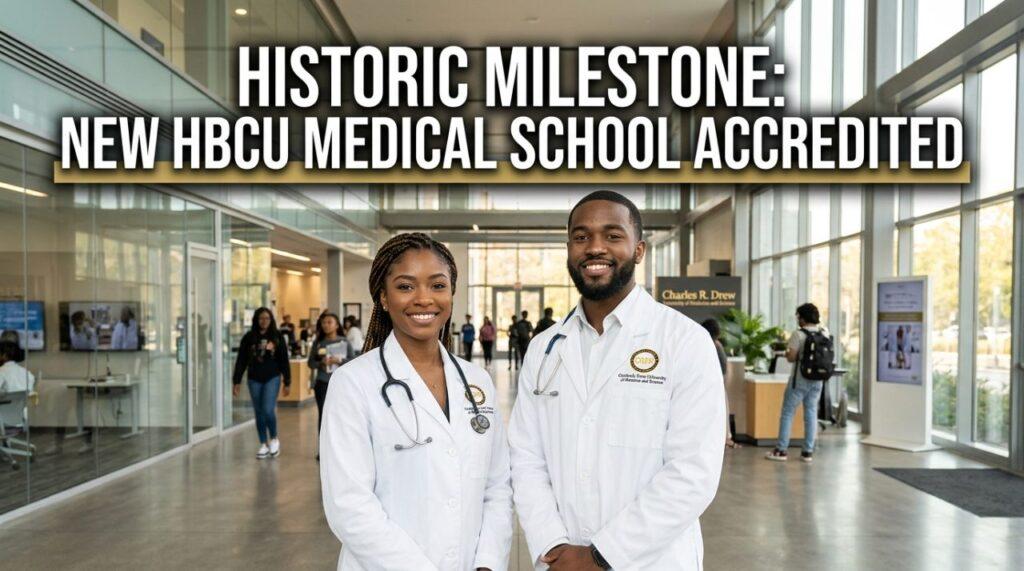
New HBCU Medical School Earns Landmark Accreditation
By Darius Spearman (africanelements)
Support African Elements at patreon.com/africanelements and hear recent news in a single playlist. Additionally, you can gain early access to ad-free video content.
A Landmark Breakthrough for the Xavier Ochsner Medical School
In October 2026, the medical community witnessed a historic milestone. The planned Xavier Ochsner College of Medicine, known as XOCOM, secured preliminary accreditation from national medical education authorities (jbhe.com, ochsner.org). This decision clears the institution to join the national admissions system and recruit its inaugural class for entry in 2027 (insidehighered.com, prnewswire.com). Located in downtown New Orleans inside Benson Tower, this campus represents the nation’s fifth medical school at a Historically Black College and University (HBCU) (jbhe.com, wwltv.com). It is also the first new HBCU medical program to emerge in the United States in five decades (blackdoctor.com, insidehighered.com).
The creation of the Xavier Ochsner medical school addresses a long-standing paradox in American higher education. Xavier University of Louisiana was founded in 1925 by Saint Katharine Drexel and the Sisters of the Blessed Sacrament (insidehighered.com, xula.edu). For decades, data from the Association of American Medical Colleges has confirmed that Xavier graduates more African American students who complete medical school than any other university in the nation (jbhe.com, xula.edu). Despite this outstanding undergraduate record, the institution lacked an independent, degree-granting medical college. Its graduates were consistently forced to leave Louisiana to pursue clinical training elsewhere (ochsner.org, xula.edu).
To overcome this limitation, university leadership partnered with Ochsner Health, the largest academic healthcare network in the state (ochsner.org, bizneworleans.com). Together, they organized a dedicated training center in the New Orleans BioDistrict (ochsner.org, studynola.com). Under the direction of Founding Dean Dr. Leonardo Seoane and university President Dr. C. Reynold Verret, the program seeks to admit an initial cohort of 50 students, with plans to expand to 100 students annually (ochsner.org, prnewswire.com). Independent studies project that the institution will generate over 150 million dollars in economic impact for the region by 2040 while expanding the healthcare workforce (prnewswire.com, studynola.com).
Understanding LCME Preliminary Accreditation and Student Pathways
The Liaison Committee on Medical Education, or LCME, serves as the primary accrediting agency for medical education programs leading to the Doctor of Medicine degree across the United States (insidehighered.com, medschoolcoach.com). Securing LCME preliminary accreditation is the crucial turning point for any developing medical program (insidehighered.com, watermarkinsights.com). This formal status grants institutional leaders the legal right to publicize their academic catalog, collect applications through the American Medical College Application Service, and enroll candidates (ochsner.org, prnewswire.com). The committee conducts thorough on-site evaluations of administrative finances, classroom facilities, library holdings, and clinical partnerships before granting this approval (watermarkinsights.com, alwmedschool.org).
Prospective candidates often question whether entering an initial cohort carries professional or licensing vulnerabilities. Official regulatory guidelines provide clear safeguards for these trainees (watermarkinsights.com, alwmedschool.org). The Federation of State Medical Boards and the National Resident Matching Program recognize preliminary status as an authorized credential (medschoolcoach.com, alwmedschool.org). Enrolled students retain full eligibility to sit for the United States Medical Licensing Examination steps and pursue federally matched residency training (watermarkinsights.com). Accreditation standards also mandate binding teach-out guarantees, ensuring that students can complete their degrees even if administrative setbacks occur (watermarkinsights.com).
LCME Allopathic Accreditation Path (Years to Completion)
Achieving complete accreditation is a multi-step process that spans several years (watermarkinsights.com). Developing colleges first secure candidate status before completing site visits to reach the preliminary phase (watermarkinsights.com, alwmedschool.org). When the inaugural class reaches its second year of coursework, accreditors review classroom delivery to confer provisional accreditation (watermarkinsights.com). Finally, when senior students rotate through hospital clerkships during their fourth year, evaluators survey clinical competencies before granting full accreditation (watermarkinsights.com). This graduated framework safeguards academic quality across every phase of institutional growth (alwmedschool.org).
The Golden Era and Shuttering of Historically Black Medical Schools
To grasp the true significance of this modern development, one must examine the history of Black medical education in the United States. During the decades following the American Civil War, newly freed populations confronted extreme discrimination across society (nih.gov, wikipedia.org). White institutions routinely refused entry to Black medical applicants, while municipal ordinances banned African American patients from segregated healthcare facilities (nih.gov, nih.gov). The establishment of independent training academies became an urgent necessity for basic community survival.
Between 1865 and 1910, African American leaders and philanthropic societies organized 14 medical schools across the nation (nih.gov, wikipedia.org). These foundational institutions emerged directly after the Civil War to build an independent professional class (nih.gov). Notable campuses included Howard University College of Medicine in Washington, D.C., founded in 1868, and Meharry Medical College in Nashville, founded in 1876 (nih.gov, wikipedia.org). In Raleigh, North Carolina, Shaw University opened Leonard Medical School in 1881, training hundreds of pioneering physicians (nih.gov, nih.gov).
Louisiana also developed its own early infrastructure to educate Black clinicians (nih.gov). In 1889, New Orleans University chartered Flint Medical College to serve urban communities and rural parishes (nih.gov, wikipedia.org). Flint maintained a dedicated teaching hospital and training program that prepared Black clinicians to serve impoverished populations throughout the Deep South (nih.gov). These early academies established critical standards of community care during a period characterized by widespread political hostility and systemic neglect (nih.gov, nih.gov).
Yet, this expanding network of historically Black medical schools proved vulnerable to centralized political and financial pressures (nih.gov, wikipedia.org). Because Black citizens faced severe economic disenfranchisement, their training institutions lacked massive private endowments (nih.gov). They relied instead on meager tuition collections, modest church donations, and volunteer clinical instruction (nih.gov, nih.gov). This structural funding disparity left Black medical academies exposed when national regulatory bodies attempted to standardize professional education standards across North America (nih.gov, dokumen.pub).
The Devastating 1910 Flexner Report Impact on Black Healthcare
In 1910, the Carnegie Foundation for the Advancement of Teaching published Bulletin Number Four, titled *Medical Education in the United States and Canada* (nih.gov, wikipedia.org). Authored by educator Abraham Flexner in collaboration with the American Medical Association, the survey evaluated 155 medical institutions (nih.gov, dokumen.pub). Flexner held up the research-intensive, laboratory-centered design of Johns Hopkins University as the singular standard for modern training (nih.gov, jhu.edu). His report sought to close commercial trade academies that lacked laboratory infrastructure (nih.gov, dokumen.pub).
While the survey eliminated exploitative diploma operations, its criteria ignored economic disparities caused by legal segregation (nih.gov, nih.gov). Flexner demanded extensive full-time faculties, specialized pathology laboratories, and exclusive control of hospital wards (nih.gov). Historically Black colleges, systematically starved of public tax revenue and private philanthropy, could not match the capital holdings of elite white universities (nih.gov). Moreover, Flexner expressed openly segregationist viewpoints, writing that Black clinicians should focus strictly on hygiene and sanitation to prevent infectious contagion from reaching white households (nih.gov, nih.gov).
The practice of the Negro doctor will be limited to his own race, which in its turn will be cared for better by good, than by poor physicians, but the physical well-being of the Negro is not only of value to himself, but of great moment to the white and of still greater moment to his children.
Abraham Flexner, 1910 (Bulletin Number Four)
The institutional destruction was immediate and severe (nih.gov, wikipedia.org). Of the seven Black medical colleges operating at the time, Flexner deemed only Howard and Meharry capable of survival (nih.gov). State medical boards revoked operating licenses, and philanthropic foundations withdrew financial subsidies from the remaining campuses (nih.gov, nih.gov). Flint Medical College in New Orleans closed in 1911, stripping the Gulf Coast of its only Black medical training center (nih.gov). Leonard Medical School closed its clinical department in 1914, followed by programs in Louisville, Knoxville, and Memphis (nih.gov, wikipedia.org).
Historically Black Medical Colleges Operating Over Time
The long-term mathematical toll of these closures was documented in a landmark 2020 study published in *JAMA Network Open* by researcher Kendall Campbell and colleagues (nih.gov, medpagetoday.com). The economists demonstrated that had those five shuttered medical programs remained open, they would have produced between 27,773 and 35,315 additional African American physicians by 2019 (nih.gov, healthaffairs.org). In the year 2019 alone, those lost schools would have yielded a 29 percent expansion in the graduating class of Black physicians nationwide (nih.gov). For over sixty years, Howard and Meharry operated as the only pipelines educating Black doctors, joined later by Morehouse School of Medicine in 1975 and Charles R. Drew University (jbhe.com, wikipedia.org).
Confronting Ochsner Health Segregation History and Governance
While the new college represents an institutional triumph, it requires examining local civil rights history. Ochsner Health was founded in 1942 by surgeon Dr. Alton Ochsner alongside four colleagues (wikipedia.org, ochsner.org). The clinic opened during the Jim Crow era as a segregated facility that excluded African American patients from its private rooms and refused clinical privileges to Black physicians (bizneworleans.com, ochsner.org). This exclusionary environment reflected the widespread history of clinical exploitation and racial segregation that dominated regional Southern healthcare for decades.
Tensions surrounding equal hospital access culminated in federal legal challenges (bizneworleans.com). In 1970, civil rights attorneys initiated federal litigation in *Cook v. Ochsner Foundation Hospital*, challenging the exclusion of low-income minority patients from facilities funded through federal Hill-Burton grants (bizneworleans.com). Although federal desegregation mandates transformed public accommodations during the late twentieth century, memories of exclusion fostered lasting skepticism among local Black residents (bizneworleans.com, xula.edu). Establishing a collaborative medical venture therefore demanded an administrative model that respected community trust.
To preserve institutional autonomy and safeguard Xavier University’s founding social justice mission, planners established the medical school as an independent 501(c)(3) nonprofit corporation (ochsner.org, xula.edu). Rather than operating as an Ochsner subsidiary, governance is managed through a balanced board of directors (ochsner.org). Xavier University and Ochsner Health hold an equal 50-50 allocation of voting seats (ochsner.org, bizneworleans.com). This governance parity guarantees that the HBCU exercises shared authority over executive hiring, budget priorities, curriculum approvals, and long-term institutional strategy (ochsner.org, xula.edu).
Administrative leadership also integrated community empowerment mechanisms directly into the school structure (xula.edu). The organization created an independent Faculty Assembly alongside an Office of Community Empowerment (xula.edu). A dedicated Associate Dean for Health Equity directs clinical coursework toward addressing structural barriers in primary care delivery (ochsner.org, xula.edu). By securing legal parity at the highest governing level, Xavier ensures that historical power imbalances will not compromise its historic obligation to community health advocacy (xula.edu).
Tackling Tuition Debt and the Black Physician Shortage Crisis
The urgency behind this institutional initiative stems directly from the modern Black physician shortage crisis (jbhe.com, ochsner.org). Across the United States, African Americans account for more than 13 percent of the general population, yet represent only 5.7 percent of the national physician workforce (jbhe.com, kff.org). In Louisiana, the disparity is even wider. While Black residents comprise 32.6 percent of the statewide population, Black physicians account for only 8.3 percent of licensed medical providers (ochsner.org). Furthermore, federal authorities classify 60 of Louisiana’s 64 parishes as Health Professional Shortage Areas (ochsner.org, wwltv.com).
Black Population vs. Physician Representation
Extensive clinical research confirms that provider representation directly affects community survival rates (nih.gov, healthaffairs.org). Epidemiological surveys indicate that African American patients report higher satisfaction, follow medical regimens more closely, and accept vital preventive screenings when treated by racially concordant clinicians (nih.gov). In maternal health, where Black women in the United States die from pregnancy complications at nearly three times the rate of white women, closing communication gaps is critical to saving lives (ajmc.com). HBCU medical colleges, though comprising only two percent of all medical campuses, historically graduate up to twenty percent of all Black clinicians (jbhe.com, healthaffairs.org).
However, educational debt remains a formidable barrier for prospective applicants from historically marginalized backgrounds (robertsmith.com, prnewswire.com). To combat this challenge, institutional planners secured substantial corporate and philanthropic backing prior to student recruitment (robertsmith.com, prnewswire.com). In January 2026, the Humana Foundation established a 3 million dollar health workforce scholarship fund dedicated specifically to incoming students (prnewswire.com). Additionally, the project obtained 5 million dollars in founding capital from Bloomberg Philanthropies through its Greenwood Initiative, which targets systemic racial wealth gaps across American institutions (robertsmith.com, prnewswire.com).
State and federal leaders are coordinating additional legislative appropriations to subsidize clinical rotations and student financial aid (prnewswire.com). By lowering the cost of attendance, the program encourages graduates to choose primary care residencies in underserved regions rather than pursuing high-paying subspecialties solely to pay down personal loan balances (prnewswire.com, xula.edu). These structural financial initiatives reflect the analytical focus found across modern Black studies programs, which examine how economic policies shape institutional equality.
When the first 50 medical students walk through the doors of the Xavier Ochsner College of Medicine in August 2027, their arrival will bridge more than a century of historical fracture (ochsner.org, prnewswire.com). Their presence in New Orleans will officially end a 116-year absence of an HBCU medical academy in Louisiana, fulfilling the uncompleted journey that began when Flint Medical College was forced to close in 1911 (nih.gov). Through preliminary accreditation and shared community governance, this new HBCU medical school establishes a vital foundation for racial equity and public health across the Gulf South (ochsner.org, prnewswire.com).
About the Author
Darius Spearman is a professor of Black Studies at San Diego City College, where he has been teaching for over 20 years. He is the founder of African Elements, a media platform dedicated to providing educational resources on the history and culture of the African diaspora. Through his work, Spearman aims to empower and educate by bringing historical context to contemporary issues affecting the Black community.
