


Riverview Police Department Probe: Whistleblower & Scandals
By Darius Spearman (africanelements)
Support African Elements at patreon.com/africanelements and hear recent news in a single playlist. Additionally, you can gain early access to ad-free video content.
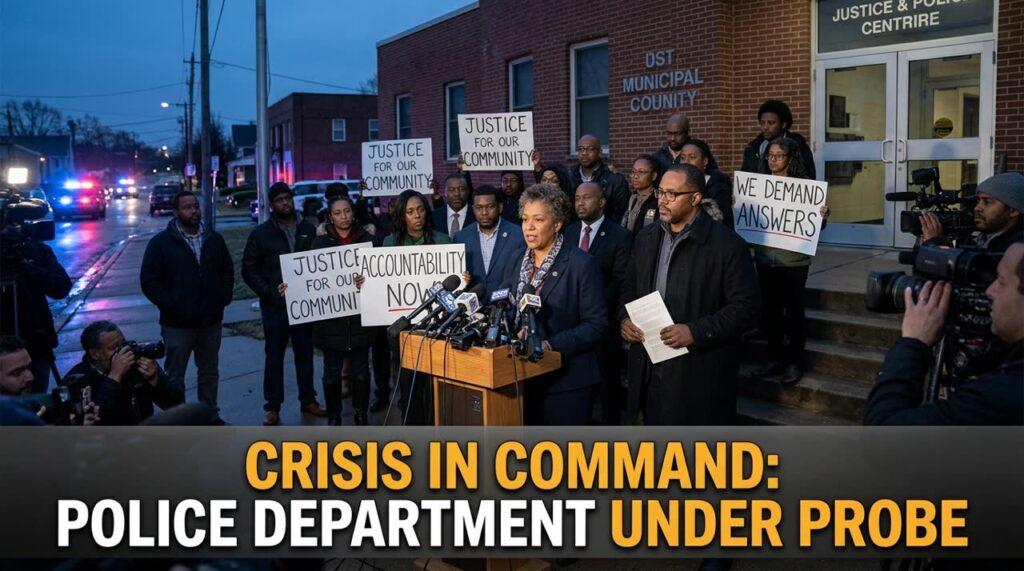
Civil rights leaders, legal monitors, and residents in North St. Louis County are demanding an independent investigation into the Riverview Police Department. The public outcry escalated after department leadership dismissed an internal investigator who reported questionable background records and internal excessive force concerns. Community members view this clash as part of a larger historical struggle over municipal power and racial justice in Missouri (blacknews.com, ksdk.com).
The Village of Riverview spans less than one square mile and is home to roughly 2,500 residents (datausa.io, worldpopulationreview.com). Despite its modest size, the municipality has become the center of a regional storm involving allegations of municipal corruption, retaliation against internal investigators, and an abrupt collapse of municipal services. Understanding this crisis requires examining the long history of regional separation, racial transition, and predatory revenue systems that have defined North St. Louis County for decades (rooseveltinstitute.org, usdoj.gov).
Marico Wilson Whistleblower Retaliation in Riverview
The immediate conflict inside the Riverview Police Department began during an internal pre-employment screening in the spring of 2026. Detective Corporal Marico Wilson was assigned to conduct a background check on Brandin Neil before Neil assumed the role of police chief. During the inquiry, Wilson discovered state regulatory records showing that Neil had performed armed private security details without required law enforcement licensing or state authorization (blacknews.com, coptalklive.org).
Recognizing potential criminal violations, Detective Wilson flagged Neil for possible arrest on suspicion of impersonating a police officer. Wilson then issued an internal safety alert within regional law enforcement channels. However, village officials moved forward with Neil’s appointment as top administrator. Shortly after taking command in May 2026, Neil terminated Wilson and Wilson’s immediate supervisor (blacknews.com, reddit.com).
Neil issued a formal reprimand against Wilson, accusing the detective of filing an unethical background flag, and classified the firings as private personnel decisions (blacknews.com). Wilson promptly filed formal legal complaints alleging direct whistleblower retaliation for reporting misconduct. Legal scholars note that municipal law enforcement officers in Missouri face steep barriers when exposing corruption within small departments. Under the Missouri Whistleblower’s Protection Act, public subdivisions and municipal governments are explicitly excluded from the statutory definition of an employer, leaving municipal officers without standard administrative whistleblower protections (bakersterchi.com, lglawllc.com).
Furthermore, small departments rarely maintain civil service review boards, leaving non-union officers subject to at-will termination. Federal civil rights claims under the First Amendment frequently encounter judicial hurdles, because statements made pursuant to an officer’s official investigative duties do not receive absolute constitutional protection against employer discipline (justia.com). Consequently, external agencies such as the St. Louis County Prosecuting Attorney, the Missouri Attorney General, or the Civil Rights Division of the United States Department of Justice must step in if allegations involve official misconduct or tampering with records (justice.gov, justice.gov).
Chief Brandin Neil Excessive Force Records and Video Evidence
Public scrutiny surrounding the department intensified as community organizations and investigative reporters uncovered a documented history of violence involving Neil. Civil rights monitors pointed out that the decision to hire Neil overlooked physical encounters that had been captured on video recordings over several years (blacknews.com, youtube.com).
In 2019, while working an off-duty security shift in the City of St. Louis, Neil struck an unarmed patron with a pair of metal handcuffs. Although that encounter led to state felony assault charges, a bench trial resulted in an acquittal (blacknews.com). In 2025, Neil arrested a sitting Riverview alderwoman who had openly criticized village leadership. That arrest triggered an ongoing federal civil rights lawsuit alleging false imprisonment, First Amendment retaliation, and excessive physical restraint (blacknews.com, youtube.com).
Public outrage grew further when video footage surfaced from a March 2026 altercation outside a St. Louis entertainment venue. The recording showed Neil repeatedly striking a man who was pinned to the pavement by multiple security guards (blacknews.com, youtube.com). Legal advocacy organizations argued that such incidents demonstrate how under-regulated private security operations and suburban law enforcement agencies overlap in eastern Missouri, allowing individuals with documented physical force complaints to retain command authority (coptalklive.org, eji.org).
Racial Demographics: Riverview vs St Louis County
Michael Cornell Jailhouse Appointment and Local Patronage
The appointment of Riverview’s police chief revealed severe systemic vulnerabilities in local municipal governance. In mid-2026, regional investigative reporters published recordings of more than 50 hours of telephone calls originating from the St. Louis County Jail. Former Riverview Mayor Michael Cornell Jr. had been incarcerated at the facility while awaiting trial on felony sex offense charges (blacknews.com, youtube.com).
Despite his incarceration, the recorded audio captured Cornell directing municipal operations and arranging Neil’s selection as police chief. Neil and Cornell discussed strategy on recorded phone lines, including plans to coordinate interviews so the selection process would appear open and competitive to the public (blacknews.com, youtube.com). Cornell assured Neil that village trustees would approve the promotion without significant resistance.
This behind-the-scenes arrangement demonstrated how tiny municipalities lack the institutional barriers that protect public safety agencies from direct personal patronage. In major metropolitan departments, police leadership appointments require vetting, confirmation votes, and public testimony before city councils. In small micro-jurisdictions, hiring authority can be concentrated in a handful of municipal figures, allowing personal networks to bypass standard checks and balances (rooseveltinstitute.org, rooseveltinstitute.org).
St Louis County Municipal Fragmentation and the 1876 Great Divorce
The institutional crisis in Riverview did not emerge in a vacuum. Its structural roots trace back to an 1876 political rupture known as the Great Divorce. That year, voters in the booming City of St. Louis voted to separate from rural St. Louis County, establishing an artificial boundary that prevented the urban center from expanding outward as the region grew (wikipedia.org, wikipedia.org).
During the mid-twentieth century, white residents and commercial capital migrated across the city border into St. Louis County. Because the county government lacked comprehensive regional land-use powers, suburban developers incorporated dozens of tiny villages to establish exclusionary zoning and shield local tax revenues (rsfjournal.org, thesaintlouisstory.org). By the late 1980s, the county contained nearly 90 autonomous municipalities, each maintaining independent municipal courts, administrative staff, and miniature police forces (rooseveltinstitute.org, justice.gov).
Beginning in the late twentieth century, rapid demographic shifts altered North St. Louis County. Industrial job losses in the central city led thousands of Black working-class families to move north into suburbs such as Wellston, Kinloch, Ferguson, and Riverview. This movement connected with deep historical transformations documented in studies of post-civil war reconstruction and residential segregation (eji.org, studlife.com).
Although the population in these suburbs became predominantly Black, administrative offices and police departments often stayed under the control of long-standing political networks. Lacking retail centers or industrial employers, small enclaves turned to municipal courts to fund basic operations. Micro-jurisdictions transformed police officers into ticket collectors, issuing citations for minor driving infractions and code violations to generate revenue (justice.gov, usdoj.gov).
This predatory system, often described as policing for profit, was laid bare following the fatal police shooting of Michael Brown Jr. in Ferguson in 2014. The United States Department of Justice issued a comprehensive report in 2015 documenting widespread Fourth and Fourteenth Amendment violations across North St. Louis County (usdoj.gov, justice.gov). Federal monitors found that municipal courts issued tens of thousands of warrants against low-income residents, creating cycles of debt and incarceration that mirrored the historical transition between the early civil rights era and mass incarceration policies of modern decades (finesandfeesjusticecenter.org, archcitydefenders.org).
St Louis County Municipal Fragmentation
Missouri POST Police Decertification and Wandering Officers
The controversy in Riverview highlights long-standing gaps in Missouri’s regulatory process for police officers. Under Chapter 590 of the Missouri Revised Statutes, the Peace Officer Standards and Training program oversees law enforcement licenses (mo.gov, mo.gov). However, state decertification mechanisms depend heavily on local administrative referrals, which often break down in small departments (mo.gov, mo.gov).
Mandatory license suspension or revocation typically requires formal criminal charges, felony convictions, or protracted hearings before the Administrative Hearing Commission (mo.gov, mo.gov). When officers face internal administrative complaints or allegations of excessive force, departments frequently allow them to resign voluntarily. These voluntary departures prevent formal disciplinary findings from being registered in state databases, preserving the officer’s certification (police1.com, police1.com).
This dynamic fuels a phenomenon known as wandering officers. Larger, well-funded suburban departments use thorough background investigations and competitive salaries to screen out troubled applicants. Financially distressed municipalities, by contrast, offer low compensation and lack dedicated investigative staff. Consequently, these departments often hire candidates whose state certifications remain technically active despite multiple misconduct complaints (police1.com).
State reporting mandates under Missouri law require departments to notify the state Department of Public Safety when an officer separates amid criminal investigations (mo.gov, mo.gov). Crucially, the statute does not require tracking civil lawsuits, excessive force claims settled out of court, or civilian complaints. As a result, problematic use-of-force histories remain invisible in official state licensing records (kcpolice.org, slu.edu).
| Statutory Mechanism | Legal Scope Under RSMo | Impact on Municipal Accountability |
|---|---|---|
| POST License Revocation | RSMo § 590.080 / § 590.090 | Requires formal criminal charges or lengthy hearings; rarely triggered by civil rights settlements (mo.gov). |
| Separation Reporting | RSMo § 590.070 | Mandates reporting only during active criminal investigations; bypasses voluntary resignations (mo.gov). |
| Whistleblower Protection | RSMo § 285.575 | Excludes public agencies and municipalities; leaves municipal officers exposed to retaliation (bakersterchi.com). |
| Municipal Fine Revenue Cap | Missouri Senate Bill 5 (2015) | Restricted court fine income to 12.5% without replacing municipal operating budgets (reason.org, legalnewsline.com). |
Riverview Police Furlough Crisis and the Struggle for Black Self-Determination
Following the passage of Missouri Senate Bill 5 in 2015, the state restricted how much operating revenue municipalities could extract from minor traffic fines and municipal court fees (reason.org, ballotpedia.org). While the reform checked abusive ticketing practices, it cut off the primary revenue source for small suburban municipalities without providing alternative funding models (legalnewsline.com). Riverview soon entered a fiscal tailspin.
On September 10, 2026, the village furloughed municipal administrative staff and dismissed most of its police force. The Riverview Police Department dropped to two commissioned officers, leaving the village incapable of maintaining daily patrols or answering emergency calls (blacknews.com, ksdk.com). St. Louis County Executive Sam Page directed the St. Louis County Police Department to take over emergency 911 dispatch and patrol duties across the village (ksdk.com).
Outside observers frequently ask why small, financially distressed municipalities do not disincorporate or merge public services into county departments. The answer lies in the history of Black self-determination and political representation in suburban St. Louis. After enduring decades of segregation and discriminatory housing practices, Black residents built political power in North County, winning mayoral seats, municipal councils, and local administrative offices (rooseveltinstitute.org, studlife.com).
Disincorporating would dissolve these municipal boundaries, folding local authority into unincorporated county land. In regional consolidation plans, such as the failed 2019 “Better Together” merger proposal, local authority would be absorbed into a predominantly white county electorate (slu.edu, slu.edu). Many Black residents view municipal independence as essential protection against outside encroachment, drawing on traditions of community organizing that date back to black institution building during post-emancipation struggles.
Furthermore, deep distrust persists toward county law enforcement. Community members recall the aggressive tactical responses deployed by county police during civil rights demonstrations in Ferguson in 2014 (justice.gov, fergusoncity.com). Even when local municipal forces face administrative breakdown, residents often view them as more directly accountable to neighborhood concerns than a distant county bureaucracy. This tension between political representation and municipal insolvency remains one of the unresolved dilemmas facing North St. Louis County (finesandfeesjusticecenter.org, archcitydefenders.org).
Riverview Police Staffing Collapse
The civil rights backlash in Riverview represents far more than an internal personnel dispute. It reflects a systemic crisis rooted in decades of municipal fragmentation, economic starvation, and regulatory failure. While state reforms successfully curbed predatory municipal court practices, they did not resolve the underlying structural barriers facing small suburban municipalities (reason.org, archcitydefenders.org).
Until state lawmakers establish independent oversight bodies, close statutory loopholes in police decertification laws, and ensure sustainable public safety funding, low-income communities in North St. Louis County will remain vulnerable to internal corruption and administrative collapse (justice.gov, slu.edu). The ongoing demands for an outside investigation into Riverview demonstrate that the fight for equitable justice and community self-determination continues to shape the region’s civil rights landscape.
About the Author
Darius Spearman is a professor of Black Studies at San Diego City College, where he has been teaching for over 20 years. He is the founder of African Elements, a media platform dedicated to providing educational resources on the history and culture of the African diaspora. Through his work, Spearman aims to empower and educate by bringing historical context to contemporary issues affecting the Black community.
