
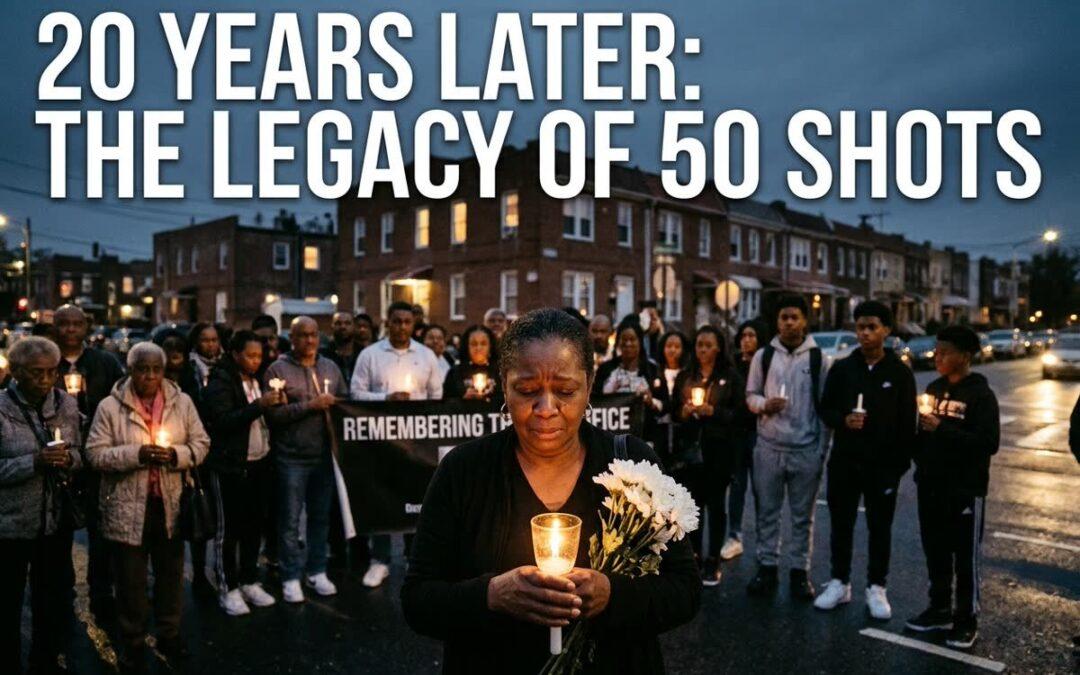

Sean Bell Shooting: 20 Years After 50 Shots Stunned Queens
By Darius Spearman (africanelements)
Support African Elements at patreon.com/africanelements and hear recent news in a single playlist. Additionally, you can gain early access to ad-free video content.
Sean Bell Anniversary Queens: Remembering a Tragic Morning
Two decades after gunfire shattered the early morning quiet of South Jamaica, Queens, community leaders and residents gathered once again to honor Sean Bell. The gathering took place on November 26 to reflect on a case that permanently transformed New York City. Bell was twenty-three years old when plainclothes police officers discharged fifty rounds into his vehicle on the morning of his wedding day in 2006. The gathering in Queens was not merely a memorial for a life cut short. It was a renewal of community demands for institutional accountability and an end to systemic gun violence (blackenterprise.com).
Queens Borough President Donovan Richards Jr. joined community advocates, family members, and local clergy to mark the milestone. Richards possessed a deep personal connection to the tragedy. As a young man in his early twenties who lived in the immediate neighborhood, he had visited the Bell family home on the very morning of the shooting. During the memorial, Richards reflected on how the loss altered his own trajectory and forced the entire municipality to confront the human cost of aggressive street tactics (blackenterprise.com).
“I was probably early twenties, just starting out in the business, trying to make sense of all of this, but we know you couldn’t—you couldn’t make sense of this. It was tragic, and what happened in Jamaica, Queens forced our city to confront how it polices our communities. Their advocacy pushed us to change policies, debate legislation, and ask hard questions about what we fund in the name of public safety.”
— Donovan Richards Jr., Source: (blackenterprise.com)
The legacy of that tragedy continues to shape the civic consciousness of Queens. Local leaders emphasized that remembering Bell requires persistent legislative oversight, municipal budget scrutiny, and active investment in neighborhood resources. Over the past twenty years, civil rights groups have pointed to this tragedy to examine the broader political dynamics in the Black community, connecting street-level survival directly to legislative power.

African Elements Press • Sociology & Black Family Studies
Legacy of Survival: The Dynamics of the Black Family
By Professor A. Darius Spearman • 284 Pages • ISBN: 979-8-9924836-0-4
For decades, mainstream sociology framed the Black family as a crisis to be diagnosed rather than a resilient institution to be understood. Legacy of Survival dismantles those deficit narratives—tracing the extended kinship networks, matriarchal anchors, paternal struggles, and psychological survival strategies that carried Black households from the transatlantic rupture to the modern era.
Club Kalua Shooting Timeline: What Happened on November 25, 2006
The events leading up to the tragedy unfolded during the early hours of Saturday, November 25, 2006. Sean Elijah Bell, a former high school baseball standout and father of two young daughters, spent Friday evening celebrating his bachelor party at Club Kalua on 91st Avenue in Jamaica, Queens. Bell was scheduled to marry his high school sweetheart, Nicole Paultre, at five o’clock that afternoon. The gathering was meant to be a joyous milestone among close childhood friends (wikipedia.org, blackpast.org).
Unbeknownst to the patrons inside, the venue was under undercover surveillance by New York City Police Department vice detectives investigating allegations of prostitution and drug sales. At approximately 4:00 a.m., Bell and his companions, Joseph Guzman and Trent Benefield, exited the venue. Outside the club, an argument reportedly occurred involving other individuals. Detective Gescard Isnora, operating in plainclothes without a uniform, claimed that he overheard someone reference a firearm during the dispute. Suspecting an imminent armed confrontation, Isnora followed Bell and his companions as they walked toward Bell’s silver Nissan Altima (wikipedia.org, cnn.com).
As Bell entered the driver seat and started the engine, plainclothes detectives surrounded the car with service weapons drawn. The accounts of the encounter diverged sharply. Police asserted that Detective Isnora displayed his badge and shouted that he was an officer. Conversely, the surviving occupants testified that the armed men in street clothes never clearly identified themselves as law enforcement. Believing they were about to be robbed or carjacked, Bell attempted to drive away, striking an unmarked police minivan in the process. In response, five officers opened fire on the vehicle (wikipedia.org, cnn.com).
Rounds Discharged by NYPD Officers
The NYPD 50 Shots Shooting: Breakdown of the Deadly Barrage
The sheer volume of gunfire unleashed on November 25, 2006, shocked the public and forensic investigators alike. Over the course of mere seconds, five officers discharged fifty bullets into Bell’s vehicle. Detective Michael Oliver fired thirty-one rounds, completely emptying his standard fifteen-round semi-automatic magazine, pausing to reload, and firing sixteen additional rounds. Detective Isnora fired eleven rounds, while three other officers discharged eight rounds combined (wikipedia.org, blackpast.org).
The physical devastation inside the vehicle was severe. Bell sustained four gunshot wounds to his neck and torso, succumbing to his injuries shortly after arrival at Jamaica Hospital Medical Center. Joseph Guzman survived despite being struck between sixteen and nineteen times, enduring permanent physical impairments. Trent Benefield, seated in the rear, was wounded by three bullets. An extensive forensic search of the vehicle and the surrounding street confirmed that neither Bell nor his friends possessed any firearms. No weapon was recovered from the scene (wikipedia.org, latimes.com).
The tragedy immediately drew public comparisons to the 1999 killing of Amadou Diallo. Diallo was an unarmed West African immigrant shot nineteen times when four members of the Street Crime Unit fired forty-one rounds at his Bronx apartment doorway. The similarity between the forty-one rounds fired at Diallo and the fifty rounds fired at Bell illustrated persistent structural flaws in weapon discipline, target identification, and threat assessment within specialized plainclothes deployments (wikipedia.org, morningsidecenter.org).
Key Case Metrics and Ballistics
NYPD Plainclothes Unit Tactics and the History of Street Enforcement
To understand how this encounter occurred outside Club Kalua, one must examine the institutional policing philosophy of that era. During the 1990s and 2000s, municipal leaders embraced “Broken Windows” policing and aggressive order-maintenance doctrines. These operational frameworks operated on the assumption that aggressively cracking down on low-level offenses would deter serious felonies. Under this philosophy, precinct anti-crime units and specialized undercover squads deployed into working-class Black and Latino communities with broad discretionary latitude (manhattan.institute, nyclu.org).
Plainclothes assignments operated as a flashpoint for municipal tension. Officers operated in civilian clothing and drove unmarked cars while tasked with intercepting street-level drugs and weapons. This operating model routinely produced extreme confusion. When unidentified officers drew firearms in low-light environments, civilians frequently assumed they were facing robbery crews or rival crews. This perceived threat created immediate fight-or-flight reactions that plainclothes officers then interpreted as criminal noncompliance or armed aggression (stanford.edu, nyclu.org).
These street encounters carried a disproportionate racial toll. Hundreds of thousands of Black and Latino men experienced aggressive street stops without reasonable suspicion, building generations of community alienation. Community organizers situated the encounter within long-standing efforts toward addressing historical racial injustices. The operational disconnect between undercover officers and the civilians they engaged transformed common disputes into fatal confrontations (stanford.edu, manhattan.institute).
The Sean Bell Trial Verdict: Why the Bench Trial Stunned the City
In March 2007, a Queens County grand jury indicted three detectives involved in the shooting. Detective Gescard Isnora and Detective Michael Oliver faced manslaughter and assault charges, while Detective Marc Cooper was charged with reckless endangerment. In a tactical maneuver common in high-profile police prosecutions, the defendants exercised their statutory right under New York law to waive a trial by jury. Instead, they opted for a bench trial before a single jurist, State Supreme Court Justice Arthur J. Cooperman (wikipedia.org, blackpast.org).
Defense attorneys deliberately avoided a local Queens jury. Jurors drawn from the borough would have reflected the diverse community and might have identified with the unarmed victims. Historically, defense teams in police misconduct cases favor bench trials because judges work alongside law enforcement daily and tend to evaluate split-second use of force under permissive legal precedents. On April 25, 2008, Justice Cooperman acquitted all three detectives of all criminal counts. In his decision, Cooperman cited discrepancies in the testimony of civilian witnesses while concluding the prosecution failed to prove criminal intent beyond a reasonable doubt (wikipedia.org, blackpast.org).
The acquittals ignited widespread public demonstrations and accusations of systemic judicial bias. Activists led by the Reverend Al Sharpton and the Bell family organized peaceful street marches and temporary blockades across major transit arteries. Community advocates argued that bench trials effectively circumvented the democratic role of the jury. This mechanism insulated law enforcement officers from the judgment of their peers while upholding a perceived double standard of municipal justice (wikipedia.org, cnn.com).
NYC Wrongful Death Settlement ($7.15M Total)
Transforming Police Accountability in NYC Across Two Decades
Although the criminal trial yielded acquittals, civil proceedings and administrative reviews produced tangible consequences. In February 2010, the United States Department of Justice announced it would not file federal criminal civil rights charges, citing the demanding statutory standard to prove willful deprivation of rights. However, in July 2010, the City of New York agreed to pay a 7.15 million dollar settlement to resolve federal wrongful death claims. Two years later, an internal NYPD departmental trial concluded with Police Commissioner Raymond Kelly terminating Detective Gescard Isnora and forcing three other officers into early departure (wikipedia.org, justice.gov).
The tragedy catalyzed structural changes that reshaped the legal and operational framework of New York law enforcement. Bell’s fiancée, Nicole Paultre Bell, transformed personal grief into sustained civil rights organizing. She worked alongside community coalitions in a manner reminiscent of past leaders honoring the tradition of civil rights activism. Their persistent advocacy exposed systemic conflicts of interest when local district attorneys investigated the municipal police officers with whom they regularly collaborated (amsterdamnews.com, clearinghouse.net).
Two primary statutory reforms emerged from this generational struggle:
- Repeal of Civil Rights Law § 50-a (2020): For decades, Section 50-a served as a statutory shield preventing the public, journalists, and victims’ families from inspecting internal NYPD misconduct, civilian complaints, and disciplinary outcomes. The full legislative repeal of this measure removed official secrecy surrounding officer discipline (nyclu.org, theguardian.com).
- Independent Special Prosecutor Jurisdiction (Executive Law § 70-b): To resolve conflicts of interest among county prosecutors, New York established the Office of Special Investigation under the State Attorney General. This independent office holds statewide jurisdiction over fatal law enforcement encounters involving unarmed civilians (clearinghouse.net, justice.gov).
Today, Liverpool Street between 94th and 95th Avenues carries the co-name “Sean Bell Way,” permanently marking the pavement where his life ended. Twenty years after fifty rounds altered the course of South Jamaica, Bell’s legacy endures as a driving force in ongoing municipal debates. The remembrance in Queens affirms that community survival, statutory reform, and public accountability remain inextricably bound together across time (wikipedia.org, blackpast.org).
About the Author
Darius Spearman is a professor of Black Studies at San Diego City College, where he has been teaching for over 20 years. He is the founder of African Elements, a media platform dedicated to providing educational resources on the history and culture of the African diaspora. Through his work, Spearman aims to empower and educate by bringing historical context to contemporary issues affecting the Black community.
