

Sir Hilary Beckles: The NYU Scholar Reshaping Reparations
By Darius Spearman (africanelements)
Support African Elements at patreon.com/africanelements and hear recent news in a single playlist. Additionally, you can gain early access to ad-free video content.
NYU CSAAD Distinguished Scholar Shapes Global Discourse
In autumn 2026, New York University announced a major academic appointment. The Center for the Study of Africa and the African Diaspora selected Professor Sir Hilary Beckles as its distinguished scholar for the 2026–2027 academic year (uwi.edu, nyu.edu). Beckles serves as Vice-Chancellor of the University of the West Indies (uwi.edu, uwi.edu). He also chairs the CARICOM Reparations Commission (uwi.edu, reparationscomm.org). The appointment marks an institutional partnership between scholars in the Global South and research centers in North America (uwi.edu, jbhe.com).
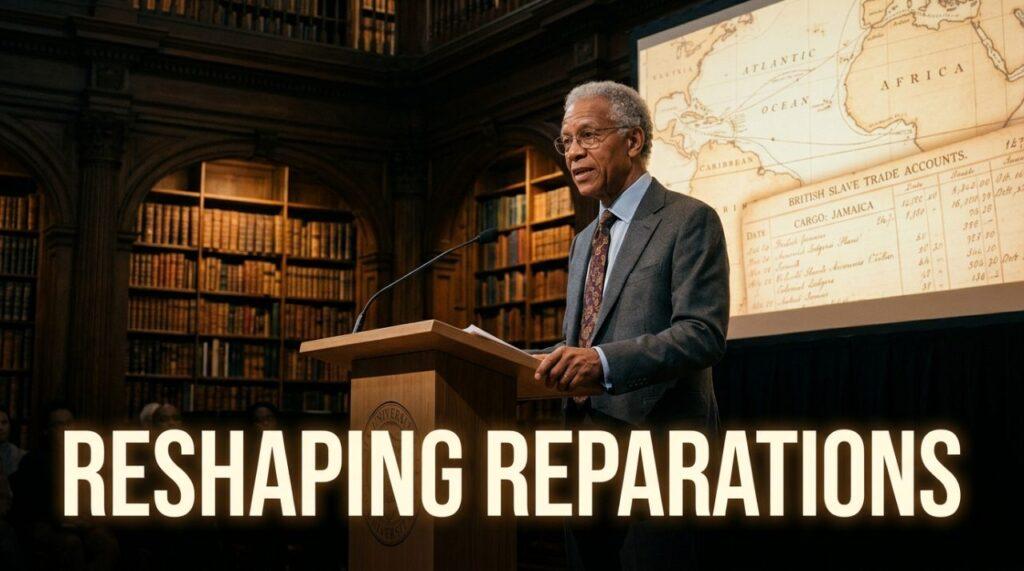
Beckles delivered his inaugural lecture at New York University on October 13, 2026 (uwi.edu). His address examined the economic mechanics of colonial plantations (uwi.edu, nyu.edu). The lecture was titled “The Economics of Wealth Creation: Why Enslaved Black Women Were the Financial Core of the Slavery Business Model” (uwi.edu). The event marked his return to the university after thirty-two years (uwi.edu). In 1994, he served as a visiting scholar following Barbadian intellectual Kamau Brathwaite (uwi.edu). Today, this role amplifies the Caribbean reparations movement within mainstream American academic discourse (uwi.edu, jbhe.com).
The appointment reflects a shift in university commitments toward reparatory justice (uwi.edu, nyu.edu). Historian Michael Gomez directs the research center at New York University (uwi.edu, nyu.edu). Under his leadership, the center investigates the global impact of transatlantic slavery (nyu.edu, nyu.edu). Beckles brings decades of archival research into modern legal policy (uwi.edu, reparationscomm.org). His scholarly career has redefined how international courts examine historical extraction (brattle.com, reparationscomm.org). As an appointed NYU CSAAD Distinguished Scholar, Beckles continues to connect historical research directly to international diplomatic action (uwi.edu, uwi.edu).
The Roots of Transatlantic Slavery Economics and Wealth
Modern studies of slavery examine financial accounting rather than isolated moral debates (reparationscomm.org, lse.ac.uk). For generations, European historians treated chattel slavery as a minor trade anomaly (lse.ac.uk). That narrative changed in 1944 when Trinidadian historian Eric Williams published Capitalism and Slavery (wikipedia.org, lse.ac.uk). Williams demonstrated that Caribbean plantation profits financed the British Industrial Revolution (lse.ac.uk). Unpaid agricultural labor provided the capital surplus needed to build British factories, canals, and commercial banks (reparationscomm.org, lse.ac.uk).
Williams showed that economic shifts caused abolition rather than humanitarian benevolence alone (lse.ac.uk). When British manufacturing surpassed agricultural commerce in profitability, imperial financiers abandoned the West Indian plantation monopolies (lse.ac.uk). Beckles expanded this economic analysis in his books Britain’s Black Debt and How Britain Underdeveloped the Caribbean (reparationscomm.org, uwi.edu). He documented how transatlantic slavery economics systematically stripped resources from African territories and transferred them to Europe (reparationscomm.org, lse.ac.uk). European empires extracted labor and raw commodities while intentionally preventing industrial development across the Caribbean basin (reparationscomm.org, uwi.edu).
Transatlantic slave trade archives reveal the enormous human scale of this extraction (wikipedia.org). Over 12.5 million captive Africans were forced onto European slave ships between the sixteenth and nineteenth centuries (wikipedia.org). Approximately 10.7 million people survived the Middle Passage to disembark in the Americas (wikipedia.org). The Caribbean basin absorbed more than four million captive workers (wikipedia.org). Sugar monoculture plantations generated mortality rates that required continuous human importation (reparationscomm.org). These commercial profits sustained transatlantic financial institutions that operate to this day (reparationscomm.org, lse.ac.uk).
Transatlantic Captive Transport Estimates
The Legal Impact of the Partus Sequitur Ventrem Doctrine
The foundation of plantation finance relied directly upon colonial jurisprudence (wikipedia.org). In December 1662, the Virginia General Assembly codified a statute that fundamentally reshaped property law (wikipedia.org). The legal statute was known as the Partus Sequitur Ventrem doctrine (wikipedia.org). The Latin phrase translates to “that which is brought forth follows the womb” (wikipedia.org). This statute established that every child born in the colony inherited the legal status of the mother (wikipedia.org).
This law marked a direct break from English domestic jurisprudence (wikipedia.org). Under English common law, parental inheritance followed the paternal lineage through patris sequitur conditionem (wikipedia.org). A child took the legal rank, land rights, and freedom of the father (wikipedia.org). Colonial lawmakers abandoned that centuries-old tradition (wikipedia.org). They replaced English inheritance standards with Roman civil property doctrines used for livestock (wikipedia.org). By anchoring servitude to Black mothers, lawmakers ensured that colonial courts classified African newborns as commercial chattel rather than free subjects (wikipedia.org).
The statute transformed biological reproduction into an automated mechanism for capital accumulation (uwi.edu). Enslavers expanded their labor forces and property portfolios without paying purchase or importation costs (uwi.edu). Furthermore, the law granted legal protection to enslavers who engaged in sexual exploitation (wikipedia.org). Children fathered by white men upon enslaved Black women remained enslaved laborers (wikipedia.org). This erased all legal claims to paternal inheritance, child support, and civil rights (wikipedia.org). These policies disrupted Black households, prompting generations to develop unique kinship patterns under oppression to protect their communities.
The 1833 Slavery Abolition Act and State Compensations
The official end of British chattel slavery set a clear financial precedent for reparations (reparationscomm.org). When Parliament passed the 1833 Slavery Abolition Act, the British state did not offer restitution to the victims (reparationscomm.org, reparationscomm.org). Instead, the British government paid massive financial reparations exclusively to enslavers (reparationscomm.org, reparationscomm.org). British officials declared that enslaved laborers were lawful commercial property under colonial statutes (reparationscomm.org, reparationscomm.org). Freeing them without payment was viewed by Parliament as an unconstitutional seizure of private wealth (reparationscomm.org, reparationscomm.org).
The British Treasury paid £20 million in cash to approximately 46,000 enslavers across the empire (reparationscomm.org, reparationscomm.org). That payout consumed roughly 40 percent of the annual national budget of Great Britain (reparationscomm.org, reparationscomm.org). The imperial government took out massive commercial loans to finance the transaction (reparationscomm.org, reparationscomm.org). British taxpayers did not finish paying off the interest on that debt until 2015 (reparationscomm.org, reparationscomm.org). Because of post-war migration, Caribbean descendants living in the United Kingdom helped pay the national debt that compensated their ancestors’ captors (reparationscomm.org, reparationscomm.org).
Formerly enslaved laborers received nothing from the British Crown (reparationscomm.org, reparationscomm.org). Furthermore, the 1833 legislation subjected freed people to a mandatory Apprenticeship System from 1834 to 1838 (wikipedia.org, reparationscomm.org). During this four-year period, workers performed uncompensated labor on the same plantations where they were held captive (wikipedia.org, reparationscomm.org). The imperial state released them into legal freedom without land, schools, hospitals, or capital (reparationscomm.org, uwi.edu). This institutionalized poverty trapped Caribbean populations in debt peonage for over a century (reparationscomm.org, uwi.edu).
British 1833 Abolition Financial Settlements
The CARICOM Reparations Commission and the 10-Point Plan
In 2013, regional leaders established an institutional framework to secure historical accountability (reparationscomm.org, caricom.org). The Caribbean Community formed the CARICOM Reparations Commission to lead diplomatic engagement with European states (reparationscomm.org, caricom.org). Heads of government appointed Sir Hilary Beckles as the inaugural chairman of the regional body (uwi.edu, reparationscomm.org). CARICOM represents fifteen member states across the Caribbean basin (caricom.org). The commission shifted reparations discussions away from abstract moral pleas toward formal state claims under international law (reparationscomm.org, reparationscomm.org).
Under Beckles’ leadership, the commission authored the 10-Point Action Plan for Reparatory Justice (reparationscomm.org, caricom.org). The document outlines diplomatic, cultural, and developmental restitution (reparationscomm.org, reparationscomm.org). Point one demands formal apologies from European governments, rejecting ambiguous statements of regret (reparationscomm.org, reparationscomm.org). Point two demands funding for repatriation programs to support Rastafarians and other citizens wishing to resettle in Africa (reparationscomm.org, reparationscomm.org). Point three requires European nations to finance Caribbean cultural institutions and return looted heritage artifacts (reparationscomm.org, reparationscomm.org).
The framework also addresses public health, education, and institutional development (reparationscomm.org, reparationscomm.org). The plan links the high regional rates of type 2 diabetes and hypertension to dietary deprivation under plantation rule (reparationscomm.org, reparationscomm.org). It mandates European investment in regional clinics, schools, and research universities (reparationscomm.org, reparationscomm.org). This approach aligns with broader efforts for decolonizing academic institutions across the African diaspora. Furthermore, the plan demands sovereign debt cancellation and clean technology transfers (reparationscomm.org, reparationscomm.org). In 2019, Beckles negotiated a £20 million reparatory partnership with the University of Glasgow, proving the viability of this model (uwi.edu, reparationscomm.org).
Assessing Restitution: The Brattle Group Reparations Report
In June 2023, an international team of economists delivered an unprecedented financial assessment (brattle.com, brattle.com). The Brattle Group reparations report was presented at the American Society of International Law in Washington (brattle.com, brattle.com). Judge Patrick Robinson of the International Court of Justice convened the expert panel (brattle.com, brattle.com). The University of the West Indies co-sponsored the econometric study (brattle.com, brattle.com). The report quantified historical liabilities across thirty-one transatlantic enslavement destinations (brattle.com, brattle.com).
The study estimated total transatlantic liabilities between $107.8 trillion and $131 trillion (brattle.com, brattle.com). Economists calculated unpaid wages, physical injury, deprivation of liberty, and long-term societal damage (brattle.com, brattle.com). The report assessed a $24 trillion liability against Great Britain for harms inflicted upon fourteen Caribbean states (brattle.com, brattle.com). Jamaica alone holds an assessed claim of $9.5 trillion against the British government (brattle.com, brattle.com). The report also assessed a $17 trillion liability against Spain for colonial extraction in the Americas (brattle.com, brattle.com).
The analysis assessed a $26.8 trillion liability against the United States for harms between 1776 and 1865 (brattle.com, brattle.com). This transatlantic tort model intersects with domestic American initiatives (brattle.com). While CARICOM focuses on diplomatic negotiations for regional infrastructure, American activists pursue lineage-based restitution (brattle.com, reparationscomm.org). Domestic advocates cite the Brattle Group findings to support federal legislation like H.R. 40 and state-level restitution frameworks (brattle.com). The econometric data converts historical injustice into an empirical accounting balance sheet (brattle.com, brattle.com).
Brattle Group Assessed Liabilities
Sir Hilary Beckles and Transatlantic Reparatory Justice
The appointment of Sir Hilary Beckles signals an institutional convergence across the Black Atlantic (uwi.edu, nyu.edu). Scholars no longer examine diaspora history solely through narratives of suffering (reparationscomm.org, lse.ac.uk). Instead, academic leaders analyze chattel slavery as the foundational economic engine of contemporary global inequality (uwi.edu, reparationscomm.org). Beckles’ research unites archival rigor with international legal frameworks (reparationscomm.org, uwi.edu). This scholarly synthesis links colonial plantation registers to the balance sheets of modern multinational financial institutions (reparationscomm.org, lse.ac.uk).
International bodies increasingly reflect this analytical framework (caricom.org, un.org). The African Union has declared reparatory justice a primary diplomatic objective (un.org). The United Nations Permanent Forum on People of African Descent works closely with CARICOM representatives (un.org). By providing an intellectual platform at New York University, Western academia acknowledges the legitimacy of Caribbean legal models (uwi.edu, nyu.edu). UWI Vice Chancellor Beckles continues to lead this intellectual movement across borders (uwi.edu, uwi.edu). His scholarship demonstrates that achieving genuine transatlantic reparatory justice requires addressing the direct economic roots of transatlantic slavery (uwi.edu, reparationscomm.org).
About the Author
Darius Spearman is a professor of Black Studies at San Diego City College, where he has been teaching for over 20 years. He is the founder of African Elements, a media platform dedicated to providing educational resources on the history and culture of the African diaspora. Through his work, Spearman aims to empower and educate by bringing historical context to contemporary issues affecting the Black community.
