


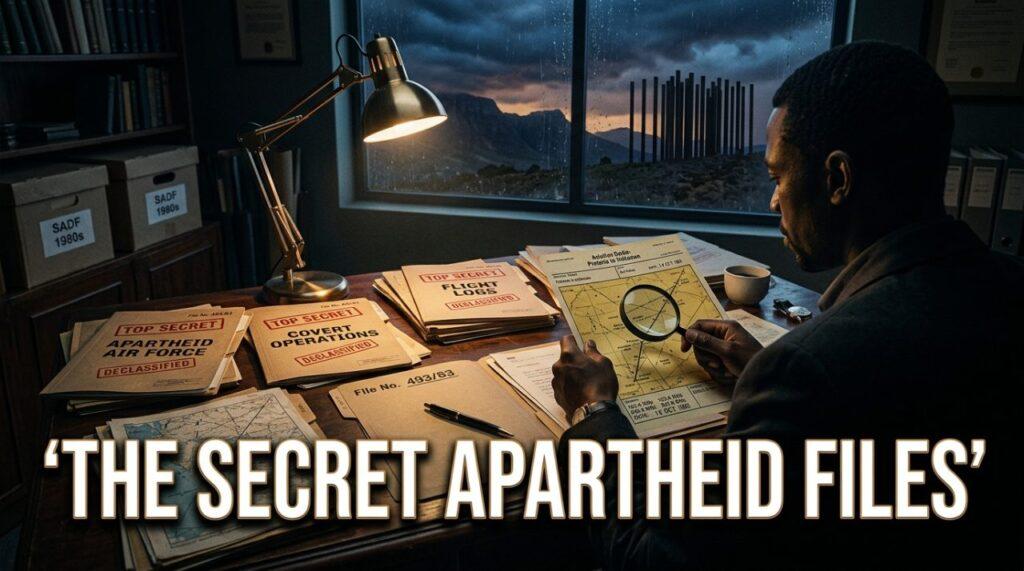
The Secret Apartheid Files Behind the Samora Machel Crash
By Darius Spearman (africanelements)
Support African Elements at patreon.com/africanelements and hear recent news in a single playlist. Additionally, you can gain early access to ad-free video content.
The Gathering at Mbuzini: A Forty-Year Cry for Justice
The wind carries a sharp whistle through thirty-five steel tubes standing on a hillside in Mbuzini (clubofmozambique.com). This memorial marks the spot where a presidential aircraft crashed four decades ago (www.gov.za). The impact killed Samora Moisés Machel, the charismatic founding president of independent Mozambique (sahistory.org.za). It also claimed the lives of thirty-four diplomats, advisers, and crew members on October 19, 1986 (wikipedia.org).
Forty years later, the tragedy remains an open wound across Southern Africa (clubofmozambique.com). Dignitaries, historians, and human rights activists recently gathered at the hillside memorial to honor the fallen leader (www.gov.za, allafrica.com). Mozambican President Daniel Chapo delivered a resolute address before the assembly (clubofmozambique.com). He stressed that the explanations provided over past decades have failed to satisfy the public (clubofmozambique.com). The families of the victims still demand the full truth about what occurred on that hillside (clubofmozambique.com).
South African Minister of International Relations Ronald Lamola attended the solemn event alongside regional delegations (www.gov.za). The memorial service quickly turned into an urgent call for political transparency (clubofmozambique.com, allafrica.com). Activists and historians are demanding that the South African government declassify remaining apartheid-era intelligence files (saha.org.za, opensecrets.org.za). These long-hidden archives may finally prove whether the crash was an accident or a state-sponsored assassination (justice.gov.za, dailymaverick.co.za).
The Mbuzini Crash: Human Toll (October 19, 1986)
The Frontline States and the Crucible of Liberation
To understand why Samora Machel was targeted, one must look at the geopolitical map of the 1970s and 1980s (sahistory.org.za). After leading the Front for the Liberation of Mozambique (FRELIMO) through a brutal guerrilla war, Machel achieved independence from Portugal in 1975 (wikipedia.org). He immediately turned his young socialist republic into a haven for regional freedom fighters (sahistory.org.za). Machel believed that Mozambique could never be completely free while neighboring Black populations suffered under racist regimes (sahistory.org.za, heraldonline.co.zw).
Consequently, Mozambique became an anchor of the Frontline States alliance (wikipedia.org, sahistory.org.za). This regional coalition included independent Black-led nations such as Tanzania, Zambia, Angola, and Botswana (sahistory.org.za). Together, these countries offered safe training grounds, logistical supply lines, and diplomatic protection to freedom fighters (sahistory.org.za). Machel welcomed Robert Mugabe’s forces fighting against white-minority rule in Rhodesia (sahistory.org.za, heraldonline.co.zw). Furthermore, he sheltered the armed wing of the African National Congress (ANC) battling the apartheid system in South Africa (wikipedia.org, sahistory.org.za).
This bold solidarity reflected the radical spirit of global liberation ideologies that inspired freedom struggles across the African diaspora. However, this pan-African commitment carried a devastating price tag for the Mozambican people (sahistory.org.za, heraldonline.co.zw). White-minority regimes viewed Machel as an immediate threat to their regional supremacy (sahistory.org.za, samilitaryhistory.org). As a result, Mozambique became the primary target for South African military sabotage and cross-border aggression (wikipedia.org, sahistory.org.za).
Total National Strategy: Apartheid Covert Warfare
During the late 1970s, the apartheid government in Pretoria adopted a severe military doctrine known as the Total National Strategy (justice.gov.za, sahistory.org.za). Apartheid leaders claimed that a communist plot, known as the Total Onslaught, threatened their survival (justice.gov.za, sahistory.org.za). Under State President P. W. Botha, the South African military launched covert cross-border attacks to destabilize neighboring states (justice.gov.za, sahistory.org.za). Pretoria financed, trained, and armed a rebel militia called RENAMO to wage civil war inside Mozambique (wikipedia.org, sahistory.org.za).
The proxy war caused immense destruction, triggering mass starvation and wrecking the Mozambican economy (wikipedia.org, sahistory.org.za). Seeking to halt the slaughter of his citizens, Machel signed the Nkomati Accord with Botha in March 1984 (wikipedia.org, sahistory.org.za). Under this non-aggression pact, Mozambique agreed to expel ANC fighters (wikipedia.org, sahistory.org.za). In exchange, South Africa promised to end all covert backing for RENAMO rebels (wikipedia.org, sahistory.org.za). Nevertheless, Pretoria repeatedly broke its word by continuing secret arms shipments and tactical support to the rebels (wikipedia.org, sahistory.org.za).
By October 1986, the diplomatic climate reached a dangerous boiling point (wikipedia.org, sahistory.org.za). A landmine incident along the border injured six South African soldiers, prompting immediate outrage in Pretoria (wikipedia.org, sahistory.org.za). Apartheid Defence Minister Magnus Malan publicly threatened that President Machel would clash head-on with South Africa (wikipedia.org, sahistory.org.za). Just twenty-four hours before his death, Machel held a private briefing in Maputo with senior military commanders and journalists (wikipedia.org, sahistory.org.za). He warned them that South African intelligence agencies were actively planning to assassinate him (wikipedia.org, sahistory.org.za).
The Night of the Crash: An Engineered Catastrophe
On October 19, 1986, Machel attended an urgent diplomatic summit in Mbala, Zambia (wikipedia.org, sahistory.org.za). The Frontline leaders discussed regional security and transit routes to bypass apartheid trade blockades (wikipedia.org). After the meetings concluded, Machel boarded his presidential aircraft, a Soviet-built Tupolev Tu-134A-3 (wikipedia.org, samilitaryhistory.org). The plane departed Zambia at dusk, heading home toward Maputo International Airport under the guidance of an experienced flight crew (wikipedia.org, samilitaryhistory.org).
As the aircraft approached Mozambican airspace around 9:11 PM, the crew initiated an unexpected 37-degree turn to the southwest (wikipedia.org, samilitaryhistory.org). The pilots believed they were following a radio signal guiding them toward the runway in Maputo (wikipedia.org, samilitaryhistory.org). In reality, the turn directed the jet into the high, dark ridges of the Lebombo Mountains (wikipedia.org, samilitaryhistory.org). Flying through dense clouds, the aircraft struck the hillside at an altitude of 2,180 feet, scattering debris across the South African border hamlet of Mbuzini (wikipedia.org, samilitaryhistory.org).
The conduct of South African authorities following the crash raised immediate suspicions of sabotage (wikipedia.org, justice.gov.za). South African police and military units took over four hours to arrive at the crash site (wikipedia.org, justice.gov.za). When officers finally arrived, they bypassed critically injured passengers who were pleading for medical help (wikipedia.org, justice.gov.za). Instead, the armed operatives rifled through the wreckage, confiscating diplomatic pouches, presidential cables, and classified state documents (wikipedia.org, justice.gov.za).
The Battle of Inquiries: Pilot Error Versus Decoy Beacons
Pretoria moved quickly to control the narrative by establishing an official Board of Inquiry under Supreme Court Judge Cecil Margo (wikipedia.org, samilitaryhistory.org). In 1987, the Margo Commission concluded that the crash was simply an accident caused by pilot error (wikipedia.org, samilitaryhistory.org). The commission stated that the Soviet crew misread their instruments, ignored ground proximity alarms, and tracked the wrong radio beacon (wikipedia.org, samilitaryhistory.org). However, critics pointed out that Judge Margo held an honorary rank in the South African Air Force, creating an undeniable conflict of interest (wikipedia.org, dokumen.pub).
Conversely, a parallel investigation conducted by Soviet and Mozambican aviation specialists pointed to covert electronic warfare (wikipedia.org, samilitaryhistory.org). Their technical report showed that the aircraft avionics locked onto a false Very High Frequency Omnidirectional Range beacon (wikipedia.org, samilitaryhistory.org). This decoy transmitter operated on the exact frequency of the Maputo airport tower (wikipedia.org, samilitaryhistory.org). The false signal diverted the plane into the mountains (wikipedia.org, samilitaryhistory.org). Military records later confirmed that South African forces possessed portable decoy beacons and had deployed them in regional combat zones (wikipedia.org, justice.gov.za).
Years later, South Africa’s Truth and Reconciliation Commission (TRC) examined the evidence during closed-door hearings (justice.gov.za). Led by Archbishop Desmond Tutu, the TRC concluded that the Margo findings were fundamentally flawed (justice.gov.za, dailymaverick.co.za). The commission discovered that a special military detachment had set up camp near Mbuzini days before the crash, only to vanish immediately afterward (justice.gov.za). The TRC formally stated that circumstantial evidence strongly supported the decoy beacon theory and recommended a full criminal investigation (justice.gov.za, dailymaverick.co.za).
Inquiries Challenging the Official 1987 Finding
The 2012 Hawks Probe and the Broken Paper Trail
In 2012, South Africa reopened the case under the Directorate for Priority Crime Investigation, an elite police unit known as the Hawks (mg.co.za, dailymaverick.co.za). Working alongside Mozambican authorities, investigators gathered fresh witness accounts and technical reports (mg.co.za, dailymaverick.co.za). Investigators examined flight recordings and military movement logs from the night of the disaster (mg.co.za). Public statements suggested that modern forensic tools might finally unravel the secret conspiracy behind the crash (mg.co.za).
Unfortunately, the elite inquiry ground to an abrupt halt amid bureaucratic evasion (mg.co.za, dailymaverick.co.za). Police representatives claimed they had compiled a comprehensive case docket and handed it to the presidency (mg.co.za). In response, presidential spokespersons denied ever receiving the finished investigative folder (mg.co.za). The National Prosecuting Authority never issued subpoenas or brought formal criminal indictments against former apartheid commanders (mg.co.za, dailymaverick.co.za).
This institutional inertia mirrors historical patterns where broken post-war promises denied systemic justice to oppressed communities. The failure to publish the Hawks findings left the Machel family and Mozambican citizens deeply disappointed (mg.co.za, dailymaverick.co.za). The investigation simply disappeared into the administrative machinery of the modern state (mg.co.za). As elderly apartheid generals died of old age, vital eyewitness testimony vanished forever (dailymaverick.co.za, opensecrets.org.za).
Why Democratic South Africa Keeps Apartheid Secrets
Many observers wonder why a democratic, ANC-led government continues to guard the classified records of its former oppressors (dailymaverick.co.za, opensecrets.org.za). The answer lies in the messy political compromises that ended apartheid during the early 1990s (dailymaverick.co.za, csvr.org.za). In the months before the historic 1994 elections, apartheid intelligence agencies incinerated tons of sensitive surveillance documents (opensecrets.org.za). The negotiated settlement that followed prioritized national stability over sweeping criminal trials (csvr.org.za, opensecrets.org.za).
Furthermore, releasing the remaining operational files poses significant political risks for modern leaders (opensecrets.org.za). Apartheid intelligence units ran extensive espionage networks that penetrated anti-apartheid liberation movements (opensecrets.org.za). Declassifying complete files could expose prominent political figures who once operated as double agents or police informants (opensecrets.org.za). Fearing reputational damage and internal political chaos, state security officials have routinely chosen silence (dailymaverick.co.za, opensecrets.org.za).
Additionally, modern security departments have inherited an institutional culture of state secrecy (opensecrets.org.za). Agencies such as the Department of Defence continue to fight freedom-of-information requests filed by public interest legal groups (saha.org.za, opensecrets.org.za). These archival barriers reflect wider institutional patterns often discussed in the study of the civil rights movement and modern surveillance states. Bureaucrats insist on shielding military files under the guise of protecting national security (opensecrets.org.za).
Key Secret Archives Demanded for Public Release
Transitional Justice and the Unfinished Struggle
Civil society groups are no longer waiting for government agencies to act voluntarily (saha.org.za, opensecrets.org.za). Organizations such as the South African History Archive and Open Secrets are waging court battles to force the release of historical records (saha.org.za, opensecrets.org.za). They want access to the minutes of the State Security Council from late 1986 (opensecrets.org.za). They also seek operational logs from the Directorate of Special Tasks, which oversaw covert electronic warfare (opensecrets.org.za). Opening these archives is essential to exposing the economic networks and political crimes that shaped inequality in South Africa today.
For the people of Mozambique, declassification is not an academic exercise (clubofmozambique.com). Their nation suffered thousands of casualties and economic ruin for supporting the South African freedom struggle (sahistory.org.za, heraldonline.co.zw). The death of Samora Machel altered the political trajectory of Southern Africa (wikipedia.org, sahistory.org.za). True regional solidarity cannot exist if the South African state conceals the circumstances of his assassination (clubofmozambique.com, dailymaverick.co.za).
The fortieth anniversary commemorations at Mbuzini send an unmistakable signal to regional leaders (clubofmozambique.com, allafrica.com). Passing decades will not extinguish the demand for genuine historical accountability (clubofmozambique.com). Releasing these classified apartheid dossiers will finally provide closure to grieving families (clubofmozambique.com, dailymaverick.co.za). Until those archives open, the steel tubes at Mbuzini will continue to sing their mournful song into the mountain winds (clubofmozambique.com).
About the Author
Darius Spearman is a professor of Black Studies at San Diego City College, where he has been teaching for over 20 years. He is the founder of African Elements, a media platform dedicated to providing educational resources on the history and culture of the African diaspora. Through his work, Spearman aims to empower and educate by bringing historical context to contemporary issues affecting the Black community.
