

U.S. Boat Strike Lawsuit: Caribbean Families Seek Truth
By Darius Spearman (africanelements)
Support African Elements at patreon.com/africanelements and hear recent news in a single playlist. Additionally, you can gain early access to ad-free video content.
A Missile in the Caribbean Waters
On October 14, 2025, an open boat was traveling across the Gulf of Paria toward Trinidad. Suddenly, a U.S. military missile struck the vessel without warning. The blast instantly vaporized the small boat and killed all six people aboard (aclu.org, apnews.com). Among the dead were Chad Joseph, a twenty-six-year-old father of three, and Rishi Samaroo, a forty-one-year-old worker rushing home to care for his sick mother (ccrjustice.org, aljazeera.com). Both men lived in the coastal village of Las Cuevas in northern Trinidad (iowapublicradio.org).
Following the strike, the White House published aerial surveillance video of the explosion on social media. Officials declared the victims were illicit narcoterrorists affiliated with foreign syndicates (apnews.com, ua.news). However, the United States government presented no contraband, cargo manifests, or forensic evidence to substantiate the claim (aclu.org, theguardian.com). In Trinidad, local authorities confirmed that neither Joseph nor Samaroo had any criminal records involving narcotics trafficking (ccrjustice.org, aljazeera.com). The sudden strike sparked outrage across regional maritime communities that have long navigated these waters.
Historical Roots of Caribbean Maritime Policing
The lethal attack represents a severe departure from four decades of established diplomatic protocols. Following the expansion of the War on Drugs, the United States Congress passed the Maritime Drug Law Enforcement Act in 1986 (wikipedia.org). This legislation asserted federal extraterritorial jurisdiction over vessels on the high seas. Crucially, the statute operated strictly within a civilian criminal justice framework. Maritime interdiction was treated as police work, requiring federal agents to collect physical evidence, respect legal custody chains, and preserve individual due process (uscg.mil).
During the 1990s, Washington negotiated bilateral maritime pacts known as Shiprider Agreements with Caribbean nations, including Trinidad and Tobago and Jamaica (state.gov, jis.gov.jm). These treaties respected national territorial sovereignty (miami.edu). U.S. Coast Guard personnel were permitted to pursue suspect vessels only while hosting a local law enforcement officer aboard (state.gov). The historical interdiction model relied on a measured continuum of force: tracking, verbal warnings, physical boardings, and precision disabling fire directed strictly at outboard motors (uscg.mil). Suspects were brought before federal courts for criminal trials rather than executed at sea.
Lethality Comparison: Coast Guard vs. Missile Strikes
The Gulf of Paria Trade and Labor Corridor
The waters separating Trinidad from Venezuela are geographically narrow and historically interconnected. At its narrowest points, the Bocas del Dragón and Boca del Serpiente measure less than ten miles across. For centuries, working-class communities navigated these straits for seasonal agricultural harvesting, artisanal fishing, and commercial barter. Families on the northern coast of Trinidad maintained personal, cultural, and trade bonds with towns on the Paria Peninsula.
When economic contraction struck Venezuela in recent decades, these maritime passages developed a complex character. The same open waters supported honest fishermen and desperate laborers while drawing transnational criminal organizations. Many vulnerable Black workers traveled abroad to tend livestock, harvest crops, and provide food for their households. Chad Joseph and Rishi Samaroo were doing precisely this agricultural labor in Venezuela (aclu.org, ccrjustice.org). They were returning home across historic routes when military warheads obliterated their vessel (aclum.org, iowapublicradio.org).
The Pivot to War: Operation Southern Spear
The fatal missile strike was not an isolated event. Instead, it was an intentional escalation under Operation Southern Spear (syr.edu, defense.gov). In late 2025, the executive branch discarded standard maritime interdiction policies. The administration designated regional drug networks and street gangs as Foreign Terrorist Organizations and enemy combatants (justsecurity.org, cfr.org). By invoking asymmetric warfare doctrines, the Pentagon substituted military kinetic strikes for civilian law enforcement (defense.gov, defense.gov).
Under U.S. Southern Command, Navy guided-missile destroyers, carrier strike groups, and combat aircraft entered the Caribbean basin (defense.gov, defense.gov). The operational guidelines eliminated verbal warnings, engine disabling fire, and physical boardings (syr.edu, justsecurity.org). High-tech air-to-surface missiles struck small civilian boats without giving occupants any chance to surrender (aclu.org, justsecurity.org). Washington argued these measures were lawful strikes conducted during a non-international armed conflict against drug cartels (syr.edu, justsecurity.org). This unilateral shift weaponized international sea lanes that coastal Caribbean communities relied on for their daily survival.
Operation Southern Spear Fatalities (2025–2026)
Extrajudicial Killings Versus the Laws of War
The central constitutional controversy hinges on the boundary between legitimate wartime targeting and extrajudicial murder. Under the Law of Armed Conflict, nations engaged in genuine military conflict may target lawful combatants with lethal force (justsecurity.org, justsecurity.org). This military standard bypasses civilian criminal due process entirely. However, International Human Rights Law demands that law enforcement officers preserve life whenever possible (aclu.org, justsecurity.org). Lethal force is permitted only as an unavoidable last resort against immediate, mortal danger (justsecurity.org).
Civil liberties organizations argue that counter-narcotics policing can never legally qualify as an international war (aclu.org, ccrjustice.org). Suspected smugglers are civilians entitled to an arrest, criminal representation, and judicial proceedings (aclum.org, justsecurity.org). When foreign militaries destroy civilian craft without verified threats or judicial warrants, the law defines that action as extrajudicial execution (aclu.org, ccrjustice.org). The executive branch circumvented Congress, which never enacted an authorization for use of military force against regional drug cartels (ccrjustice.org, justsecurity.org). When historical constitutional protections failed to restrain military command, vulnerable people paid the ultimate price.
Burnley v. United States: The Families Demand Justice
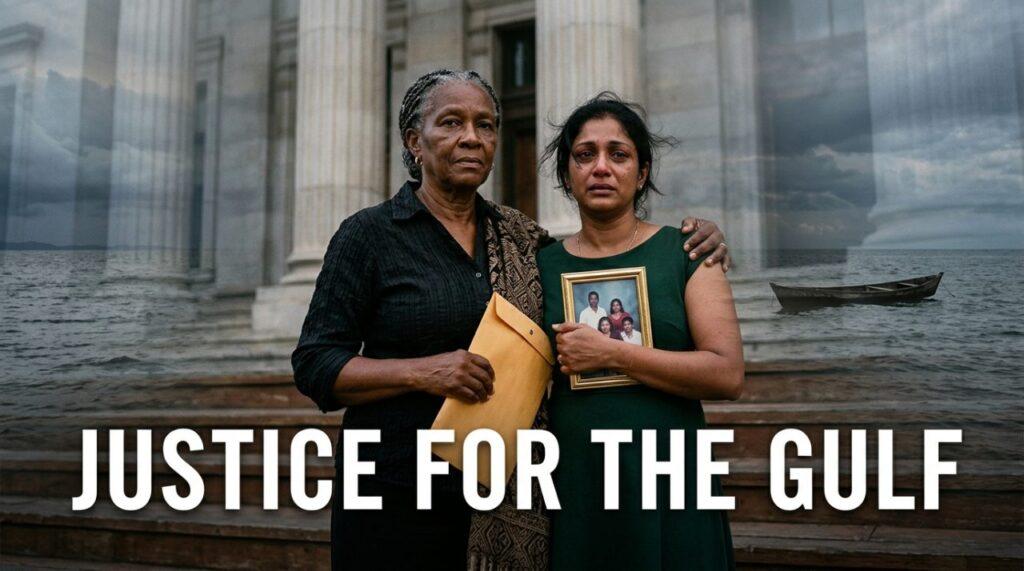
On January 27, 2026, the grieving families transformed their private sorrow into a historic legal action (aclu.org, cbsnews.com). Lenore Burnley, the mother of Chad Joseph, and Sallycar Korasingh, the sister of Rishi Samaroo, filed a wrongful death lawsuit in federal court (aclu.org, ccrjustice.org). Supported by the American Civil Liberties Union, the Center for Constitutional Rights, and Seton Hall University School of Law, the plaintiffs filed Burnley v. United States in Massachusetts (aclu.org, aclum.org, courthousenews.com).
The lawsuit asserts violations under the Death on the High Seas Act and the Alien Tort Statute (aclu.org, ccrjustice.org). The complaint argues that military officers committed actionable torts and gross negligence by killing foreign civilians on the high seas (ccrjustice.org, courthousenews.com). Demonstrating the quiet strength and resilience of working families, the plaintiffs seek full disclosure of surveillance records, official accountability, and financial damages (aclu.org, ccrjustice.org). Meanwhile, Department of Justice attorneys have invoked sovereign immunity and the political question doctrine, claiming executive military decisions are immune from federal court review (syr.edu, courthousenews.com).
Physical Contraband Recovered for Federal Prosecution
Diplomatic Ruptures Across the Caribbean Basin
The deadly missile strikes provoked deep political divisions across the Caribbean Community. Trinidad and Tobago Prime Minister Kamla Persad-Bissessar and the Ministry of Defence initially praised aggressive counter-narcotics actions (cbc.ca, kaieteurnewsonline.com). The administration maintained that the missile strike took place in international waters outside Trinidadian jurisdiction (kaieteurnewsonline.com). This posture reflected historical pressures on small Caribbean governments to align with Washington on regional security programs (cfr.org, wola.org).
Conversely, other regional leaders expressed outrage over the loss of Caribbean lives. The Prime Minister of Saint Lucia publicly demanded answers from the U.S. government regarding missing regional fishermen (cbc.ca, cbc.ca). Human rights advocates and regional scholars condemned the militarization as an assault on national sovereignty (peoplesdispatch.org, nycaribnews.com). Member states reiterated their longstanding commitment to maintain the Caribbean Sea as an official Zone of Peace (cbc.ca, peoplesdispatch.org). The unilateral exercise of sovereign power from abroad has tested unity across the African diaspora in the Americas.
The Legacy of Gunboat Diplomacy
The lethal tactics of Operation Southern Spear evoke painful historical memories across the Caribbean. For over a century, powerful nations deployed naval gunboats to enforce economic mandates and political interests across the hemisphere (cfr.org). The contemporary shift from cooperative Shiprider agreements to unilateral missile bombardments mirrors that old imperial dynamic (miami.edu, wola.org). Once again, naval warships patrol regional waterways, treating local fishermen and travelers as disposable combatants.
The human toll continues to mount. By late 2026, U.S. forces carried out more than seventy boat strikes, killing over 235 individuals without securing evidence or criminal trials (ccrjustice.org, justsecurity.org). The legal crusade by Lenore Burnley and Sallycar Korasingh challenges the assumption that foreign militaries can operate above the law (aclu.org, ccrjustice.org). Their struggle demands that maritime sovereignty, human rights, and the presumption of innocence prevail over unchecked military violence.
About the Author
Darius Spearman is a professor of Black Studies at San Diego City College, where he has been teaching for over 20 years. He is the founder of African Elements, a media platform dedicated to providing educational resources on the history and culture of the African diaspora. Through his work, Spearman aims to empower and educate by bringing historical context to contemporary issues affecting the Black community.
