

Why the CMPD Racist Text Scandal Stems from History
By Darius Spearman (africanelements)
Support African Elements at patreon.com/africanelements and hear recent news in a single playlist. Additionally, you can gain early access to ad-free video content.
A Chilling Contest Behind Police Badges
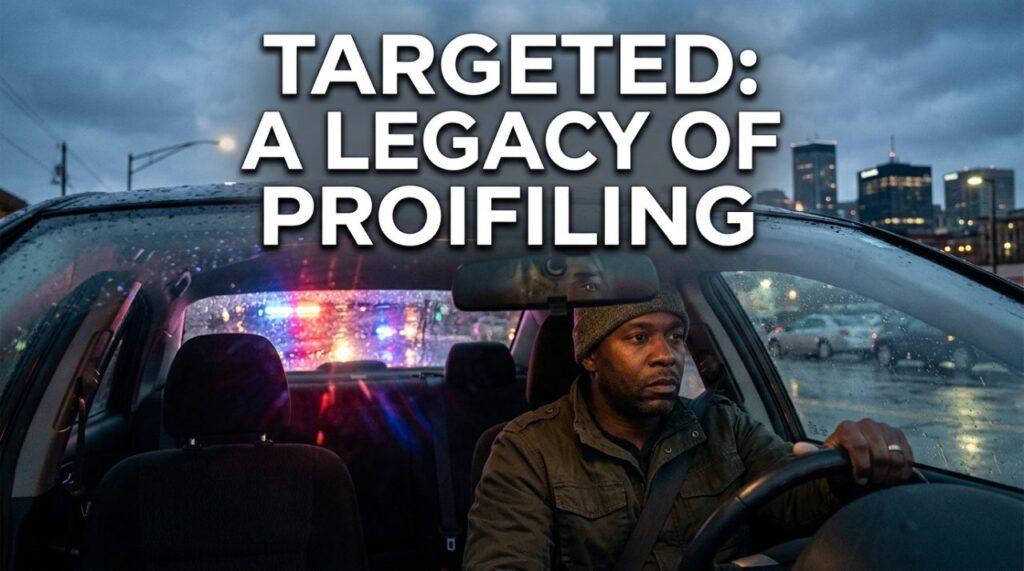
A disturbing scandal recently emerged within the Charlotte-Mecklenburg Police Department. State investigators uncovered a private group text chat shared among several patrol officers. The messages contained vile racial slurs, casual threats of lethal violence, and a brazen competition to pull over Black drivers (wfae.org, wcnc.com). Officers actively competed to see who could target the highest number of Black residents (michiganchronicle.com, wsoctv.com).
The fallout from these revelations was immediate across Mecklenburg County. Six officers were suspended without pay and cited for termination before the local Civil Service Board (wcnc.com, wsoctv.com). Another officer resigned before formal departmental charges were filed (wsoctv.com). Community organizers noted that the participating officers worked across multiple patrol divisions. This geographic spread showed that the behavior was not confined to one isolated precinct (wfae.org, wcnc.com).
CMPD Vehicle Search Rate After Traffic Stops
From Slave Patrols to Modern Charlotte Beats
Modern law enforcement did not emerge in a cultural vacuum. In the American South, urban police departments grew directly out of antebellum slave patrols and municipal town guards. These early organizations existed to restrict Black mobility and defend white property interests. After the Civil War, formerly enslaved people faced post-slavery legal traps such as vagrancy statutes and convict leasing systems.
During Reconstruction, Black men temporarily served on Charlotte municipal watch forces. At one point, Black officers comprised between twenty and forty percent of the local patrol staff. However, the rise of Jim Crow segregation quickly erased those political gains. White municipal leaders systematically purged Black officers from the ranks by the turn of the twentieth century. Consequently, local police departments functioned as armed guardians of racial segregation for several generations.
In 1993, local officials merged the Charlotte Police Department with the Mecklenburg County Police Department. This merger created the consolidated Charlotte-Mecklenburg Police Department operating today. The newly combined agency promised professionalized services and modern administrative oversight. Yet the organizational culture retained deep historical patterns of aggressive containment in working-class Black neighborhoods.
Pretextual Policing and the Broken Windows Legacy
During the 1990s, police departments across the country embraced proactive policing doctrines. Theorists argued that stopping low-level infractions would deter serious felony crimes. In practice, this philosophy encouraged officers to use minor traffic code violations as pretexts for criminal investigations. Officers pulled motorists over for broken taillights, cracked windshields, and expired registration tags.
These discretionary encounters rarely focused on highway safety. Instead, officers utilized minor infractions to conduct speculative roadside interrogations and warrantless vehicle searches. Black motorists bore the brunt of these intrusive practices on daily commutes. Such aggressive enforcement created persistent animosity between communities of color and the officers patrolling their streets.
These practices eventually sparked sustained police accountability campaigns modeled after historical grassroots struggles. Generations of Black drivers learned to navigate routine traffic stops with extreme caution. Discretionary traffic enforcement evolved into an effective mechanism of racial profiling. The modern text message contest was simply an explicit expression of this long-standing operational model.
The Unbroken Thread: Jonathan Ferrell and Keith Lamont Scott
Tensions between the department and Black residents reached boiling points during the past decade. In September 2013, twenty-four-year-old Jonathan Ferrell suffered a severe late-night automobile accident in eastern Mecklenburg County. Seeking medical help, Ferrell knocked on the door of a nearby house. The homeowner called emergency services to report an alleged breaking and entering in progress.
Arriving CMPD Officer Randall Kerrick confronted the unarmed young man. Kerrick fired twelve bullets, striking Ferrell ten times and killing him at the scene. Kerrick stood trial for voluntary manslaughter in 2015, but the proceeding ended in a hung jury. State prosecutors subsequently chose not to retry the case, leaving the local Black community deeply disillusioned.
Three years later, tragedy struck the city again. On September 20, 2016, CMPD officers shot and killed forty-three-year-old Keith Lamont Scott outside an apartment complex. Scott’s death ignited days of impassioned civil unrest and mass street protests across Charlotte. The governor deployed the National Guard, and municipal leaders declared a state of emergency. Demonstrators demanded transparent oversight and an end to systemic racial discrimination in police enforcement.
CMPD Traffic Stop Arrests by Race
Academic Proof: Frank Baumgartner and the Hit Rate Paradox
The racist text messages confirmed statistical realities that researchers have tracked for decades. In 1999, North Carolina enacted landmark legislation requiring all law enforcement agencies to record demographic details for routine traffic stops. University of North Carolina professor Frank R. Baumgartner spent years analyzing this database of over twenty million encounters. His research established clear, recurring racial disparities across Charlotte.
Baumgartner discovered that Black motorists experienced vehicle searches at more than three times the rate of white motorists. Furthermore, Black drivers accounted for sixty-two percent of all traffic-related arrests, despite comprising approximately thirty-five percent of the city population. White motorists accounted for only eighteen percent of traffic arrests. Officers frequently stopped Black drivers for discretionary equipment violations rather than serious moving infractions.
Most importantly, the data revealed what criminologists call the hit rate paradox. Although officers searched Black motorists far more frequently, searches of white drivers yielded illegal drugs and weapons at higher rates. Officers operated with a remarkably low threshold of suspicion when confronting Black drivers. The numbers demonstrated that widespread racial bias was operating under the guise of public safety.
Surveillance Creep and the Flock Camera Investigation
The racist group text chat surfaced through a state criminal inquiry into surveillance misuse. In mid-2024, the North Carolina State Bureau of Investigation opened a corruption inquiry into former CMPD Officer Seth Daniel Elliott (wsoctv.com). Elliott faced accusations of accessing private police databases without authorization (wfae.org, wcnc.com). Investigators alleged that he ran license plates to help an acquaintance who was targeted in a narcotics probe (wcnc.com, wsoctv.com).
Elliott utilized several sensitive law enforcement databases during his patrol duties. These systems included the CJLEADS records portal and the municipal Flock Safety automated license plate reader network (wcnc.com). State agents seized Elliott’s mobile phone and completed a forensic data extraction (wfae.org, wcnc.com). During that examination, investigators incidentally discovered the separate patrol group chat containing racial slurs and the driver competition (michiganchronicle.com, wfae.org, wcnc.com).
Critics frequently worry about the state surveillance apparatus and its impact on marginalized groups. However, official records confirm that officers did not use camera software to run the contest. Automated license plate cameras capture vehicle attributes, not the race of occupants inside. Instead, the officers used traditional patrol tactics to stop Black drivers while tracking their numbers privately.
Contraband Hit Rate Comparison During Searches
Dismantling Transparency: The 2024 Legislative Repeal
Public accountability suffered a massive blow shortly before the text scandal surfaced. In mid-2024, the North Carolina General Assembly repealed the landmark 1999 traffic stop data reporting mandate (ncleg.gov). Lawmakers quietly inserted Section 19.4 into Session Law 2024-41, which was the state budget bill (ncleg.gov). The repeal terminated twenty-five years of mandatory racial demographic tracking across North Carolina (ncleg.gov).
Legislative leaders defended the repeal by describing the reporting system as an administrative burden. They argued that removing the paperwork would allow officers to spend more time patrolling neighborhoods. However, civil rights advocates condemned the decision as a deliberate dismantling of public transparency. The state shut down the public data portal just as technological surveillance expanded across the region.
Local civilian oversight remains severely limited by North Carolina judicial doctrine. Under the principle known as Dillon’s Rule, municipal governments possess only powers granted directly by state lawmakers. Consequently, the Charlotte Citizens Review Board cannot issue subpoenas or enforce officer discipline. Furthermore, CMPD has never operated under a binding federal consent decree. This structural dynamic reflects the complex state and federal authority that frequently hampers municipal police reform.
The Brady Reckoning: Tainted Cases and Post-Conviction Relief
The fallout from the group text extends far beyond departmental disciplinary hearings. Under the landmark Supreme Court decision Brady v. Maryland, prosecutors must give defense attorneys any evidence favorable to the accused. The subsequent ruling in Giglio v. United States expanded that requirement to include information impeaching government witnesses. Documented racial slurs and biased contests directly challenge an officer’s courtroom credibility.
Local prosecutors maintain internal tracking registries known as Brady lists or do-not-call rosters. When an officer lands on this roster, prosecutors rarely call them to testify in criminal trials. Defense attorneys can use documented records of racial bias to discredit the officer before a jury. Consequently, single-officer arrests handled by the implicated CMPD officers face immediate evidentiary challenges in local courtrooms.
This dynamic triggers widespread case dismissals and opens the door for post-conviction relief. In North Carolina, convicted individuals can file a Motion for Appropriate Relief to challenge tainted verdicts. If an individual was convicted based on testimony from an officer harboring hidden racial animus, judges can vacate that sentence. Legal defense organizations are auditing hundreds of past arrests to determine how many convictions require reversal.
Rebuilding Trust on Fractured Ground
The discovery of the text chat validated fears that Black residents had voiced for decades. Community leaders stressed that an active competition across multiple divisions cannot be dismissed as a few bad apples (wfae.org, wcnc.com). When officers turn routine traffic enforcement into a game targeting Black motorists, the entire justice system loses legitimacy (michiganchronicle.com, wfae.org). Discretionary policing practices allowed this misconduct to flourish without detection for months (wfae.org).
Meaningful reform demands transparent civilian oversight and rigorous institutional changes. Legal organizations and community groups continue calling for thorough case audits across Mecklenburg County (wfae.org). True accountability requires confronting the long historical lineage that normalized racial profiling in the first place. Only structural transparency and sustained community oversight can finally dismantle these entrenched patterns of injustice.
About the Author
Darius Spearman is a professor of Black Studies at San Diego City College, where he has been teaching for over 20 years. He is the founder of African Elements, a media platform dedicated to providing educational resources on the history and culture of the African diaspora. Through his work, Spearman aims to empower and educate by bringing historical context to contemporary issues affecting the Black community.
