

Why Wells Fargo Banking While Black Incidents Persist
By Darius Spearman (africanelements)
Support African Elements at patreon.com/africanelements and hear recent news in a single playlist. Additionally, you can gain early access to ad-free video content.
The In-Branch Standoff: When Routine Banking Turns Urgent
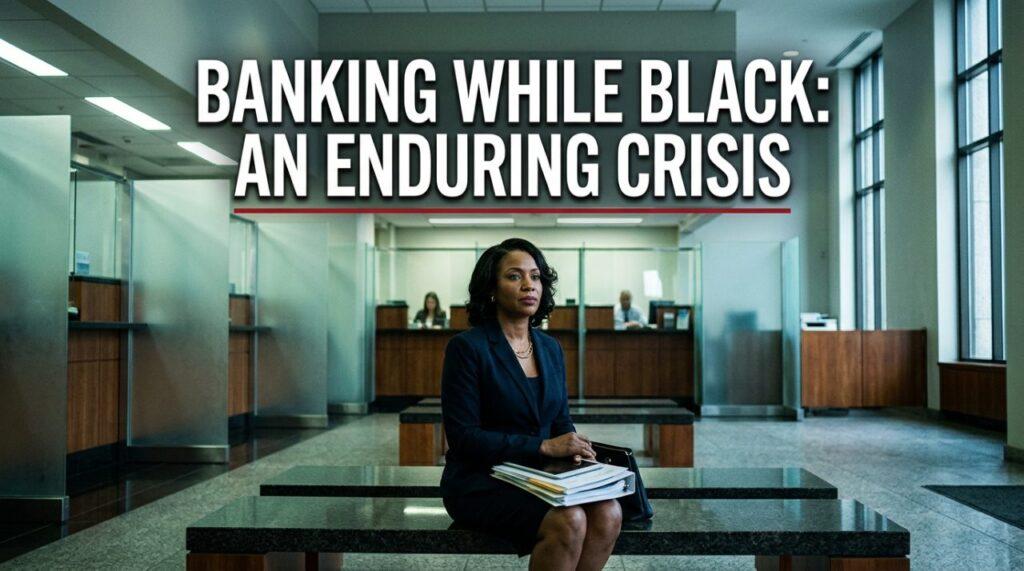
The viral video spread across social media platforms within hours. Viewers watched a Black business owner sitting calmly in a bank lobby while speaking directly to emergency dispatchers. Celebrity fashion stylist and entrepreneur Ebony Brown visited a Wells Fargo branch in February 2024 to resolve an abrupt administrative hold placed on her business account. Instead of receiving assistance, she faced suspicion, delayed answers, and immediate hostility from branch staff (youtube.com, atlantablackstar.com).
Telephone representatives had previously provided conflicting instructions and refused basic verification requests. When Brown arrived in person to withdraw her capital and close the account, employees ordered her to vacate the building. Recognizing the grave danger of having bank staff call the police to remove her, Brown took defensive action. She dialed 911 herself and requested police presence to document the encounter safely (facebook.com, atlantablackstar.com).
When local officers arrived, Brown declined requests to step out onto the sidewalk. She knew that leaving the lobby could result in a trespassing citation. Instead, she remained seated inside for nearly two hours under the watch of responding officers. Branch personnel finally lifted the freeze, disbursed her legal funds, and permitted her to close the account (atlantablackstar.com, youtube.com). Her composure prevented physical harm, but the confrontation exposed an ongoing crisis facing Black patrons nationwide.
Criminalizing Daily Commerce: The Pattern of Branch Profiling
Brown was far from the first customer to experience this treatment. Routine commercial transactions frequently trigger baseless accusations against minority account holders. In 2025, entrepreneur Shawn Davis filed a federal discrimination lawsuit against Wells Fargo. Davis, the creator of a multimillion-dollar food enterprise featured on Shark Tank, attempted to deposit an official $20,403 United States Treasury tax refund check. A branch manager refused the deposit, questioned the legitimacy of the federal draft, and ordered him to leave under threat of police arrest (atlantablackstar.com, bencrump.com).
Similarly, former bank teller Clarice Middleton experienced intense scrutiny at an Atlanta branch in Druid Hills. Middleton attempted to cash a standard $200 security deposit return check. Branch workers immediately suspected fraud and summoned law enforcement to the lobby. Middleton held two valid identification cards and personal banking records, yet staff still treated her as a criminal suspect (11alive.com). These incidents mirror the early financial obstacles documented in the history of early Black entrepreneurs across the United States.
Black patrons call this humiliating phenomenon “Banking While Black.” Transactions that white customers finish in minutes often prompt delays, interrogation, and aggressive security measures for Black depositors. The systemic criminalization of basic commerce reveals institutional attitudes that view Black wealth as inherently fraudulent. These branch-level confrontations reflect historical patterns that stretch back more than a century.
Wells Fargo 2020 Refinance Approval Disparity
The First Betrayal: The Collapse of the Freedman’s Savings Bank
Modern branch bias did not appear overnight. It is the continuation of institutional betrayal that began directly after the Civil War. In 1865, the federal government chartered the Freedman’s Savings and Trust Company. The bank was designed to help newly emancipated African Americans accumulate wealth and build commercial independence during Reconstruction (uchicago.edu, brennancenter.org). These promises followed deep post-Civil War labor struggles where Black laborers sought economic security.
Thousands of Black soldiers, agricultural laborers, and business owners deposited their modest earnings into the institution. By the early 1870s, more than 61,000 customers maintained accounts with the bank. Depositors believed their capital carried federal guarantees. However, an all-white board of trustees engaged in wild real estate speculation and unsecured corporate lending. Those reckless loans left the bank insolvent (uchicago.edu).
The Panic of 1873 crushed the remaining reserves. Famed abolitionist Frederick Douglass invested thousands of dollars of his personal capital to keep the doors open. His intervention could not stop the failure. The bank collapsed in 1874, wiping out nearly $3 million in savings belonging to Black depositors. That catastrophe destroyed the financial foundation of an entire generation, cementing lasting distrust toward mainstream banking institutions (uchicago.edu, brennancenter.org).
Federal Blueprints: How Redlining Built Financial Apartheid
Decades after the Reconstruction disaster, the federal government created new tools for racial exclusion. During the Great Depression, federal housing programs formalized nationwide segregation. The Home Owners’ Loan Corporation produced color-coded real estate maps for hundreds of American metropolitan areas in the 1930s (fairhousingnc.org, brennancenter.org). These maps guided private capital investment.
Neighborhoods received grades based on race and national origin. Commercial appraisers marked white suburbs in green and blue ink to indicate safety. Areas where Black citizens resided received red ink and a “hazardous” rating. The Federal Housing Administration adopted these guidelines, refusing to insure mortgages in minority communities. Private commercial lenders followed suit by denying commercial credit to urban Black neighborhoods (fairhousingnc.org, ncrc.org).
This organized disinvestment choked commercial corridors and depressed home equity for four decades. The practice stripped Black communities of the primary vehicle for generational wealth accumulation. Banks collected deposits from urban areas while denying those same neighborhoods basic mortgage loans. That dynamic established modern commercial branch deserts across the country (brennancenter.org, ncrc.org).
Modern U.S. Homeownership Disparity Gap
From Denial to Predation: Subprime Debt and Reverse Redlining
The civil rights movement compelled legislators to pass the Fair Housing Act of 1968 and the Equal Credit Opportunity Act of 1974. These laws made racial bias in lending illegal. However, major banking corporations altered their strategy rather than reforming their culture. Instead of outright denial, financial giants adopted predatory lending techniques (fairhousingnc.org, justice.gov).
During the housing bubble of the early 2000s, commercial institutions engaged in reverse redlining. Lenders flooded historically segregated Black neighborhoods with toxic, high-fee subprime loans. Loan officers marketed these products aggressively to Black borrowers who met standard underwriting metrics for conventional prime mortgages. Systemic inequities grew as anti-Black policies influenced financial regulation.
When the housing market collapsed in 2008, minority communities suffered catastrophic losses. Black families lost nearly fifty percent of their accumulated net worth. Foreclosure waves cleared historic neighborhoods of family equity. The extraction of community capital proved that legal reform alone could not stop discriminatory corporate conduct (justice.gov, ncrc.org).
The Regulatory Record of Wells Fargo
Wells Fargo maintains an extensive record of federal civil rights enforcement penalties. In 2012, the United States Department of Justice secured a historic $175 million fair lending settlement against the company. Federal prosecutors proved that between 2004 and 2009, the institution steered over 4,000 qualified Black and Hispanic applicants into predatory subprime mortgages (justice.gov). Internal employee testimonies revealed that branch personnel casually referred to high-interest subprime notes as “ghetto loans” (justice.gov).
A decade later, federal mortgage records revealed persistent underwriting gaps. An extensive 2022 investigative review of Home Mortgage Disclosure Act figures revealed that Wells Fargo approved only 47% of Black homeowners seeking refinancing in 2020. Conversely, the company approved 72% of white applicants during the same historically low interest-rate cycle (senate.gov, therealdeal.com). Wells Fargo stood out as the sole major lender to deny more Black refinance applicants than it approved (therealdeal.com, newsday.com).
Civil rights attorney Ben Crump responded by filing sweeping nationwide class-action litigation against the bank. Crump highlighted systemic loan denial metrics and severe racial pricing disparities (bencrump.com). Soon after, the Consumer Financial Protection Bureau levied an unprecedented $3.7 billion enforcement order against the company in 2022. Regulators cited widespread consumer harm, unverified fees, and arbitrary account freezes across millions of customer accounts (consumerfinance.gov, investing.com).
Key Regulatory Enforcement Penalties
The Deposit Window Loophole and Legal Roadblocks
Federal lending rules police home mortgages and consumer credit cards carefully. In contrast, legal scholars point out a dangerous regulatory void at the retail branch teller counter (uchicago.edu, unc.edu). Federal statutes such as the Equal Credit Opportunity Act do not explicitly cover basic deposit activities. Tellers, branch managers, and fraud officers exercise broad personal discretion when verifying identification, holding checks, or calling the police (unc.edu).
When mistreated, victims must file lawsuits under Section 1981 of the Civil Rights Act of 1866. Reconstruction legislators designed this statute to protect the right of newly freed citizens to make and enforce contracts without racial prejudice. Because deposit and checking transactions represent commercial contracts, Section 1981 serves as the primary federal legal remedy for branch bias (uchicago.edu, mdpi.com).
Section 1981 creates high evidentiary hurdles for consumers. The United States Supreme Court confirmed in Comcast Corp. v. National Association of African American-Owned Media that plaintiffs must prove race was the direct “but-for” cause of the injury. Litigants cannot succeed simply by showing that a policy causes disparate harm. Banks routinely escape liability by claiming teller discretion or standard fraud prevention protocols (uchicago.edu, mdpi.com).
Demands for Reform: Closing the Accountability Deficit
Consumer advocacy organizations and civil rights groups demand concrete policy changes rather than public corporate apologies. Meaningful reform requires closing the retail deposit loophole. Lawmakers must expand federal civil rights statutes to provide explicit protections at the teller counter. Banks should no longer operate behind subjective fraud assertions (senate.gov, ncrc.org).
Advocates also demand rigorous enforcement of Section 1071 of the Dodd-Frank Act. Section 1071 requires lenders to collect and disclose demographic lending data for small business applications (senate.gov, ncrc.org). Similar to mortgage records, this reporting illuminates commercial approval rates, loan pricing terms, and denial frequencies. Effective oversight requires an assertive balance of federal regulatory authority across the banking sector.
Finally, federal regulators must require institutions to maintain clear records of police calls. Major banks should document, report, and audit every branch incident where staff summon emergency personnel against a customer. Until regulators hold retail branches accountable for criminalizing account holders, Black entrepreneurs will continue to face barriers while attempting to access their own money (atlantablackstar.com, ncrc.org).
About the Author
Darius Spearman is a professor of Black Studies at San Diego City College, where he has been teaching for over 20 years. He is the founder of African Elements, a media platform dedicated to providing educational resources on the history and culture of the African diaspora. Through his work, Spearman aims to empower and educate by bringing historical context to contemporary issues affecting the Black community.
