

Beyond the “Arab Empire”: 5 Surprising Realities of Ancient East African Society
For decades, the soaring coral towers and intricate stone mosques of the East African coast were treated as the “orphan child” of African studies (Allen, 1974, 42). Colonial-era historians, unable to reconcile such urban sophistication with indigenous African agency, “disinherited” the local population. They attributed these ruins to a hypothetical “Arab Empire” or Persian settlers who were allegedly culturally distinct from the “Zanj” who surrounded them (Allen, 1974, 42).

Modern archaeological and linguistic data have dismantled this myth, revealing a much deeper, indigenous narrative. We now recognize that Swahili culture did not emerge from a medieval migration but from a 1,500-year legacy of continuity and local innovation, with roots reaching back to the early first centuries AD (Chami, 1998, 199, 214). Far from being a pale imitation of the Middle East, this society developed a distinct material language—from porite door and window frames with beautiful curved panels to uniquely dressed coral (Chami, 1998, 214).
1. The Great Pivot: When Farmers Became Instant Fishermen
The colonization of the Mafia Archipelago provides a striking example of “strategy-switching” in early African history. When Early Iron Age (EIA) Bantu-speaking groups migrated from the mainland to the islands, they performed a counter-intuitive cultural pivot. They essentially abandoned the traditional “Bantu package” of terrestrial crops and livestock that defined their mainland identity (Crowther et al., 2016, 227).
Archaeological evidence from the Juani Primary School site reveals a near-total absence of domesticated crops in the EIA layers, showing instead a rapid shift toward marine foraging (Crowther et al., 2016, 227). This was a specific “colonization-phase strategy”—a vital survival mechanism that allowed pioneers to establish a foothold by focusing on the sea’s predictable bounty before re-introducing agriculture later (Crowther et al., 2016, 227). This adaptability suggests that early Swahili ancestors were pragmatic innovators, capable of radical shifts in subsistence to conquer new maritime environments.
2. The Laboratory of the Dead: Tombs as Architectural Playgrounds
While Swahili mosques often adhered to a “sterile traditionalism” to satisfy religious norms, funerary architecture served as a vibrant laboratory. It was in the construction of tombs that builders felt free to “try out their latest ideas” (Allen, 1974, 45). This led to the creation of “pillar tombs”—a phenomenon exclusive to the Swahili world that represents a fascinating syncretism of Islamic tradition and local, pre-Islamic pillar worship (Allen, 1974, 44, 46).
The Ishakani panels, located just south of the Somalia border, represent the peak of this creative urgency. Regarding these designs, the archaeological record notes:
“Islamic as well as Christian art is descended from the adult, rational arts of the classical world… But the Ishakani panels look back, some would say look forward, to an artistic world in which apparent symmetry and relevance have been superseded by an esoteric balance and urgency which only the initiated can appreciate” (Allen, 1974, 46).
Strikingly, these monuments often incorporated indigenous African aesthetics, such as Cushitic jewelry patterns or pastoralist cattle brands, onto strictly Muslim structures (Allen, 1974, 46). This fusion proves that the occupants were neither foreign colonists nor simple imitators, but participants in a unique African synthesis.
3. The Architecture of the Deal: Living with Your Trading Partners
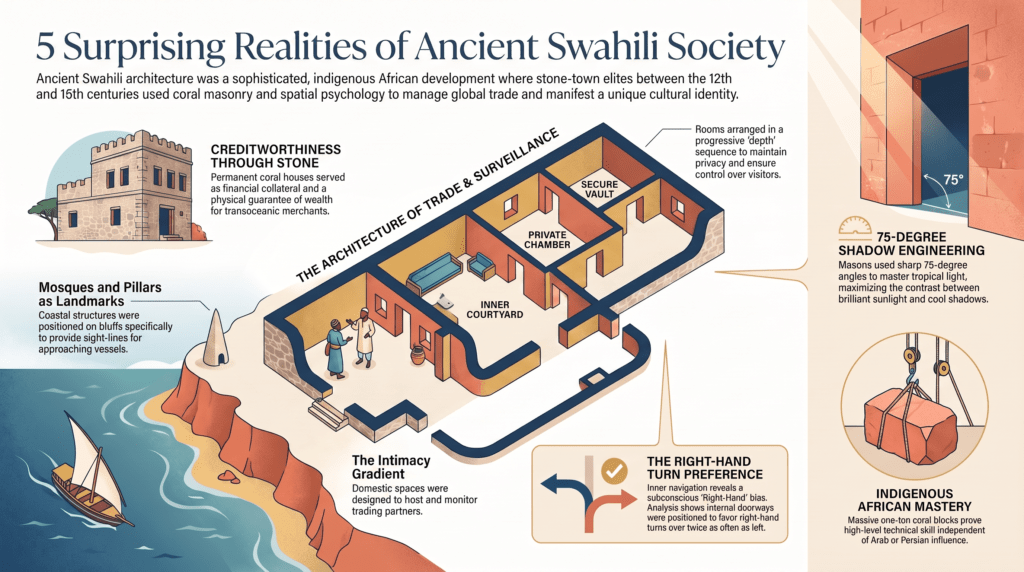
In the Swahili world, space was a sophisticated tool for economic security. The design of stone houses utilized a precise “intimacy gradient,” where rooms became increasingly private as one moved deeper into the structure (Baumanova & Smejda, 2018, 86). Wealthy families integrated “guest suites” directly into their homes to accommodate foreign trading partners for entire monsoon seasons (Baumanova & Smejda, 2018, 90).
These suites allowed hosts to provide hospitality while maintaining strict control over the movements of guests who arrived to trade for ivory, rhinoceros horn, and gold from Zimbabwe (Baumanova & Smejda, 2018, 90; Chami, 1998, 214). Architecture served as a “good faith guarantee” for business; by housing their partners, Swahili merchants ensured they remained the essential intermediaries in every transaction (Baumanova & Smejda, 2018, 88). This mastery of visual effect extended to the Zidaka (wall niches), which were designed not for lamps, but to break the monotony of blank walls and create a sense of spaciousness (Allen, 1974, 67).
4. Light, Shadow, and the 75-Degree Angle
The technical skill of Swahili masons is best seen in their manipulation of the harsh tropical sun. While Persian Gulf architecture relied on different standards, Swahili builders used a rare, fine-grained “reef” coral for dressed features like door jambs and arches (Allen, 1974, 67).
In a display of remarkable sensitivity, this coral was often cut at a slightly sharper angle—approximately 75 to 80 degrees—rather than a standard 90-degree right angle (Allen, 1974, 67). This specific manipulation was designed to maximize the contrast between brilliant white sunlight on one plane and deep, cool shadow on the other. This level of technical complexity reflects a beauty-loving society that had spent centuries refining an architectural language perfectly suited to the East African environment.
5. The “Right-Hand” Mystery: An African Urban Identity
Modern spatial analysis has revealed a hidden pattern in the movement through precolonial Swahili homes. Analysis of the “affordance for turning”—the options a person has when navigating a building—shows a statistically significant preference for right-hand movement (Baumanova & Smejda, 2018, 91). Upon leaving a central courtyard, paths through the surrounding rooms turned to the right twice as often as they did to the left.
This was a “culturally influenced subconscious behavior,” reflecting the value of the “clean” right side found in both Islamic and indigenous African contexts ({Baumanova & Smejda, 2018, 91}). Because this pattern is absent in the more symmetrical, foreign-influenced structures like Husuni Kubwa, its presence in most Swahili homes proves the residents were living in a specifically African urban environment, not an imported Arab colony (Baumanova & Smejda, 2018, 91). These subconscious spatial choices offer a more intimate look at the values of ancient residents than any simple artifact could provide.
The Synthesis: A 1,500-Year Legacy
The history of the East African coast is not a story of an imported empire, but a 1,500-year achievement of cultural continuity and local innovation (Chami, 1998, 214). Swahili culture matured through centuries of engagement with the Indian Ocean while remaining firmly anchored in African social systems. By viewing this society through its own material culture—its sharp-angled coral, its hospitality suites, and its subconscious movement patterns—we reclaim a history that was once “orphaned.” It leaves us to wonder: how many other African histories are currently hidden in plain sight, waiting for the correct lens to reveal them?
Sources Cited
Allen, J. de V., 1974. Swahili Architecture in the Later Middle Ages. African Arts, 7(2), pp. 42-47, 66-68, 83-84.
Baumanova, M. and Smejda, L., 2018. Space as Material Culture: Residential Stone Buildings on the Precolonial Swahili Coast in a Comparative Perspective. The South African Archaeological Bulletin, 73(208), pp. 82-92.
Chami, F. A., 1998. A Review of Swahili Archaeology. The African Archaeological Review, 15(3), pp. 199-218.
Crowther, A., Faulkner, P., Prendergast, M. E., Quintana Morales, E. M., Horton, M., Wilmsen, E., Kotarba-Morley, A. M., Christie, A., Petek, N., Tibesasa, R., Douka, K., Picornell-Gelabert, L., Carah, X. and Boivin, N., 2016. Coastal Subsistence, Maritime Trade, and the Colonization of Small Offshore Islands in Eastern African Prehistory. The Journal of Island and Coastal Archaeology, 11(2), pp. 211-237.
