



Black Disabled Students Face Crisis as Federal Oversight Shrinks
By Darius Spearman (africanelements)
Support African Elements at patreon.com/africanelements and hear recent news in a single playlist. Additionally, you can gain early access to ad-free video content.
The Warning Signs in Florida Classrooms
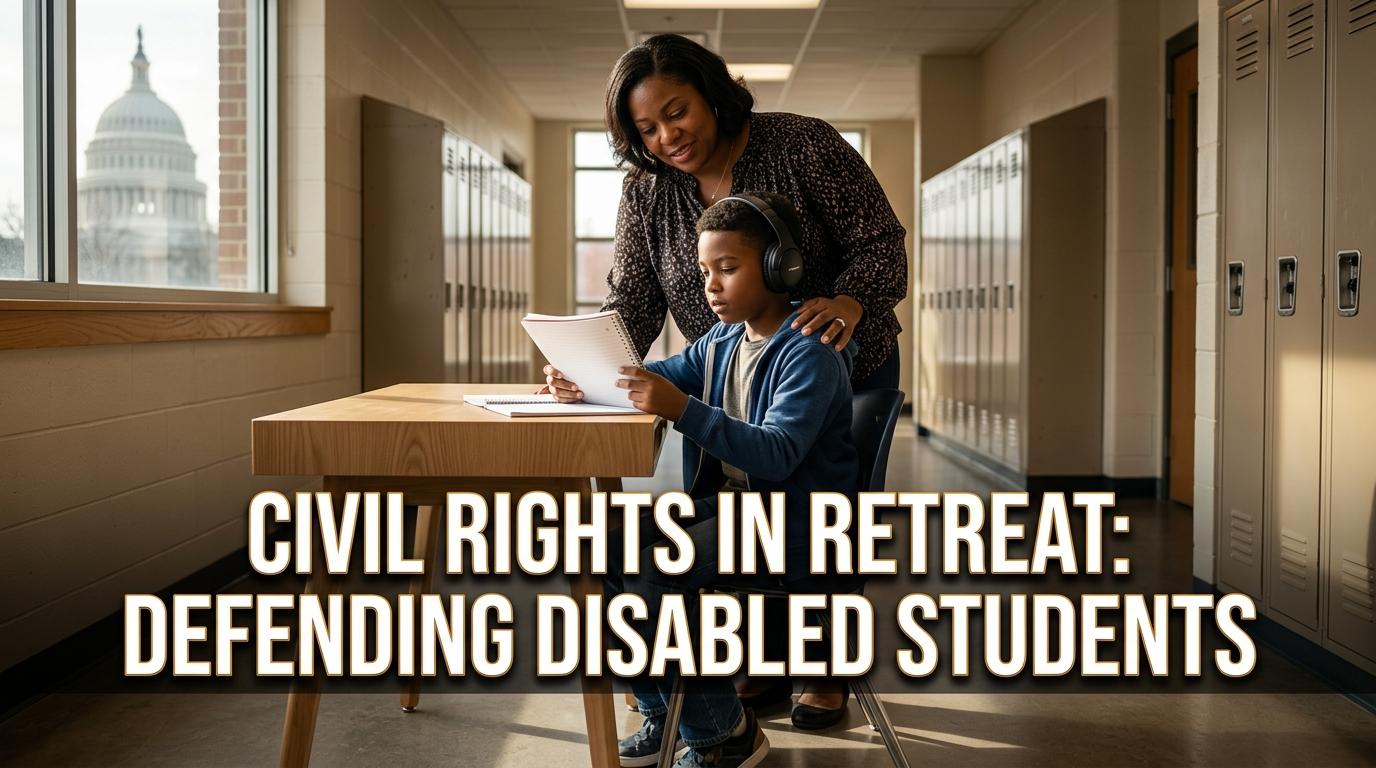
In Winter Haven, Florida, an alarming case brought national attention to the deep vulnerabilities facing Black autistic children. A mother filed a federal civil rights complaint after her nine-year-old son, who is diagnosed with autism and attention-deficit/hyperactivity disorder, faced continuous disciplinary removals instead of receiving necessary behavioral accommodations. Although his Individualized Education Program called for a dedicated aide to assist with emotional regulation, school officials repeatedly denied that support. As a result, the young boy endured multiple classroom removals, out-of-school suspensions, and encounters with law enforcement during the third grade (cbsnews.com).
This incident reflects a wider pattern across Florida school districts. In Pasco County, federal investigators revealed that schools routinely suspended students with disabilities and referred them to law enforcement for behaviors directly connected to their medical conditions (justice.gov). In Volusia County, a federal settlement documented that public schools excluded autistic children through informal removals and police interventions starting as early as kindergarten (justice.gov, fox35orlando.com). In Pinellas County, civil rights advocates showed that Black disabled students faced school-based arrest rates nearly four times higher than their white peers for minor infractions (splcenter.org).
Inequities in School Policing & Enforcement Cuts
Disproportionate discipline and the collapse of federal oversight
The Collapse of Federal Civil Rights Oversight
These local crises coincide with unprecedented rollbacks in federal civil rights monitoring. The Office for Civil Rights inside the United States Department of Education has historically served as the primary protector for families who face institutional discrimination (cbsnews.com). However, recent administrative reorganizations transferred critical special education monitoring away from established educational bodies. Responsibilities were fractured between the Department of Health and Human Services and the Department of Justice, creating immense administrative delays and jurisdictional confusion (copaa.org).
Federal watchdog investigations revealed devastating consequences from this restructuring. Resolution agreements for disability discrimination complaints dropped by nearly 79 percent, leaving thousands of filed grievances completely unaddressed (cbsnews.com). Furthermore, federal investigators finalized zero resolution agreements regarding the unlawful physical restraint and seclusion of disabled schoolchildren (cbsnews.com, endseclusion.org). Nearly 90 percent of newly submitted civil rights complaints were dismissed without full investigations, removing the primary safety net protecting vulnerable students (cbsnews.com).
Civil Rights Foundations and the Fight for Equal Education
The legal protections that modern families rely upon were born directly out of the African American freedom movement. The landmark 1954 Supreme Court ruling in Brown v. Board of Education established that public education is a fundamental right that must be made available to all children on equal terms. This legal principle became the cornerstone for the disability rights movement during the twentieth century (dredf.org, dredf.org).
Ten years later, Title VI of the Civil Rights Act of 1964 prohibited discrimination on the basis of race, color, or national origin in any program receiving federal financial assistance (northwestern.edu). Following this precedent, federal courts decided landmark cases such as PARC v. Commonwealth of Pennsylvania in 1971 and Mills v. Board of Education in 1972. These rulings affirmed that public schools cannot deny an education to children with developmental disabilities, nor can they cite budgetary shortages to justify exclusion (dredf.org). This tension between state actions and national guarantees reflects the long struggle over state versus federal power in educational equality.
Milestones in Civil Rights & Disability Law
How Black civil rights struggles built modern educational protections
Established education as a universal right and barred federal funding for racially discriminatory programs.
Banned disability discrimination in public institutions and guaranteed a Free Appropriate Public Education for all children.
Outlawed culturally biased IQ tests used to track Black students into dead-end segregated special education classes.
Larry P. and Racist Special Education Tracking
The intersection of racial bias and disability classification has a long history in American education. During the 1970s, California public schools placed Black children into dead-end classes for the Educable Mentally Retarded at more than three times their population rate. Administrators justified these placements using standardized intelligence tests that reflected severe cultural biases (northwestern.edu, escholarship.org).
In the landmark 1979 case Larry P. v. Riles, federal judge Robert Peckham ruled that these tests violated Title VI, the Equal Protection Clause, and Section 504 of the Rehabilitation Act of 1973 (escholarship.org). The court determined that standardized evaluations measured background knowledge rather than innate intellectual ability. This historic ruling exposed how school districts can weaponize special education labels to maintain racial segregation inside integrated buildings (northwestern.edu, researchgate.net).
Zero Tolerance and the Criminalization of Disability
During the 1990s, federal legislation dramatically altered school disciplinary systems. The Gun-Free Schools Act of 1994 sparked the nationwide adoption of strict zero-tolerance policies. At the same time, federal grant initiatives funded a massive expansion of armed School Resource Officers in primary and secondary schools (northwestern.edu).
This militarized school environment proved exceptionally dangerous for neurodivergent children. Autistic behaviors like stimming—which includes repetitive physical movements or vocalizations used to self-regulate—are often misidentified as intentional defiance. Similarly, elopement occurs when an overwhelmed child flees an overstimulating environment due to sensory distress. Untrained school personnel regularly view these coping responses as willful insubordination (shu.edu, endseclusion.org).
For Black children, these misunderstandings are magnified by adultification bias. Research demonstrates that educators and law enforcement perceive Black children as older, less innocent, and more aggressive than their white classmates (shu.edu). When a Black autistic child experiences sensory distress, authority figures frequently respond with physical force, handcuffs, or campus arrests, feeding directly into the modern shift toward mass incarceration.
The Dangerous Misuse of Florida’s Baker Act
In Florida, the criminalization of neurodivergent youth is intensified by the state mental health statute known as the Baker Act. Under Chapter 394 of the Florida Statutes, police officers and certain health professionals can take individuals into custody for involuntary psychiatric evaluations lasting up to 72 hours if they appear to pose an imminent danger (wuft.org, splcenter.org).
School administrators and campus officers frequently deploy the Baker Act against young children experiencing sensory meltdowns. Civil rights reports from the Southern Poverty Law Center show that thousands of school-age children are removed from public classrooms in handcuffs each year without parental consent (splcenter.org). Instead of implementing proactive behavior plans, schools use involuntary psychiatric holds to remove neurodivergent children from the premises (wuft.org, justice.gov).
Key Disparities Facing Black Disabled Youth
Institutional barriers in special education and diagnostic access
Black disabled students face out-of-school suspensions at up to four times the rate of white non-disabled peers.
Black children receive an accurate autism diagnosis years later than white children, delaying critical early interventions.
Federal agency rollbacks have resulted in the dismissal of roughly nine out of ten civil rights complaints without investigation.
FAPE, LRE, and the Disparate Impact Rollback
The Individuals with Disabilities Education Act guarantees every qualifying child a Free Appropriate Public Education delivered in the Least Restrictive Environment. In the 2017 ruling Endrew F. v. Douglas County School District, the Supreme Court determined that school districts must provide educational programs reasonably calculated to enable a child to make meaningful academic progress (dredf.org, ed.gov).
Federal regulations mandate that students with disabilities should learn alongside general education peers to the maximum extent appropriate. Removing a child to a more restrictive environment is legally permitted only when education cannot be achieved with supplementary supports (ed.gov). However, recent federal policy changes removed the disparate impact legal standard from civil rights reviews. This standard previously allowed families to challenge neutral policies that produced discriminatory consequences (civilrights.org).
Without disparate impact protections, families must prove intentional racial hostility to hold school districts accountable. Proving subjective racial animus is an exceedingly difficult legal threshold. This rollback allows systemic discipline practices to continue unchecked across the nation (civilrights.org).
The Unequal Cost of Justice in Special Education
When a school district fails to provide mandated accommodations, parents face severe financial barriers to justice. An administrative due process hearing under special education law operates like a civil trial. Parents must hire private legal counsel, pay independent medical evaluators, and cover court reporting fees, often costing tens of thousands of dollars out of pocket (kayfamilylaw.com).
For decades, filing a complaint with the Office for Civil Rights offered a free, low-barrier alternative for families seeking justice (cbsnews.com, kayfamilylaw.com). The dismantling of this office leaves low-income and working-class families with no effective recourse. These systemic hurdles add to long-standing educational barriers affecting Black students across the country.
Furthermore, clinical diagnostic disparities compound these institutional failures. Black autistic children receive diagnoses one to three years later than their white peers (shu.edu). Instead of receiving developmental evaluations, Black children experiencing sensory overload are disproportionately misdiagnosed with Oppositional Defiant Disorder or Emotional and Behavioral Disorders. This mislabeling leads schools toward disciplinary containment rather than therapeutic support (shu.edu).
Community Mobilization and the Road Ahead
In response to the weakening of federal civil rights agencies, legal organizations and grassroots coalitions are stepping into the breach. Organizations like the Disability Rights Education and Defense Fund, the Council of Parent Attorneys and Advocates, and the Southern Poverty Law Center are filing impact lawsuits in federal courts to preserve student protections (dredf.org, splcenter.org, copaa.org). These groups argue that shifting special education oversight across federal departments without congressional approval violates federal statutes (copaa.org).
At the grassroots level, Black neurodivergent parent networks and local advocates are organizing educational workshops to train caregivers on enforcing Individualized Education Programs independently. By combining legal litigation with community-based advocacy, families continue to defend the civil rights established across generations of struggle (thearc.org, aapd.com).
About the Author
Darius Spearman is a professor of Black Studies at San Diego City College, where he has been teaching for over 20 years. He is the founder of African Elements, a media platform dedicated to providing educational resources on the history and culture of the African diaspora. Through his work, Spearman aims to empower and educate by bringing historical context to contemporary issues affecting the Black community.
