


Exploring the Resilient Cultural Footprint of Black Oakland
By Darius Spearman (africanelements)
Support African Elements at patreon.com/africanelements and hear recent news in a single playlist. Additionally, you can gain early access to ad-free video content.
A dedicated group of Pomona College students recently traveled to Oakland, California, for an immersive community-engagement experience (pomona.edu). Organized through the student-led AlternaBreak program, this initiative allowed students to analyze the deep cultural footprint of Black Americans in the East Bay (pomona.edu). The program was coordinated in partnership with the Office of Black Student Affairs and the Draper Center for Community Partnerships (pomona.edu, claremont.edu). Consequently, the trip served as both an academic exercise and a practical service initiative (pomona.edu, pomona.edu).
The journey provided students with a rare opportunity to engage directly with local history (pomona.edu). By stepping off their Southern California campus, these young scholars connected historical struggles for racial justice to contemporary movements (pomona.edu). The trip combined rigorous historical education with hands-on volunteer work, helping students understand the legacy of Black liberation (pomona.edu, pomona.edu). Ultimately, the experience demonstrated how past movements continue to shape modern activism in urban spaces (pomona.edu).
The Great Migration and the Birth of a Cultural Capital
The historical foundation of Black Oakland is rooted in the Second Great Migration (wikipedia.org). Before the Second World War, the African American population in Oakland was minimal (wikipedia.org). Indeed, it stood at under three percent in the year 1940 (wikipedia.org). However, the onset of the war created new economic opportunities in the defense industries and shipyards of the East Bay (wikipedia.org, foundsf.org).
Many Black families arrived from the American South to escape the harsh realities of the Jim Crow South (wikipedia.org). In addition, many found employment as Pullman car porters on national railways, which provided steady wages and geographic mobility (wikipedia.org, foundsf.org). By 1970, the Black population of Oakland grew to thirty-four point five percent, transforming the city into a powerhouse of Black political thought (wikipedia.org, wikipedia.org). This rapid demographic shift established Oakland as a cultural capital and laid the groundwork for future generations of community organizers (wikipedia.org, foundsf.org).
Oakland Black Population Growth (1940-1980)
Beyond the Armed Image: Survival Programs of the Panthers
In October 1966, Huey P. Newton and Bobby Seale founded the Black Panther Party for Self-Defense in West Oakland (wikipedia.org, libertarianism.org). While historical accounts often focus on their armed patrols, the true core of their work rested in their community programs (pbs.org, libertarianism.org). These initiatives, known as “Survival Programs Pending Revolution,” were designed to meet the immediate physical needs of the community (pbs.org, libertarianism.org). Consequently, the programs offered clothing, medical care, and legal aid (pbs.org).
The most famous initiative was the Free Breakfast for School Children Program, which began in January 1969 (pbs.org, pbs.org). It was hosted at Saint Augustine’s Episcopal Church in West Oakland (pbs.org, pbs.org). The program started by feeding only eleven children on its first day (pbs.org). Within months, it expanded rapidly across the country, highlighting the failure of the federal government to address childhood hunger (pbs.org). Understanding this legacy is critical to tracing the revolutionary rise and evolution of the movement (pbs.org, wikipedia.org).
However, the success of the program drew negative attention from the federal government (pbs.org, pbs.org). FBI Director J. Edgar Hoover declared the Black Panthers to be a major national security threat (pbs.org, pbs.org). The FBI used its COINTELPRO operations to actively disrupt the program by raiding breakfast centers and spreading false rumors (pbs.org, pbs.org). Despite this intense repression, the initiative established a lasting blueprint for modern community survival models (pbs.org).
Free Breakfast Program Rapid Scale (1969)
Day 1
11 Children
Week 1
140 Children
End of 1969
20,000+ Daily
The Oakland Community School and Liberation Education
The Black Panther Party also focused heavily on education as a tool for community liberation. In 1973, the Party founded the Oakland Community School, which operated until 1982 (hueypnewtonfoundation.org, blackpantherpartymuseum.org). Directed by Ericka Huggins and Donna Howell, the school offered an innovative, liberation-based curriculum (hueypnewtonfoundation.org, medium.com). The program emphasized critical thinking and encouraged students to analyze their social environments (medium.com).
The curriculum integrated standard academic subjects with global Black history, creative writing, meditation, and martial arts (medium.com). In addition, the school prioritized a “whole child” approach (medium.com). This model included providing three free meals per day and access to medical and dental care (medium.com). Teachers aimed to teach children how to think, rather than what to think, fostering self-determination and dignity (medium.com).
This holistic model has influenced modern community school frameworks. Today, educators look to this history to understand the factors affecting African American student success (medium.com, umich.edu). By studying the Oakland Community School, the Pomona students gained a deeper appreciation for education as an act of resistance. The curriculum showed that learning could be used to challenge social inequities (pomona.edu, medium.com).
The Fight for Space: Claremont Student Activism in 1969
While activists organized in Oakland, Black students at the Claremont Colleges fought similar battles for institutional representation (claremont.edu, claremontindependent.com). In the mid-1960s, these elite Southern California campuses were overwhelmingly white (claremont.edu, claremontindependent.com). In 1969, a report indicated that out of four thousand two hundred total students, only eighty-five were Black (claremontindependent.com).
This extreme isolation prompted intense student activism. Black student unions organized protests, sit-ins, and demonstrations to demand institutional change (claremont.edu, claremontindependent.com). These efforts led directly to the creation of the Black Studies Center in 1969, which later evolved into the Office of Black Student Affairs (claremont.edu, tsl.news). This center provided a dedicated, safe space for Black students within the consortium (claremont.edu, tsl.news).
This history is essential to understanding the development of ethnic studies programs across Southern California (claremont.edu, tsl.news). Today, OBSA continues to support students by sponsoring educational and community-engagement opportunities (pomona.edu, claremont.edu). The AlternaBreak trip represents a continuation of this activist legacy, linking past struggles to current student needs (pomona.edu, pomona.edu).
Claremont Colleges Student Body Disparity (1969)
Only 85 Black Students out of 4,200 Total Enrollment (1969)
Preserving Legacy in the Face of Gentrification
A major focus of the AlternaBreak trip was the ongoing crisis of gentrification in Oakland (pomona.edu, pomona.edu). The historical Black population of the city has experienced a dramatic decline (wikipedia.org, datausa.io). In 1980, the Black population reached its historic peak at forty-seven percent of the total population (wikipedia.org). By 2020, that number plummeted to approximately twenty percent due to foreclosure patterns and rising housing costs (datausa.io, oaklandside.org).
This demographic shift threatens to erase the historic Black cultural footprint of Oakland (pomona.edu, pomona.edu). Student coordinators like Se’maj Griffin pointed out that supporting Black-owned businesses is crucial for cultural preservation (pomona.edu). By visiting local establishments, the cohort directly contributed to the local economy and helped sustain historic venues (pomona.edu, pomona.edu).
The loss of historic spaces makes deliberate community engagement even more vital. Understanding the history of Black-owned businesses helps explain why economic self-determination remains a central pillar of Black liberation (pomona.edu, pomona.edu). The students observed how local activists continue to fight displacement through creative economic and cultural organizing (pomona.edu, pomona.edu).
Modern Mutual Aid in Action
To connect history with the present, the Pomona cohort partnered with local grassroots organizations (pomona.edu, pomona.edu). They worked on-the-ground with People’s Programs, an Oakland-based, youth-led collective (peoplesprograms.com, peoplesprograms.com). This organization operates as a modern successor to the survival programs of the Black Panther Party (peoplesprograms.com, peoplesprograms.com). They refuse top-down charity structures, choosing instead to focus on community autonomy and self-determination (peoplesprograms.com, peoplesprograms.com).
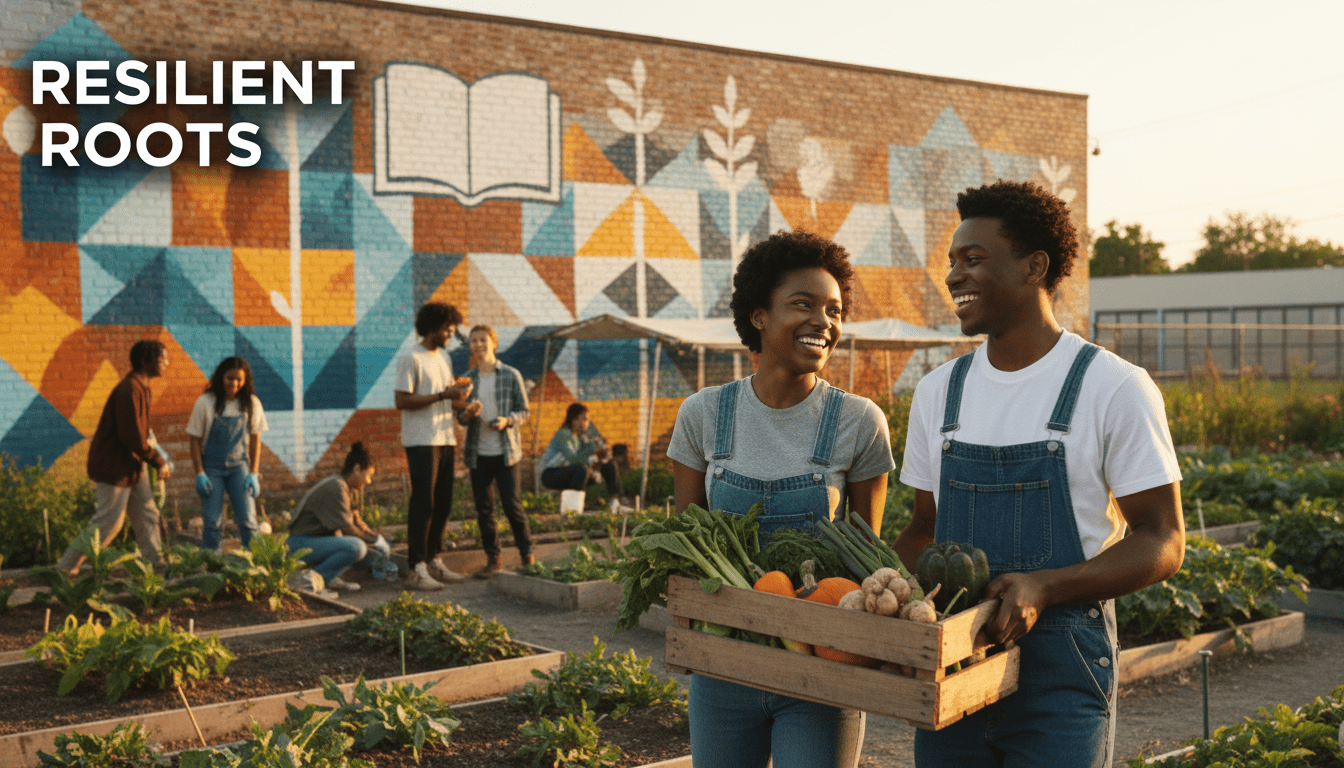
The students participated in agricultural work at The People’s Farm, a community garden that produces fresh food for West Oakland residents (peoplesprograms.com, peoplesprograms.com). In addition to gardening, the cohort helped prepare more than five hundred fifty meals for food-insecure individuals during their spring break trip (pomona.edu, pomona.edu). This direct action mirrored the late 1960s mutual aid frameworks that sought to build community power (pomona.edu, pbs.org).
People’s Programs also operates the People’s Breakfast Oakland and a mobile health clinic (peoplesprograms.com, peoplesprograms.com). By participating in these modern initiatives, students saw that the struggle for resources and survival is ongoing. They learned that mutual aid is not a historical relic, but an active, necessary tool for urban survival (pomona.edu, peoplesprograms.com).
Facing Bias on Campus: The 2026 Wake-Up Call
The students’ search for historical connection and safe spaces is directly influenced by the current climate on their own campus (tsl.news, claremontindependent.com). In early 2026, Pomona College was shaken by a series of high-profile anti-Black bias incidents (claremontindependent.com). These events included student-athletes using racial slurs, a sociology professor uttering a slur in a lecture, and the vandalism of a student lounge (tsl.news, claremontindependent.com).
In response, the Black Student Union hosted town halls and protests demanding systemic administrative reform (tsl.news, claremontindependent.com). For students facing contemporary racial tensions at elite, historically white institutions, tracing the lineage of Black resistance provided vital emotional support. The trip to Oakland allowed them to draw strength from historical models of survival and protest (pomona.edu, tsl.news).
By connecting their contemporary campus struggles with the historical activism of Oakland, the students found a sense of intergenerational solidarity. The lessons of the Black Panther Party and the Office of Black Student Affairs provided them with the tools needed to challenge modern institutional racism. This powerful experience demonstrated that history is not static, but a living guide for current and future activism (pomona.edu, tsl.news).
About the Author
Darius Spearman is a professor of Black Studies at San Diego City College, where he has been teaching for over 20 years. He is the founder of African Elements, a media platform dedicated to providing educational resources on the history and culture of the African diaspora. Through his work, Spearman aims to empower and educate by bringing historical context to contemporary issues affecting the Black community.
