Federal Civil Rights Enforcement: Why Are Protections Vanishing?
/
RSS Feed
Share
Link
Embed
Federal agencies are dismantling disparate impact rules, weakening civil rights enforcement and shifting the burden of proving bias to Black communities.
Federal Civil Rights Enforcement: Why Are Protections Vanishing?
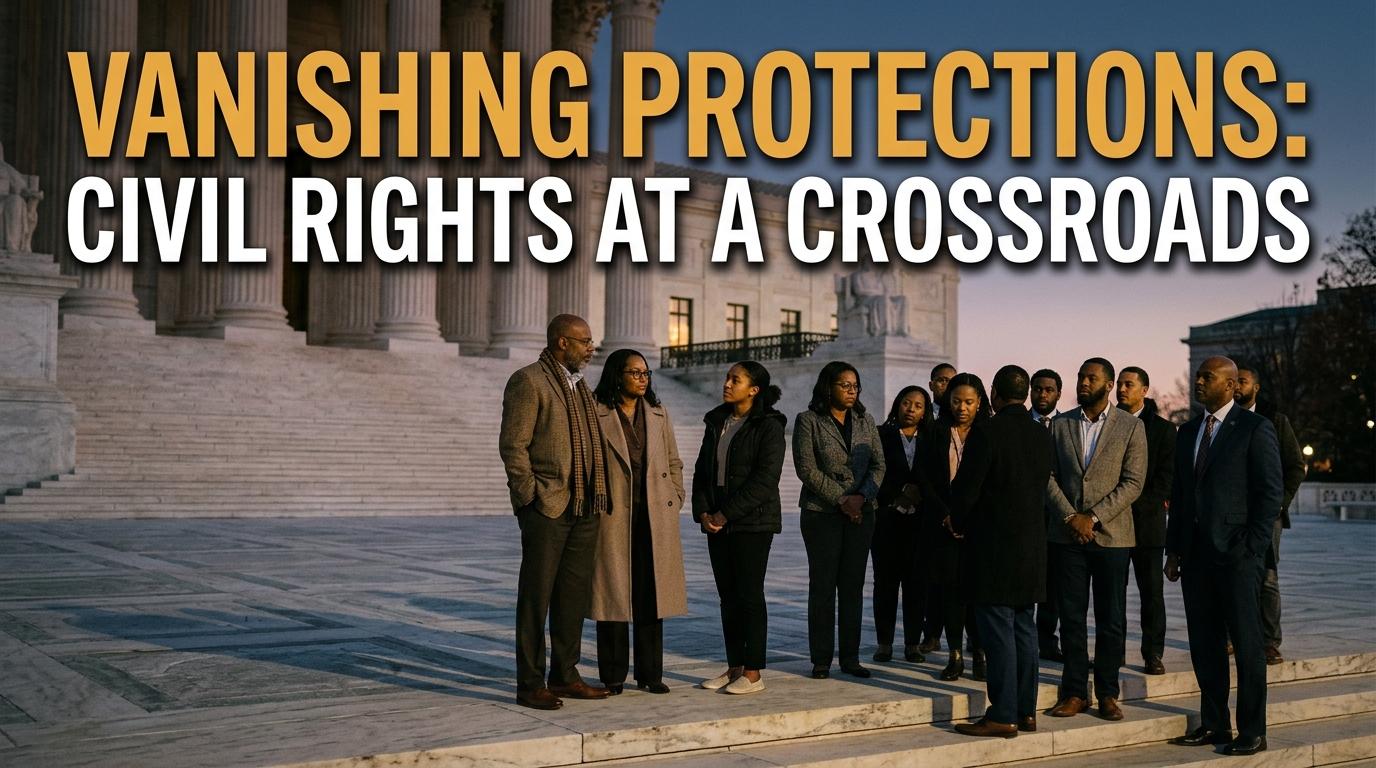
Federal civil rights enforcement is experiencing one of its sharpest philosophical pivots in modern history. A major policy analysis published this morning reveals rapid shifts across the administrative state. The Department of Justice and the Equal Employment Opportunity Commission have significantly curtailed structural investigations. These moves have sparked widespread calls from racial justice advocates to defend foundational anti-discrimination mandates (civilrights.org, democracyforward.org).
At the center of this controversy lies the dismantling of the disparate impact doctrine. This legal standard holds institutions accountable when policies produce racially discriminatory outcomes, regardless of stated intentions. Federal agencies have historically used this framework to address institutional inequalities. Without it, the burden of proving racial hostility falls entirely upon individual citizens (civilrights.org, dorsey.com). Understanding this dramatic retreat requires examining the long historical struggle over state and federal power in shielding Black communities from systemic bias.
The 1957 Roots of Federal Protection
Before the mid-twentieth century, the federal government possessed very few tools to confront state-sanctioned racial discrimination. Black Americans faced disenfranchisement and economic exclusion throughout the Jim Crow South. Local courts and police departments routinely upheld these oppressive systems. The federal government rarely intervened in local civil rights violations (justice.gov, justice.gov).
The passage of the Civil Rights Act of 1957 marked a critical turning point in national administrative oversight. This legislation created the Civil Rights Division within the Department of Justice. It also established the United States Commission on Civil Rights to investigate voting disenfranchisement and equal protection violations (justice.gov). These structural innovations laid the groundwork for centralized federal oversight, echoing the unresolved promises of the
The Civil Rights Act of 1964 established the contemporary federal regulatory framework. Title VI prohibited discrimination within any educational institution, municipality, or program receiving federal tax dollars. This provision tied federal funding compliance directly to racial equality standards (justice.gov, ed.gov). Public hospitals, segregated school systems, and transportation boards faced swift financial penalties if they maintained exclusionary racial practices.
Concurrently, Title VII banned employment discrimination based on race, color, religion, sex, or national origin. The statute also created the Equal Employment Opportunity Commission to administer workplace justice (eeoc.gov). The EEOC processed tens of thousands of workplace grievances annually, addressing widespread hiring and promotion inequities. Through this agency, Black workers gained an administrative forum to challenge workplace bias across the country (eeoc.gov).
These legal protections reflected a long-overdue response to the legacy of racial exploitation rooted in early constitutional design. Federal authority increasingly functioned as a crucial buffer against institutional discrimination across state lines.
Griggs v. Duke Power and the Disparate Impact Shield
As overt segregation became illegal, many corporations adopted subtle methods to exclude Black job applicants. A prime example occurred at the Dan River Steam Station owned by Duke Power in North Carolina. Before 1964, the company explicitly restricted Black workers to the lowest-paying Labor department (harvard.edu, harvard.edu). White employees in operating divisions enjoyed substantially higher compensation and promotional tracks.
When the Civil Rights Act took effect, Duke Power abandoned explicit racial classifications. However, the company immediately added new requirements for non-labor positions. Applicants were required to possess a high school diploma and pass two standardized intelligence tests (harvard.edu). In North Carolina at that time, state-mandated segregated schooling severely disadvantaged Black residents. Consequently, 34 percent of white males possessed high school diplomas compared to only 12 percent of Black males (harvard.edu).
In addition, 58 percent of white test takers passed the company aptitude tests, compared to only 6 percent of Black workers (harvard.edu, harvard.edu). In the landmark 1971 case Griggs v. Duke Power Co., the Supreme Court ruled unanimously against these testing mandates. The Court held that Title VII prohibits facially neutral practices that operate as built-in headwinds for minority workers when those practices are not demonstrably related to job performance (harvard.edu). Congress subsequently codified this disparate impact principle into statutory law under the Civil Rights Act of 1991 (eeoc.gov, ogletree.com).
Anti-Classification Versus Anti-Subordination Ideology
The current federal rollback stems from a profound philosophical clash over the definition of constitutional equality. On one side stands the anti-subordination principle. This doctrine maintains that civil rights statutes were enacted to dismantle institutional power imbalances and structural caste systems (democracyforward.org, civilrights.org). Under this view, statistical disparities reveal ongoing systemic barriers that require regulatory remedies.
On the opposing side stands the anti-classification principle, commonly referred to as the color-blind standard. Proponents of this view argue that the law must focus exclusively on intentional, overt discrimination (dorsey.com, justice.gov). Conservative legal scholars argue that evaluating organizations through disparate outcome metrics improperly coerces institutions into using race-conscious hiring methods. The Department of Justice Office of Legal Counsel has issued influential opinions embracing this anti-classification doctrine (justice.gov).
Because formal written opinions from the Office of Legal Counsel bind executive branch agencies, this ideological shift prompted immediate changes across the federal government (justice.gov). Agencies quickly halted systemic reviews, refocusing their civil rights divisions exclusively on proving deliberate malicious intent (dorsey.com, govexec.com).
The Philosophical Divide in Civil Rights Law
Anti-Classification Standard
Focuses strictly on individual treatment and formal color-blindness.
Prohibits overt disparate treatment and intentional discrimination.
Rejects statistical outcomes as evidence of civil rights violations.
Views disparate impact liability as improper racial balancing.
Anti-Subordination Standard
Focuses on dismantling historical hierarchies and institutional oppression.
Challenges facially neutral practices that reinforce racial disparities.
Considers historical context and unequal systemic starting points.
Uses disparate impact as an essential tool for equity.
The Sandoval Trap and Lost Legal Recourse
The current administrative rollbacks carry severe consequences because of a landmark Supreme Court ruling delivered over two decades ago. In the 2001 decision Alexander v. Sandoval, the Court held that private individuals have no right to sue under Title VI disparate impact regulations (civilrights.org, civilrights.org). The justices determined that private lawsuits can only challenge intentional disparate treatment.
Consequently, everyday citizens lost the ability to bring discriminatory effect lawsuits directly into federal courtrooms. The sole remaining mechanism to challenge discriminatory effects in federally funded programs was filing an administrative complaint with federal funding agencies (civilrights.org, democracyforward.org). These administrative complaints authorized agencies to investigate systemic bias and withhold federal funding from non-compliant programs (civilrights.org).
When federal departments eliminate disparate impact rules from their enforcement manuals, this administrative path disappears. Black communities are left with no judicial or administrative recourse to challenge systemic disparities in federally funded programs (civilrights.org, civilrights.org). These dynamics parallel the historic institutional abandonment that followed the collapse of post-emancipation labor protections.
Executive Orders and the Title VI Deregulation Wave
The institutional dismantling of disparate impact reached a turning point through executive action. On April 23, 2025, Executive Order 14281 directed all executive agencies to eliminate disparate impact liability to the maximum extent permitted by law (federalregister.gov, dorsey.com). The order formally revoked presidential approval for agency Title VI disparate impact regulations across the federal government.
Following this mandate, the Department of Justice published a final rule in December 2025 formally rescinding disparate impact provisions from its Title VI regulations under 28 C.F.R. § 42.104 (federalregister.gov). Other federal agencies, including the Department of Education and the Department of Housing and Urban Development, swiftly initiated similar rescissions (ed.gov, federalregister.gov). Under these new rules, recipients of federal grants no longer face federal scrutiny based on statistically unequal outcomes (federalregister.gov, dorsey.com).
This administrative shift directly threatens environmental justice initiatives in Black communities. Federally funded state agencies frequently permit toxic waste sites and petrochemical facilities near predominantly Black residential areas (hrw.org). In addition, healthcare systems receiving Medicare funding can close urban hospitals serving Black neighborhoods without federal disparate impact review (leadingage.org). Similarly, local transit authorities face less federal oversight when cutting inner-city bus routes to subsidize suburban commuter lines (civilrights.org).
Federal Civil Rights Enforcement by the Numbers
40,000+
Civil rights cases filed annually in U.S. District Courts across all categories.
70,000+
Workplace discrimination charges processed annually by the EEOC.
50+
Federal grant programs impacted by Title VI disparate impact rollbacks.
Algorithmic Bias, Job Screens, and Black Workers
The retreat from systemic civil rights enforcement presents immediate hurdles in the modern labor market. The EEOC has shifted resources away from broad systemic investigations toward isolated individual grievances (eeoc.gov, ogletree.com). Consequently, corporations face reduced scrutiny over automated hiring software and artificial intelligence screening tools (dorsey.com, ogletree.com). These algorithmic screening tools often incorporate historical hiring data that systematically filters out Black applicants.
Furthermore, federal rollbacks threaten longstanding protections regarding criminal background screenings. In 2012, the EEOC issued guidance restricting blanket criminal record exclusions because widespread arrest disparities translate directly into employment exclusion (eeoc.gov). These disparities stem from decades of punitive criminal justice policies that disproportionately impacted Black neighborhoods.
The EEOC guidance required employers to conduct individualized assessments rather than imposing automated disqualifications for arrest records (eeoc.gov). Under revised enforcement directives, employers receive broader discretion to implement rigid background checks (dorsey.com). Additionally, unchecked degree inflation allows companies to require four-year college credentials for entry-level roles, excluding qualified non-degreed workers (ogletree.com).
The Path Forward for Systemic Justice
Federal civil rights enforcement is undergoing a fundamental realignment. The rollback of disparate impact regulations strips administrative agencies of tools designed to identify institutional bias (civilrights.org, federalregister.gov). This shift places the immense legal and financial burden of challenging institutional discrimination entirely onto individual workers and marginalized communities (democracyforward.org).
In response, civil rights coalitions are mounting major legal challenges in federal courtrooms. Advocates argue that executive agencies cannot unilaterally erase statutory protections enacted by Congress (civilrights.org, democracyforward.org). However, with regulatory oversight curtailed, protecting equal opportunity will require sustained community organizing, state-level legislative action, and persistent judicial advocacy. The battle for civil rights continues in the courts and on the ground.
About the Author
Darius Spearman is a professor of Black Studies at San Diego City College, where he has been teaching for over 20 years. He is the founder of African Elements, a media platform dedicated to providing educational resources on the history and culture of the African diaspora. Through his work, Spearman aims to empower and educate by bringing historical context to contemporary issues affecting the Black community.
Explore why thousands of Ethiopian migrants brave desert heat, human trafficking, and active war in Yemen along the deadly Horn of Africa Eastern Route.