



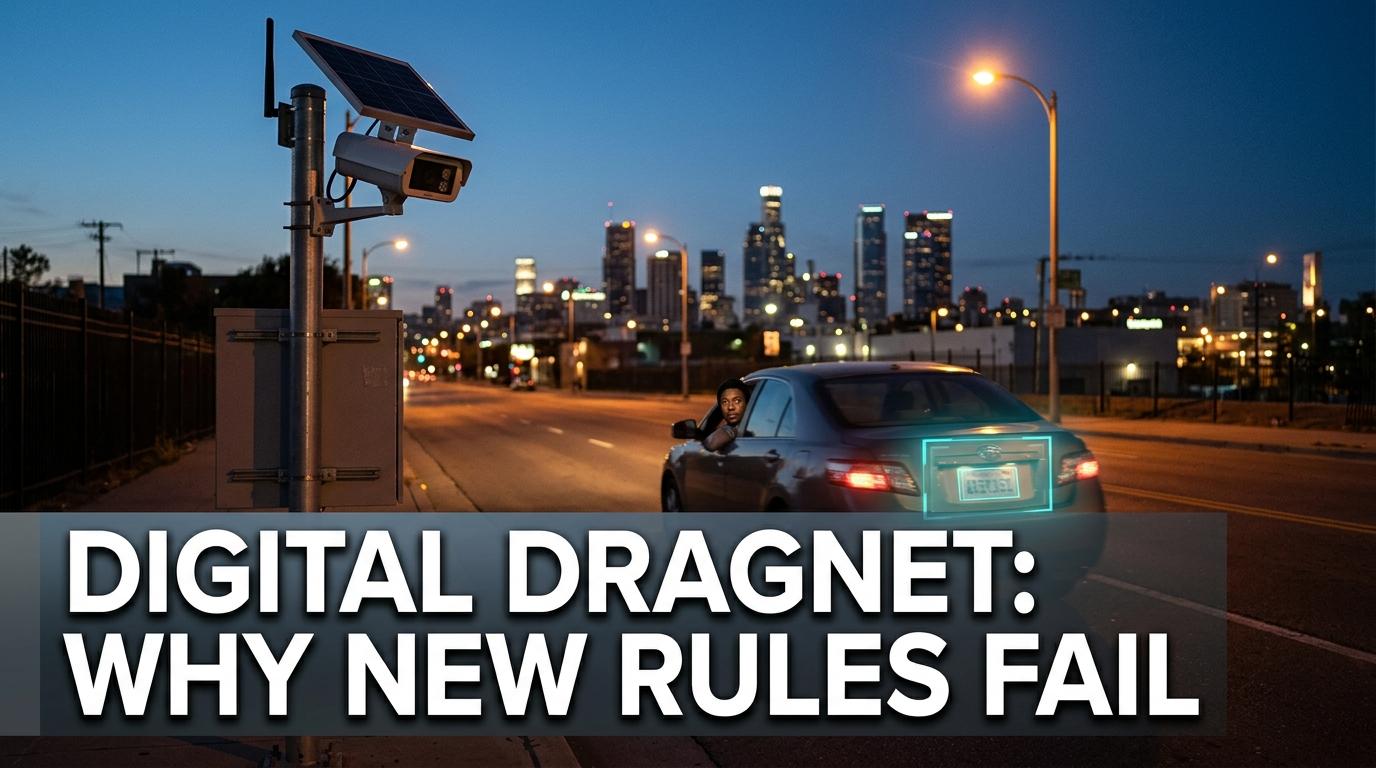
Flock Safety License Plate Readers: Why New Rules Fail
By Darius Spearman (africanelements)
Support African Elements at patreon.com/africanelements and hear recent news in a single playlist. Additionally, you can gain early access to ad-free video content.
From Neighborhood Watch to Mass Digital Dragnet
In mid-August 2026, private surveillance provider Flock Safety announced major policy changes across its nationwide network (washingtonpost.com, flocksafety.com). The company declared that privacy features and audit protections would become mandatory for all six thousand law enforcement client agencies (washingtonpost.com, flocksafety.com). This decision followed investigative reports exposing how police officers routinely used automatic license plate readers to stalk ex-partners and track citizens without legal approval (washingtonpost.com, ij.org). While news headlines focused on technology company reforms, civil rights advocates pointed out a deeper history of technological overreach (aclu.org, ij.org).
Automated plate readers record location data on millions of ordinary drivers every single day (flocksafety.com, eff.org). For Black motorists across America, roadside surveillance cameras represent an expansion of historical movement control (aclu.org, luc.edu). Examining the history behind recent headlines reveals how neighborhood property protection tools transformed into a widespread surveillance grid. Understanding this technological growth explains why internal software safeguards cannot resolve fundamental constitutional concerns surrounding digital tracking (aclu.org, aclu.org).
How Automated License Plate Readers Built a Mass Network
Automatic license plate reader technology originated during the late 1970s as high-cost hardware designed for fixed border posts and toll roads (wikipedia.org). Early units cost up to twenty thousand dollars each, keeping deployment limited to high-budget police departments (wikipedia.org). In 2017, entrepreneur Garrett Langley co-founded Flock Safety in Atlanta after experiencing neighborhood property crimes (wikipedia.org, contrary.com). Langley developed low-cost, solar-powered cameras called Falcon units that captured vehicle movement using cellular connections (businessmodelcanvastemplate.com, flocksafety.com).
Flock introduced a subscription business model known as Safety-as-a-Service, bundling software, hardware, and maintenance into annual fees (businessmodelcanvastemplate.com). This affordable price structure allowed Homeowners Associations, small towns, and municipal police departments to install mass vehicle surveillance (flocksafety.com). Over nine years, the company expanded from a single Atlanta pilot into a massive infrastructure containing over one hundred twenty thousand active cameras across forty-nine states (flocksafety.com, flocksafety.com). Artificial intelligence vision models allow users to search vehicles by color, roof racks, and unique bumper stickers across thousands of participating cities (flocksafety.com).
Flock Safety Policy Shift: Pre vs. Post-August 2026 Mandates
Pre-August 2026 (Optional Controls)
- 30-Day standard data retention
- Optional case numbers or search reasons
- Audit tools adopted by only 33% of agencies
- Discretionary Multi-Factor Authentication
Post-August 2026 (Mandatory Mandates)
- 7-Day standard data retention
- Mandatory criminal case numbers for searches
- Required automated anomaly detection review
- Mandatory Multi-Factor Authentication
Behind the Headlines: Police Misuse and Stalking
While marketing materials emphasized solving property crimes, major investigations exposed widespread internal abuse within law enforcement agencies (washingtonpost.com, ij.org). Reports published by investigative news outlets and the Institute for Justice documented over fifty officers criminally charged, terminated, or formally investigated for using plate reader databases to track personal targets (washingtonpost.com, ij.org, ij.org). Law enforcement personnel routinely queried system databases to monitor ex-girlfriends, romantic interests, and former spouses (washingtonpost.com, ij.org).
Audit logs showed officers frequently bypassed agency requirements by typing single punctuation marks or generic words like “investigation” into reason fields (washingtonpost.com). In some police departments, up to eighty-five percent of database searches lacked valid criminal case numbers (washingtonpost.com). Furthermore, internal police audits rarely caught technology misuse (ij.org, ij.org). Misconduct came to public attention only after victims reported physical stalking or harassment directly to external authorities (ij.org, ij.org).
Pretextual Stops and Racial Profiling on Black Drivers
Pretextual traffic stops occur when law enforcement officers stop drivers for minor equipment issues or expired registration tags to search for unrelated criminal activity (aclu.org, aclunorcal.org). Automated plate readers expand this practice by scanning every tag continuously to detect minor violations or system hotlist hits (aclu.org). In communities where automated cameras operate, these machine-generated stops disproportionately target Black motorists, reinforcing systemic racial profiling on public roadways (aclum.org, aclunorcal.org).
An official analysis of police oversight data in Oak Park, Illinois, showed that eighty-four percent of drivers stopped during plate reader traffic stops were Black (aclum.org). Similarly, a report analyzing Sacramento Police Department records found Black drivers represented thirty-three percent of total traffic stops despite making up twelve percent of the city population (aclunorcal.org). Seventy percent of those stops involved minor equipment or non-moving violations used as pretexts (aclunorcal.org). These disproportionate encounters show how automated tagging systems function like modern digital checkpoints, extending patterns seen in early historical labor oppression that restricted Black mobility after emancipation.
Racial Disparities in ALPR Traffic Stops
Spatial Concentration and Over-Policing in Black Neighborhoods
Empirical spatial analyses demonstrate that automated surveillance cameras are not distributed evenly across municipal geography (luc.edu). Instead, camera density mirrors income levels and neighborhood racial composition (luc.edu, researchgate.net). A spatial study by Christopher Newport University researchers revealed that Black neighborhoods in Hampton Roads, Virginia, experienced plate reader surveillance at nearly four times the rate of white areas (luc.edu, researchgate.net).
The study found seventy-five percent of high-poverty census tracts contained automated cameras compared to under forty percent of low-poverty tracts (luc.edu). Statistical regression models proved that Black population geography and local poverty levels were the strongest predictive variables for camera placement (luc.edu). Meanwhile, local violent crime rates showed no positive statistical connection to camera locations (luc.edu). This unequal spatial footprint creates a continuous surveillance net over lower-income Black neighborhoods, subjecting residents to warrantless state location tracking (aclu.org, luc.edu).
Camera Distribution by Census Tract Poverty Level
AI Technical Errors and Life-Threatening Felony Stops
Artificial intelligence computer vision models within roadside cameras suffer from technical errors (motorbiscuit.com, eff.org). Environmental factors like vehicle shadows, dirty license plates, or decorative tag frames frequently trigger optical character recognition failures (motorbiscuit.com). Automated character misidentifications, such as confusing the number eight with the number nine, generate thousands of false alerts across national law enforcement networks (motorbiscuit.com, thedrive.com).
An internal police audit in Roseville, California, revealed that seventy-one percent of high-stakes plate reader alerts flagging stolen vehicles were inaccurate due to character reading errors (motorbiscuit.com). Similarly, an inspection report by the Los Angeles Police Department found a thirty-two percent error rate for stolen vehicle alerts (eff.org). When an automated camera incorrectly identifies a plate, officers frequently execute high-risk felony traffic stops (ij.org, thedrive.com). Officers approach vehicles with firearms drawn, forcing innocent motorists into dangerous encounters where minor miscommunications can become fatal (ij.org, thedrive.com).
Private HOA Surveillance and Tracking of Activists
Surveillance deployment extends beyond public streets into gated developments and residential neighborhoods (flocksafety.com, aclunorcal.org). Homeowners Associations account for more than two thousand five hundred deployments in Flock Safety’s nationwide network (flocksafety.com). These private camera networks integrate directly into local police department monitoring systems (flocksafety.com, aclunorcal.org). From a social justice perspective, private neighborhood systems facilitate exclusionary profiling by flagging non-resident Black drivers, delivery workers, or visitors as suspicious (aclunorcal.org).
At the same time, public agencies have used network databases to monitor political speech and civil rights movements (theguardian.com, eff.org). Server audit logs revealed over fifty law enforcement agencies conducted searches connected to political protests and racial justice organizers (theguardian.com, eff.org, eff.org). In San Francisco, civil rights organizations sued municipal authorities after police accessed over four hundred cameras to conduct mass tracking during political demonstrations (aclunorcal.org). Gathering historical location data allows agencies to build travel profiles on activists, identifying home addresses and meeting locations without judicial oversight (eff.org, eff.org).
Why Vendor Safeguards Cannot Satisfy the Fourth Amendment
The updated rules mandated by Flock Safety in August 2026 include shortening standard data retention from thirty days to seven days (washingtonpost.com, flocksafety.com). The company also enforced mandatory criminal case numbers for every search and activated automated audit software across all client contracts (washingtonpost.com, flocksafety.com). Despite these vendor changes, constitutional scholars and legal advocates maintain that administrative software updates cannot fix Fourth Amendment privacy violations (aclu.org, aclu.org).
The American Civil Liberties Union issued a public statement noting that vendor software updates represent public relations adjustments that fail to eliminate dragnet surveillance (aclu.org, aclu.org). Under Supreme Court legal precedents, continuous aggregate location tracking violates reasonable expectations of privacy unless police secure a warrant (aclu.org, aclu.org). Combining individual public location scans builds detailed profiles of personal daily movement (aclu.org, aclu.org). Corporate policies containing exceptions, such as extended evidence retention settings, allow agencies to maintain long-term location records on citizens without judicial approval (aclu.org, aclu.org).
About the Author
Darius Spearman is a professor of Black Studies at San Diego City College, where he has been teaching for over 20 years. He is the founder of African Elements, a media platform dedicated to providing educational resources on the history and culture of the African diaspora. Through his work, Spearman aims to empower and educate by bringing historical context to contemporary issues affecting the Black community.
