

How Caribbean Carnival Started as Radical Resistance
By Darius Spearman (africanelements)
Support African Elements at patreon.com/africanelements and hear recent news in a single playlist. Additionally, you can gain early access to ad-free video content.
The Sacred Intersection: Juneteenth and J’ouvert in Harlem
The Caribbean Cultural Center African Diaspora Institute (CCCADI) is a landmark institution in New York City. Founded in 1976 by Dr. Marta Moreno Vega and her sister Laura Moreno Gago, it began as a grassroots project in a Bronx home (cccadi.org, cccadi.org). Over the decades, it has served as a cultural bridge for communities of African descent (cccadi.org). Today, the organization operates out of a historic, renovated municipal firehouse on East 125th Street in East Harlem (cccadi.org, denhamwolf.com). In recent years, the institute expanded its footprint by opening a second collaborative space called CCCADI Ilé Oyin, meaning House of Honey in the Yoruba language (cccadi.org).
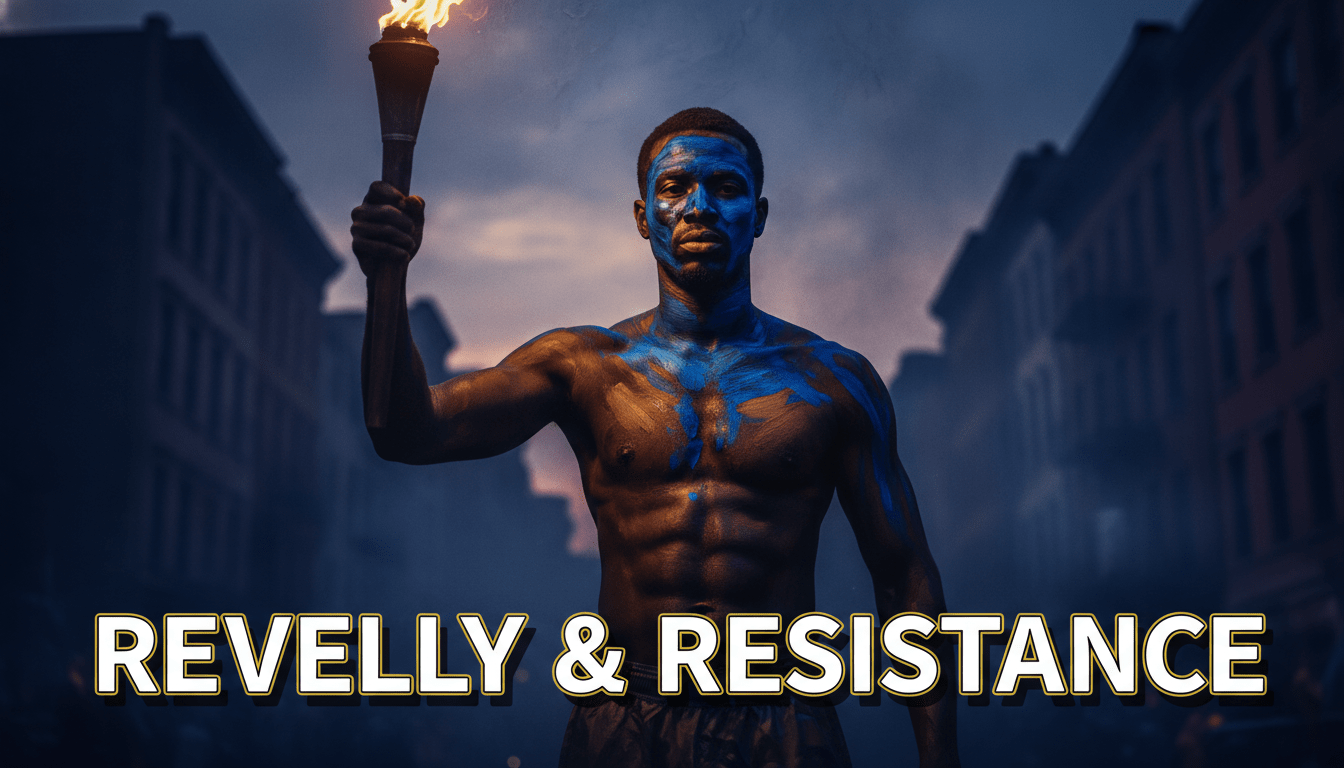
Ahead of Juneteenth 2026, the institute launched its second annual celebration under the theme “Our Road to Freedom: Jab, J’ouvert, Revelry & Resistance” (cccadi.org). This landmark program deliberately aligned the American struggle for liberation with the Summer Solstice and the feast day of the West African Yoruba deity Eleguá (cccadi.org). In Yoruba cosmology, Eleguá is the guardian of the crossroads and the owner of all pathways (patheos.com). He is the divine messenger who must be acknowledged first in any spiritual ritual (patheos.com). By invoking Eleguá, organizers framed Carnival as a spiritual tool to clear obstacles and open roads to collective healing (cccadi.org).
To honor this spiritual connection, community members participated in a symbolic walking procession (cccadi.org). The route stretched from the CCCADI firehouse on 125th Street to the Harlem African Burial Ground on First Avenue (cccadi.org, cccadi.org). Active from 1668 until 1856, this sacred burial site was the only designated plot in the colonial village where Black individuals were legally permitted to be buried (tenement.org). The ground was eventually paved over and became a bus depot, but community advocacy led to its archaeological confirmation in 2015 (tenement.org). The walk transformed the streets of Manhattan into an active site of ancestral memory, linking Harlem to the Caribbean (cccadi.org).
The Spark of Canboulay: From Burning Fields to Street Riots
To understand the revolutionary origins of J’ouvert, one must look back to the colonial history of Trinidad (wikipedia.org). In 1783, the Spanish crown issued the Cedula of Population to develop the sparsely populated island (wikipedia.org). This royal decree invited Roman Catholic settlers from other nations to populate Trinidad (wikipedia.org). It offered free land grants based on the number of enslaved African laborers they brought with them (wikipedia.org). Consequently, a massive wave of French Catholic planters and free people of color migrated to the island, effectively “Frenchifying” local culture (wikipedia.org).
These French planters held elaborate, exclusive masquerades before the arrival of Lent (wikipedia.org). Enslaved Africans were strictly prohibited from participating in these high-society balls (wikipedia.org). In response, the enslaved population staged parallel celebrations in their backyard barracks (wikipedia.org). In these spaces, they safely mocked their masters, preserved traditional African rhythms, and maintained their humanity. Following Emancipation in the British West Indies between 1834 and 1838, these formerly enslaved people took their celebrations directly to the streets (wikipedia.org).
This public assertion of freedom took the form of Canboulay, which translates to burning cane in French Creole (wikipedia.org, natt.gov.tt). During slavery, when sugarcane fields caught fire, enslaved workers were forced at whip-point to extinguish the blazes in exhausting nighttime operations (wikipedia.org). Post-emancipation, the freed population turned this painful memory into a celebration of survival (wikipedia.org). They marched through the night with lighted torches, heavy drumming, and traditional stickfighting (wikipedia.org). Canboulay was a literal reclamation of public space and a physical rejection of plantation trauma (wikipedia.org).
British colonial authorities viewed the nighttime festival with extreme fear and hostility (wikipedia.org). In the early 1880s, the chief of the colonial police force, Captain Arthur Baker, vowed to eradicate Canboulay (wikipedia.org). In February 1881, Baker led a force of 150 armed police officers to confiscate the revelers’ drums and torches in Port of Spain (wikipedia.org). However, the working-class descendants of enslaved Africans fought back with sticks and stones (wikipedia.org). They successfully routed the police force in the historic Canboulay Riots of 1881 (wikipedia.org). This triumph permanently secured Carnival as a site of defiance, eventually evolving into the pre-dawn celebration known as J’ouvert (wikipedia.org).
Reclaiming the Code Noir: The Spiritual Weapon of the Jab
At the center of J’ouvert is the figure of the Jab, which translates to devil in French Creole (wikipedia.org). To understand this character, one must look at King Louis XIV’s Code Noir, or Black Code, of 1685 (wikipedia.org). This legal framework mandated Catholicism and declared all African spiritual practices to be satanic (wikipedia.org). Under this dogma, European colonizers claimed that Black people were inherently evil to justify the horrors of chattel slavery (wikipedia.org). In Trinidad, wealthy French planters continued to enforce these customs on their estates with the approval of Spanish and British military authorities (wikipedia.org).
By actively “playing devil,” formerly enslaved Africans hijacked the colonizers’ greatest fear and used it as a psychological weapon (wikipedia.org). The Jab Molassie, or molasses devil, serves as a living monument to plantation cruelty (wikipedia.org). In the sugar factories, workers who fell into boiling vats of molasses suffered agonizing deaths or permanent disfigurement (wikipedia.org). Revelers who play Jab Molassie cover their bodies in molasses, mud, oil, or grease, moving in contorted, non-human ways to represent the suffering of their ancestors (wikipedia.org).
Similarly, many J’ouvert masqueraders coat their bodies in vibrant cobalt blue paint (trinisoca.com). Historically, this color was made by mixing lard with Reckitt’s Blue, a common British household laundry whitening powder (trinisoca.com). This temporary transformation masked the identities of the working class, allowing them to mock the colonial elite without fear of retaliation (trinisoca.com). Today, the performance of the blue-painted devils—who clank heavy chains and blow conch shells—is a powerful demand for reparations and a subversion of racist colonial stereotypes (wikipedia.org, trinisoca.com).
Kalinda: Martial Arts Disguised as Dance
Among the most sacred practices of early Carnival was Kalinda, an ancient stickfighting warrior tradition (trinisoca.com). Enslaved peoples from the Congo, Yoruba, and Fon nations brought these martial techniques to the Caribbean (trinisoca.com). To avoid detection and brutal punishment by slave owners, the fighters encoded combat and self-defense movements into rhythmic dances (trinisoca.com). This clever disguise allowed them to hone their warrior skills in plain sight of colonial overseers.
In a Kalinda match, combatants entered a physical fighting arena called a gayelle to face off using hardened wooden sticks, or bois (trinisoca.com). These intense duels were directed by a lead singer known as a chantwell (trinisoca.com). The chantwell sang call-and-response battle chants, called lavways, to fire up the fighters and captivate the crowd (trinisoca.com). These satirical, fast-paced chants served as the direct structural ancestor to modern Calypso and Soca music (trinisoca.com). This physical lineage showcases a deep history of cultural resistance that preserved African warrior cultures in the face of colonial violence.
The Demographic Shift: Moving the Masquerade to Brooklyn
The modern iterations of these traditions in New York City have their own history of displacement and survival. From the 1920s to the mid-1940s, Caribbean Carnival was celebrated indoors in Harlem brownstones, basements, and ballrooms (citylore.org). In 1947, organizers launched the first outdoor parade on Lenox Avenue (citylore.org, amsterdamnews.com). However, rising public safety concerns and political tensions in the late 1950s led city officials to permanently revoke Harlem’s outdoor parade permits (amsterdamnews.com).
During this exact period, the West Indian population in New York experienced a massive demographic shift. Families increasingly relocated from Manhattan’s Harlem to Central Brooklyn. In 1960, a Trinidadian immigrant named Lionel “Rufus” Gorin resurrected the street celebration by organizing unauthorized neighborhood block parades in Brooklyn (citylore.org). Gorin eventually incorporated the United West Indian Day Development Association in 1966 to secure legitimate permits (amsterdamnews.com). This legal victory permanently established the modern home of the Carnival on Brooklyn’s Eastern Parkway (citylore.org, amsterdamnews.com). This transition highlights the enduring strength and resilience of African American families and Caribbean immigrant networks.
The Economic Powerhouse of the Caribbean Diaspora
Today, New York City serves as the de facto capital of the Caribbean diaspora in the United States (nyctourism.com). Approximately two million New Yorkers trace their heritage to the Caribbean region (nyctourism.com). Dominicans make up the largest group with about 702,000 residents, followed by Puerto Ricans at 596,000 (edc.nyc, 6sqft.com). The city is also home to up to 235,000 Jamaicans, 140,000 Guyanese, 117,000 Haitians, and over 58,000 Trinidadians (nyctourism.com, edc.nyc).
This demographic scale fuels an immense cultural and economic engine. The Brooklyn Labor Day Carnival and pre-dawn J’ouvert celebrations draw between two and three million participants annually (amsterdamnews.com, nyctourism.com). This massive gathering injects an estimated 300 million dollars into the economy of New York City each year (nyctourism.com). Globally, the economic impact is even more staggering. In 2025, Trinidad and Tobago Carnival generated over 200 million dollars, with seasonal visitor spending topping 668 million dollars (guardian.co.tt, iadb.org).
Combined regional Carnival revenues across Trinidad, Jamaica, Barbados, and the Bahamas exceed 500 million dollars annually (iadb.org). The Inter-American Development Bank and UNESCO estimate that cultural and creative industries across Latin America and the Caribbean generate 124 billion dollars in revenue (iadb.org). This creative economy supports roughly 1.9 million jobs, proving that Carnival is a major global powerhouse (iadb.org). This legacy shows how Black workers fought for their own economic and cultural self-determination.
An Unbroken Line of Pan-African Liberation
The historical connections between Juneteenth in the United States and Caribbean Emancipation Day are deep. Both holidays represent the hard-fought culmination of liberation struggles against European and American chattel slavery. Both histories are marked by a bitter pattern of delayed liberation and political betrayal. Just as Texas slaveholders hid news of the Emancipation Proclamation for over two years, Caribbean colonial authorities weaponized distance to delay news of freedom and enforced a forced apprenticeship system that prolonged free labor.
Early celebrations of both milestones functioned as active forms of resistance against oppressive legal structures, such as Black Codes in the United States and colonial bans in the West Indies. In modern times, both events are increasingly linked in Pan-African advocacy. Organizations view them as part of a single, continuous liberation spectrum. They use this shared platform to demand reparatory justice and champion cultural nationalism as a path to collective healing. Ultimately, CCCADI’s programming shows that modern West Indian Day Carnivals are not mere street parties, but holy archives of survival.
About the Author
Darius Spearman is a professor of Black Studies at San Diego City College, where he has been teaching for over 20 years. He is the founder of African Elements, a media platform dedicated to providing educational resources on the history and culture of the African diaspora. Through his work, Spearman aims to empower and educate by bringing historical context to contemporary issues affecting the Black community.
