


How Local Reparations Under Federal Attack Threaten Future Wealth
By Darius Spearman (africanelements)
Support African Elements at patreon.com/africanelements and hear recent news in a single playlist. Additionally, you can gain early access to ad-free video content.
A Historic Groundbreaker Under Siege
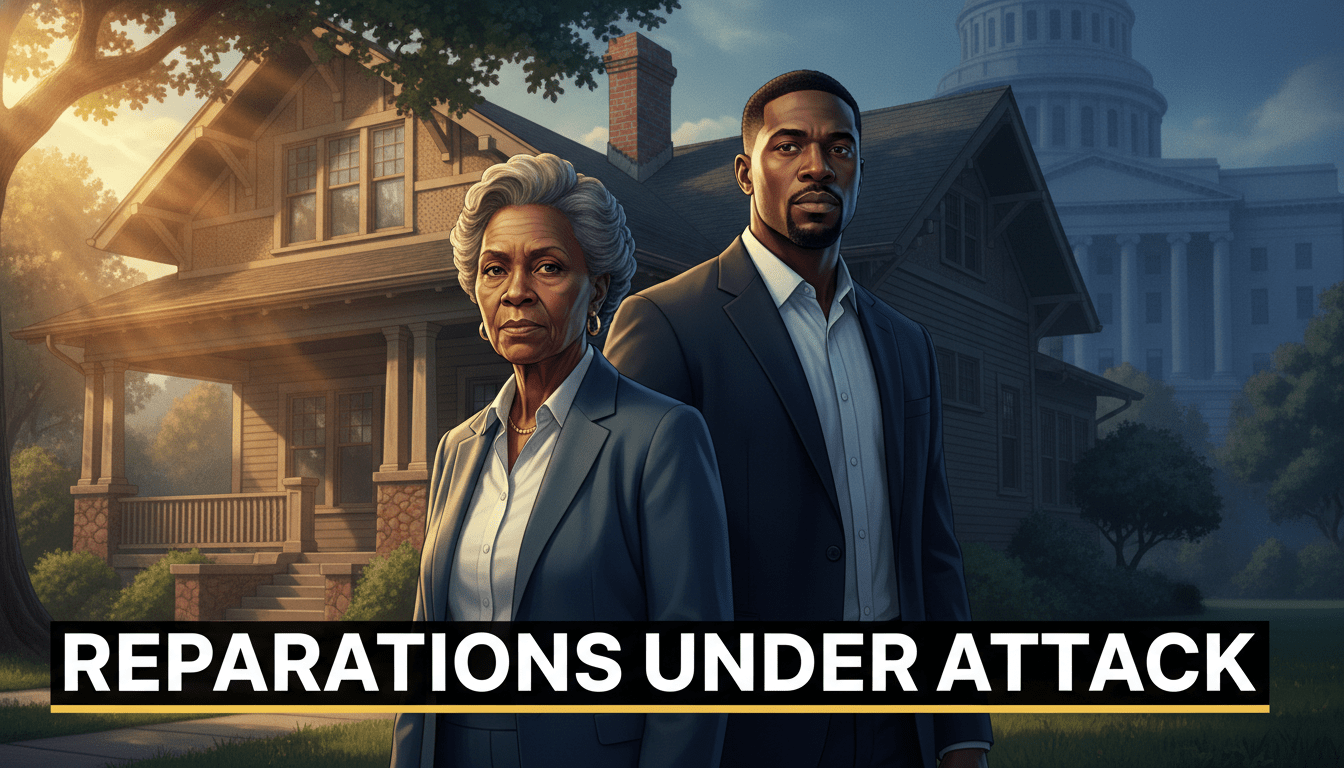
The year 2026 has brought a massive legal storm to the city of Evanston, Illinois. This wealthy suburb is famous for creating the first municipal reparations program in the United States (theguardian.com, dailynorthwestern.com). Today, that historic effort is fighting for its very life in federal court (justice.gov, wttw.com).
In June 2026, the United States Department of Justice made a shocking move. The federal government decided to intervene in a lawsuit against the city (justice.gov, fox32chicago.com). This action has stunned racial justice advocates across the country (theguardian.com, nationofchange.org). The decision represents a major escalation in the national battle over racial justice programs.
The Department of Justice joined a legal battle started by a conservative group called Judicial Watch (legalnewsline.com, judicialwatch.org). Federal lawyers argue that the Evanston housing program constitutes unlawful racial discrimination (justice.gov, judicialwatch.org). They claim that the program violates the Equal Protection Clause of the Fourteenth Amendment (justice.gov, judicialwatch.org). This federal action could destroy local efforts to heal communities nationwide (theguardian.com, nationofchange.org).
Supporters of reparations view this intervention as a major setback. They believe that local governments must have the right to fix their own past mistakes. To understand the stakes, one must examine the history of this proud city (dailynorthwestern.com).
The Roots of Spatial Segregation in Evanston
To understand the current legal battle, one must look back to the early twentieth century. Between 1915 and 1970, millions of Black Americans left the South during the Great Migration (wikipedia.org, wikipedia.org). Many families arrived in Evanston looking for industrial jobs and household work (rsfjournal.org, rooseveltinstitute.org). The Black population grew from about 125 people in 1880 to over 6,000 by 1940 (luc.edu, dailynorthwestern.com).
As the Black community grew, white leaders reacted with fear. They worked with real estate agents to confine Black residents to one small area (luc.edu, dailynorthwestern.com). In 1921, Evanston passed a strict zoning ordinance (luc.edu, dailynorthwestern.com). This law coded the majority-Black neighborhood for commercial and industrial use (luc.edu). It prevented Black residents from buying homes in other parts of the city (luc.edu, dailynorthwestern.com).
The city pushed almost all Black residents into the Fifth Ward (luc.edu, dailynorthwestern.com). At the same time, white homeowners formed the West Side Improvement Association (luc.edu). This group used racially restrictive housing covenants to block integration (luc.edu). These covenants legally banned the sale of homes to non-white buyers (luc.edu, oup.com). By the mid-twentieth century, segregation in Evanston was complete and rigidly enforced (luc.edu, dailynorthwestern.com).
These restrictive covenants ran with the land (oup.com). This meant they remained attached to the property records forever (oup.com). Any future buyer had to obey these rules (oup.com). The use of these covenants surged across northern suburbs (oup.com). White residents actively worked to protect their neighborhoods from integration (luc.edu, oup.com).
In 1948, the Supreme Court ruled on these covenants in the landmark case of Shelley v. Kraemer (wikipedia.org, oup.com). The court decided that state courts could not enforce these contracts (oup.com). However, private real estate agents in Evanston continued to use them informally (luc.edu). They refused to show homes in white areas to Black buyers (luc.edu). This informal system kept the city divided for decades (luc.edu, dailynorthwestern.com).
Enforced Disinvestment and Redlining
Segregation was only the first step in stripping wealth from Black families. Once the city confined Black residents to the Fifth Ward, economic starvation began (luc.edu). Banks and municipal leaders refused to invest in this enclave (luc.edu, dailynorthwestern.com). This systemic denial of mortgage loans is known as redlining (localhousingsolutions.org, ncrc.org).
The federal government standardized redlining in the late 1930s (richmond.edu, chicagofed.org). The Home Owners’ Loan Corporation created maps that graded neighborhoods (richmond.edu). They marked Black neighborhoods in red as hazardous for investments (richmond.edu, chicagofed.org). Local banks in Evanston used these maps to deny loans to Black buyers (luc.edu).
Without capital, Black residents could not maintain their homes. The city then used “sanitary” laws to demolish Black-owned properties outside the Fifth Ward (luc.edu). They claimed these homes were overcrowded or unsafe (luc.edu). In reality, the city wanted to clear land for commercial development (luc.edu, dailynorthwestern.com).
Evanston also approved segregated temporary housing for Black veterans after World War II (luc.edu). The city refused to pass a fair housing ordinance until federal law forced them in 1969 (luc.edu). This long history severely damaged the stability of African American families.
Redlining prevented Black families from building home equity (localhousingsolutions.org, ncrc.org). Home equity is the main way American families build wealth (localhousingsolutions.org, rsfjournal.org). White families bought homes in appreciating neighborhoods (luc.edu, rsfjournal.org). Meanwhile, Black families were trapped in depreciating areas (luc.edu, localhousingsolutions.org). This wealth gap grew larger over several generations (rsfjournal.org). It created a massive disparity in household wealth today (rsfjournal.org). The modern wealth gap in Evanston is the direct result of these practices (luc.edu).
Building the Legal Defense: The Harms Report
Evanston leaders knew that any program helping Black residents would face legal challenges. Under federal law, governments cannot easily use racial classifications (pacificlegal.org). The Supreme Court established this in the 1989 case of City of Richmond v. J. A. Croson Co. (pacificlegal.org, wustllawreview.org). To survive a court challenge, a race-conscious policy must pass “strict scrutiny” (pacificlegal.org).
To prepare, the city commissioned historians Morris Robinson Jr. and Jenny Thompson (dailynorthwestern.com). They spent months researching city archives (luc.edu, dailynorthwestern.com). In 2021, they released a 77-page study (luc.edu, dailynorthwestern.com). This document is formally known as the Harms Report (luc.edu). It was a vital step in creating a clinical paper trail of discrimination.
The Harms Report provided a detailed paper trail of municipal discrimination (luc.edu). It proved that the modern wealth gap in Evanston was not an accident (luc.edu, dailynorthwestern.com). It was the direct result of deliberate city laws and zoning codes (luc.edu, dailynorthwestern.com). By documenting this history, the city argued that reparations were a specific settlement (legalnewsline.com). This report became the foundation for their fight for economic justice.
Strict scrutiny requires the government to prove a compelling interest (pacificlegal.org, jacksonlewis.com). The program must also be narrowly tailored to fix that specific interest (pacificlegal.org). Evanston argued that fixing its own documented housing discrimination met this high standard (cityofevanston.org, legalnewsline.com).
The Harms Report did not focus only on general societal discrimination (luc.edu). It focused strictly on the active role of the city in housing segregation (luc.edu). This specific focus was designed to protect the program from legal challenges (legalnewsline.com). It aimed to show that the city was correcting its own actions.
A Restorative Structure with Unique Funding
With the Harms Report complete, the city council took action. Led by former Alderwoman Robin Rue Simmons, they created the Local Reparations Restorative Housing Program (newsone.com, dailynorthwestern.com). The program offers a $25,000 grant to eligible individuals (patch.com, cityofevanston.org).
To qualify, an applicant must fall into specific categories (patch.com, cityofevanston.org). First, “Ancestors” are Black adults who lived in Evanston between 1919 and 1969 (patch.com, cityofevanston.org). Second, “Descendants” are the children or grandchildren of those Ancestors (patch.com, cityofevanston.org). Third, residents of any race can qualify if they suffered housing discrimination after 1969 (patch.com, cityofevanston.org). This multi-racial tier helps the program navigate federal challenges under the Equal Protection Clause.
Recipients cannot spend the $25,000 grant on whatever they want (patch.com). The funds must go directly to housing costs (patch.com, cityofevanston.org). These costs include home down payments, mortgage principal reduction, or home repairs (patch.com, cityofevanston.org). Initially, the city planned to fund this program using a 3% tax on legal cannabis sales (patch.com, dailynorthwestern.com). This carried huge symbolic weight because Black residents suffered most during the War on Drugs (dailynorthwestern.com).
However, cannabis tax revenues fell far short of projections (dailynorthwestern.com). Instead of $1 million a year, it brought in only $100,000 (dailynorthwestern.com). In 2022, the city council voted to supplement the fund (patch.com, dailynorthwestern.com). They added revenue from a graduated real estate transfer tax on luxury home sales (patch.com, dailynorthwestern.com). This change kept the program moving forward.
This new funding source also had an important economic meaning (patch.com, dailynorthwestern.com). It took money from high-value real estate sales to fund affordable housing (patch.com). This directly redistributed wealth to families harmed by segregation (patch.com, dailynorthwestern.com). The city committed to spending $20 million over ten years on this effort (dailynorthwestern.com).
The Legal Battle of 2026: Flinn v. City of Evanston
The legal storm finally broke in May 2024. Judicial Watch filed a class-action lawsuit on behalf of six non-Black plaintiffs (judicialwatch.org, legalnewsline.com). The lawsuit is called Flinn v. City of Evanston (judicialwatch.org, legalnewsline.com). The plaintiffs are direct descendants of residents who lived in Evanston during the segregation era (judicialwatch.org).
These six white plaintiffs—Margot Flinn, Carol Johnson, Stasys Neimanas, Barbara Regard, Henry Regard, and Stephen Weiland—argue that the city is discriminating against them (judicialwatch.org). They meet the residency timeline, but they cannot get the grants because they are not Black (judicialwatch.org). They claim that using race as an eligibility requirement violates the Fourteenth Amendment (judicialwatch.org).
The city tried to dismiss the lawsuit in early court hearings. They argued that the plaintiffs did not have standing because they had never applied (legalnewsline.com, clearinghouse.net). However, on March 27, 2026, U.S. District Judge John F. Kness rejected the motion of the city (patch.com, clearinghouse.net). He ruled that applying would have been a futile effort (patch.com). Since the guidelines require applicants to be Black, the lawsuit was allowed to go to trial (patch.com, clearinghouse.net).
Standing is a key concept in federal law (clearinghouse.net, clearinghouse.net). To have standing, a plaintiff must prove a concrete injury (clearinghouse.net). The city argued that the plaintiffs suffered no real injury because they did not apply (legalnewsline.com). They claimed the harm was only theoretical.
However, the court decided that the exclusionary guidelines themselves caused the injury (patch.com). This decision allowed the lawsuit to move forward (clearinghouse.net). It created a major obstacle for the legal team of the city (dailynorthwestern.com). It also drew the attention of federal authorities.
The Federal Intervention of June 2026
On June 16, 2026, the Department of Justice officially stepped into the case (justice.gov, justice.gov). Assistant Attorney General Harmeet K. Dhillon led this effort (justice.gov, justice.gov). She issued a strong statement condemning the municipal program (justice.gov, justice.gov). Dhillon called the program race discrimination “pure and simple” (justice.gov).
The federal government supports a colorblind interpretation of the Constitution. This philosophy argues that the government cannot use racial categories for any policy (pacificlegal.org). It does not matter if the policy is trying to fix historical harms (pacificlegal.org). This legal view gained strength after the Supreme Court struck down affirmative action in college admissions (jacksonlewis.com, rosenbergfirm.com).
Opponents of reparations are using that ruling to challenge local programs across America. Racial justice advocates warn that this federal challenge is dangerous (theguardian.com, nationofchange.org). It could stop progress made by the reparations task force in California (theguardian.com, ca.gov). It may also freeze similar initiatives in New York (theguardian.com, theguardian.com).
The final decision in this case will have massive consequences. It will decide if cities can use targeted financial repair to settle documented histories of municipal theft. For now, Evanston Mayor Daniel Biss promises to defend the program in court (dailynorthwestern.com). The nation is watching this critical legal battle unfold (theguardian.com, nationofchange.org).
The DOJ filed its complaint under the Civil Rights Act of 1964 (justice.gov, justice.gov). This law allows the federal government to intervene in important equal protection cases (justice.gov). Federal prosecutors argue that the program of the city violates the Fair Housing Act (justice.gov, justice.gov). They claim that any racial barrier in housing programs is illegal.
This federal intervention shows a major shift in civil rights enforcement. The government is now using civil rights laws to challenge racial justice programs (theguardian.com, nationofchange.org). This development has created deep concern among legal scholars who support systemic repair (ballsandstrikes.org, rsfjournal.org). They worry it will close the door on future attempts to close the racial wealth gap.
About the Author
Darius Spearman is a professor of Black Studies at San Diego City College, where he has been teaching for over 20 years. He is the founder of African Elements, a media platform dedicated to providing educational resources on the history and culture of the African diaspora. Through his work, Spearman aims to empower and educate by bringing historical context to contemporary issues affecting the Black community.
