


Inside the DC Police Overtime Fraud Scheme Scandal
By Darius Spearman (africanelements)
Support African Elements at patreon.com/africanelements and hear recent news in a single playlist. Additionally, you can gain early access to ad-free video content.
The Anatomy of the Fifth District Overtime Scandal
Public safety in the nation’s capital faces renewed scrutiny following federal and local criminal indictments against six law enforcement workers. Prosecutors uncovered a massive overtime scheme within the Metropolitan Police Department. The defendants worked inside the Fifth District Administrative Office. Over the course of 2024, they systematically billed taxpayers for thousands of unworked hours (justice.gov, dc.gov).
The six defendants claimed a combined total of 11,017.5 work hours during that single calendar year. Public records show they collected more than $935,000 in total compensation. Investigators determined that 5,618 of those hours were completely fraudulent. This time theft siphoned $441,137.03 directly from municipal coffers (justice.gov, justice.gov). The scale of this theft reveals deep administrative vulnerabilities in departmental oversight.
Digital Deception and the Mechanics of Uttering
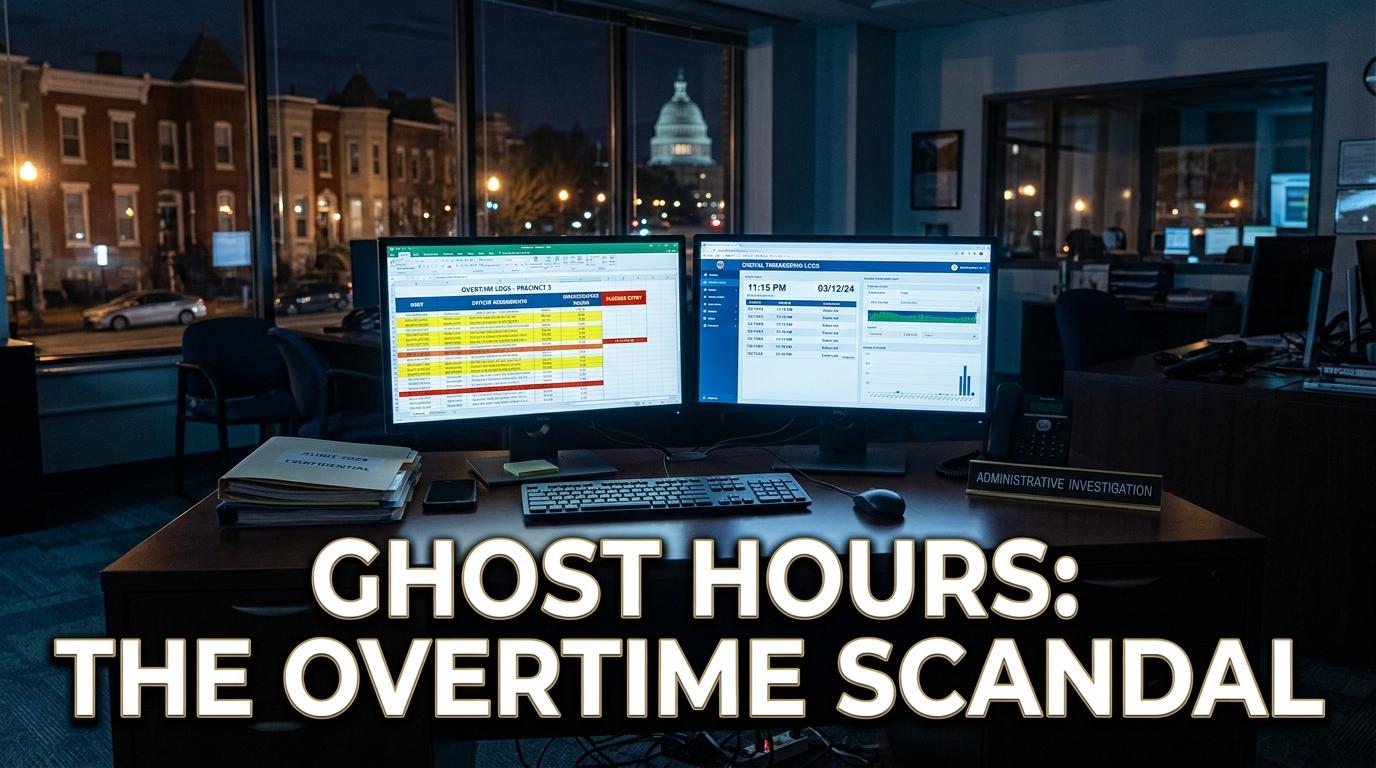
The alleged conspiracy relied on deliberate manipulation of the Timesheet Manager Application (justice.gov, justice.gov). Defendants held key administrative duties inside the station. This positioning allowed them to bypass standard checks. They forged supervisory signatures on overtime authorization forms. Furthermore, they entered unworked shifts directly into the payroll database without required supervisory sign-offs (justice.gov).
Prosecutors charged the defendants with first-degree fraud, first-degree theft, forgery, and uttering (justice.gov, dc.gov). In criminal law, forgery refers to the unauthorized creation or alteration of a document. In contrast, uttering occurs when someone submits that forged document as genuine to receive payment. The defendants submitted false slips while traveling out of state, vacationing overseas, or working private security jobs (justice.gov, justice.gov).
Investigators unraveled the scheme by matching digital records. They analyzed body-worn camera logs, cruiser GPS units, and license plate readers. In addition, detectives checked cell tower connections and keycard entries. These electronic records proved that officers were nowhere near their assigned duty posts when billing for public service (justice.gov, justice.gov).
Abandoned Beats and the Impact on Northeast D.C.
The Metropolitan Police Department’s Fifth District covers major portions of Northeast Washington. It includes historic neighborhoods such as Trinidad, Ivy City, Brookland, Eckington, and Brentwood (dccourts.gov). These communities are home to generations of Black residents. Many families in these wards navigate high living costs alongside chronic municipal service gaps. These challenges reflect the ongoing struggles of working-class families seeking fair treatment.
The Fifth District handles a substantial share of priority emergency calls. When officers log ghost hours, emergency response times suffer. Neighborhood beats sit completely unstaffed during critical hours. Residents calling for help during violent incidents face longer waits because scheduled patrol units do not exist on the street (dccourts.gov). The absence of scheduled staff directly harms public safety.
Furthermore, this dynamic places an unfair burden on honest patrol officers. Remaining field units must cover enlarged patrol sectors to compensate for missing personnel. This workload produces officer exhaustion and weakens basic community engagement. Unchecked administrative fraud damages community trust in places where police legitimacy remains exceptionally fragile (dccourts.gov).
The 1990s Control Board and Echoes of Past Scandals
Overtime fraud is an established pattern in the history of the District. During the late 1990s, Washington operated under the Financial Responsibility and Management Assistance Authority. Congress created this unelected Control Board to oversee city finances during a fiscal emergency (washingtonpost.com). This intervention altered the local balance of federal power and limited self-governance in a majority-Black city.
In September 1997, a major overtime scandal rocked the department’s homicide division. Detectives and supervisors accumulated $6 million in overtime claims. That figure represented one-third of the entire department overtime budget (washingtonpost.com). An external audit by Booz Allen Hamilton discovered that supervisors regularly approved false court appearance overtime. The findings forced leadership to reassign the entire homicide command structure (washingtonpost.com).
The 1997 crisis demonstrated how organizational chaos allows timekeeping fraud to thrive. When internal controls weaken, fraudulent practices become normalized within specialized units. Decades later, similar vulnerabilities reappeared in administrative divisions. These recurring failures show that technology alone cannot replace managerial integrity (washingtonpost.com).
The Overtime Economy and the 50-Year Staffing Deficit
To understand how ghost hours go unnoticed, one must examine the operational stress within the department. Sworn staffing levels recently dropped below 3,300 officers (dcauditor.org). This reduction marks the lowest operational staffing level in fifty years. The department lost personnel to suburban departments offering higher base pay and fewer high-stress calls (dcauditor.org).
To maintain basic street coverage, department leaders routinely cancel scheduled days off. Supervisors mandate extended overtime shifts across all seven patrol districts. Consequently, annual overtime spending for police climbed to nearly $134 million. Citywide overtime spending across all public safety agencies approached $220 million (dcauditor.org, dcauditor.org).
This massive spending volume creates administrative desensitization. When hundreds of officers regularly log extreme overtime, outlier timesheets raise fewer immediate red flags. High overtime claims become standard operating procedure rather than exceptions. Fraudulent entries easily hide within this flood of legitimate overtime paperwork (dcauditor.org, dcauditor.org).
Secondary Employment and the Double-Dipping Dilemma
Department regulations permit officers to work off-duty armed security for private retail businesses. Private companies hire uniformed officers because they retain arrest authority while wearing the official uniform. However, General Order PER-201.08 establishes strict boundaries. Officers must submit authorization forms to prevent ethical conflicts and guard against extreme physical fatigue (dc.gov).
Working secondary shifts while on the city clock constitutes criminal theft. The 2024 indictments mirror earlier prosecutions involving union leaders. In May 2023, former police union vice chairman Medgar Webster pleaded guilty to first-degree fraud (washingtonpost.com, washingtoninformer.com). Webster double-billed 246.5 overtime hours while working private security at Whole Foods stores (washingtonpost.com).
These cases highlight a systemic conflict between private security work and public duty. When officers prioritize secondary employment, public accountability breaks down. The broader community suffers when commercial retail corridors receive taxpayer-funded protection at the expense of residential neighborhoods. This exploitation undermines the historical fight for economic justice within public institutions.
Home Rule, Federal Jurisdiction, and Local Accountability
The prosecution of these six defendants reflects the unique constitutional status of the District of Columbia. Under the Home Rule Act of 1973, Washington lacks complete judicial independence (dccouncil.gov). The locally elected D.C. Attorney General handles civil matters, juvenile cases, and minor misdemeanors. In contrast, the federally appointed United States Attorney retains exclusive jurisdiction over all local adult felony offenses (justice.gov, dccouncil.gov).
This structure prevents D.C. residents from electing the chief prosecutor who handles major police misconduct cases. In all fifty states, local voters elect county prosecutors to oversee felony matters. To navigate this division of power, the D.C. Attorney General partners directly with federal prosecutors. Local attorneys are cross-designated as Special Assistant U.S. Attorneys to prosecute municipal public corruption (justice.gov, justice.gov).
This hybrid prosecution model allows local investigators to bring felony charges in D.C. Superior Court. Nevertheless, the framework reminds residents of their ongoing lack of full self-determination. Democratic control over local criminal justice remains limited by federal oversight. True accountability requires institutional independence alongside rigorous internal auditing (justice.gov, dccouncil.gov).
Budget Realities and the Cost to Community Programs
Uncontrolled police overtime spending directly impacts the municipal budget. When agency overtime exceeds allocated funds, city leaders must reprogram general revenue to cover the deficit. Every dollar diverted to pay for fraudulent overtime is unavailable for alternative public safety investments. Community violence intervention initiatives lose essential funding during mid-year budget adjustments (dcauditor.org, dcauditor.org).
Programs like the Office of Neighborhood Safety and Engagement rely on consistent municipal support. These initiatives address root causes of violence through credible messengers and job opportunities. Similarly, civilian mental health crisis teams need resources to expand their operational reach. Diverting public funds to pay for ghost shifts weakens these community-led public safety models (dcauditor.org, dcauditor.org).
Addressing overtime fraud requires automated technological controls and supervisory accountability. Police managers who approve fraudulent timesheets must face clear administrative consequences. Moving forward, the city must balance sworn police resources with community investments. Protecting the public treasury ensures that municipal services reach the working neighborhoods that need them most (dcauditor.org, dcauditor.org).
About the Author
Darius Spearman is a professor of Black Studies at San Diego City College, where he has been teaching for over 20 years. He is the founder of African Elements, a media platform dedicated to providing educational resources on the history and culture of the African diaspora. Through his work, Spearman aims to empower and educate by bringing historical context to contemporary issues affecting the Black community.
