


Inside the History of Kimberle Crenshaw Intersectional Push
By Darius Spearman (africanelements)
Support African Elements at patreon.com/africanelements and hear recent news in a single playlist. Additionally, you can gain early access to ad-free video content.
The Contemporary Emergency of Critical Race Theory
Pioneering legal scholar Kimberle Crenshaw has initiated a major national conversation with her new memoir, Backtalker (columbia.edu). She explains that marginalized communities face a coordinated threat to their civil rights (columbia.edu, ucla.edu). The systematic dismantling of critical legal frameworks has created an immediate emergency (columbia.edu). For many, grassroots resistance is now a vital survival tactic (columbia.edu). It is necessary to understand how the history behind the headlines explains this modern crisis.
To fully grasp this political moment, one must trace the origins of the academic frameworks that are currently under siege. Scholars like Derrick Bell, Richard Delgado, and Mari Matsuda helped co-found Critical Race Theory in the late 1980s (uic.edu, wikipedia.org). It is an analytical framework explaining that racism is systemic. It is deeply embedded in legal systems, public policies, and institutional structures (uic.edu, wikipedia.org). Individuals who wish to engage with these concepts often participate in a panel discussion on critical race theory to understand how structural disparities replicate themselves even without explicit, individual prejudice (uic.edu, wikipedia.org).
Defining Intersectionality and Its Legal Origins
Crenshaw first introduced the term “intersectionality” in her landmark 1989 academic paper (columbia.edu). This work was titled Demarginalizing the Intersection of Race and Sex: A Black Feminist Critique of Antidiscrimination Doctrine, Feminist Theory and Antiracist Politics (columbia.edu). She argued that antidiscrimination law, mainstream feminism, and traditional anti-racist politics operated on a flawed single-axis framework (columbia.edu). These structures treated race and gender as mutually exclusive categories, which marginalized those who existed at their intersection (columbia.edu).
The reality is that Black women stand at the exact point where multiple systems of oppression meet (columbia.edu). They experience both racism and sexism simultaneously (columbia.edu). Crenshaw used the metaphor of a busy traffic intersection to explain this dynamic (ted.com). If an accident occurs where two roads meet, the injury can be caused by cars traveling from multiple directions (ted.com). In legal terms, Black women were frequently falling through the cracks (columbia.edu). Courts routinely dismissed their discrimination lawsuits (columbia.edu). This happened because employers hired Black men or white women, which allowed the courts to claim no bias existed (columbia.edu). This reality demonstrates how legal systems ignore intersectional oppression and fail to protect vulnerable citizens.
The Historic Marshall-to-Thomas Transition
In her recent commentaries, Crenshaw points back to the autumn of 1991 as a pivotal moment of failure (columbia.edu). This historical moment set the stage for the current erosion of civil liberties (columbia.edu). In June 1991, Justice Thurgood Marshall retired from the Supreme Court (wikipedia.org). Marshall was a towering giant of the civil rights struggle (wikipedia.org). He served as the legendary lead attorney in the historic Brown v. Board of Education case in 1954 (wikipedia.org, britannica.com). This landmark ruling successfully dismantled the unconstitutional doctrine of “separate but equal” in public education (wikipedia.org, britannica.com).
To replace Marshall, President George H.W. Bush nominated Clarence Thomas, a staunch Black conservative (wikipedia.org, wikipedia.org). Thomas held a deeply skeptical view of the legal avenues Marshall had spent his life building (wikipedia.org). He actively opposed affirmative action and other racial remedies (wikipedia.org, wikipedia.org). Crenshaw notes that many in the public mistakenly equated Thomas’s racial identity with Marshall’s civil rights legacy (columbia.edu). They ignored the profound ideological chasm between the two men (columbia.edu). This paved the way for a massive shift in the court’s direction (columbia.edu).
The 1991 Hearings and Intersectional Failure
During the confirmation proceedings, Oklahoma law professor Anita Hill came forward with credible allegations of sexual harassment (npr.org). She stated that Thomas had repeatedly harassed her while serving as her supervisor at the Equal Employment Opportunity Commission (npr.org, eeoc.gov). Crenshaw served as part of Hill’s legal support team and witnessed a tragic political collision (columbia.edu). The white-led feminist groups that rallied around Hill lacked the racial literacy to understand the historical stereotypes being weaponized against her (columbia.edu). They did not see how her credibility was uniquely vulnerable to racialized tropes (columbia.edu).
Conversely, many civil rights advocates prioritized racial solidarity with Thomas (columbia.edu). They viewed Hill’s allegations as a threat to a Black man’s ascension to the nation’s highest court (columbia.edu). This dynamic relates to the historic struggle for black liberation, where conflicting ideologies often fragment unity. The turning point of the hearings came when Thomas denounced the inquiry as a “high-tech lynching for upstart Blackmen” (wikipedia.org). Historically, lynching was a horrific form of extrajudicial murder and racial terror used to enforce white supremacy in the South (eji.org, eji.org). By invoking this painful legacy, Thomas wrapped himself in a narrative of racial victimization (columbia.edu). He utilized a male-centered model of racism that completely erased the experiences of Black women (columbia.edu). Thomas was ultimately confirmed to the Court by a narrow 52–48 vote (wikipedia.org).
The Cost of Silence: Retrenchment on the Bench
Crenshaw argues that the failure to support Anita Hill directly undermined the social democracy and civil liberties of the entire nation (columbia.edu). Over his decades on the bench, Justice Clarence Thomas has provided crucial votes to dismantle major achievements of the mid-20th-century civil rights movement (columbia.edu). He voted to gut Section 5 of the Voting Rights Act of 1965 in the landmark 2013 case, Shelby County v. Holder (brennancenter.org, brennancenter.org). This federal provision had previously protected voters in states with histories of discrimination by requiring federal preclearance for changes to voting laws (justice.gov, brennancenter.org).
Furthermore, Thomas was a decisive vote in the 2023 ruling that ended race-conscious admissions in higher education (forbes.com). He also joined the majority in the 2022 Dobbs decision to overturn Roe v. Wade, ending federal protection for bodily autonomy (plannedparenthoodaction.org). An intersectional analysis reveals that this ruling disproportionately harms Black women (guttmacher.org, bcphr.org). Due to systemic racism and economic disparities, Black women are both more likely to seek abortion care and more vulnerable to maternal mortality crises (bcphr.org, nih.gov). This demonstrates how judicial retrenchment compounds existing inequalities for marginalized populations.
Quantifying the Modern Anti-CRT and Anti-DEI Backlash
Crenshaw’s call to “talk back” is a direct response to a coordinated legislative campaign designed to outlaw critical intellectual tools (columbia.edu). This backlash began in late 2020 with federal executive actions and has expanded into a sweeping institutional purge (ucla.edu). According to the CRT Forward Tracking Project conducted by the UCLA School of Law, there have been 862 anti-CRT measures introduced at the local, state, and federal levels since 2021 (ucla.edu). More than half of all U.S. states have restricted discussions of systemic racism or gender identity in public K-12 education.
This movement has also targeted Diversity, Equity, and Inclusion (DEI) initiatives (highereddive.com). Since 2023, at least 28 anti-DEI bills have been signed into law across the United States (highereddive.com). Major public universities, including the Texas A&M University System and the University of Houston, have been forced to close their DEI offices and terminate support staff (highereddive.com). Additionally, PEN America’s Index of Educational Gag Orders indicates that at least 21 states have enacted laws that censor higher education classrooms (pen.org). Nearly 40% of the entire United States population now lives in a state where public university classrooms are censored regarding discussions of race, gender, and inequality (pen.org).
The Art of Backtalking as a Survival Mechanism
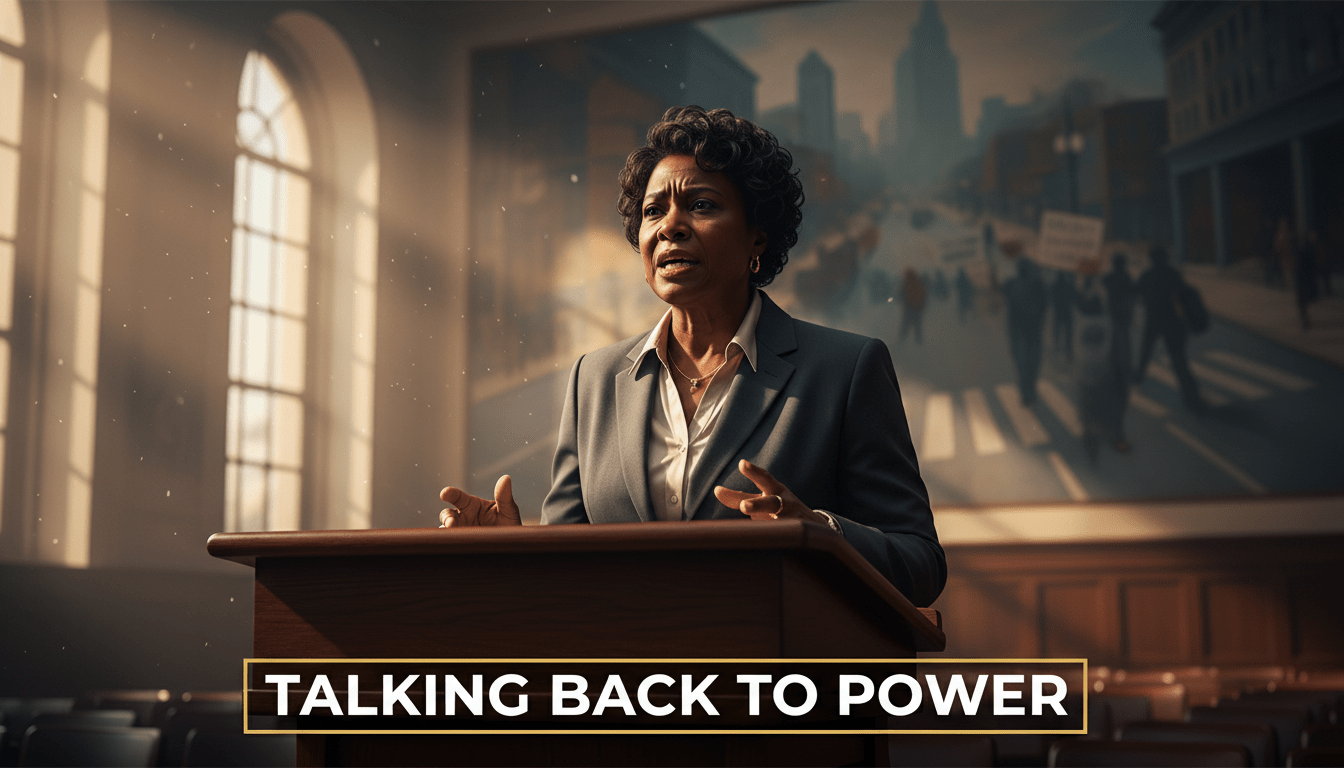
In her memoir, Crenshaw defines “backtalking” as a culturally resonant and necessary concept (youtube.com, columbia.edu). Growing up in Canton, Ohio, she was raised by a strong-minded teacher who taught her the value of challenging authority (youtube.com). To talk back is the deliberate refusal to accept the terms of the status quo handed down by dominant power structures (youtube.com). True backtalking is not safe, and it implicitly anticipates a harsh response, including social marginalization or professional exclusion (youtube.com). It is a legacy that honors the ancestral legacy of survival in the face of continuous structural oppression.
Crenshaw asserts that the current dismantling of civil rights protections requires grassroots, intersectional coordination rather than relying solely on elite legal battles (columbia.edu). Because state laws are actively rewriting history, marginalized communities must utilize local storytelling and political defiance (columbia.edu, pen.org). This censorship directly threatens the memory of major civil rights milestones, such as the Selma marchers who secured the Voting Rights Act of 1965 (nps.gov, archives.gov). These activists faced brutal state violence on “Bloody Sunday” at the Edmund Pettus Bridge to secure basic democratic rights (nps.gov, archives.gov). In the face of modern erasure, local community resistance becomes an immediate survival tactic (columbia.edu).
Conclusion: The Power of Speaking Back
The history behind the headlines reveals that contemporary culture wars are not isolated battles. They are the direct descendants of the intersectional failures of 1991 (columbia.edu). When the nation chose to ignore Anita Hill’s warnings and allowed Clarence Thomas to co-opt racial justice rhetoric, it paved the way for a conservative judicial majority (columbia.edu, wikipedia.org). This majority has systematically clawed back decades of hard-won civil rights progress (columbia.edu).
Crenshaw’s work serves as a vital reminder that the path to a just society requires deep historical study. It is necessary to understand how systems of power collide to produce complex inequalities (columbia.edu, columbia.edu). Ultimately, individuals must possess the courage to loudly, persistently, and collectively “talk back” to protect the civil rights of all marginalized communities (columbia.edu).
About the Author
Darius Spearman is a professor of Black Studies at San Diego City College, where he has been teaching for over 20 years. He is the founder of African Elements, a media platform dedicated to providing educational resources on the history and culture of the African diaspora. Through his work, Spearman aims to empower and educate by bringing historical context to contemporary issues affecting the Black community.
