


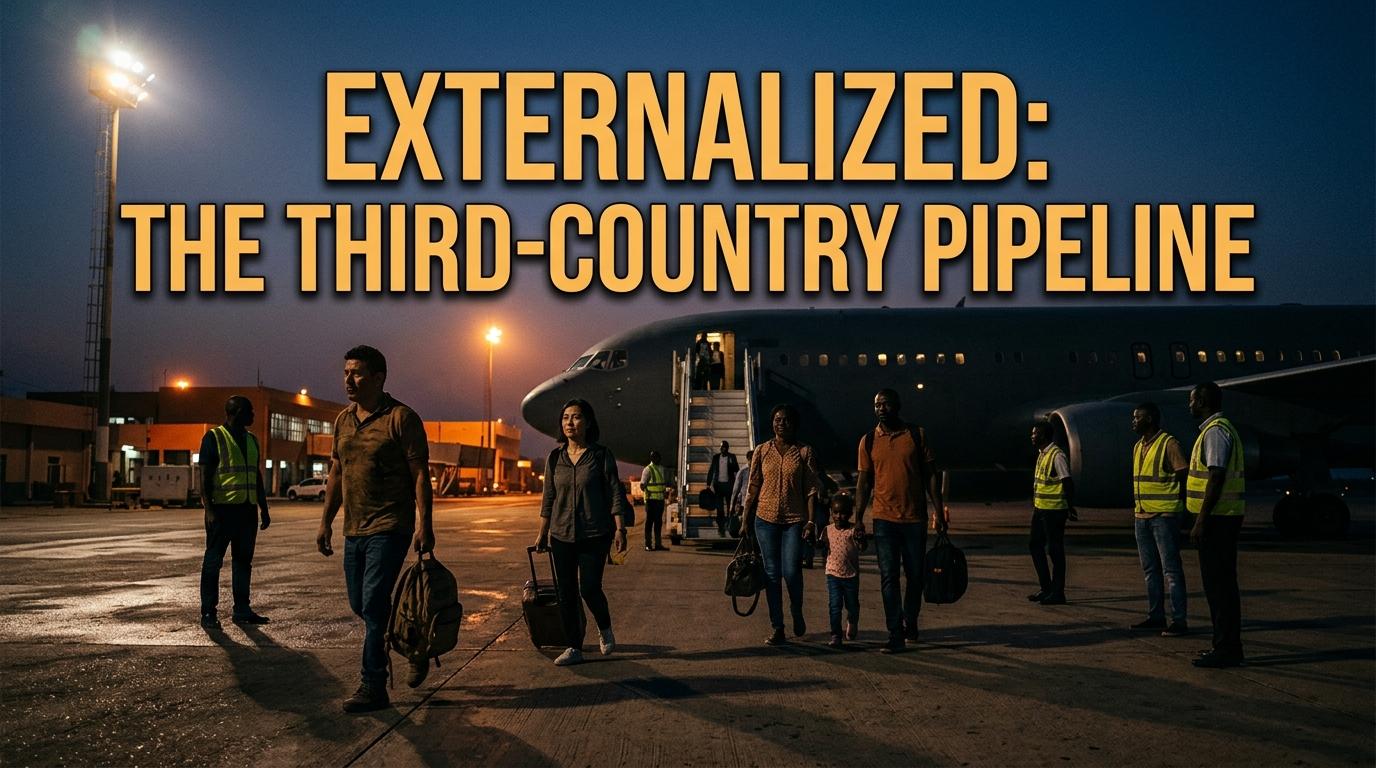
Inside The Third-Country Deportation Policy In Africa
By Darius Spearman (africanelements)
Support African Elements at patreon.com/africanelements and hear recent news in a single playlist. Additionally, you can gain early access to ad-free video content.
A Secret Expansion Across the Atlantic
Recent investigative reports and leaked federal records reveal a quiet expansion in American immigration enforcement. The United States government is expelling foreign nationals to third-party African nations. These deported individuals share no family roots, cultural ties, or legal status with those countries (cbsnews.com, thirdcountrydeportationwatch.org). Instead of returning migrants to their homelands, federal agencies charter long flights to distant African capitals (cbsnews.com, theguardian.com).
The practice represents a dramatic turn in federal deportation strategy. Internal government documents describe chartered planes dropping off groups across multiple nations within days (cbsnews.com). Migrants from South America, Central America, and Asia have landed in West, Central, and Southern Africa (cbsnews.com, ibtimes.com). Immigrant justice coalitions and human rights advocates have raised immediate alarms over this practice (facebook.com, haitianbridgealliance.org). They point out that these removals bypass foundational human rights treaties (amnesty.org, hrw.org).
The History of Externalizing Asylum
To understand these headlines, one must study the global history of border externalization (externalizingasylum.info, uwaterloo.ca). Wealthy nations have spent decades attempting to push asylum seekers far away from their sovereign borders (externalizingasylum.info). Australia established offshore detention centers on Nauru and Manus Island during the early 2000s (uwaterloo.ca, wikipedia.org). Similarly, Israel brokered covert agreements to send African asylum seekers to Rwanda and Uganda (cmi.no). The British government later tried a similar scheme to deport irregular arrivals to Rwandan soil (theguardian.com).
The United States adopted this logic through regional pacts in 2019 (americanimmigrationcouncil.org, americanimmigrationcouncil.org). Under Asylum Cooperative Agreements, federal authorities sent non-Guatemalan border crossers directly to Guatemala (americanimmigrationcouncil.org). While those early pacts were later halted, the administrative framework remained ready for reuse (americanimmigrationcouncil.org, americanimmigrationcouncil.org). Today, global powers continue shifting humanitarian obligations onto nations in the Global South (cambridge.org, global-council.org). This practice mirrors historic imperial arrangements that turned sovereign lands into holding territories (cambridge.org, academia.edu).
Bypassing Domestic Asylum and Torture Protections
Federal immigration law contains strict rules governing where non-citizens can be sent (cornell.edu, brooklaw.edu). Section 241(b) of the Immigration and Nationality Act creates an orderly process (cornell.edu, brooklaw.edu). Authorities must first attempt removal to the person’s homeland or country of origin (cornell.edu). Third-country removals were meant to be rare exceptions of last resort (courthousenews.com, americanimmigrationcouncil.org). Federal agencies are now using obscure clauses to treat third countries as primary destinations (courthousenews.com, americanimmigrationcouncil.org).
This aggressive policy endangers individuals who earned explicit court protection (cbsnews.com, courthousenews.com). Immigration courts grant Withholding of Removal and protection under the Convention Against Torture (lawofficeimmigration.com, myattorneyusa.com). These legal protections require meeting very high evidentiary standards (lawofficeimmigration.com, dworskylaw.com). They forbid the government from returning a person to face violence or death (michiganlegalhelp.org, lawofficeimmigration.com). Sending protected individuals to third countries violates domestic statutes and international treaties (courthousenews.com, refworld.org). One documented case involved sending an Afghan refugee directly to the Central African Republic (cbsnews.com).
The Acute Danger of Chain Refoulement
The core danger of third-country expulsions is chain refoulement (refugees.org, unhcr.org). Under international human rights law, governments cannot send refugees to places of persecution (unhcr.org, refworld.org). Direct deportation to danger violates the 1951 Refugee Convention (unhcr.org). Transferring a migrant to an unsafe middle country creates an identical legal violation (deu.edu.tr, diplomacyandlaw.com). If that middle country deports the person home, chain refoulement occurs (unhcr.org, wikipedia.org).
Congressional inquiries and human rights investigations show this happening in real time (hrw.org, senate.gov). Over eighty percent of deportees sent to certain third countries faced swift onward removal (senate.gov). Recipient governments rarely possess the resources to manage complex international asylum claims (amnesty.org, hrw.org). In several instances, local authorities held deportees in airport cells before forcing them onto flights back home (theguardian.com, senate.gov). The initial sending nation remains legally culpable for this dangerous downstream harm (deu.edu.tr, diplomacyandlaw.com).
Financial Leverage and Neocolonial Deals
African governments do not accept these deportation pacts in a geopolitical vacuum (theguardian.com, pbs.org). Western powers frequently use foreign assistance, sovereign debt relief, and trade terms as diplomatic leverage (theguardian.com, washingtonpost.com). The United States has allocated tens of millions of dollars to migration management funds (senate.gov). Receiving countries obtain direct budget support in exchange for processing foreign deportees (pbs.org, washingtonpost.com). In some cases, officials agreed to deportation terms to lift heavy visa sanctions (theguardian.com, wsws.org).
These bilateral transactions create deep frustration among local African populations and legal scholars (thirdcountrydeportationwatch.org, youtube.com). Human rights defenders view the agreements as capitulations that degrade sovereign governance (wsws.org, youtube.com). Activists argue that outside powers treat African territory as an overseas detention zone (facebook.com, haitianbridgealliance.org). Fragile nations struggle to support their own citizens during economic downturns (theguardian.com, wsws.org). Absorbing international deportees places unsustainable stress on underfunded public institutions (wsws.org, youtube.com).
The dynamic echoes broader historical struggles seen across the diaspora (academia.edu). African communities have long resisted structural extraction and external control (global-council.org). Just as scholars demand decolonizing African institutions, organizers now demand migration sovereignty (thirdcountrydeportationwatch.org, global-council.org). Sovereign nations must protect vulnerable people rather than serving as carceral subcontractors (facebook.com, academia.edu).
Detention and Destitution on the Ground
The conditions facing deportees upon arrival in Africa are often harrowing (cbsnews.com, ibtimes.com). Transferred migrants do not receive lawful residency, employment authorizations, or integration support (ibtimes.com, amnesty.org). Instead, authorities frequently move them straight into high-security prisons or military barracks (cbsnews.com, ibtimes.com). In Eswatini, foreign deportees were held inside the Matsapha Correctional Complex without legal representation (cbsnews.com, ibtimes.com). Language barriers and constant surveillance leave deportees completely isolated from local communities (ibtimes.com, hrw.org).
Deportations to unstable conflict zones present immediate threats to human life (amnesty.org, hrw.org). Federal flights have sent individuals to the Central African Republic, South Sudan, and the Democratic Republic of the Congo (cbsnews.com, pbs.org). These nations face ongoing insurgencies, severe political instability, and acute humanitarian crises (amnesty.org, hrw.org). In absolute monarchies like Eswatini, political repression prevents independent judicial oversight (cbsnews.com, ibtimes.com). Forcing vulnerable people into these volatile environments creates grave physical harm (amnesty.org, hrw.org).
Black Immigrant Resistance and Regional Courts
Black immigrant organizations are leading the resistance against these third-country removals (facebook.com, haitianbridgealliance.org). Groups like the Black Alliance for Just Immigration and the Haitian Bridge Alliance challenge these policies (facebook.com, haitianbridgealliance.org). They describe externalization as an extension of racialized enforcement and crimmigration (haitianbridgealliance.org, ohioimmigrant.org). Black immigrants in detention face higher bond amounts and frequent denials of relief (haitianbridgealliance.org, ohioimmigrant.org). These disparities mirror the carceral realities built during the modern era of mass incarceration (haitianbridgealliance.org).
Legal challenges are also unfolding within African regional judicial bodies (up.ac.za, kas.de). The Community Court of Justice of the Economic Community of West African States offers binding jurisdiction (up.ac.za, kas.de). In June 2026, human rights lawyers sued the Ghanaian government on behalf of twenty-seven deportees (theguardian.com, up.ac.za). The lawsuit alleges violations of regional free movement protocols and non-refoulement guarantees (up.ac.za, journals.co.za). These regional suits challenge secret executive deals that bypass domestic parliaments (youtube.com, kas.de).
This struggle reflects a continuous historical legacy of resilience and self-determination (haitianbridgealliance.org). African and diaspora populations have continually fought systemic disenfranchisement across centuries (facebook.com, haitianbridgealliance.org). When political systems broke down after Reconstruction failed, communities organized mutual aid networks to survive (haitianbridgealliance.org). Today, cross-border coalitions unite to challenge state-sponsored displacement and protect asylum rights (facebook.com, facebook.com).
Reclaiming Human Rights Across the Diaspora
The expansion of third-country deportations to African nations marks a critical moment in global migration policy (cbsnews.com, thirdcountrydeportationwatch.org). Outsourcing border control compromises foundational human rights protections established after the Second World War (externalizingasylum.info, unhcr.org). It turns vulnerable people seeking safety into geopolitical pawns traded through closed-door agreements (facebook.com, global-council.org). The practice places severe burdens on recipient nations while exposing migrants to indefinite detention (cbsnews.com, amnesty.org).
Ending these abusive arrangements requires sustained transatlantic solidarity and legal accountability (facebook.com, haitianbridgealliance.org). Grassroots advocates continue exposing secret flight manifests and challenging illegal expulsions in court (cbsnews.com, courthousenews.com). The global diaspora understands that justice cannot be divided by national borders (facebook.com, academia.edu). True immigration reform must uphold the dignity of displaced people everywhere (haitianbridgealliance.org, ohioimmigrant.org).
About the Author
Darius Spearman is a professor of Black Studies at San Diego City College, where he has been teaching for over 20 years. He is the founder of African Elements, a media platform dedicated to providing educational resources on the history and culture of the African diaspora. Through his work, Spearman aims to empower and educate by bringing historical context to contemporary issues affecting the Black community.
