
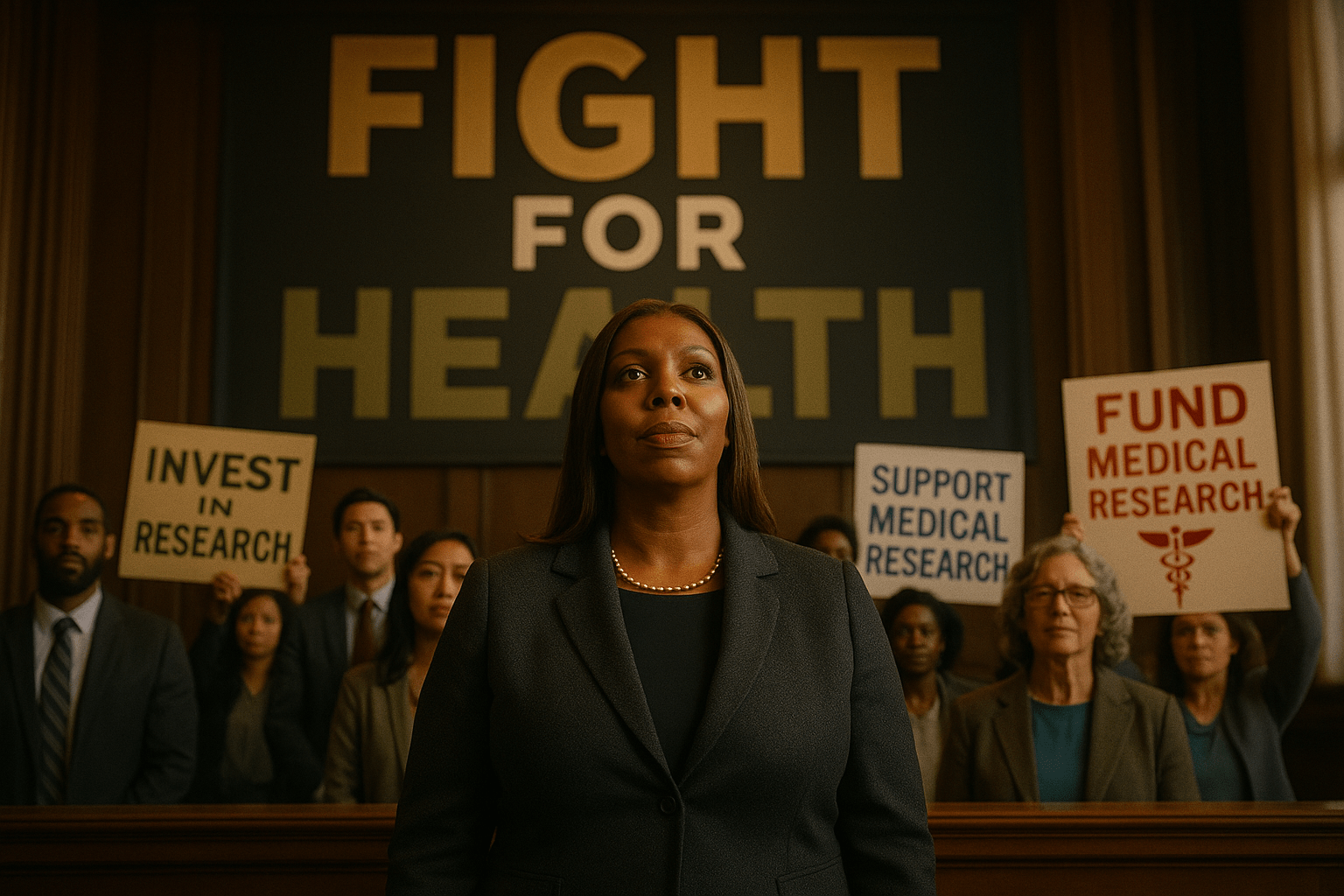
Letitia James’s Fight for Medical Research Funding
By Darius Spearman (africanelements)
Support African Elements at patreon.com/africanelements and hear recent news in a single playlist. Additionally, you can gain early access to ad-free video content.
A Resounding Victory for Public Health
New York Attorney General Letitia James has once again delivered a significant victory in the courtroom against the Trump administration. This time, the battle centered on crucial medical research funding, a fight that holds deep importance for communities across the nation, especially for Black and other marginalized populations who often bear the brunt of health disparities. The Attorney General announced her triumph on June 23, 2025, marking a pivotal moment for scientific progress and health equity. The U.S. District Court for the District of Massachusetts ruled that the administration’s cuts to National Institutes of Health (NIH) funding were illegal and void (ag.ny.gov).
This ruling is more than just a legal win; it is a powerful affirmation that medical research, particularly that which addresses the needs of diverse communities, cannot be arbitrarily undermined. The court’s decision means that millions of dollars in previously approved research grants will be restored, ensuring that vital studies can continue. For Black communities, this is particularly impactful, as many of the targeted projects focused on areas like diversity, equity, and inclusion (DEI), LGBTQ+ health, and vaccine hesitancy, all of which are critical for understanding and addressing health challenges within our populations (ag.ny.gov).
Understanding the National Institutes of Health
To truly grasp the significance of this victory, it is important to understand what the National Institutes of Health (NIH) is and its vital role. The NIH stands as the primary U.S. federal agency responsible for conducting and supporting medical research. It is, in fact, the world’s largest public funder of biomedical research, driving discoveries that improve health and save lives globally (nature.com). The work funded by the NIH spans a vast array of health issues, from cancer and heart disease to infectious diseases and mental health.
Research grants are the lifeblood of scientific progress, representing financial awards provided by institutions like the NIH to support specific scientific projects. These grants are absolutely crucial for funding the personnel, equipment, and resources needed to conduct complex medical research (aclu.org). When these grants are cut, it is not just about numbers on a ledger; it means that promising studies are halted, researchers lose their jobs, and potential breakthroughs that could benefit all of us, especially those in underserved communities, are delayed or never realized. The Trump administration began terminating these research grants in late February 2025, claiming they no longer met “agency priorities” (nature.com).
The Coalition for Justice Takes a Stand
The lawsuit challenging these cuts was not a solitary effort. In April 2025, Attorney General James joined a powerful coalition of 15 other attorneys general from across the nation in suing the Trump administration (ag.ny.gov). This widespread opposition underscored the severity of the administration’s actions and the broad concern among state leaders about the impact on public health and scientific integrity. The lawsuit was a direct response to the administration’s termination of millions of dollars in grant funding for previously approved research projects.
The projects targeted by these cuts were not random; they included those focused on diversity, equity, and inclusion (DEI), LGBTQ+ health, and vaccine hesitancy (ag.ny.gov). DEI initiatives are efforts aimed at promoting fair treatment, equal opportunity, and representation for marginalized groups within various sectors, including research and academia (bmj.com). For Black communities, research into DEI and health disparities is absolutely essential. It helps us understand and address the systemic issues that contribute to poorer health outcomes, from chronic diseases to access to care. Cutting funding for such critical research is a direct attack on the health and well-being of our people.
Targeted Research Areas
Judge Young’s Powerful Declaration
The court’s ruling was delivered by Judge William Young, a Reagan appointee, whose words resonated with profound gravity. His decision declared the administration’s cuts illegal and void, following a verbal decision the previous week that asserted the funding cuts represented racial discrimination and discrimination against the LGBTQ+ community (ag.ny.gov). Judge Young did not mince words, stating that he had “never seen government racial discrimination like this” in his 40-year career (hcinnovationgroup.com). This is a powerful statement from a seasoned judge, underscoring the egregious nature of the administration’s actions.
Furthermore, Judge Young found no evidence that the DEI initiatives in question were supporting unlawful discrimination. He challenged the administration directly, asking, “Point me just anywhere in this record where it’s pointed out that any particular grant or group of grants is being used to support unlawful discrimination on the basis of race. From what I can see, it’s the reverse” (hcinnovationgroup.com). This judicial rebuke highlights that the cuts were not based on merit or legal grounds, but rather on discriminatory intent. For Black communities, this ruling is a crucial reminder that efforts to promote equity are often met with resistance, and that legal protections are vital to ensure our progress is not rolled back.
The Administration’s Justification and Broader Agenda
The Trump administration attempted to justify these cuts by claiming that the research grants “no longer met agency priorities” and that they prioritized “ideological agendas over scientific rigour and meaningful outcomes for the American people” (nature.com). This framing suggests a deliberate attempt to redirect federal resources away from research that supports diversity and inclusion, labeling it as ideological rather than essential scientific inquiry. In the context of the Trump administration’s actions, “gender ideology” refers to policies and initiatives related to gender identity and LGBTQ+ issues, which the administration sought to remove support for, often framing them as ideological rather than scientifically rigorous (bmj.com).
These funding cuts are consistent with Trump’s broader efforts to reshape the government, slash federal spending, and end government support for DEI programs and transgender healthcare (reuters.com). He has signed executive orders requiring agencies to ensure grant funds do not promote “gender ideology” and to end support of what he sees as discriminatory DEI programs (reuters.com). This pattern reveals a clear agenda to dismantle initiatives aimed at promoting equity and inclusion, which disproportionately impacts Black and other marginalized communities who rely on such programs for fair treatment and representation. The administration’s actions are not isolated incidents but part of a larger strategy to roll back progress in areas of social justice and health equity.
NIH Grant Restoration
The Real-World Impact on Research and Public Health
The funding cuts had a tangible and potentially devastating impact on ongoing research projects. Among the canceled grants were clinical trials and research into ways to mitigate serious diseases like kidney disease, Alzheimer’s disease, and cervical cancer in diverse population groups (bmj.com). These are not abstract studies; they are critical investigations aimed at improving the lives of real people, many of whom are in Black communities disproportionately affected by these conditions. The lawsuit brought by Attorney General James specifically challenged the unlawful cancellation of NIH research grants that fund these critical medical and scientific advancements (ag.ny.gov).
While the full long-term consequences on public health are not yet detailed, the cuts clearly threatened vital medical and scientific progress. Attorney General James herself stated that the court decision is a major victory in protecting New Yorkers and the entire nation from “dangerous and illegal attacks on public health” (ag.ny.gov). For Black communities, where health disparities are often stark, the continuation of research focused on diverse populations is not merely beneficial; it is essential for achieving health equity and ensuring that medical advancements serve everyone, not just a select few.
A Pattern of Blocked Attempts to Undermine Science
This recent victory is not an isolated incident but rather part of a larger pattern of the Trump administration’s attempts to cut research funding being challenged and blocked. In February, U.S. District Judge Angel Kelley blocked a rule that would have vastly limited how much the government paid out for the indirect costs of research, such as equipment, maintenance, utilities, and support staff (nbcnews.com). The administration had estimated that this rule limiting indirect costs would cut $4 billion in funding to research centers (nbcnews.com).
In addition to these attempts, another federal judge has temporarily blocked the administration’s plans to cut 10,000 jobs at health agencies, including the NIH (reuters.com). These repeated attempts to slash funding and jobs within critical health and research institutions demonstrate a consistent effort to undermine the very infrastructure that supports public health and scientific inquiry. Each blocked attempt represents a win for science, for public health, and for the communities that depend on these institutions for their well-being.
ABOUT THE AUTHOR
Darius Spearman has been a professor of Black Studies at San Diego City College since 2007. He is the author of several books, including Between The Color Lines: A History of African Americans on the California Frontier Through 1890. You can visit Darius online at africanelements.org.
