



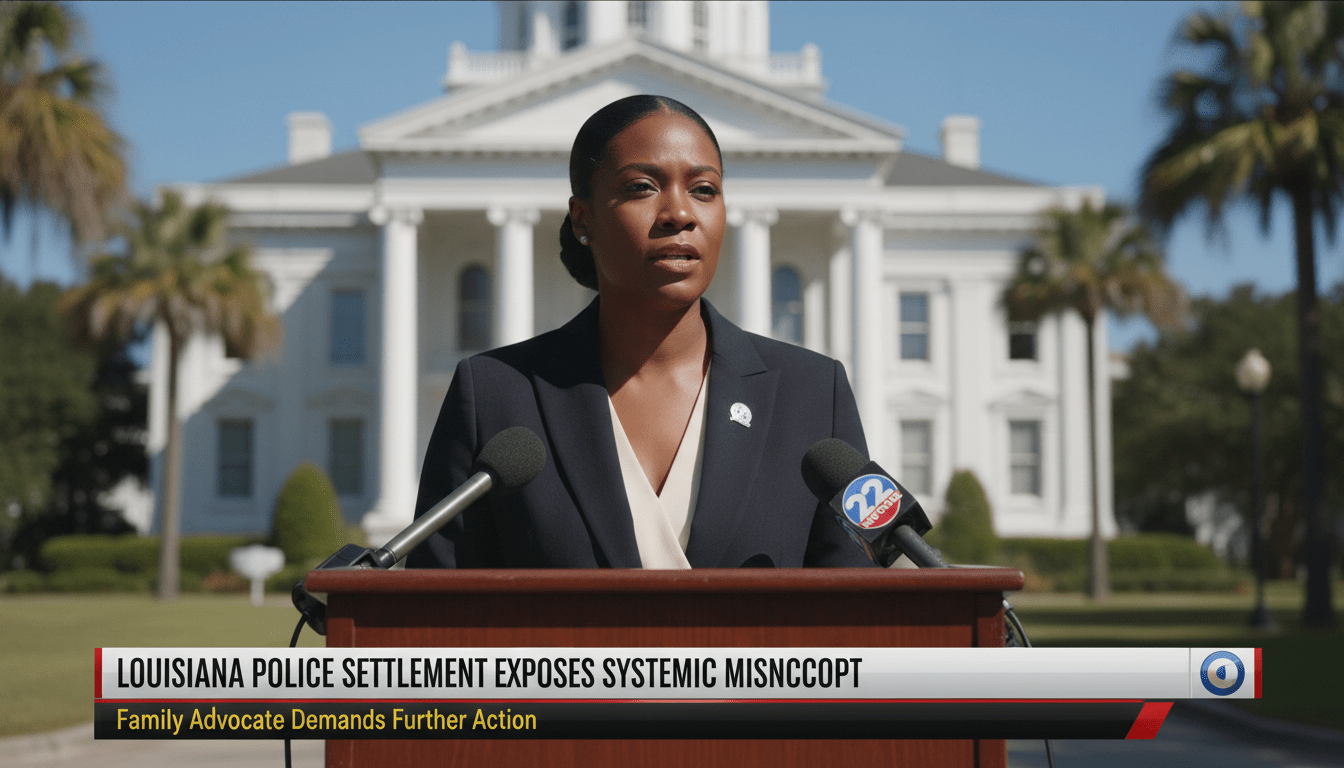
Louisiana Police Settlement Exposes Systemic Misconduct
By Darius Spearman (africanelements)
Support African Elements at patreon.com/africanelements and hear recent news in a single playlist. Additionally, you can gain early access to ad-free video content.
The Truth Hidden Behind a Car Crash
On May 10, 2019, Louisiana State Troopers chased Ronald Greene, a forty-nine-year-old Black man, outside Monroe, Louisiana. The pursuit started over allegations of speeding and a red-light violation. Officials initially reported that Greene died from a car crash and subsequent cardiac arrest. Police commanders told his family that he perished upon impact after hitting a tree. This false story successfully hid the truth from the public for over two years (apnews.com).
Medical staff immediately doubted the official police report. An emergency room doctor noted that the law enforcement story made absolutely no sense. Medical professionals found stun gun prongs embedded in the back of the victim and noted a complete lack of severe crash injuries (apnews.com). This accidental death narrative functions as a common systemic tactic to shift blame and protect violent officers from public scrutiny.
A Mother Fights for the Hidden Video
Mona Hardin, the mother of Ronald Greene, steadfastly refused to accept the state narrative. She traveled across the country to ensure the public would remember her son. For two long years, the Louisiana State Police refused to release the body camera footage. Authorities falsely claimed that an ongoing investigation legally prevented the release of any visual evidence (theguardian.com).
The truth finally emerged when an investigative reporter obtained the leaked forty-six-minute body camera video in May 2021. The shocking footage proved the car crash narrative was a complete fabrication. The world watched as troopers deployed pepper spray, threw punches, and repeatedly stunned Greene. He was brutally dragged face-down across the pavement while fully handcuffed and shackled at the ankles (apnews.com).
A Legacy of Disparities in Policing
The violence Ronald Greene faced reflects much larger statistical trends across Louisiana. A recent three-year data analysis revealed alarming racial disparities. Black residents made up over sixty percent of all use-of-force incidents, despite comprising only thirty-one percent of the state population (themarshallproject.org). These numbers demonstrate a clear and persistent danger for minority motorists.
Furthermore, data shows that a Black person in Louisiana is roughly three to five times more likely to die during a police encounter than a white person. These grim statistics suggest that the deadly encounter in 2019 belonged to a deeply rooted cultural problem rather than acting as an isolated anomaly (justicelouisiana.org). This reality deeply impacts the political experience of Black Americans who demand fundamental civil rights and personal safety.
Echoes of a Painful Historical Past
The modern policing tactics seen in the Ronald Greene case do not exist in a historical vacuum. Law enforcement in the American South carries a complex and incredibly painful legacy. Historically, many early police departments grew directly from patrols designed to control enslaved populations. Even after the abolition of slavery, discriminatory legal practices persisted for generations across the region (wikipedia.org).
Historians document the countless ways that newly freed people face ongoing systemic oppression through convict leasing and biased policing. The recent events in Louisiana serve as a stark reminder of this enduring legacy. The systemic failure to hold violent officers accountable mirrors historical efforts to prioritize state power above the value of Black lives (themarshallproject.org).
Federal Action and the Pattern Inquiry
The leaked video and massive public outcry finally forced the federal government to intervene. In January 2025, the United States Department of Justice released a damning report. The investigation concluded that the Louisiana State Police engaged in a statewide pattern or practice of excessive force. The Ronald Greene case served as the primary catalyst for this rare statewide inquiry (justice.gov).
Pattern or practice investigations actively search for widespread constitutional violations rather than focusing solely on individual crimes. Investigators found that troopers frequently used dangerous physical force against restrained individuals who posed absolutely no threat (justice.gov). This specific type of federal oversight perfectly illustrates the complicated sharing of federal power required to enforce civil rights today.
The Notorious Culture of Troop F
The specific unit involved in the death of Ronald Greene was Troop F, located in Monroe, Louisiana. This mostly rural, multi-parish region allowed a localized culture of violence to thrive far away from public cameras. Investigative reports detailed how Troop F held an infamously violent reputation for many years prior to this tragedy (newsfromthestates.com).
Internal audits showed that supervisors frequently buried critical evidence of excessive force. A deep-rooted system of internal patronage often protected bad officers from necessary discipline. In fact, internal affairs formally investigated nine different members of Troop F by 2021 for severe misconduct. This disturbing behavior included officers jokingly texting each other about beating suspects (wbrz.com).
Legacy Troopers and Systemic Silence
The severe lack of accountability within the agency was significantly worsened by the presence of legacy troopers. These are sworn officers whose fathers or close family members held high-ranking positions within the state police. This familial network effectively created a powerful shield that prioritized internal career protection over public justice (lawdragon.com).
One key figure in the violent incident was a legacy trooper whose father served as the second-in-command of the agency. Even though training instructors warned supervisors about his highly toxic behavior, the agency allowed him to graduate and remain on the active force. This entrenched generational culture fosters a blue wall of silence that makes true institutional reform nearly impossible to achieve (theguardian.com).
Qualified Immunity Delays Justice
While the grieving family sought immediate accountability, they faced the massive legal hurdle known as qualified immunity. This controversial legal doctrine protects government officials from personal civil liability unless they violate a clearly established constitutional right. The intense legal battle over this specific shield delayed the civil case for more than four long years (iowapublicradio.org).
In February 2026, a federal appeals court finally rejected a claim of qualified immunity from one of the involved officers. This landmark ruling allowed the vital discovery process to proceed, opening the door for the eventual financial settlement (opb.org). However, the exhausting delay deeply illustrates the immense difficulty civilian families face when seeking civil justice against modern law enforcement agencies.
Reduced Charges and Misdemeanor Pleas
Although the civil lawsuit resulted in a major financial settlement, the criminal outcomes deeply disappointed community advocates. Prosecutors saw most of the original charges against the involved troopers significantly reduced or completely dropped. The public watched clear video evidence of severe physical violence, yet the criminal legal consequences remained incredibly minimal (apnews.com).
Master Trooper Kory York and a local sheriff deputy eventually pleaded no contest to simple battery, which is a misdemeanor charge. A no contest plea legally allows a defendant to accept judicial punishment without formally admitting any guilt. Consequently, the officers received sentences of probation instead of prison time, sparking deep outrage from activists engaged in the struggle for black liberation (theguardian.com).
(Negligent Homicide & Malfeasance)
(No Contest)
(Misdemeanor Probation)
A Historic Financial Resolution
In May 2026, the state formally agreed to pay $4.85 million to resolve the pending federal wrongful death lawsuit. This payout represents one of the largest financial settlements for police misconduct in the entire history of Louisiana. The strict legal structure directed the awarded funds entirely to Tayla Greene, the surviving daughter of Ronald Greene (apnews.com).
Under the Louisiana Civil Code, the specific right to recover financial damages for a wrongful death belongs first to the surviving children. Because Tayla Greene held first priority legal standing, the settlement centered entirely around her federal claims (ricekendig.com). While Mona Hardin led the visible public campaign for justice, the final legal resolution strictly followed the hierarchy established by state legislation.
Shifting Federal Oversight Priorities
Despite the scathing federal findings report published in 2025, the Louisiana State Police avoided a strict federal consent decree. A formal consent decree would have placed the troubled agency under the direct supervision of a federal judge and an independent monitor. State political officials strongly resisted this heavy level of federal judicial control (newsfromthestates.com).
Reports clearly indicate that the severe federal findings were later rescinded following a major shift in administration under current President Donald Trump. Consequently, the state law enforcement agency continues to operate its daily business without formal federal court supervision (pbs.org). This abrupt political shift leaves many civil rights advocates wondering if internal state mandates possess the power to change a deeply entrenched culture.
Evaluating Internal Reforms Today
In direct response to the intense public fallout, the Louisiana State Police created a brand new Force Investigation Unit in 2022. This specialized team of internal detectives exclusively investigates all in-custody deaths and serious uses of physical force. The agency publicly claims this internal unit operates completely independently from local troop influence (lsp.org).
However, many community critics remain highly skeptical of these internal adjustments. The investigative unit remains staffed entirely by internal state police detectives. Because these specialized investigators police their own departmental colleagues, advocates strongly argue they remain incredibly susceptible to the traditional blue wall of silence (gpb.org). For many observing this tragedy, genuine justice requires far more than a financial settlement or superficial internal restructuring.
About the Author
Darius Spearman is a professor of Black Studies at San Diego City College, where he has been teaching for over 20 years. He is the founder of African Elements, a media platform dedicated to providing educational resources on the history and culture of the African diaspora. Through his work, Spearman aims to empower and educate by bringing historical context to contemporary issues affecting the Black community.
