


Red Sea Displacement: Why Thousands Flee to Djibouti
By Darius Spearman (africanelements)
Support African Elements at patreon.com/africanelements and hear recent news in a single playlist. Additionally, you can gain early access to ad-free video content.
A Dangerous Crossing Over Ancient Waters
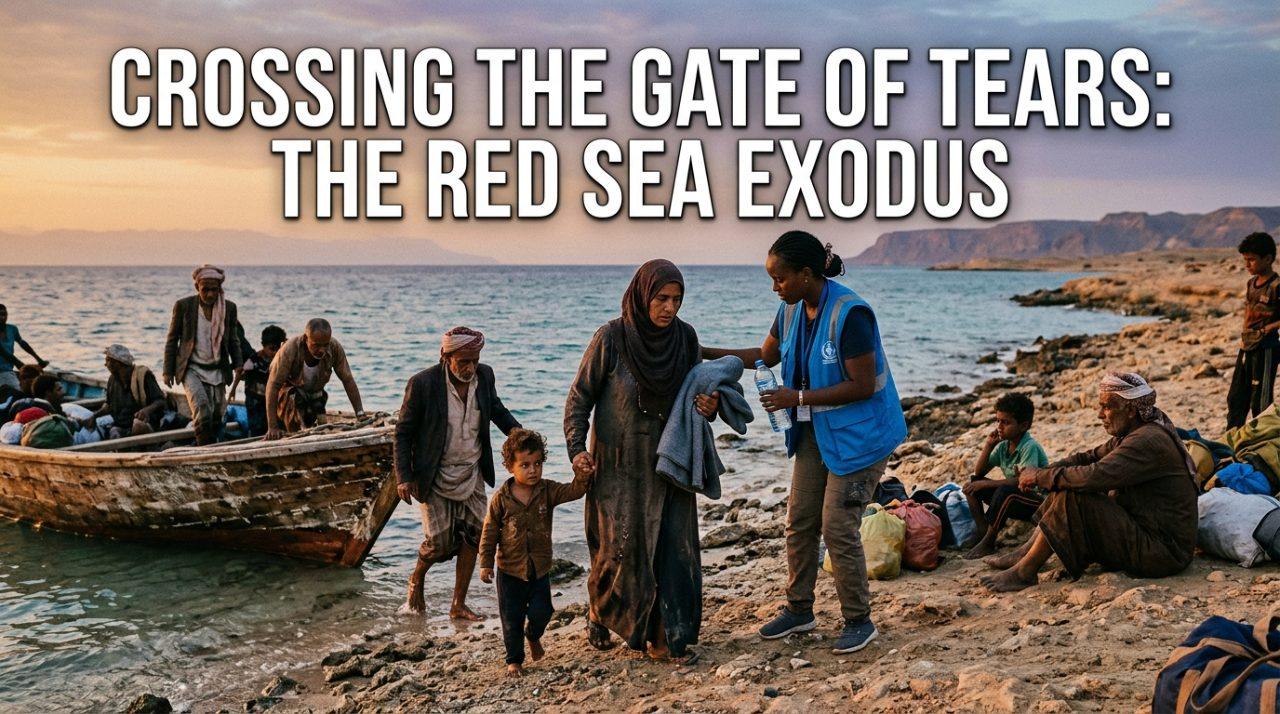
A sudden escalation in armed conflict along Yemen’s southern coast has triggered a massive civilian exodus across the southern Red Sea. Over a brief span of days, more than 2,000 individuals climbed into wooden fishing boats to escape coastal bombardment and reached northern Djibouti. More than 1,400 of these asylum seekers landed within a single 24-hour window, testing the emergency capacity of coastal transit hubs (youtube.com, tribune.com.pk).
These arrivals step ashore in Obock, an arid district enduring extreme desert heat and limited freshwater reserves. Aid monitors from the International Organization for Migration and local emergency groups met these boats immediately. Exhausted families suffered from acute dehydration, severe trauma, and exposure after navigating treacherous maritime routes. This rapid surge underscores the deep humanitarian vulnerabilities connecting the Arabian Peninsula with the Horn of Africa (iom.int, iom.int).
Surge Metrics: Displacement Crisis (September 2026)
The Gate of Tears and Millennia of Afro-Arab Ties
The body of water separating Yemen from Djibouti is the Bab-el-Mandeb Strait, which translates from Arabic as the “Gate of Tears.” This maritime passage spans roughly twenty-nine kilometers at its narrowest channel. The strait earned its name from dangerous underwater reefs and unpredictable currents that wrecked ancient trading dhows. In modern times, the passage reflects human sorrow caused by war and displacement (wikipedia.org, wikipedia.org).
For thousands of years, this waterway linked people rather than separating them. Long before imperial powers mapped modern borders, merchants and families traded freely across these coastlines. Afar and Somali seafarers moved livestock, spices, and textiles alongside Arab traders from the Tihamah coast. Exploring a brief history of Africa reveals how sovereign nations across the Red Sea basin sustained deep family, linguistic, and cultural affinities without European interference (wikipedia.org).
Shifting Sanctuary and Reciprocal Refuge
Movement across the Bab-el-Mandeb has historically operated as a reciprocal humanitarian refuge. During the twentieth century, regional upheaval routinely prompted cross-border sanctuary. When civil war erupted in North Yemen during the 1960s, coastal families found open doors in modern Djibouti. Political exiles and commercial merchants integrated into Horn of Africa ports without state resistance (wikipedia.org, cmsny.org).
The direction of protection reversed when turmoil engulfed the African continent. Following state collapse in Somalia in 1991, Yemen accepted tens of thousands of displaced Black families. Yemeni authorities granted arriving Somalis automatic prima facie refugee status under international humanitarian principles. This legal doctrine presumes protection needs without bureaucratic delays, welcoming families into national communities for decades (unhcr.org, unhcr.org).
The War in Yemen and the Rise of Reverse Flows
In early 2015, the political landscape cracked open when the Houthi movement seized control of Sana’a. The Houthi movement, known officially as Ansar Allah, is a Zaydi Shia organization from northern Yemen. The group aligned politically with Iran and confronted Yemen’s internationally recognized governing institutions. As foreign air campaigns and ground clashes tore through Yemeni infrastructure, domestic safety collapsed entirely (mei.edu, cfr.org).
Consequently, Yemeni families who once harbored refugees suddenly became refugees themselves. Thousands boarded dangerous artisanal boats to escape southwestern port towns. They arrived on the shores of Djibouti, settling around the newly established Markazi refugee camp in Obock. This transformation created a rare humanitarian phenomenon known as reverse flows, turning a traditional African departure gate into an emergency arrival hub (unhcr.org, cmsny.org).
The Hazardous Eastern Migration Corridor
Even as Yemeni refugees fled southwest toward Africa, another vulnerable population moved simultaneously in the exact opposite direction. This transit route is known to international monitors as the Eastern Route. Each year, between one hundred thousand and two hundred thousand young people—mostly from rural Ethiopia and Somalia—walk hundreds of miles across scorched deserts to reach Obock (iom.int, mrp-easternroute.com).
These African migrants pool meager life savings to purchase passage on small skiffs crossing the Bab-el-Mandeb Strait. Their primary objective is reaching Gulf economies like Saudi Arabia to escape joblessness and hunger. These journeys expose travelers to organized trafficking rings, arbitrary ransom arrests, and physical torture. Tragically, these outbound African economic migrants now navigate the identical maritime waters through which inbound Yemeni refugees flee (iom.int, mixedmigration.org).
Baseline Refugee Population Demographics in Djibouti
New Frontlines Along the Western Coastline
The current emergency stems directly from fierce fighting along Yemen’s Red Sea plain. In late August and early September 2026, Houthi forces launched ground assaults toward the historic port city of Mocha and Mayyun Island. Opposing them were the National Resistance Forces, an elite anti-Houthi coalition commanded by Tareq Saleh and backed by the United Arab Emirates (mappingmilitants.org, westpoint.edu).
Heavy artillery shelling, rocket salvos, and drone strikes smashed small fishing communities across Taiz, Hudaydah, and Lahij. Over eighty-five thousand residents inside Yemen were uprooted, turning local roads into panicked avenues of flight. When fighting cut off northern transit corridors, trapped civilians moved toward the water. Families contracted local fishermen to carry them into international shipping lanes to reach safety in Djibouti (youtube.com, unocha.org).
Djibouti and Progressive Integration Policies
Despite housing only one million citizens and enduring severe water shortages, Djibouti maintains progressive refugee legislation. In 2017, the Djiboutian government signed national decrees integrating displaced persons into domestic institutions. This reform mirrors the United Nations Comprehensive Refugee Response Framework, an international plan designed to dismantle isolated refugee camps (refworld.org, unhcr.org).
Under these protective statutes, registered refugees can attend local public schools, seek legitimate employment, and enter public medical clinics. In addition, rural hubs like Ali Addeh, Holl-Holl, and Markazi evolved into permanent municipal spaces. However, these systems rely heavily on external grants. A sudden wave of arrivals threatens to overwhelm regional schools, community health clinics, and municipal water supplies in northern towns (unhcr.org, unhcr.org).
Global Militarization and Strategic Chokepoints
While civilian refugees scrape together boat fares, international powers treat the Bab-el-Mandeb as a high-stakes military corridor. Approximately fifteen percent of world trade passes through this narrow bottleneck. In recent years, Western militaries formed multinational armadas to protect commercial container ships from Houthi missiles and surface drones (securitycouncilreport.org, ynetnews.com).
Djibouti hosts extensive foreign military installations, including Camp Lemonnier, the primary permanent United States naval base on the continent. Billions of dollars flow into advanced weapons, warship escorts, and surveillance radars. Yet, humanitarian agencies operating mere miles away cannot secure basic resources to feed displaced families. These military priorities echo broader issues surrounding historical debt and extraction that leave African infrastructure subordinate to external defense interests (dayan.org, northeastern.edu).
Global Humanitarian Funding Disparities
Systemic Disparities in Global Relief Funding
The humanitarian infrastructure in northern Djibouti faces severe deficits caused by unequal funding allocations. When conflict erupted in Eastern Europe, international donors rallied hundreds of millions of dollars within weeks. Western institutions disbursed rapid cash grants, suspended immigration restrictions, and shipped advanced medical centers (unocha.org, unric.org).
In contrast, relief appeals for the Horn of Africa consistently secure less than forty percent of needed financing. As a result, agencies like the World Food Programme have slashed daily camp rations to barely a quarter of standard caloric requirements. Observing how reconstruction promises fractured historically reveals that human dignity often gives way to racial hierarchies when distributing emergency assistance (unocha.org, reliefweb.int).
Climate Shocks and Fragile Realities
Compounding this crisis is the reality of severe climate instability across East Africa. The Horn contributes a negligible percentage of global greenhouse gas emissions. Nevertheless, the territory suffers from destructive, historic droughts and devastating flash floods (climatecentre.org, disasterphilanthropy.org).
In Djibouti, more than ninety percent of staple foodstuffs must be imported from abroad. Successive failed rainy seasons have devastated local pastoral herds, forcing over one hundred and sixty thousand Djiboutian citizens into acute food distress. When thousands of displaced Yemenis land in rural areas like Obock, they must share depleted water tables with host communities that are also struggling to survive (humanitarianaction.info, climatecentre.org).
Human Rights Abuses and Migrant Protection
Beyond the immediate cross-strait transit, Black African migrants moving through these war zones endure immense danger. Migrant rights monitors document routine atrocities along remote desert corridors. Criminal smuggling syndicates trap vulnerable travelers in clandestine compounds, using torture to extract phone transfers from overseas relatives (mixedmigration.org, humanrightsresearch.org).
Women and unaccompanied children face widespread sexual abuse and physical exploitation at maritime assembly points. Inside Yemen, migrants are often pressed into dangerous transport labor near active battlefronts. Dozens drown regularly when unseaworthy skiffs capsize in heavy surf. These brutal abuses occur silently, obscured by international military operations that monitor ship traffic rather than civilian safety (mixedmigration.org, yale.edu).
Paths Forward for Regional Justice
Resolving this crisis requires looking beyond emergency food tents and military security measures. Civil rights coalitions and local leaders demand a coordinated plan centered on mutual accountability. First, international navies operating in the Red Sea must expand dedicated search-and-rescue patrols to assist civilian skiffs in distress (unhcr.org, iom.int).
Second, global donors must provide direct financial aid to the Djiboutian state to protect public utilities and expand medical centers. Long-term peace requires addressing systemic inequities that leave African populations vulnerable to foreign proxy wars. Recognizing our common human destiny demands that we affirm the dignity and safety of every family crossing the Gate of Tears (unhcr.org, cmsny.org).
About the Author
Darius Spearman is a professor of Black Studies at San Diego City College, where he has been teaching for over 20 years. He is the founder of African Elements, a media platform dedicated to providing educational resources on the history and culture of the African diaspora. Through his work, Spearman aims to empower and educate by bringing historical context to contemporary issues affecting the Black community.
