

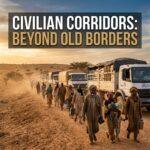


Sahel Civilian Corridors: Why Old Borders Are Breaking
By Darius Spearman (africanelements)
Support African Elements at patreon.com/africanelements and hear recent news in a single playlist. Additionally, you can gain early access to ad-free video content.
The Crisis Behind Sahel Humanitarian Headlines
Diplomatic talks across Niger, Mali, and Burkina Faso are moving at a rapid pace. Regional leaders are trying to establish civilian protection corridors in areas torn by war. These corridors aim to shield innocent families from armed violence and deliver food to isolated towns. For observers across the African diaspora, the headlines highlight an urgent struggle for survival and self-determination (globalr2p.org, unocha.org).
The roots of this crisis run deep into history. Today, over seventeen million people across the Sahel require emergency assistance (unric.org). In addition, more than three million individuals have fled their homes as internally displaced persons (reliefweb.int, unhcr.org). Decades of systemic neglect, harsh climate shocks, and outside meddling have created an unprecedented emergency. Understanding the present demands a careful look at how these historical forces unfolded (crisisgroup.org).
Libya’s Collapse and the Azawad Rebellion
The current instability began with the 2011 overthrow of Muammar Gaddafi in Libya. The collapse of the Libyan state flooded the Sahel with military-grade weapons (wikipedia.org, army.mil). Thousands of Tuareg fighters who had served in the Libyan armed forces returned to northern Mali. These fighters brought advanced firepower and combat experience back to their ancestral homeland (cfr.org).
In early 2012, secular Tuareg rebels organized under the National Movement for the Liberation of Azawad (wikipedia.org). They launched a lightning offensive across northern Mali to claim self-determination (wikipedia.org). However, hardline Islamist factions soon pushed the secular rebels aside. Groups like Ansar Dine and al-Qaeda in the Islamic Maghreb seized control of northern cities like Timbuktu and Gao, setting off a massive regional security catastrophe (wikipedia.org, cfr.org).
The Long Legacy of Foreign Interventions
Foreign powers stepped in as northern Mali fell under militant control. In 2013, France launched Operation Serval to push insurgents out of urban centers (harvardpolitics.com). That mission soon expanded into Operation Barkhane, which placed five thousand French soldiers across the region (wikipedia.org, wikipedia.org). The United Nations also established a major peacekeeping force known as MINUSMA to support stability (globalr2p.org, securitycouncilreport.org).
These foreign operations focused heavily on kinetic force rather than the underlying drivers of unrest. Insurgent networks adapted by moving into remote rural zones. Millions of civilians suffered as violence spread across borders, generating deep public anger against foreign troops (acleddata.com). Much like previous eras of economic exploitation and paternalistic rule, Western military intervention generated widespread local disillusionment across the population (policycenter.ma, harvardpolitics.com).
The Tri-Border Epicenter in Liptako-Gourma
The geographical center of this armed struggle is the Liptako-Gourma region. This vast border zone covers roughly 370,000 square kilometers across Mali, Niger, and Burkina Faso (arcgis.com). Arid plains and dense bush allow non-state groups to operate across national boundaries without hindrance (crisisgroup.org). Consequently, the area accounts for more than half of all conflict casualties in the Central Sahel (acleddata.com, acleddata.com).
Two rival insurgent groups dominate this landscape. Jama’at Nusrat al-Islam wal-Muslimin operates as the regional affiliate of al-Qaeda (acleddata.com). Meanwhile, the Islamic State in the Sahel carries out violent attacks across the borderlands of Niger and Mali (acleddata.com). These groups exploit historical grievances, land disputes, and weak rural governance to recruit disenfranchised young people (issafrica.org). They also control illegal gold mines and cattle routes to fund their operations (africacenter.org, tufts.edu).
Why Civilian Protection Corridors Are Essential
Insurgent groups have increasingly adopted siege tactics to control rural populations. Militants place landmines along transit highways and surround important towns like Djibo in Burkina Faso (acaps.org). By cutting off food, clean water, and medicine, they force local communities into submission (unocha.org, acaps.org). These brutal tactics have made safe passage routes an absolute humanitarian necessity (unocha.org).
Civilian protection corridors are physical routes designated to let non-combatants escape violence and allow aid trucks to enter safely. Local traditional elders and religious leaders often negotiate these agreements directly with armed factions (crisisgroup.org, crisisgroup.org). Although these pacts are fragile, they reflect remarkable community survival strategies in the absence of dependable state protection (crisisgroup.org, drc.ngo).
The Rise of the Alliance of Sahel States
Public frustration with persistent insecurity triggered a wave of military coups between 2020 and 2023 (cfr.org, fpa.org). Military officers took power in Mali, Burkina Faso, and Niger (securitycouncilreport.org). In September 2023, the three governments signed the Liptako-Gourma Charter to form the Alliance of Sahel States, known as the AES (securitycouncilreport.org, wikipedia.org). This coalition created a mutual defense pact to counter both insurgent threats and external political pressure (policycenter.ma, wikipedia.org).
The AES countries dismissed Western military forces and demanded the departure of French and United Nations personnel (globalr2p.org, wikipedia.org). In their place, the transitional leaders turned to new international security partners, including Russia’s Africa Corps (globalr2p.org, rferl.org). They also mobilized large domestic auxiliary forces, such as Burkina Faso’s Volontaires pour la Défense de la Patrie (africacenter.org). This major shift reflects a clear determination to control national defense directly (policycenter.ma, issafrica.org).
Breaking with Regional Alliances and Economic Realities
In early 2024, Mali, Burkina Faso, and Niger announced their formal withdrawal from the Economic Community of West African States (trtafrika.com, wikipedia.org). The military administrations argued that the regional bloc had imposed harsh economic sanctions instead of offering meaningful counterterrorism assistance (policycenter.ma, trtafrika.com). This historic departure ended decades of institutional integration across West Africa (migrationpolicy.org, wikipedia.org).
The exit from the regional bloc creates serious challenges for everyday citizens. Landlocked Sahelian nations depend heavily on coastal ports for fuel and food imports (migrationpolicy.org). Furthermore, millions of pastoralists move their livestock south across national borders during dry seasons (migrationpolicy.org, iwgia.org). Similar to historical struggles for representation, ordinary working families now face new trade tariffs, travel restrictions, and higher prices for essential goods (migrationpolicy.org).
Pan-African Ideals and the Road to Stability
The leadership of the AES has framed this political break in powerful anti-colonial terms. Military leaders frequently cite revolutionary figures like Thomas Sankara to rally public support (africasacountry.com). They present their new security alliance as a second wave of national liberation from foreign domination (policycenter.ma, africasacountry.com). This message resonates strongly with younger generations across the region who demand authentic sovereignty (africasacountry.com, harvardpolitics.com).
Nevertheless, lasting peace will require more than new military alliances. Humanitarian negotiators must continue securing safe corridors so vulnerable families can access food and medical relief (unocha.org, unocha.org). Resolving deep-seated ethnic grievances and building resilient local economies are essential steps forward (crisisgroup.org, issafrica.org). The future of the Sahel ultimately rests on the ability of regional leaders to combine military sovereignty with meaningful civilian protection (globalr2p.org, crisisgroup.org).
About the Author
Darius Spearman is a professor of Black Studies at San Diego City College, where he has been teaching for over 20 years. He is the founder of African Elements, a media platform dedicated to providing educational resources on the history and culture of the African diaspora. Through his work, Spearman aims to empower and educate by bringing historical context to contemporary issues affecting the Black community.
