


Springfield 1908 Racial Terror: What Soil Remembers
By Darius Spearman (africanelements)
Support African Elements at patreon.com/africanelements and hear recent news in a single playlist. Additionally, you can gain early access to ad-free video content.
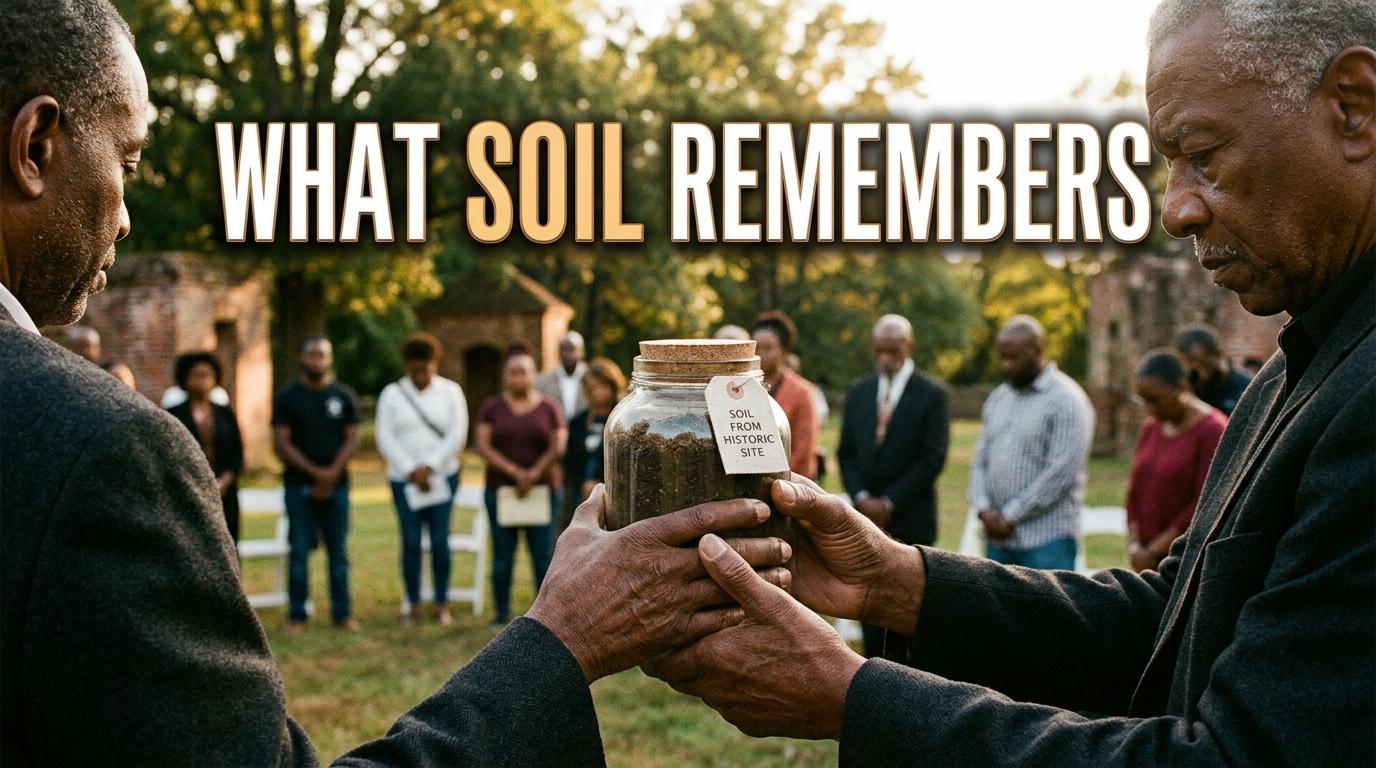
Every August, grassroots activists and historians observe Black August to reflect on centuries of Black resistance, state violence, and survival. In Springfield, Illinois, this tradition took physical form through a solemn gathering on sacred ground. Community leaders, civil rights advocates, and museum professionals assembled to collect soil from the exact locations where white mobs brutally murdered two Black men in August 1908 (nprillinois.org, tspr.org). This act of restorative remembrance confronts an atrocity that took place in the hometown of Abraham Lincoln (journalofthecivilwarera.org).
The collected earth preserves the memory of Scott Burton and William Donnegan, who were lynched during the 1908 Springfield Race Riot (nprillinois.org, wikipedia.org). Organized alongside the Equal Justice Initiative and the Abraham Lincoln Presidential Library and Museum, this ceremony connects localized racial trauma to nationwide campaigns for historical preservation (nprillinois.org, eji.org). By placing jars of soil into public exhibitions and national archives, organizers refuse to allow historical amnesia to bury the reality of Northern racial violence (tspr.org, illinoistimes.com).
The Bloodshed in Lincoln’s Hometown
On August 14, 1908, racial hostility erupted into mass violence across Springfield, Illinois. The crisis began when a white mob formed outside the Sangamon County Jail, demanding the extrajudicial murder of two Black prisoners (wikipedia.org, wikipedia.org). One man, Joe James, was accused of murdering a white mining engineer named Clergy Ballard. The other man, George Richardson, was falsely accused of assaulting Mabel Hallam, a white woman who later confessed that she fabricated the entire story (wikipedia.org, wikipedia.org, wikipedia.org).
When the mob learned that the county sheriff had secretly transported the two men out of town by train to protect them, thousands of white citizens became furious (wikipedia.org, eiu.edu). A crowd numbering between 5,000 and 10,000 people turned its wrath upon the local Black population (wikipedia.org, wikipedia.org). Rioters first burned the restaurant and luxury automobile belonging to Harry Loper, a white businessman who provided the vehicle used for the evacuation (wikipedia.org, wikipedia.org). The mob then marched directly toward Black residential and business districts, chanting that they would drive all Black residents out of Springfield (wikipedia.org, journalofthecivilwarera.org).
The Lynching of Scott Burton and William Donnegan
The rioters singled out successful, respected Black men who owned property. Scott Burton, a prosperous barber in his late fifties, stood outside his shop on Madison Street to protect his livelihood (wikipedia.org, wikipedia.org). The mob overpowered him, dragged him into the street, and beat him severely. The attackers shot Burton repeatedly before hanging his body from a tree with a clothesline at the corner of Twelfth and Madison Streets (nprillinois.org, wikipedia.org, wikipedia.org).
The following evening, the mob targeted William Donnegan, an elderly cobbler between 80 and 84 years of age (wikipedia.org, wikipedia.org). Donnegan was a respected landowner and a personal acquaintance of Abraham Lincoln (nprillinois.org, wikipedia.org). He had lived in Springfield for decades and was married to a white woman. White rioters broke into his home, dragged him outside, slashed his throat with a straight razor, and hanged him in a schoolyard across from the Old State Capitol (wikipedia.org, wikipedia.org). Donnegan survived the initial hanging but died from his severe wounds the following day at the hospital (wikipedia.org, wikipedia.org).
Destruction of the “Badlands” and Forced Exodus
White newspapers and city officials regularly used the derogatory term “the Badlands” to describe the integrated, working-class neighborhood northeast of downtown Springfield along the railroad corridor (illinois.edu, sangamoncountyhistory.org, jameskrohejr.com). This label served to criminalize and dehumanize the Black families living there. The neighborhood contained established Black churches, social clubs, small enterprises, and family residences (illinois.edu, sangamoncountyhistory.org).
The mob systematically demolished this vibrant area. White attackers burned between 40 and 70 homes and businesses, causing more than $150,000 in property damage, which equals more than $5 million in modern currency (wikipedia.org, wikipedia.org). The sheer terror caused roughly 2,000 Black men, women, and children to pack whatever belongings they could carry and permanently abandon the city (wikipedia.org, wikipedia.org). This forced migration stripped one-quarter of Springfield’s Black population away overnight, severely fracturing the community’s economic foundation and generational wealth (wikipedia.org, mchistory.org).
The Outrage That Birthed the NAACP
The massacre in Springfield sent shockwaves across the United States. Many white Northerners had convinced themselves that lynching and mob violence were problems restricted entirely to the former Confederacy (journalofthecivilwarera.org, ebsco.com). The fact that a mass lynching took place within blocks of Lincoln’s former home and tomb shattered that comfortable delusion (journalofthecivilwarera.org, loc.gov). White journalist William English Walling traveled to the city and wrote an influential exposé titled “Race War in the North” (journalofthecivilwarera.org, ebsco.com).
Walling declared that the nation was failing to protect basic democratic rights and issued a public challenge to revive the abolitionist spirit (journalofthecivilwarera.org, ebsco.com). On February 12, 1909, during the centennial of Lincoln’s birth, white and Black reformers issued a manifesto called “The Call” (loc.gov, naacp.org, ebsco.com). Penned primarily by Oswald Garrison Villard and signed by pioneering activists including Ida B. Wells-Barnett, W. E. B. Du Bois, and Mary Church Terrell, this document directly organized the National Negro Committee (loc.gov, naacp.org, ebsco.com). That committee soon became the National Association for the Advancement of Colored People, transforming a local tragedy into an enduring weapon for civil rights and against voter disenfranchisement (naacp.org, naacpslocty.org).
Black August and the Sacred Power of Soil
Black August emerged in 1979 within California’s San Quentin State Prison when incarcerated activists organized to honor fallen leaders George Jackson and Jonathan Jackson (truthout.org, solitarywatch.org, liberationschool.org). Incarcerated members established a month of fasting, political education, physical training, and radical study (truthout.org, solitarywatch.org). The founders selected the month of August because it contains foundational historical markers of Black liberation, such as the 1791 Bois Caïman ceremony that launched the Haitian Revolution and Nat Turner’s 1831 uprising in Virginia (medium.com, thehaitianrevolution.com, truthout.org, liberationschool.org). Through a Black Studies framework, the tradition highlights the unbroken continuum of Black struggle.
Collecting soil from lynching grounds during Black August carries profound spiritual and political weight. Pioneered on a national scale by the Equal Justice Initiative, soil collection transforms neglected execution sites into tangible evidence of state-sanctioned terrorism (eji.org). Community members in Springfield dug their hands into the earth near Eleventh and Madison Streets to extract soil into glass jars engraved with the names of Scott Burton and William Donnegan (nprillinois.org, tspr.org, illinoistimes.com). One jar remains on display at the Abraham Lincoln Presidential Library and Museum, while another travels to the Legacy Museum in Montgomery, Alabama (nprillinois.org, tspr.org). The earth serves as a physical witness to lives stolen by white supremacy.
Unearthing Buried Foundations and the National Monument
For over a century, the physical ruins of the homes destroyed during the 1908 riot remained hidden beneath modern city streets. In 2014, archaeologists conducting Phase II surveys for the Tenth Street Rail Consolidation Project uncovered intact brick foundations, burned timbers, and personal domestic artifacts from multiple homes destroyed during the violence (doi.gov, nps.gov, npshistory.com). Federal regulations under Section 106 of the National Historic Preservation Act required transportation agencies to halt construction (doi.gov, nps.gov). Local community leaders, historians, and the Springfield NAACP organized immediately to prevent the city from covering the ruins with concrete (senate.gov, nps.gov, nps.gov).
On August 16, 2024, President Joe Biden signed Presidential Proclamation 10792 under the Antiquities Act of 1906, establishing the Springfield 1908 Race Riot National Monument across 1.57 acres of federal land (federalregister.gov, ucsb.edu, govinfo.gov). The Antiquities Act authorizes the executive branch to protect historic landmarks and objects of scientific interest without requiring immediate congressional legislation (encyclopedia.com, constitutioncenter.org, blueribboncoalition.org). This designation marks one of the few units in the entire National Park System specifically dedicated to interpreting Northern racial violence, systemic involuntary servitude, and anti-Black pogroms (illinois.gov, nps.gov, nps.gov).
Restorative Justice and Sites of Conscience
The International Coalition of Sites of Conscience defines a Site of Conscience as any historic space that interprets past human rights violations to stimulate contemporary civic dialogue and social action (sitesofconscience.org, icom.museum, umb.edu). Conventional historical markers often reduce systemic violence to passive footnotes. In contrast, Sites of Conscience intentionally link historic atrocities with modern systemic inequalities, pushing communities to address ongoing racial disparities in housing, the justice system, and economic security (worldheritageusa.org, worldheritageusa.org, newtactics.org).
The Springfield 1908 Race Riot National Monument operates directly under this restorative philosophy (worldheritageusa.org, worldheritageusa.org). By preserving physical foundations and lynching locations, the monument refuses to let visitors treat racial violence as an isolated southern anomaly (nps.gov, worldheritageusa.org). The site serves as a public classroom where descendants and citizens examine how state complicity, media sensationalism, and white grievance can destabilize communities (worldheritageusa.org, illinois.edu, nps.gov). It transforms a landscape of destruction into a permanent platform for restorative justice.
Confronting the Past to Protect the Future
The legal aftermath of the 1908 riots reveals how deeply systemic racism infected early twentieth-century institutions. Despite grand juries issuing between 117 and 150 indictments against white rioters for murder, arson, and rioting, all-white petit juries systematically refused to convict their neighbors (wikipedia.org, wikipedia.org, wikipedia.org). Instigators like Kate Howard committed suicide while in custody, while men indicted for the lynchings of Scott Burton and William Donnegan walked free (wikipedia.org, wikipedia.org). The only notable conviction was that of Abraham Raymer, who received a minimal thirty-day jail sentence and a twenty-five dollar fine for stealing a militia saber (wikipedia.org, wikipedia.org).
The two Black men whose arrests triggered the violence experienced very different fates. Joe James was prosecuted by an all-white jury in Sangamon County and executed by hanging in October 1908, despite widespread doubts about the fairness of his trial (wikipedia.org, wikipedia.org, wikipedia.org). George Richardson was quietly released from jail in September after Mabel Hallam recanted her accusations; Richardson lived out the remainder of his life in Springfield until his death in 1948 (wikipedia.org, wikipedia.org, wikipedia.org). Today, collecting soil and enshrining these historic grounds honors those who were murdered and dispossessed (nprillinois.org, nps.gov). Remembering Springfield ensures that modern generations remain vigilant in the ongoing struggle for racial justice.
About the Author
Darius Spearman is a professor of Black Studies at San Diego City College, where he has been teaching for over 20 years. He is the founder of African Elements, a media platform dedicated to providing educational resources on the history and culture of the African diaspora. Through his work, Spearman aims to empower and educate by bringing historical context to contemporary issues affecting the Black community.
