

U.S. Cuba Rhetoric: Unpacking the Takeover Threat
By Darius Spearman (africanelements)
Support African Elements at patreon.com/africanelements and hear recent news in a single playlist. Additionally, you can gain early access to ad-free video content.
A Dangerous Escalation in the Caribbean
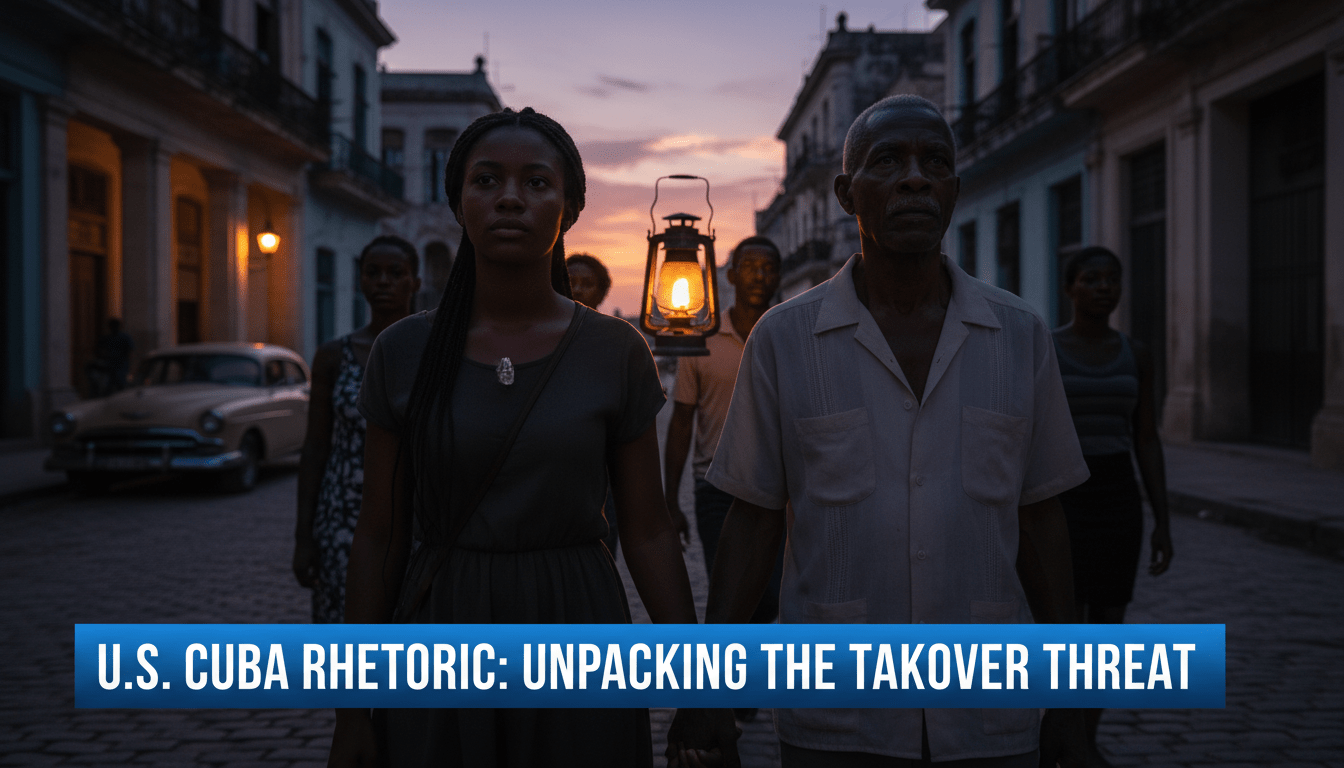
Cuban President Miguel Díaz-Canel issued a stark warning in May 2026 regarding hostile communications from Washington. He characterized recent political speeches as a highly dangerous escalation. This rhetoric revolves around a potential United States takeover of the island nation. The aggressive language follows the implementation of severe new policies directed at the region. Many international observers fear this situation could trigger a catastrophic military conflict (nycaribnews.com).
Tensions escalated dramatically after the White House signed a sweeping Executive Order. This order expanded existing sanctions to include secondary penalties on foreign entities attempting to conduct business with the island. During a recent public address in Florida, President Donald Trump suggested he could seize control of the sovereign nation almost immediately. This direct and unprecedented threat sparked profound diplomatic outrage across the Caribbean (aljazeera.com).
The current administration invokes a policy it titles the Donroe Doctrine. Officials describe this approach as a twenty-first-century update to the historical Monroe Doctrine. The doctrine aims to assert more direct control over the Western Hemisphere. These swift actions represent a definitive pivot toward maximum pressure tactics. The ultimate goal involves completely isolating the nation and forcing an immediate economic collapse (state.gov).
The Historical Roots of Imperialism
The threat of an American takeover represents a foundational element of foreign policy rather than a sudden development. This ambition dates back more than two centuries. In 1823, Secretary of State John Quincy Adams developed the ripe fruit theory. Adams famously compared the island to an apple growing on a tree. He argued that if the apple separated from its native Spanish tree by the laws of physical gravitation, it could only gravitate toward the North American Union (archives.gov).
This specific mindset laid the crucial groundwork for the Monroe Doctrine. The doctrine originally declared the Western Hemisphere off-limits to European colonialism. However, contemporary scholars view this framework as a tool for racialized imperialism. It consistently treated sovereign Black and Brown nations as a backyard designed solely for American corporate interests (chomsky.info).
The United States eventually intervened in the War of Independence in 1898. Following the conflict, the Treaty of Paris transferred control directly to the United States military, bypassing local independence fighters entirely (wikipedia.org). By 1901, the United States forced the Platt Amendment into the new constitution. This amendment granted Washington the legal authority to intervene in local affairs to preserve independence. It also established the permanent and highly controversial military base at Guantanamo Bay (visitthecapitol.gov).
An Unprecedented Economic Stranglehold
The current crisis stems directly from a series of dramatic regional events that unfolded over the past eighteen months. In January 2026, United States forces conducted a major mission that resulted in the capture of Venezuelan President Nicolás Maduro. This highly controversial operation removed a primary regional ally and essential energy provider. Consequently, the island immediately entered a devastating economic tailspin (aljazeera.com).
Following this massive disruption, the United States implemented a severe de facto fuel blockade in early 2026. This operation aggressively targeted any vessel attempting to deliver commercial fuel to the island. As a direct result, critical energy imports plummeted by an estimated 80 to 90 percent (cubaheadlines.com). The sudden lack of fuel created catastrophic daily blackouts across the nation. Current reports indicate that more than 55 percent of the island experiences power outages lasting between 20 and 30 hours per day (gatech.edu).
The overarching economic toll of these policies remains absolutely staggering. The United Nations estimates the cumulative cost of the trade embargo since 1960 at approximately $144 billion (wikipedia.org). Furthermore, recent damage from 2022 to 2023 alone was assessed at nearly $4.87 billion. Tourism serves as a vital economic lifeline, but it dropped by over 50 percent between 2018 and 2024. This severe decline accelerated rapidly as routine airline refueling became entirely impossible under the strict new blockade rules (cubaheadlines.com).
Impact on Afro-Cuban Communities
While historical revolution policies aimed to eliminate institutional racism, the current economic crisis disproportionately harms Black populations. The widespread financial devastation is deeply racialized. Structural inequalities determine who manages to survive the severe daily inflation (links.org.au). Remittances from relatives living abroad serve as the primary survival mechanism in a broken economy. However, approximately 83.5 percent of the diaspora living in the United States identifies as white. Therefore, white households receive significantly more foreign currency, creating a stark racial wealth gap in access to food and essential medicine (britannica.com).
Black residents remain massively overrepresented in the informal economy and the public sector. These critical employment sectors have completely collapsed due to the ongoing energy crisis. Furthermore, the government experienced a 90 percent drop in spending on social infrastructure (cubaheadlines.com).
The devastating fuel and electricity blockades hit Black neighborhoods the hardest. Residents in these areas typically lack the financial resources required to purchase private generators or solar power backups. Only individuals with consistent access to United States dollars can afford these modern luxuries (gatech.edu). This severe racialized poverty heavily drives a recent surge in migration. Individuals without reliable financial safety nets remain highly vulnerable to extreme scarcity and hunger (risetopeace.org).
Secondary Sanctions and Global Africa
Secondary sanctions enforce strict economic penalties on third-party countries that conduct business with the sanctioned nation. These heavy-handed measures present a massive social justice issue on a global scale. They consistently force developing nations to choose between American trade opportunities and humanitarian solidarity. The policy frequently targets African and Caribbean countries that deeply rely on affordable medical partnerships (state.gov).
Throughout 2024 and 2025, the State Department issued harsh visa restrictions against government officials from several African nations. These impacted countries prominently included Nigeria and South Africa. The officials faced severe diplomatic penalties simply for participating in international medical missions (aljazeera.com).
These aggressive sanctions deliberately disrupt the Henry Reeve medical brigades. The brigades provide critical, life-saving healthcare in rural African regions where Western medical aid remains completely absent. Furthermore, international banks routinely refuse to process legal payments for African nations hiring these doctors. The banks deeply fear over-compliance issues and severe United States retaliation. This financial de-risking effectively isolates developing Black economies (state.gov). Activists view this widespread practice as diplomatic bullying that prevents successful South-South cooperation. The ongoing interference heavily impacts the political experience of marginalized nations globally.
Black Internationalism and Solidarity
Black Internationalism views the nation as a critical ally in global African liberation struggles. Many passionate activists consider the country a mighty citadel of resistance against imperial forces. This perspective heavily honors the decisive military and medical support provided to end violent white minority rule across the African continent (chomsky.info).
During the intense conflicts of the 1970s and 1980s, direct military intervention proved absolutely vital. The historic Battle of Cuito Cuanavale successfully shattered the long-standing myth of white military invincibility. Nelson Mandela passionately credited this specific battle as the turning point that directly led to the fall of the brutal apartheid regime (britannica.com). This highlights the enduring legacy of the anti-apartheid movement in shaping global liberation strategies.
Operation Carlota boldly deployed over 300,000 dedicated volunteers to Angola. Many of these brave volunteers were Black soldiers actively fighting against dangerous forces backed by South Africa. Their primary mission focused on securing full Angolan independence (wikipedia.org). In addition to military support, the government has historically provided free medical and university training to thousands of African students. The visionary leadership framed health and education as fundamental global human rights rather than profitable corporate commodities. Black Panthers and liberation leaders frequently sought strategic alliances, viewing the island as a safe sanctuary from aggressive domestic persecution (links.org.au).
Political Exiles and United States Policy
As of early 2026, the government continues to proudly provide political asylum to several prominent Black American activists. Until her death on September 25, 2025, Assata Shakur was the most highly visible exile to reside in Havana. Activists deeply view her as a powerful symbol of unyielding resistance. However, until her passing, she remained prominently featured on the Federal Bureau of Investigation Most Wanted list with a staggering $2 million bounty (archives.gov).
The Congressional Black Caucus consistently advocates for a rational policy of diplomatic engagement rather than forced regime change. Caucus leaders frequently and loudly call for the immediate removal of the country from the State Sponsor of Terrorism list (nprillinois.org).
In 2025, influential leaders sent formal, detailed letters to the administration. They urgently requested the lifting of extreme maximum pressure sanctions. They properly identified these specific sanctions as the primary driver of dangerous, irregular migration. Caucus members argue the ancient embargo remains a failed relic of the Cold War. It actively inflicts massive collective punishment on historically marginalized groups (visitthecapitol.gov). A violent military takeover would rapidly end the asylum of Black exiles. The potential forced extradition of these individuals shapes the political dynamics in the black community and grossly violates established international refugee principles. The current actions strongly mirror historical efforts to suppress the black vote and limit minority political representation globally.
The Regional Fallout
The aggressive takeover rhetoric resonates deeply and painfully across the entire Caribbean diaspora. It causes a highly significant political rift between those hoping for systemic change and those fearing a massive regional war. During a recent and urgent regional summit, Jamaican Prime Minister Andrew Holness issued a remarkably strong warning. He clearly stated that a prolonged and violent crisis would certainly not remain confined to one single island (nycaribnews.com).
Holness cited grave and immediate concerns regarding unstoppable mass migration and widespread regional instability. Caribbean leaders actively and desperately call for urgent international intervention. They officially petition the United Nations to mediate a rapid de-escalation of hostilities. The unified leaders aim to properly maintain the Caribbean as an official, protected Zone of Peace (aljazeera.com).
They boldly seek to prevent the highly volatile situation from devolving into direct, catastrophic military conflict. Meanwhile, diaspora sentiment in Florida remains heavily and sometimes violently divided. Some vocal community members celebrate maximum pressure tactics as a necessary path to liberation. Others consistently express deep despair and profound anxiety across various social media platforms. They accurately warn that bullets have no name and that ordinary, working-class citizens bear the primary burden of the resulting humanitarian disaster (cubaheadlines.com).
Seeking a Path Forward
The current diplomatic firestorm involves significantly more than a heated exchange between powerful world leaders. It firmly represents the latest dark chapter in a two-hundred-year struggle for fundamental regional sovereignty. The dangerous transition from strict economic sanctions to direct threats of military intervention rapidly revives deep historical traumas. The old ghosts of the Platt Amendment and early colonial domination theories have fully returned to dominate modern geopolitical discussions (archives.gov, visitthecapitol.gov).
The devastating modern statistics clearly reveal a profound and unacceptable human cost. According to highly detailed recent reports, the national infant mortality rate surged by a horrifying 148 percent since 2018. It rapidly rose from 4.0 to 9.9 per 1,000 live births by late 2025 (gatech.edu).
This massive public health disaster coincides perfectly with crippling energy shortages and total, suffocating economic isolation. As international leaders urgently plead for peace and reason, the global community watches closely. The ultimate outcome of this highly aggressive policy shift will permanently shape the future of diplomatic relations. It will absolutely test the strength and resilience of developing nations striving to maintain true independence in the face of overwhelming imperial pressure (aljazeera.com).
About the Author
Darius Spearman is a professor of Black Studies at San Diego City College, where he has been teaching for over 20 years. He is the founder of African Elements, a media platform dedicated to providing educational resources on the history and culture of the African diaspora. Through his work, Spearman aims to empower and educate by bringing historical context to contemporary issues affecting the Black community.
