


Unlocking Pan-African Parliament Water Security Reforms
By Darius Spearman (africanelements)
Support African Elements at patreon.com/africanelements and hear recent news in a single playlist. Additionally, you can gain early access to ad-free video content.
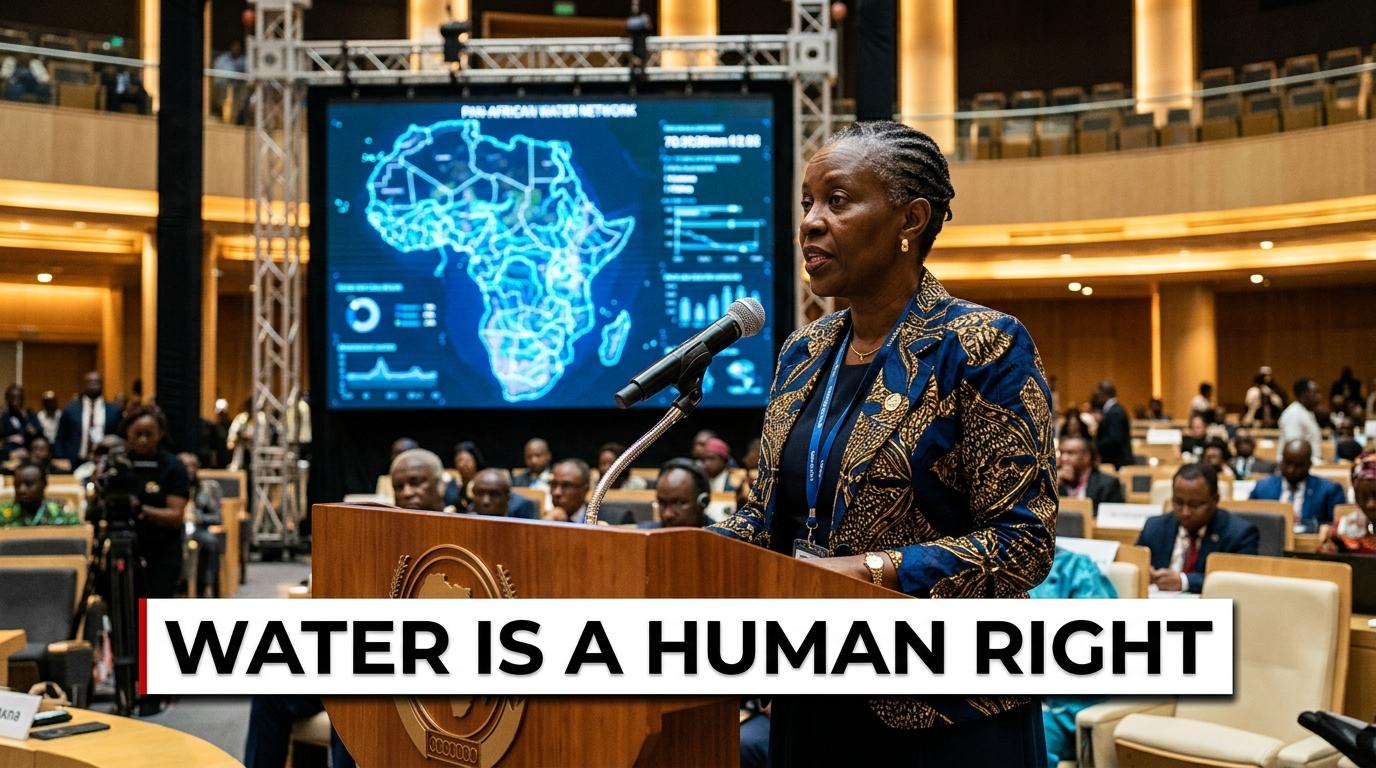
On July 27, 2026, South African President Cyril Ramaphosa took the stage at the opening of the First Ordinary Session of the Seventh Legislature of the Pan-African Parliament in Midrand, South Africa (www.gov.za, sanews.gov.za). The gathering brought together parliamentarians from across the continent under the African Union theme for 2026, which centers on assuring sustainable water availability and safe sanitation systems (www.gov.za, thepresidency.gov.za). In his address, Ramaphosa framed access to clean water and sanitation as essential human rights rather than mere service goals (thepresidency.gov.za). He argued that water security is directly linked to regional stability, economic sovereignty, and social justice across Africa (sanews.gov.za, thepresidency.gov.za).
Behind the solemn speeches in Midrand lies a deeper history of structural challenges (brill.com, wikipedia.org). The continent faces severe water stress, institutional gridlock, and historic inequalities in resource distribution (mg.co.za, worldbank.org). Even host nation South Africa struggles with severe municipal water failures that reflect wider continental crises (da.org.za, risemzansi.co.za). Understanding the debate in Midrand requires examining how historical governance, economic realities, and policy choices shape water access for millions of African citizens today (wikipedia.org, worldbank.org).
The Historical Roots of Pan-African Governance and Power
The Pan-African Parliament was born out of a long struggle to create a unified voice for the African continent (wikipedia.org, britannica.com). The vision for a continental legislature was formally established in the 1991 Treaty Establishing the African Economic Community, also known as the Abuja Treaty (wikipedia.org). The treaty aimed to move pan-African unity beyond elite diplomatic circles and involve African citizens directly in economic integration (wikipedia.org). Later, Article 17 of the Constitutive Act of the African Union formalized the parliament as a core organ (wikipedia.org). The parliament officially held its inaugural session in 2004 before establishing its permanent seat in Midrand, South Africa (internationaldemocracywatch.org, wikipedia.org).
Despite its ambitious origins, the body has faced severe structural limits since its creation (brill.com, internationaldemocracywatch.org). Under its founding protocol from 2001, the parliament operates strictly as an advisory and consultative assembly (brill.com, tandfonline.com). True legislative authority remains concentrated in the hands of the African Union Assembly of Heads of State and Government (brill.com). To resolve this issue, the African Union adopted the Malabo Protocol in 2014 to grant the parliament actual legislative powers (brill.com, africanparliamentarynews.com). However, the protocol requires 28 member states to ratify it before it takes effect (brill.com, africanparliamentarynews.com). Progress has been slow, leaving the body operating primarily as a platform for advocacy rather than binding lawmaking (brill.com, tandfonline.com).
A major critique of the Pan-African Parliament involves how its delegates are chosen (internationaldemocracywatch.org, up.ac.za). Citizens across Africa do not directly elect delegates to the continental assembly through universal suffrage (internationaldemocracywatch.org). Instead, each national parliament selects five of its own members to represent the country in Midrand (internationaldemocracywatch.org, nationalassembly.sc). Because domestic parliaments control these appointments, ruling political parties often dominate the selection process (internationaldemocracywatch.org, up.ac.za). Furthermore, Article 5f of the parliament protocol allows national parliaments to recall their representatives at any time (tandfonline.com, nationalassembly.sc). This recall power creates political pressure on delegates and limits their willingness to challenge home governments (internationaldemocracywatch.org, tandfonline.com). Consequently, the parliament remains an indirect body shaped largely by ruling political elites (internationaldemocracywatch.org, brill.com).
Sub-Saharan Africa Water & Sanitation Gap
Percentage of Population Coverage with Essential Services
Legacy of Divided Waters: Colonialism and Water Inequality
The crisis of water availability in Africa is deeply tied to historical structures established during the colonial and apartheid eras (mg.co.za, cmi.no). In South Africa, land dispossession and racial segregation directly dictated how water infrastructure was built (mg.co.za, pambazuka.org). The Group Areas Act of 1950 forced Black, Coloured, and Indian populations into designated townships and underdeveloped rural homelands (mg.co.za, pambazuka.org). Colonial and apartheid planners prioritized modern water lines and bulk infrastructure for white commercial farms and privileged urban centers (cmi.no, tni.org). Conversely, Black living areas were intentionally neglected and left with rudimentary public taps (mg.co.za, pambazuka.org).
When democratic governance arrived in 1994, South Africa introduced progressive legislation, including the National Water Act of 1998, which recognized water as a public trust (water-alternatives.org, manifoldapp.org). Nevertheless, spatial inequality has proven difficult to undo (mg.co.za, water-alternatives.org). Wealthier suburbs continue to enjoy reliable municipal water flow, while low-income townships and informal settlements experience chronic cut-offs (mg.co.za, da.org.za). Historical economic disparities mean that marginalized citizens historically fought for economic survival under harsh economic constraints, a reality that still impacts modern infrastructure access.
This ongoing divide becomes sharp during environmental and administrative emergencies (mg.co.za, water-alternatives.org). During the famous Cape Town water crisis, wealthy households insulated themselves by spending capital to drill private boreholes and install private filtration units (water-alternatives.org). In contrast, residents in Black townships like Khayelitsha relied on leaky public infrastructure and long lines at communal taps (mg.co.za, water-alternatives.org). Similar structural failures contributed to the fatal cholera outbreak in Hammanskraal, where inadequate municipal water treatment led to preventable lost lives (da.org.za, businesstech.co.za). These patterns demonstrate that historic spatial planning still shapes who receives clean water and who bears the brunt of supply failure (cmi.no, tni.org).
Continental Crisis: Health, Economics, and Transboundary Security
The scale of the continental water emergency extends far beyond any single nation (worldbank.org, unicef.org). Data compiled by international health agencies indicates that 840 million people in Sub-Saharan Africa had access to basic drinking water services by 2024 (worldbank.org, unicef.org). However, progress on sanitation has failed to match population growth (unicef.org, unicef.org). Over 803 million people across the continent still lack basic sanitation facilities (unicef.org, unicef.org). The vast majority of people lacking services are concentrated in eight nations, including the Democratic Republic of Congo, Ethiopia, Kenya, and Mozambique (worldbank.org, who.int).
The human cost of contaminated water is severe (wvi.org, embracerelief.org). Waterborne illnesses such as cholera, dysentery, and typhoid cause an estimated 115 deaths every single hour across Africa (wvi.org, embracerelief.org). Children suffer the most from these preventable conditions (wvi.org, unicef.org). Beyond health outcomes, water availability directly controls economic potential (www.gov.za, amcow-online.org). Under Agenda 2063 and the African Continental Free Trade Area, the continent aims to expand industrial manufacturing and regional trade (www.gov.za, sanews.gov.za). Yet industrial expansion is impossible without stable bulk water supplies (amcow-online.org, worldbank.org). Furthermore, over 60 percent of Africa’s population relies on agriculture for income, making food security vulnerable to shifting water availability (www.gov.za, worldbank.org).
Economic Impact of Water Investment
Returns and Human Costs Across the African Continent
Investing in water infrastructure yields huge economic returns (worldbank.org, wellawareworld.org). Research from the World Bank shows that every single dollar invested in clean water and sanitation infrastructure in Africa produces a seven-dollar return through reduced medical expenses and boosted workplace productivity (worldbank.org, wellawareworld.org). Globally, over 1.7 billion jobs sit in water-dependent sectors like agriculture and power production (who.int). Just as past organizing showed how the struggles facing South African workers were bound to industrial conditions, modern workers need basic infrastructure to thrive (amcow-online.org, worldbank.org). Managing shared river basins peacefully is necessary to avoid regional resource conflicts (amcow-online.org).
Women Bearing the Load: Gender Disparities in Rural Water Collection
The burden of water scarcity is not distributed equally across African societies (unicef.org, bridgew.edu). Cultural expectations and division of labor place the responsibility of gathering household water heavily on women and girls (unicef.org, bridgew.edu). In Sub-Saharan Africa, women and girls spend a collective estimated 200 million hours every single day carrying water containers from distant sources (wvi.org, unicef.org). In households that lack piped water on the premises, women and girls act as the primary water collectors in seven out of ten cases (unicef.org, unicefusa.org).
This physical responsibility creates deep educational disadvantages for young girls (researchoutreach.org, learngala.com). In rural areas, a single trip to collect water takes an average of 33 minutes and frequently stretches into multiple hours (bridgew.edu, learngala.com). Girls must wake up before dawn to walk long distances, causing chronic fatigue and missed school time (bridgew.edu, researchoutreach.org). A study conducted in the rural Democratic Republic of Congo revealed that 42 percent of adolescent girls assigned to fetch water experienced frequent school lateness or absenteeism (researchoutreach.org). Carrying heavy containers over long terrain also causes permanent neck and spine damage over time (bridgew.edu, thewaterproject.org).
Gender Disparity in Water Gathering
Primary Water Collectors in Households Without Piped Water
Bear the primary physical load of daily collection, leading to severe time poverty and physical injury.
Assigned to water gathering in a minority of rural households without on-premise supply.
The time poverty caused by water collection prevents adult women from pursuing paid work or community leadership (bridgew.edu, carolinapoliticalreview.org). Furthermore, walking along isolated rural roads exposes women and young girls to high risks of harassment and physical assault (bridgew.edu, unicef.org). When governments invest in localized, clean water sources, the social outcomes change rapidly (wellawareworld.org, wellawareworld.org). Studies show that providing clean water within close proximity to rural villages increases female school enrollment by 58 percent (wellawareworld.org, wellawareworld.org). Historically, African women have often endured systemic gender bias while serving as backbone pillars for community survival, making targeted infrastructure investment essential for gender equity (bridgew.edu, carolinapoliticalreview.org).
South Africa’s Water Reform: Human Right or Pathway to Privatization?
As host to the Pan-African Parliament, South Africa finds itself under scrutiny regarding its domestic water strategy (thepresidency.gov.za, da.org.za). In response to crumbling municipal networks, President Ramaphosa launched the National Water Action Plan and the National Water Access Acceleration Programme (thepresidency.gov.za, sanews.gov.za). The government committed 156 billion rand over three years to fund municipal water infrastructure (businesstech.co.za, moneyweb.co.za). Additionally, the state established the National Water Resources Infrastructure Agency to finance and manage bulk water supply assets across the country (thepresidency.gov.za, da.org.za).
To enforce institutional accountability, the government introduced the Water Services Amendment Bill (da.org.za, sanews.gov.za). The bill creates clear legal separation between municipal governance and technical water operations (da.org.za, sanews.gov.za). Under the proposed law, municipal managers face criminal liability and personal prosecution if they fail to maintain water quality standards or permit infrastructure to collapse (da.org.za, sanews.gov.za). Officials present these moves as vital structural reforms designed to protect public rights and restore falling operational standards (da.org.za, sanews.gov.za).
However, civil society groups and labor advocates express concern over the funding mechanisms within the plan (insidepolitic.co.za, tni.org). The National Water Action Plan relies heavily on private sector capital, performance-based service contracts, and public-private partnerships to fill budget gaps (insidepolitic.co.za, risemzansi.co.za). Organizations like WaterCan warn that bringing private operators into municipal management introduces a commercial, cost-recovery model (insidepolitic.co.za, tni.org). Historical precedents in South Africa show that privatized water schemes frequently lead to rising tariffs and service disconnections for low-income families (pambazuka.org, tni.org). Critics argue that this commercial direction represents broader shifts in state governance that risk turning a basic human right into a commodity for profit (da.org.za, tni.org).
Moving From Continental Rhetoric to Legislative Reality
The First Ordinary Session of the Seventh Legislature in Midrand highlights a critical turning point for continental governance (www.gov.za, sanews.gov.za). Promising universal access to clean water within parliamentary chambers means little if state policies fail to deliver tangible pipelines to rural villages and township streets (thepresidency.gov.za, mg.co.za). While leaders frame water as an undeniable human right, structural hurdles continue to block rapid progress across AU member states (brill.com, worldbank.org).
For the Pan-African Parliament to move beyond advisory status, member states must ratify the Malabo Protocol and grant the body actual legislative powers (brill.com, africanparliamentarynews.com). Continental unity requires moving past indirect elite appointments toward democratic accountability (internationaldemocracywatch.org, up.ac.za). Furthermore, domestic governments must balance private investment against their legal duty to protect vulnerable communities from high water tariffs (da.org.za, tni.org). Only when continental resolutions translate into protected public resources will universal water security become a reality for all African citizens (www.gov.za, thepresidency.gov.za).
About the Author
Darius Spearman is a professor of Black Studies at San Diego City College, where he has been teaching for over 20 years. He is the founder of African Elements, a media platform dedicated to providing educational resources on the history and culture of the African diaspora. Through his work, Spearman aims to empower and educate by bringing historical context to contemporary issues affecting the Black community.
